Wednesday, 24 January 2024

Ice, Ice Baby.....

During a winter which had so far been alternately wet or windy, the chance of some sea kayaking in settled weather had Allan and I regularly checking forecasts in mid January.  As a high pressure system built over the UK we made plans to head to Wester Ross - we were disappointed that neither Lorna or Douglas were able to join us for this short notice trip.

A family connection of Allan and Lorna's kindly allowed us the use of a house overlooking Loch Ewe as a base, which made this winter trip very comfortable indeed.  Allan headed up on a frosty morning, I left later in the day and we met at the house.  The view first thing in the morning was very encouraging as pre-dawn light coloured the sky and reflected off mirror calm water - it looked like we had a fine day ahead.


We drove to Charlestown on Loch Gairloch and loaded our boats on the slipway.  there was frost on the boats which made for chilly fingers.


There was also plenty of ice left by the falling tide.  The water in the harbour at Charlestown was free of any ice so the possibility of sea didn't really register with me as we got ready to get on the water.


After paddling out of the harbour we turned south and for a short while paddled straight into a dazzling low sun with reflections from the water - it was really hard work to see where we were headed!  We'd intended to paddle close to the shore past Badachro and around Eilean Horrisdale, but found a large area of sea ice over a centimetre thick drifting towards us on the ebb tide.


 It was pretty obvious straight away that this was hard ice which was probably drifting in and out on the tide, freezing at low water twice a day.  It was too thick to crash through with the boat or the paddle and was, disconcertingly, moving quite purposefully.  I've experienced this just twice before, once on Loch Long and near Kinlochleven - both occasions in similar prolonged deep frosts.

Manoeuvring a sea kayak in ice even a centimetre thick is difficult and unstable, the paddle has to be crashed through and sometimes glances off, destabilising things.  Add to that ice moving on a tidal flow with the possibility of constrictions and it's not a place to be....coming out of the boat would have serious consequences.  Allan and I reversed away from the ice and found a lead of clear water to take us back out into the open.  Just an hour into our winter day and it was already packed with interest!

Saturday, 6 January 2024

After the rain....


 December 2023 and into January 2024 saw some exceptionally wet weather in the north east of Scotland - Aberdeenshire received three times the average monthly rainfall in December as storms tracked more to the south than usual, resulting in a run of what felt like weeks of south easterly wind and rain for us.  This part of Scotland is usually the driest place in the country, but there have been only two dry-ish days in the last 20!

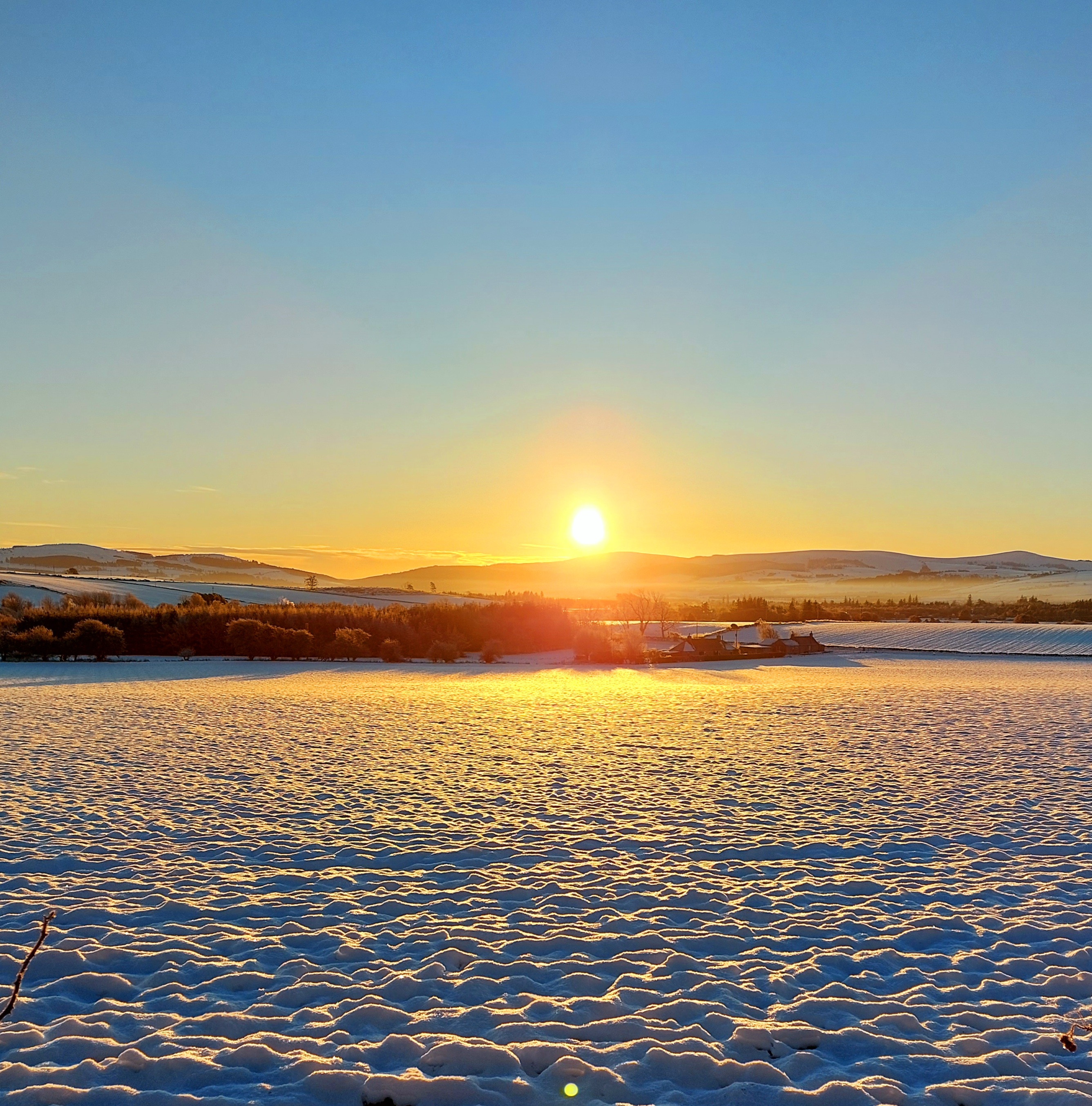
But, at last, the rain pulled away early afternoon on the 5th January with a forecast of much more settled weather for the next week or so.  As the sky cleared the temperature fell sharply and a ground mist spread across land saturated by rain.  the effect was very atmospheric as the sun set, the mist suffused by a gorgeous glow.

Wednesday, 3 January 2024

A Winter Light Show

In late December there was a wonderful display of Nacreous Cloud in the skies over Aberdeenshire.  From before sunrise the ethereal colours and effects were evident and continued to varying degrees all day.


Nacreous (mother of pearl) clouds need really specific conditions and are consequently rare phenomena:  the cloud needs to be very high at 10-20 miles above the earth's surface, the air at that height needs to be very cold (below -80 degrees Celsius) and a very low sun angle.  They're also known as Polar Stratospheric Cloud (PSC) and the particular ice crystals forming the clouds refract the low sun at an angle down to earth.  Because of these specific conditions, nacreous clouds are usually only seen in northern polar regions in winter, or when the polar upper atmosphere vortex sinks south, which was what gave rise to this lovely display.


The ice crystals in Nacreous clouds are smaller than those in lower cloud types and can often be composed of atoms of nitric acid and water ice - this combination can combine to release chlorine atoms, so they're not entirely good things!

That said, as the sun began to set in mid-afternoon the colours of the clouds intensified and the shapes changed...it was a captivating sight.


 The most intense colours happened well after sunset when the clouds were still being lit by the sun which had left the surface and was shining at just the right angle - simply stunning!

Thursday, 25 May 2023

Blown away by Knoydart


The second half of April had some really fine weather with high pressure close by the north of Scotland.  Douglas and I watched the synoptic picture carefully for several days before deciding on a trip starting at Mallaig.  we came from opposite corners of the country but arrived within minutes of each other and after a coffee and croissant from the rather excellent Bakehouse, got our boats packed and set off.

Our plan was initially to paddle up to the head of Loch Nevis for the first camp, but we soon modified that.  High pressure close to rather than over the country can, in certain circumstances give really fine, clear weather but with strong easterly winds - and this was the situation on this week.  Douglas and I both have a healthy respect for the conditions which can be created by this weather pattern; some of our hardest battles have been in easterly winds blowing from a clear blue sky.  Lochs Nevis and Hourn which frame the south and north shores of the Knoydart peninsula both have east-west topography and a short paddle to the entrance of Loch Nevis confirmed that the wind was indeed barrelling down the loch....time for a change of plan!

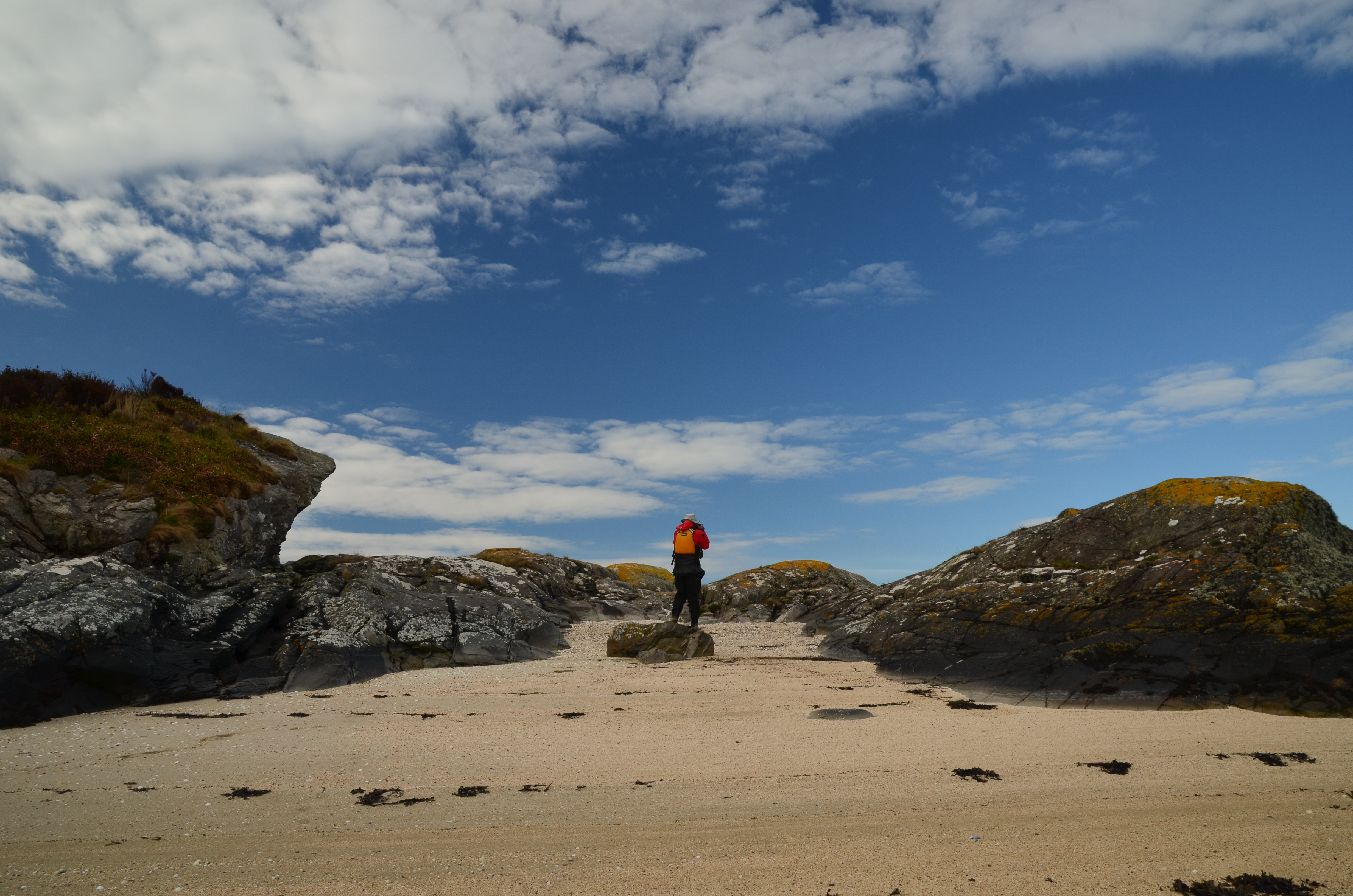
Our pre-trip planning had factored this in, we had a camp spot in mind for the first evening of three, but first we explored a bit around the entrance to Loch Nevis, climbing above a beach near Rubha Raonuill to get a view of the hills beyond Inverie.


We paddled below the statue of the Virgin Mary in the narrows at the entrance to Loch Nevis, an unusual feature.  Officially known as Our Lady of Knoydart, the statue was erected by the Catholic community in the middle of the 20th century.  It's actually made of GRP and is known locally as "Plastic Mary".  I was surprised to note that the last time I paddled through these narrows was over ten years ago!


We paddled north from the loch entrance and were faced with a difficult choice of which of several lovely beaches to camp on....sea kayaking can have these difficulties sometimes!  Having selected our beach we got the tents up, enjoyed a cup of tea and then set about collecting and sawing down sufficient driftwood for a fire below the rapidly receding tide.  


We were quite pleased with our choice of camp site; a slab of rock forming an arm of the bay gave a super place to watch the sun go down after dinner.


The sunset was relatively brief on this April evening, but what it lacked in duration it made up in intensity - a gorgeous wash spread across the sky.....


....which faded to an intense glow, silhouetting the distant Skye Cuillin.  Our plans may have been blown away by the wind, but we certainly weren't complaining about the way the trip was unfolding!


Thursday, 4 May 2023

A re-boot

 When I started this blog back in 2009 it was primarily to create a record and to share some of the sights and experiences in Scotland's outdoors.  When things got busy with work or family life, the natural tendency was to post less, but lately I've really let it slip.  The last posts were some eight months ago - and they were recalling a trip in April 2022!  "Retirement" from a long career at sea in March 2022 was quickly followed by setting up a new venture in "retirement", so there has been a lot going on.

In my defence, I've been posting a lot on the Mountain and Sea Instagram page  and while enjoying the ability to post more or less instantly, I have missed the research and reflection that blogging offers.  

It's not like I haven't been getting out and about whether solo or with friends....  There have been some great sea kayak trips.... 


To the west - here on Loch Hourn


On the "home" patch of the Moray Firth in the northeast 


In the very heart of Scotland, here on Loch Ericht.

And in the far northwest, a here in Assynt.

The hills haven't been ignored either, whether in challenging weather


or in fair weather.


And talking of weather, the range of conditions experienced have been simply marvellous!


So that's the re-boot started, and hopefully I can do much better in posting here than of late!

Tuesday, 20 September 2022

Pinned on Pabay

The morning weather was as lovely as the evening had been, clear and calm.  The view to the Cuillin of Skye was our constant companion on this trip and one of the highlights with changing light and angles subtly altering the colour and form.  We've all got great memories of climbs on that great arc of ridge - exhilarating and sometimes downright frightening!


We had a leisurely breakfast and got on the water - within a few minutes we were back ashore on a tiny island with a "now you see it, now you don't" sandy beach which disappears at higher states of the tide.  We'd wanted to stop here because it's rather a fine viewpoint; the first image in this post was taken from the beach.


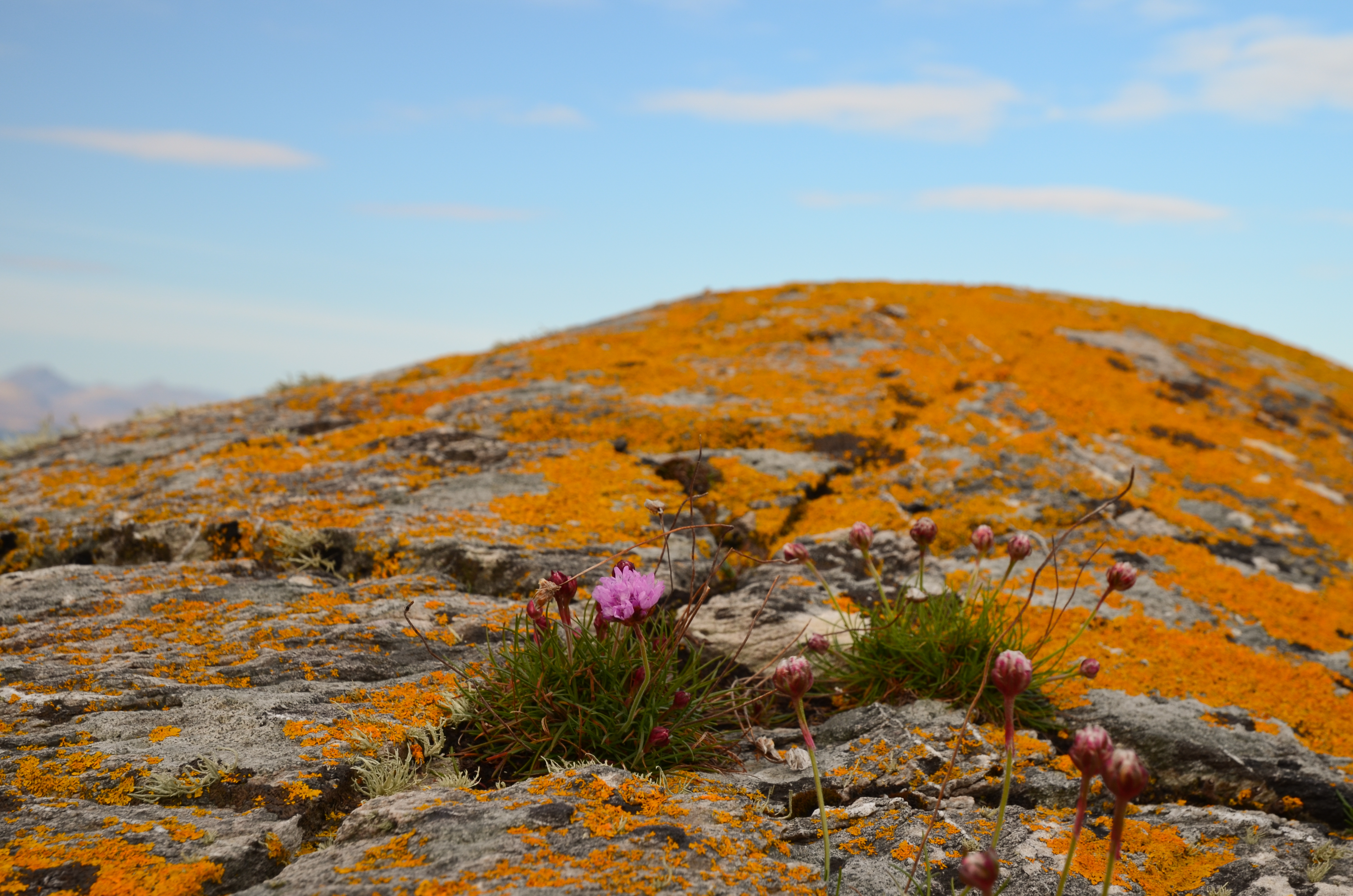
The view near to hand wasn't bad either - vivid orange lichens glowing in the morning sunshine, set off by a few Thrift flowers.


Orange seemed to be the theme of the morning; we returned briefly to Kyleakin to collect some things and whilst preparing to get back underway we noticed a bright orange vessel passing under the Skye bridge.


She's the "Mikal With", a 67 metre long palletised cargo vessel.  On most marine vessel websites she has a blue hull and a different owner than recently.  She's either owned or on charter to MOWI, a Norwegian aquaculture company.


We set out again from Kyleakin and aimed for the island of Pabay, which we intended to use as a stepping stone on our way to an intended camp on Scalpay.  The breeze had been slowly building and once clear of Kyle Akin it became quite strong from straight off the Skye coast (our port quarter).

We put our sails up to take advantage of the push and were absolutely blasted across towards Pabay.  I found this a really great sailing run, but was certainly not prepared to stop paddling in order to take photos!  Our average speed on this blast was 9.4km/h, or nearly twice cruising speed.....


Although a fast passage, it had been an energetic one - it is paddle sailing rather than just sailing!  We were all ready for a lunch stop by this point.


Approaching Pabay the wind seemed to ease  a little and we dropped our sails to paddle into the tiny harbour area.  Donny had motored along to Broadford in his F-RIB and made a direct crossing from there to Pabay; he had a pretty wet ride!


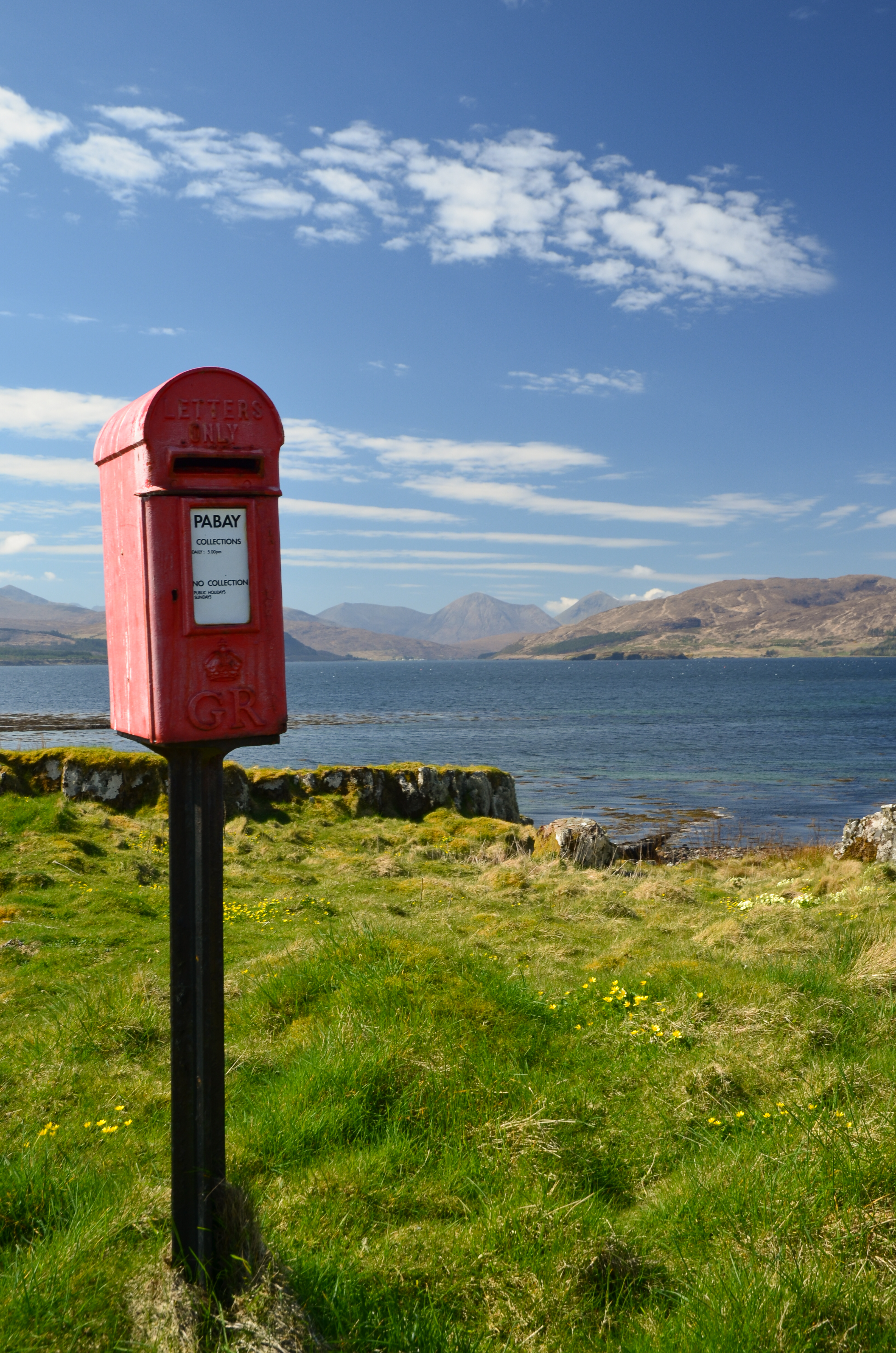
One of the iconic sights on Pabay (Norse: Priest Island) is this post box.  It seems incongruous since there are only a couple of houses on the island but is here because the island issues it's own postage stamps for mail which is transferred into the Royal Mail system in Skye (from where it needs Royal Mail stamps).


Sheltered from the breeze (which was becoming stronger) we lazed in warm sunshine, surrounded by clumps of Primroses.  The pale yellow of the flowers set against the blue of sky and sea was gorgeous.


Above where we lunched a pair of Bonxies (Great Skuas) watched us warily.  These impressive piratical predators had picked a nest site with a great view over the low lying island.


One of the features of Pabay is its geology which is shales intersected by dykes of harder rocks.  The whole island is almost flat and nearly doubles in size as the tide falls from high to low water, leaving the geometric patterns of dykes.

Another feature is that, despite being flat the island has virtually no wild camping spots accessible from the water.  The rock layers from a barrier and the softer rock gives good growing conditions for brambles and tangled low undergrowth.

This gave us a problem; we were pretty much pinned on Pabay.  The wind had continued to rise and in the Sound between Pabay and Scalpay was approaching a Force 6.  None of us was keen on trying the paddle across unless we really had to, but despite trying along the sheltered parts of Pabay by kayak we could find nowhere to camp.  We returned to the harbour to have a re-think.  Douglas and I walked up to the "big house" which is undergoing renovation by a new owner of the island.  We explained our situation and asked if we might camp near the harbour.  The Access provision in the Land Reform (Scotland) Act is wide ranging but does not cover access near to houses or infrastructure.  The owner was most kind in allowing us to camp for the night and it was really appreciated by us.


We pitched our tents in areas which wouldn't affect access to and from the harbour itself and found a spot out of the wind to cook dinner - preceded by fresh soup.  The day had been recovered but our plans would need to be altered.  The forecast was for the wind to drop almost completely by morning, so we decided on a paddle to the Applecross shore via the Crowlin Islands.


As the sun set, the wind came around a couple of points and seemed to drop by several degrees in temperature - it was pretty cold within minutes.  Dinner done, we retired to the tents (which we'd pinned very securely to Pabay) for an early night.
 

Friday, 1 July 2022

A perfect pitch

It turned out that our day could and did get better!  The camping spot we'd originally planned on was a few more kilometres up the coast, and given the wind direction we realised that it would be right in the wind.  So when a flash of white sand backed by bright green woodland caught our eye at the back of a small bay, we had to take a look.


Landing near low water we found ourselves in an enclosed bay, sheltered from the wind and in full sunshine.  A few folk were enjoying the late afternoon sunshine, indicating that the bay was fairly accessible, but it did look very promising as a wild camping spot.  Our preference is for fairly remote areas which are little used, but never look a gift horse in the mouth!


As the day visitors started to leave, we pitched our tents, Donny and Douglas pitched on the level turf above the beach itself - where there was even a picnic bench......


Allan and I chose spots in a beautiful wood of birches at the back of the bay which was alive with birdsong.  At the time and in the memory, this felt a perfect pitch.


Once we'd pitched up we wandered the bay, just enjoying the sunshine and the location.  We came across this lovely piece of beach art which must have taken both patience and real creative talent to produce.  Transient and perfect, it would be washed away by the evening's high tide.


Much of the beach was covered in pieces of white "coral" - actually Maerl, a corraline algae which when living is a purplish colour.  When they die, the calcereous remains of Maerl are broken and crushed by wave action, then bleached in the sun to form dazzling white "coral" beaches such as this one.  

A rare and fragile environment, Maerl beds have comprehensive protection, but are at risk from scallop dredging - one pass by a scallop dredger's bottom gear can destroy a bed which might be hundreds of years old.   Loch Carron has some of the best examples of Maerl beds and as a result is protected by designation as a Marine Protected Area (MPA).  


In the wood, Primroses were in flower on sunny banks - perhaps my favourite of the early Spring flowers; such a cheery sight at the back of a long winter.


After dinner we wandered over to the edge of the bay and climbed a rocky outcrop to photograph the setting sun - it was a really lovely evening.


Our fire below the Spring tide mark was lit to get going while we took our photographs and brought snacks and drinks down from the tents.


 Across the sea, beyond Skye and Raasay, the setting sun slipped down to the horizon to end a truly great day on the water.  We sat with a dram by our fire and chatted into a glorious evening.

Note: Since we camped here, the bay and its beach have been featured in a national newspaper and on a well known travel website as "one of the most beautiful and accessible in Scotland".  This is undoubtedly going to increase it's popularity and perfect as it is, we will avoid camping here for the foreseeable future in order to go a small way to reducing future pressure.