Showing posts with label Wester Ross. Show all posts

Thursday, 15 February 2024

An anything but "dry" January


January can, in some years, be a month of enforced abstinence from most outdoor activities.  Limited daylight, often hostile weather and low temperatures can combine to make things a bit of a challenge.  this year, with more free time, I was keen to grab opportunity where I could, work with the weather and just generally "seize the day".  


I did at least one walk every day, averaging 13km per day across the month in a variety of conditions from the sublime to the downright nasty.


When the snow came in heavily, accompanied by strong winds and drifting....time to switch from walking to skiing!


There were a few days of really good conditions for XC Skiing right from home


A spell of settled weather in the north west of Scotland tempted Allan and I to plan a few days kayaking


...amply rewarded by some superb winter paddling conditions.....


..and some great wildlife encounters.


Generally amenable if breezy weather gave good opportunities for gravel riding in the Cairngorms...


...and several rides closer to home, such as here on Lord Arthur's Hill on the Correen ridge.


So, January proved to be anything but a "dry" month for outdoor ventures; the trick now is to keep it up for the year!

Wednesday, 31 January 2024

Winter colours - Wester Ross

On the second paddling day of our trip in Wester Ross Allan and I launched from the jetty at Laide in Gruinard Bay.  This is a handy launch spot but there's virtually no parking at the jetty itself so we parked back up the road a way so as not to block things for any other users.  There's also an honesty box, ingeniously adapted from an old fire extinguisher, for donations towards the jetty's upkeep.

It was another very cold, clear and calm morning - "frost smoke" was rising from the sea as the sun climbed a bit higher.


We paddled around the inner part of Gruinard Bay and landed at the northern end of the big beach which is so popular in summer.  Today we had it to ourselves for a leisurely coffee break.


Heading north we had a view to Priest Island and the Summer Isles, we've had some great paddling ventures there!  Conditions were near perfect and we landed at Mungasdale Bay for a second stop - not sure whether that was third breakfast or first luncheon though.....


From Mungasdale we paddled over to land on the boulder spit at the south of Gruinard Island, infamous for the experiment that was carried out here to test the efficacy of a biological weapon.  The desparate measures under consideration during WW2 are understandable, but not the indifference of the UK government for decades afterward - they were eventually forced to properly (hopefully!) decontaminate the whole island in 1990.  The disconnect between a remote UK government and the north of Scotland is neatly illustrated in the staged image at the end of the BBC news article linked above with a Defence Minister pulling down the "Landing Prohibited" sign....dressed in a pinstripe city suit and immaculate dress shoes.

We stopped but briefly on the bouldery spit - it's hard on the feet in paddling footwear.  Interestingly the island has been recently and intensively planted with forestry, so clearly there is confidence that disturbing the soil won't release any dormant anthrax spores.  Behind Allan in this image, the brilliant white summits of  An Teallach rose into a blue sky .


The view across to Torridon when we arrived back in Laide was glorious - winter can sometimes throw up the most stunning conditions.


Back at our base on Loch Ewe the last of the sun lit the Fisherfield hills s we enjoyed a post-paddle cup of tea, but the best of the colour was reserved for well after the sun had set.....


 ....as the sky and sea suffused with the most intense and beautiful lilac pink light.  Some winter days are just so perfect!

Sunday, 28 January 2024

Beach Life - The Winter Edition


 We paddled along the southern shore of Loch Gairloch (a tautological name which translates as Loch of the Short Loch) and took a coffee break at Port Henderson where a narrow strip of sand allows an easy landing on an otherwise bouldery beach.


Of course, when there are so many excellent beaches to savour, it pays to have plenty of hot water for coffee!  We headed north and made the 4km crossing of the outer loch to a beach which is simply known as "Big Sand"...for the most obvious of reasons!  A landing on the broad expanse of warm-coloured sand was followed by another coffee break.  To get these conditions in winter is a rare treat; it was actually pleasantly warm due to the lack of wind, clear sky and our paddling drysuits. An advantage of this winter beach-life is a lack of biting insects and crowds...though it has to be said tha the air temperature was hardly above freezing all day.


As Allan headed out from the beach I took a short video on my phone to show the "widescreen" situation, which is pretty special.


On our paddle back along the north shore of Loch Gairloch we took time to hang out with the local youth - these two young Otters were curious rather than wary, a real treat.


It seemed a shame to end such a superb day as we headed back towards Charlestown but the views to the Torridon hills went some way to compensating for the shortness of daylight.


After packing up at Charlestown we drove out to a spot above Big Sand to watch the sun set over the north of Skye.  It had been a great day and the bonus was returning to our base on Loch Ewe to a warm house, home cooked food and a sports recovery drink - all in all a fine day!

Wednesday, 24 January 2024

Ice, Ice Baby.....

During a winter which had so far been alternately wet or windy, the chance of some sea kayaking in settled weather had Allan and I regularly checking forecasts in mid January.  As a high pressure system built over the UK we made plans to head to Wester Ross - we were disappointed that neither Lorna or Douglas were able to join us for this short notice trip.

A family connection of Allan and Lorna's kindly allowed us the use of a house overlooking Loch Ewe as a base, which made this winter trip very comfortable indeed.  Allan headed up on a frosty morning, I left later in the day and we met at the house.  The view first thing in the morning was very encouraging as pre-dawn light coloured the sky and reflected off mirror calm water - it looked like we had a fine day ahead.


We drove to Charlestown on Loch Gairloch and loaded our boats on the slipway.  there was frost on the boats which made for chilly fingers.


There was also plenty of ice left by the falling tide.  The water in the harbour at Charlestown was free of any ice so the possibility of sea didn't really register with me as we got ready to get on the water.


After paddling out of the harbour we turned south and for a short while paddled straight into a dazzling low sun with reflections from the water - it was really hard work to see where we were headed!  We'd intended to paddle close to the shore past Badachro and around Eilean Horrisdale, but found a large area of sea ice over a centimetre thick drifting towards us on the ebb tide.


 It was pretty obvious straight away that this was hard ice which was probably drifting in and out on the tide, freezing at low water twice a day.  It was too thick to crash through with the boat or the paddle and was, disconcertingly, moving quite purposefully.  I've experienced this just twice before, once on Loch Long and near Kinlochleven - both occasions in similar prolonged deep frosts.

Manoeuvring a sea kayak in ice even a centimetre thick is difficult and unstable, the paddle has to be crashed through and sometimes glances off, destabilising things.  Add to that ice moving on a tidal flow with the possibility of constrictions and it's not a place to be....coming out of the boat would have serious consequences.  Allan and I reversed away from the ice and found a lead of clear water to take us back out into the open.  Just an hour into our winter day and it was already packed with interest!

Monday, 5 October 2020

Coming back to Ewe


We left Camas Mor with some reluctance.  It's a wild and beautiful spot and we'd been lucky enough to experience the place at its best in calm, sunny conditions.


We had a good distance to paddle back to our starting point in Loch Ewe and it was now hot in the afternoon sun. Our pace was steady, and why would we rush in such superb conditions?


Our friend the White Tailed Eagle was still in the same spot as we passed one of the higher points on the coast, taking off to become a huge shape just after we passed below.


At the mouth of Loch Ewe we landed on a skerry to take a break; it wouldn't be possible to land here on most days with swell running onto the angled slabs.  It was near here that the American liberty ship "William H Welch" was wrecked in a gale and snowstorm in the early hours of 26th February 1940.  Of her 74 crew only 12 survived.


We saw several other kayakers on our way back, like us taking advantage of a lovely summer afternoon.


The last leg into Loch Ewe was made much easier for us when an onshore breeze started up.  We had our sails up immediately and were soon scooting back towards our launch pint at a very satisfactory 8km/h with very little effort.


 Our route had been 27km and we'd enjoyed a simply superb day's sea kayaking in a fantastic location.  At the fourth time of trying I'd managed to paddle out to Rubha Reidh, and it had been so worth the wait!

Monday, 14 September 2020

Stacks of colour at Rubha Reidh

The point and lighthouse at Rubha Reidh marked the extent of our outward journey on this superlative summer day.  We turned and headed back around the point, pausing to investigate the tiny jetty at Port an Amaill which was used to supply the light with paraffin and stores for many years - the narrow, twisting road from Melvaig to Rubha Reidh was only completed in 1962.


Seen from the west the stacks are even more impressive than our initial view from the east as they stand out from the cliffs.  It's a great place to explore with a sea kayak and one can paddle in and around the narrow channels at the base of each stack - so we did!


A last run between tow of the larger stacks in perfect conditions brought us back out to the eastern side....


...and back out into the riot of colour in the bay of Camas Mor.  I'd rate this pace, in these conditions, as one of the best places I've ever explored by kayak - just superb.


Image by Allan McCourt

We took turns to pose in our boats for photographs, seemingly suspended on brilliant aquamarine water which would grace a tropical island.


After spending time just absorbing the intensity of the colours we headed in to a small beach we'd spotted on our outward leg.  If Camas Mor is difficult of access on foot, then this beach takes it to another level.  At spring tide high water it will pretty much disappear and is guarded by rocks and reefs, but if you make it here, and it's possible to land, we recommend that you do so.....


 ....we promise you won't be disappointed!  An utterly superb beach, surrounded by dramatic rock architecture and lapped by a sea of stunningly intense colour; it's a great place.

Tuesday, 1 September 2020

Smooth headland, smooth going

We left Camas Mor with some reluctance, it's a lovely spot and one that's usually difficult to land on.  Ahead of us the sea shaded from aquamarine to indigo and every shade of aqua blue in between.  The cliffs are high here and we began to pick out the stacks near to our destination.


A glimpse of another strip of pale golden sand caught our attention - and if Camas Mor is difficult of access then this beach takes it to another level.  Backed by rugged, loose cliffs it would be a tricky scramble down and back.  The scale of the place is put in perspective by the group of walkers on the skyline near the lowest cliffs......


We were now paddling in emerald green water - an indication of some depth over a sandy seabed.  The sandstone stacks rose up in front of us, intricate and challenging.


When we came to shallower water the sea colour changed again - bright turquoise alternating with a deep green where patches of laminaria weed grow from the seabed......


...while behind us the emerald green was stunning - flashes of light darting across the seabed as the bright sunshine was refracted off the ripples on the surface.


As if this couldn't get any better, the colour of the water intensified close to the stacks, which added their own warm red shade to provide contrast.


Against an intensely blue summer sky, the contrast of the sandstone's red was startling.


 Suddenly, we were past the stacks and the height of the land fell quickly to Rubh Reidh (the smooth headland).  Rubh Reidh is named for the appearance of the sloping slabs.  These are of a different type of sandstone, termed autoclastic (made of itself) and are understood to have been sediments broken and tilted 30 degrees to the northwest, possibly by earthquakes.


Across the headland, Rubh Reidh lighthouse stands tall and distinct, visible from many miles up and down this northern coast.  Built by David Alan Stevenson between 1908 and 1912, the tower stands 25 metres tall (37 metres above the sea) and shows four white flashes every fifteen seconds.  I've travelled this coast in large vessels and the intricate chain of lights is perfect, each distinct and in just the right place - one of the great engineering and navigational feats.

To be here, at the Smooth Headland, in smooth conditions was a real treat.  I've walked to the light and tried three previous times by sea kayak to turn this point; each time conditions were too big for me.  the tide sweeps around at 3 knots, it's absolutely exposed and despite it's lack of height is described in yachtsman's pilot books and the sea kayak guide to the north west as "the most dramatic and challenging of the Wester Ross headlands".  We felt pretty lucky!

Tuesday, 25 August 2020

Under the Eagle's gaze at Camas Mor

Continuing from Rubha nan Sasan we left Loch Ewe and began to head west towards Rubha Reidh.  A couple of low-lying skerries came into view and we just managed to squeeze between them and the mainland at quite a low tidal state.


The rock architecture began to grow again in stature as we paddled out of the loch; I remarked to Allan and Lorna that this spot was the furthest I'd previously managed in two attempts to reach Rubha Reidh from Loch Ewe (and one attempt from Gairloch when I didn't get far up the coast before it became to rough to safely continue.  So far everything was looking good.  We weren't the only ones enjoying this sunny morning either.....


I got a glimpse of a huge and unmistakable shape wheeling away above a small headland, and another huge shape atop a post.  A view of a White-Tailed Eagle (Haliaeetus albicilla) is always a thrill and this bird stayed obligingly on it's perch as we paddled below.  It was well aware of us as the head with its massive beak occasionally swivelled to stare at us as we passed by.  The bird had chosen its viewpoint well; as we rounded the headland on which it sat a great view into Camas Mor (big bay) opened up.....


It's an impressive place; a sweep of golden sand backed by steep grassy cliffs and in any kind of swell it has a reputation as a pretty difficult landing.  No road or easy path leads here either, to reach the place on foot is a long walk on a rough path, then a steep scramble down the 150m cliffs.  On this day conditions were about as perfect as you could wish, so we made our approach and landed on the sand among some reefs at the near end of the shore.  

First luncheon was most definitely in order, but before that I walked up the beach to explore a bit and to get a view right along the beach.


I deliberately kept my focus on the small sights, saving the wide view until I was in just the right place.  The only tracks here were animal tracks; whelks moving across the wet sand left their trails - these two forming a neat saltire shape.


A sandstone boulder had really interesting lichen patterns - I picked out the the outline of a heart shape and a turtle in the patterns....or is it just me?!


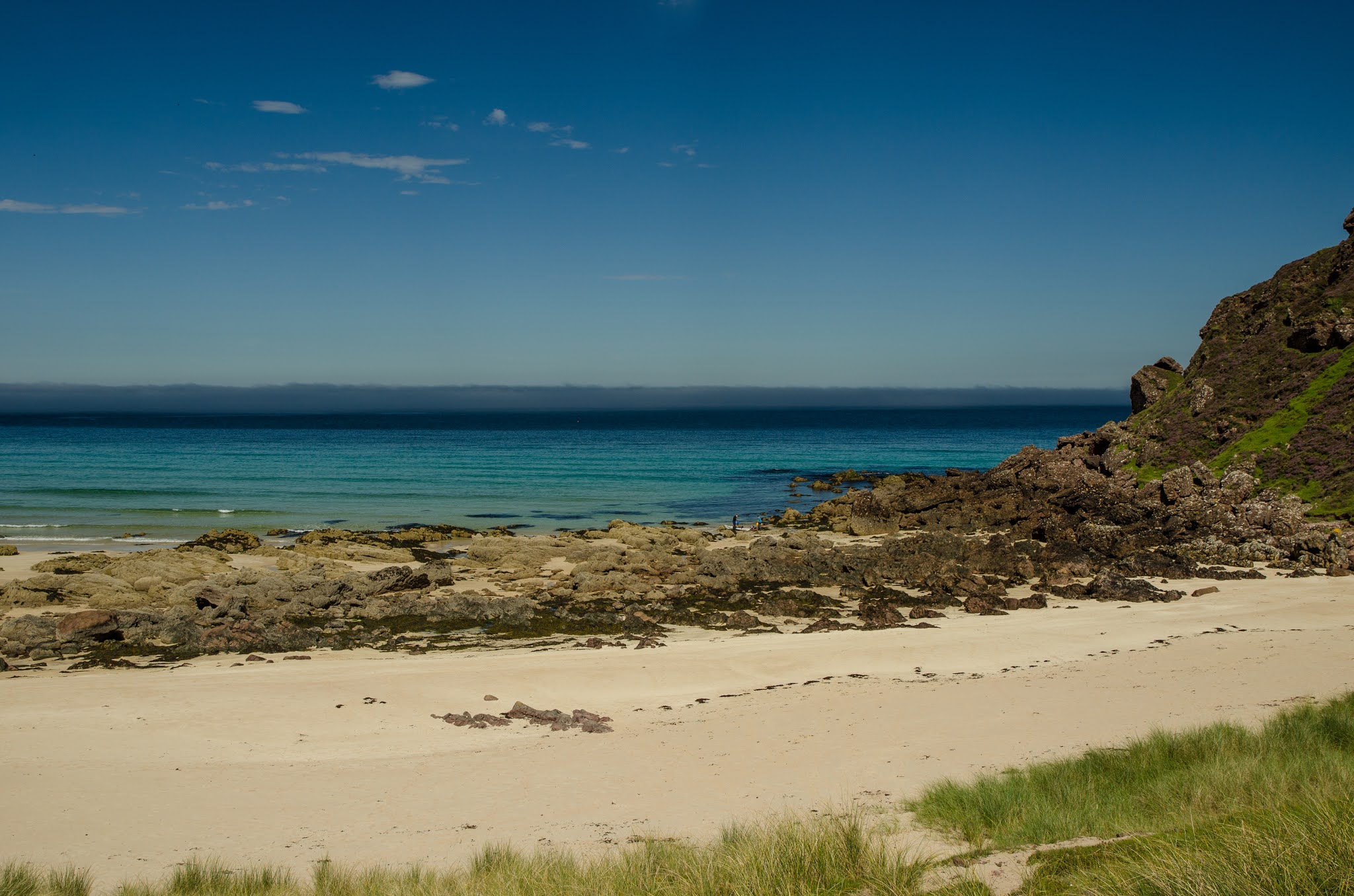
From the base of the cliffs I looked back to our landing place among the reefs, the view a layered one of green marram grass, golden sand, warm coloured rock, aquamarine water shading to deep indigo and a thin bank of sea mist below a blue sky.  It was lovely, but if the view over the beach was good.....


The view along it was superb!  We enjoyed a leisurely first luncheon, followed by a swim.  We can report that despite the warmth of the day, the sea temperature was on the bracing side of refreshing...though refreshing it certainly was.  It took no time at all to dry off in the sunshine and we ere soon ready to get back on the water; we were leaving as a double kayak and a RIB were arriving.  Camas Mor is a beautiful beach, and the fact that it's difficult of access by land or sea adds to its appeal.  But for all it's grandeur, we were to find out that it's not even the best beach on this stunning stretch of coast.