Showing posts with label Isle of Bute. Show all posts

Wednesday, 30 March 2022

A very special induction

The third week of March promised some very fine and warm weather in Scotland.  Having studied the forecasts and checked availability we decided on a sea kayak trip over four days and three nights in the Firth of Clyde and Loch Fyne.  Allan, Raymond and I would start near Tighnabruaich in the West Kyle, Donny would launch his F-RIB from the same spot and Douglas and Mike would kayak from Portencross on the Ayrshire coast to join us for an overnight camp.

Our planning was very flexible, there was no fixed itinerary other than getting out on the water for a journey and to enjoy the fine weather.  From previous knowledge of the area we had several potential wild camp sites in mind for our first night and were able to keep in touch through the day to decide which one would work best for our varied starting points and times.

It's a fair drive from Aberdeenshire to Tighnabruaich, but Allan and I made good time and after stopping for brunch en route we were packing the boats shortly after 1pm - Raymond arrived a few minutes after us from his home near Stirling. We noted Donny's car in the parking area so he was on the water already, a message from Douglas and Mike indicated that they had set off late morning and the weather could not have been better....the plan was coming together!


We paddled south down the West Kyle of Bute and past Ardlamont Point into open water at the mouth of Loch Fyne, it was a cracking day to be on the water.


The slight breeze dropped completely as we crossed to the north end of the island of Inchmarnock - a couple of messages exchanged just as we set off had confirmed our meeting point as the south end of the island where we knew we'd get a good camp site provided that it wasn't inhabited by cattle.


We couldn't quite believe the conditions we paddled in...warm sun on the face, a heat haze and perfect reflections on mirror calm water.  All the more remarkable, conditions were due to be similar for the whole week - and the clocks hadn't even gone forward!


We landed at the shingle spit at the north end of Inchmarnock for coffee and a leg-stretch, greeted by this bright orange Seven Armed Starfish (Luidia ciliaris) which was a very neat colour match with the deck of my Cetus MV.  

"Inchmarnock" means Marnoc's Island and is named for the Celtic monk St Marnoc.  His name appears in several other place names in south west Scotland including the town of Kilmarnock.  Near where we landed a stone "cist" or burial container was excavated to reveal the remains of a Bronze Age lady buried with a jet bead necklace and a finely made dagger.  the remains were carbon dated to about 3500 BC and the lady (subsequently named the "Queen of the Inch") re-interred beneath a heavy glass pane.


Rested and refreshed, we paddled at a relaxed pace down the west side of Inchmarnock, sighting deer and a Peregrine Falcon along the cliffs.  It didn't feel like an afternoon to be rushing along.


In fact, quite the opposite, this was an afternoon to take things very easily and to enjoy the beautiful weather.


A call on the VHF radio from Douglas alerted us that we were just a few hundred metres from the beach above which we'd camp for the night.


Image courtesy of Dr Douglas Wilcox

Douglas took this wonderful panoramic image of Allan, Raymond and I just about to arrive at the camp site; I think it really sums up the day and the superb position.


From the water the position is no less superb, a gently shelving shingle and pebble beach with an area of flat turf above.  This place is sometimes frequented by the herd of Luing cattle which are grazed on Inchmarnock - this breed can be aggressive and don't make good neighbours if camping.  It's their home, so if they're around we go elsewhere to camp!
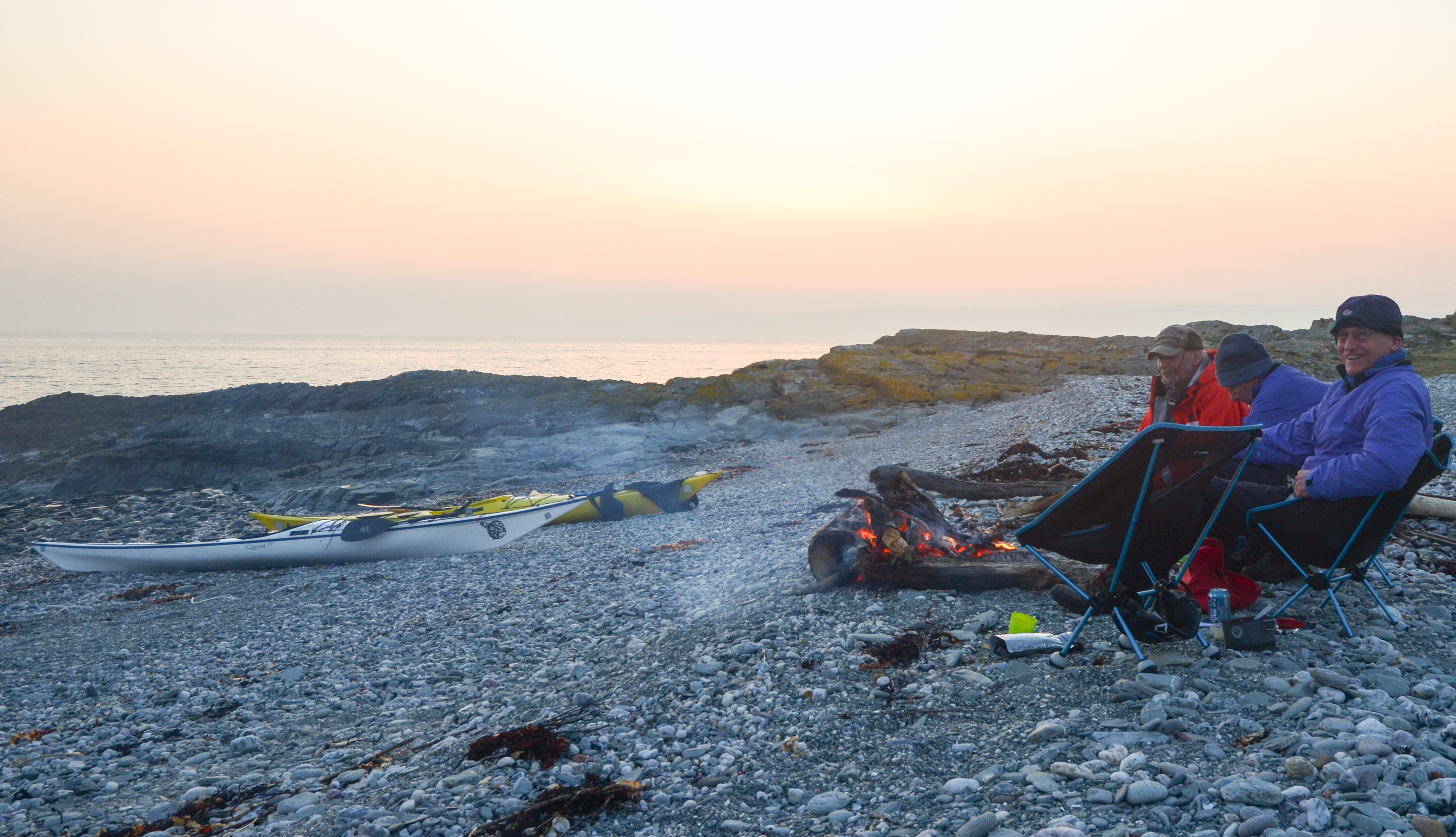


 After putting up our tents and settling in we joined Douglas, Mike and Donny for dinner around the camp fire.  this early in the Spring there was plenty of driftwood for a fire to be lit below the high water mark.  Raymond, Allan and I had each cooked a fresh meal for one night of this trip - we started this evening with a chilli con carne and rice, accompanied with a glass of red wine - no need to rough it!

This trip was significant for a couple of reasons, the first being that this was the first time we'd been out together for some time, and the first overnight trip of the year for most of us.  The second reason was that all the people on the trip apart from me are retired or semi-retired....and I was imminently to retire.  So, this was a very special induction into the club!


Sat by the fire on a lovely evening in a superb location, sharing a dram with good friends....I think I could get to like this retirement thing! 😊

Monday, 24 August 2015

Blue boats blasting back from Bute


We woke at our camp on the west coast of Inchmarnock to a bright blue day with a WNW breeze to keep the midges away; it looked a perfect day for sea kayak sailing.  After breakfast we moved the boats down to the water - one portage strap is a really useful aid to allow three people to move a loaded boat - and prepared to get going.  Starting the day in a location like this is one of the real joys of camping from a kayak :o)


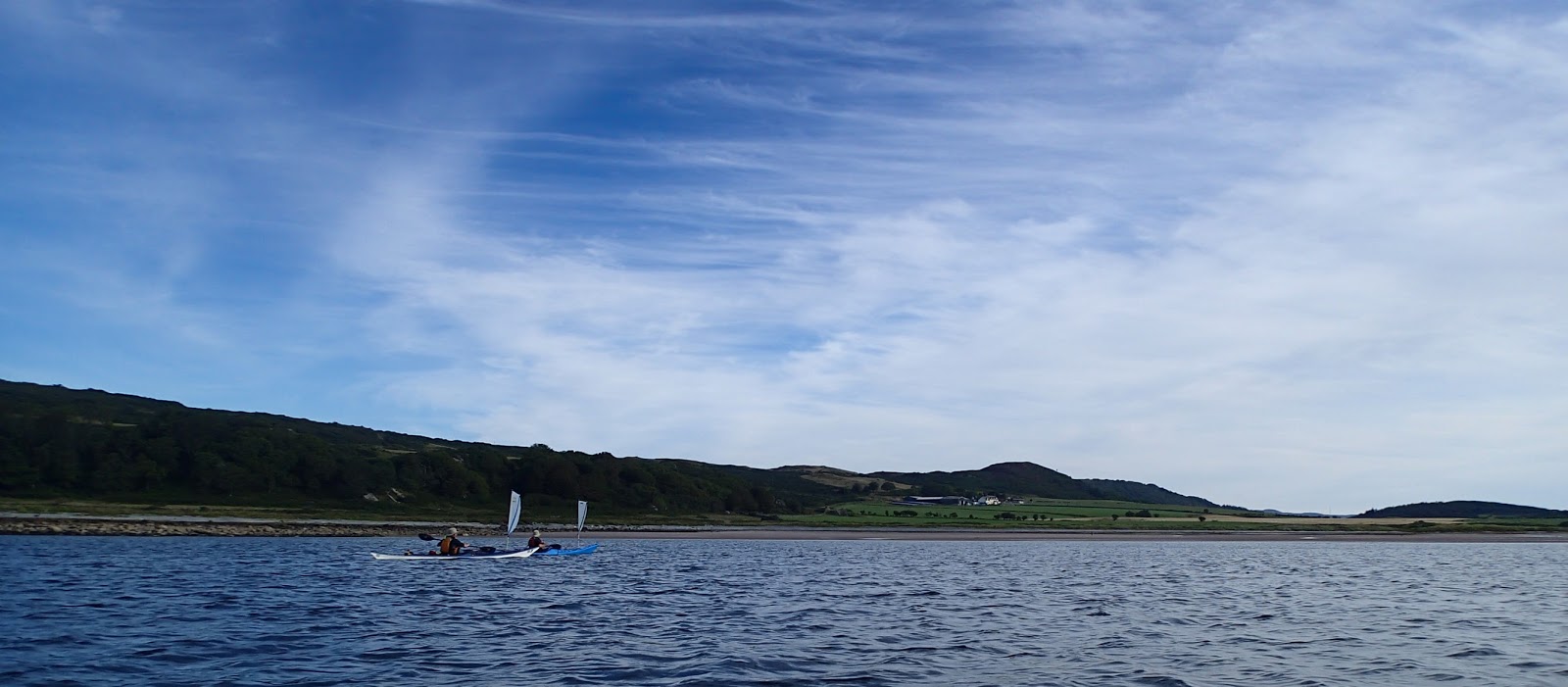
Straight from getting launched we hoisted sails to catch the light breeze.  The colour palette on this morning was most definitely blue; sky, sea and Douglas & Mike's boats all in harmony!


A relaxing and gentle sail downwind took us directly to Ardscalpsie Point on the island of Bute and then around Scalpsie Bay with its resident seal population.  The name "Scalpsie" indicates a place where scallops (shellfish) can be found and that's certainly the case.  When we lived on Bute the beach was a favourite walk and there's a seal viewing point on the road above the point.

As we came out of the bay we immediately noted a freshening of the breeze from a F2-3 to much more like F3-4.......


...let the fun begin!  Our speed rapidly increased with the wind strength while the quickly building small swell was the perfect height and length to enjoy some surfing rides.


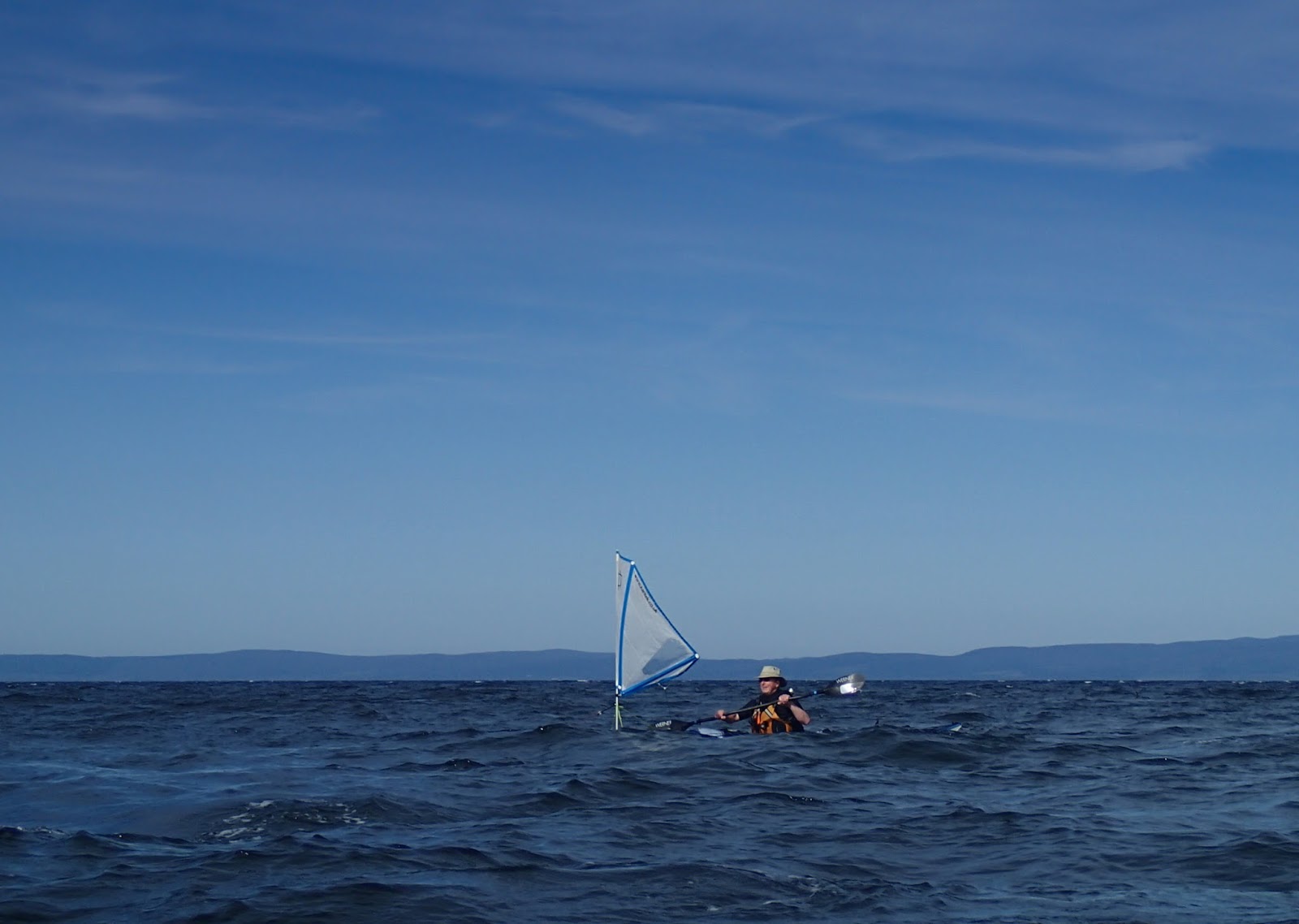
I'm by no means an experienced paddle sailor but do have some dinghy sailing experience from many years ago.  My immediate impression of the FEKS Trade Wind sail was that in these conditions it pulls hard and strong and with a bit more drive than the Code Zero I'd previously borrowed from Douglas.  The drive was steady and predictable...and a whole heap of fun!  This is when sea kayak sailing really comes alive - continue to paddle hard and the boat speed can be adjusted to catch each swell.  The blue boats blasted back past Bute.....


......flying past the distinctive volcanic outcrops at the south end of the island; this one reallylooks like the dorsal fin of the porpoises we'd seen the previous afternoon.


The swell had built quite quickly as the wind blew across the Sound of Bute.  Mike had recently completed some rather skillful fibreglass repairs to his Cetus MV, and although at times we lost sight of his boat, Douglas and I were confident that he was just temporarily between swells!


As we rounded Garroch Head at the south end of Bute we came into the wind shadow and out of the swell - thins slowed from the exciting run we'd enjoyed and we paddled ashore at Glencallum Bay for second breakfast.  As we left, a couple of folk camping on the shore were lighting their fire using what appeared to be a fairly incendiary material....


The wind dropped to a very light breeze as we headed past Rubh'an Eun (point of the birds). The small light here marks the port hand side of the main channel for vessels bound for the upper Clyde and flashes red every six seconds.


The blue theme of the day continued as we headed across the Clyde towards Great Cumbrae in what had become a glassy calm and very warm afternoon. A large submarine headed down the Clyde and out to sea as we paddled along the coastline.  It had an escort of two large RHIB's which we thought might be manned by Royal Marines.  This thought was reinforced when both boats roared back up the Clyde having escorted the submarine out of the Cumbrae Gap with Meat Loaf's "Bat Out of Hell" blasting from a speaker system!


Our final stop was on the pebble shore of Fintray Bay where we enjoyed first luncheon before rounding the north end of Great Cumbrae for a final gentle sail down to the marina at Largs.

We'd been out for a fraction over 24 hours but what a great mini-trip!  In twenty four hours we'd enjoyed the wildlife of the Clyde with porpoises, Gannets and Shearwaters aplenty; had a super wild camp in a place which seems utterly remote from the bustle of a big city just 45 kilometres distant; we'd visited four islands and had the most superb "blue day" blast under sail. You'll be able to read about this trip in "Sea Kayak Stereovision" at Douglas' blog starting here.

To just head out with a couple of like-minded friends on small trips like this is absolutely one of life's joys.  I'd been away a long time...it was so good to be back.


Wednesday, 19 August 2015

A summer evening on the Firth of Clyde


After a long work-enforced break from paddling and walking I was very keen to get back out on the water, and if possible to do a short overnight trip.  A good forecast for two consecutive days in the Clyde area (a rarity in the poor summer of 2015) and the availibilty of Douglas and Mike settled the deal, location and start time sorted by two texts and a brief phone call.  We met at Largs Marina on a gloriously warm afternoon and loaded our boats for a two day trip among the Clyde islands.

Douglas kindly helped me set up my new FEKS Trade Wind 80 sail before we set off, though it didn't look too promising for a test given the windless calm!  We paddled out from the public slipway and past the "Pencil Monument" which commemorates the 1263 Battle of Largs during which a Scots army under King Alexander II beat off a Norwegian force under King Hakon of Norway.


It was so warm that we'd set out in shorts and T-shirts, stowing our padde kit inside the boats, but even lightly dressed it was a warm afternoon.  The initial few kilometres south through Fairlie Roads between the mainland and Great Cumbrae is an industrial scene with the Hunterston ore terminal, Hunterston nuclear power station and two gigantic wind turbines dominating the view.


 In contrast to the modern industry on the shore, we passed this beautifully maintained sailing craft whith her varnished hull and graceful rig.


 After an hour so we detected a faint breeze and hoisted our own sails for a short while.  Although we'd only been on the water for an hour, a stop for afternoon tea below the 16th century Little Cumbrae Castle seemed very much in order.  A keep with royal connections, Little Cumbrae castle was in the possession of the High Steward of Scotland and is very similar to Portencross Castle over on the Ayrshire mainland.


 As we passed around Gull Point at the southern end of Little Cumbrae we got our first view of the distinctive outline of the Arran skyline some 15 kilometres across the Firth of Clyde.  We also saw two groups of Porpoises in this area, their sharp exhalations clearly audible on the calm air.


 The west coast of Little Cumbrae is a long series of lava flows.  These are best viewed from the south end of Bute where three distinct flows can easily be picked out.  A Peregrine Falcon zipped along the cliff edge before landing on the skyline and as we paddled out a little farther we were treated to a series of close passes by squadrons of Manx Shearwaters.

This rugged and quite remote coast with its wildlife is, amazingly, just 45 kilometres from the centre of Scotland's biggest city - but a world away.


As we'd not set out from Largs until mid-afternoon we would be paddling into the summer evening before reaching our intended camp site.  The sun wouldn't set until late and it was a lovely evening to be on the water, we had no sense of hurry or a schedule to keep; we just enjoyed being out here.


 We made a brief stop at a tiny pebble beach near Garroch Head on the south tip of the island of Bute to stretch our legs and to put on paddling clothes.  It wasn't that the temperature had dropped much, more that we knew we'd be landing next just as the midges were getting most active and thought that covering our legs would be best- it pays to plan ahead!


A crossing of a little over 10 kilometres of paddling lay between us and our camp site as we paddled away from the coast and out onto a mirror calm Sound of Bute.  It was truly great to be out on the water again......

Friday, 12 June 2015

West Church, Rothesay


The West Church in the town of Rothesay on the island of Bute was built in 1846-7 and remained in use until 1978.  It is considered a fine example of a three by six bay Victorian Romanesque kirk; since 1978 there have been several applications to demolish the building but all have so far been refused.

There's no doubt that the fabric of the kirk is in decline - it couldn't yet be described as totally derelict but perhaps well on the way.  While the arguments about the future of the building rumble on, nature has found a remarkable use for the sunny south facing walls........


......which have become a vertical garden of ivy and flowering plants.


In early summer the walls surrounding the empty window apertures bloom into a carpet of brilliant purple flowers.  It's not so easy to get close enough to ell which species, but the effect is undeniably beautiful, transforming a run-down building on the edge of a car park into something more attractive entirely.

Ironically, the builders use of sandstone rubble to incorporate into some of the detail of the building has probably created the conditions in which this vertical garden has flourished.


There's a sort of symbolism in the decline of a church building giving rise to such an outpouring of natural energy - but aside from that, on its own merit this is a lovely and colourful display.

Tuesday, 31 March 2015

A melted fort on a Burnt Island


The final part of our day in the Kyles of Bute was visiting the Burnt Islands, a collection of three small islands at the top of the East Kyle.  We arrived at the largest of the three, apropriately named Eilean Mor (Big Island) just as the tidal stream was turning, but didn't land as the gulls were already in residence and it's a noisy place in the Spring.


The short crossing to the second largest island crosses the narrow navigable channel, marked by red and green conical buoys.  The tide runs strongly here; just five minutes after slack water and the west going stream was already beginning to take effect.


We landed on the smallest of the islands, Eilean Buidhe (yellow island) simply because none of us had done so previously.  The rock on the shore has some wonderful textures and patterns.


The remains of a vitrified hillfort can be found on this island, though the visible evidence isn't too obvious - a low bank enclosing a flattened area.  It must have once been in a very strategic position to control sea traffic through the Kyles although defensivley it doesn't seem to have been very strong.  The main defence now is the profusion of brambles across the whole island - a few weeks later and we wouldn't have been able to reach the fort at all.

In the distance the Colintraive - Rhubodach ferry can be seen leaving the mainland for the short crossing to Bute, a few hundred metres only at this point.  Our cars were waiting at the parking area adjacent to the ferry slip and our short day out was nearly over.   We paddled and sailed just 16 kilometres on this trip, but managed to pack in two luncheons, musical entertainment, great kayak sailing conditions and good company.........


Monday, 30 March 2015

An Caladh - the harbour


On the crossing from Kames back towards Bute we got into the wind shadow of the hills at the north end of the island and the wind died away completely.


The Highland Boundary Fault passes through the centre of Bute along the trench of Loch Fad (Long Loch) and divides the island's geology and landforms markedly.  South of the fault line the land is comparatively low-lying with rolling, fertile farmland pierced by volcanic rocks.  North of the fault line the landscape is most definitely Highland in character with steep slopes, craggy hills and much poorer soil.  We kept close along the shore enjoying the quiet atmosphere and the wader calls as we went.


Near the northernmost point of the island stand the Maids of Bute, two large rocks which were first painted over 100 years ago.  When I first saw the Maids they were decorated in simple red and white colour bands but lately the decoration has become garish, the rocks painted to resemble cartoon creatures.  They're still an interesting and unusual feature of the landscape though!


Turning away from Bute as we passed the Maids, our next destination was An Caladh (the harbour), a protected bay near the mouth of Loch Riddon formed by the close proximity of Eilean Dubh (Black or Dark Island).  The island has been overrun by Rhododendron originally planted on the Caladh estate as decorative shrubs, but the larger trees rising above the choking vegetation host a large heronry.  Any visit here in late Spring is accompanied by the unearthly clamour, shrieks, clacking and hissing of the young herons.


The entrance to An Caladh is marked by a stone light tower which once held an oil lamp, again dating from the heyday of the big estates.  Nowadays the bay is a popular anchorage for yachtsmen transiting the Kyles of Bute. 


At one end of the bay is the jetty once used by Caladh estate, which was latterly owned by the Clark family (of Clarks shoes).  The boathouse and harbour cottages are now holiday homes but one former occupant was an inspiration for the author Neil Munro when he wrote the series of stories featuring Peter Macfarlane, the Gaelic-speaking skipper of a Clyde Puffer - better known as Para Handy


As the houses were unoccupied at the time of our visit we landed on the slipway and took second luncheon on the manicured turf of the jetty.......


           ...including the soup du jour, home-made  Sweet Potato, Butternut Squash & Chili


The jetty is complete with a remarkably well-preserved derrick crane.  Aside from Puffers, yachts and kayaks, other vessels have used the shelter of An Caladh.  During the Second World War, Glen Caladh Castle was commissioned into the Royal Navy as HMS James Cook.  The area around the Kyles and Loch Riddon was utilised to train beach landing and coastal navigation to Landing Craft crews, the name of the establishment is a reference to the new techniques which Captain James Cook introduced to the Navy.

The area was also utilised for the training of X-Craft crews.  Based at Port Bannatyne on Bute and headquartered in the Kyles Hydro Hotel which was known as HMS Varbel, X-Craft miniature submarines were designed to attack shipping in harbours and anchorages, and were used in attacks on the German battleship Tirpitz as well as the sinking of two Italian cruisers.  The four-man crews of these 35 tonne vessels displayed incredible skill and bravery both in training and on operations; in total 39 men were killed serving in X-Craft and 68 awards for bravery were made, including four of the Victoria Cross.  A memorial to the service is displayed at St Ninian's church in Port Bannatyne.

An Caladh is a place which nowadays has a calm and tranquil atmosphere; there are woodland walks nearby and it's well worth a visit whether by water or on foot.


Friday, 27 March 2015

The Craic at Kames


 Having lifted our boats just far enough up the beach to allow luncheon and a frothing sports recovery drink, we adjourned to the bar of the Kames Hotel.  Recently decorated and very welcoming, the hotel bar has a fine view of the West Kyle and we struck up a conversation with a group of customers who'd observed our speedy crossing of the Kyle under sail.  Remarkably, Phil found that he knew some of the same people and so some lively craic ensued.


Our food order of two vegetarian burgers and two home-made beef burgers was fairly straightforward and before long we were sitting down to luncheon.  The hotel is well used to serving yachtsmen, kayakers and divers so a table of four in drysuits didn't even raise an eyebrow.

The folk we'd been chatting with disappeared temporarily, but soon returned with a treat......


....a musical treat.  All four were folk musicians and an impromtu session started as we finished our meal.  Other diners entering the bar were amused to see a band playing with an audience dressed in drysuits singing along!


Such a spontaneous "session" presented us with some difficulty.  It would be great to have another sports recovery drink and listen to the music for a while, but that's how afternoons can become messy!  We imbibe very sparingly when kayaking, and anyway our tidal rise versus carrying distance equations had been quite precise......regretfully we said our farewells and headed back down to the boats.

The combination of location, the welcome, the ambience, food and range of beers makes the Kames Hotel a great sea-kayaking establishment - we score it 12/10; if you're lucky enough to be in when there's a band staying the weekend, make that 13/10  !


Back on the water, we lost the strength of the wind once we crossed over to the northern shore of Bute, leaving just a gentle breeze to to carry the sound of music across from Kames.....