Showing posts with label Ailsa Craig. Show all posts
Saturday, 23 May 2020
One good thing - 22nd May 2020
In a bank shaded by a large Copper Beech tree at the edge of the garden, a clump of English Bluebells (Hyacinthoides non-scripta) have flowered - the second year they've done so after we transplanted a few bulbs some years ago.
These lovely flowers, when seen in large numbers, give a violet glow to woodlands which is actually quite difficult to depict accurately on camera. they are associated with ancient woodland and can be a good indication of where a woodland once was - good examples are found at Eilean Fhianan in Loch Shiel and Ailsa Craig in the middle of the Firth of Clyde. In late spring and early summer Ailsa Craig's slopes are carpeted in violet blue - as shown on the visit Douglas made in 2012
Sunday, 4 January 2015
Memories of 2014
Looking back over 2014, I've been blessed with some outstanding days in the outdoors both on the water and on the hill. Sea kayaking trips again featured heavily; an early Spring overnighter, a super multi-day trip around Arran, long days in the far northwest of Scotland, white sands and clear water at Arisaig and an introduction to the intense colours of summer on the Angus coast were all highlights.
On the hill there were numerous day walks, camping high in the Cairngorms and the opportunity to share in the experiences of Duke of Edinburgh's Award teams on their qualifying ventures.
As ever, it's difficult to pick a single memory from the year - and this January I'm going to cheat and indulge in two special memories.
The first combined hillwalking, sea kayaking, swimming and wildlife into a single day.......
...on a superb trip to Ailsa Craig. In the course of a single day Douglas and I paddled over 35 kilometres, climbed to the 338 metre summit (more difficult than the height would suggest) swam in the sea and explored the lighthouse. But it's the wildlife spectacle on the west side which leaves the greatest impression - on all the senses.
This "day trip" was amongst the best outdoor days I've ever had, and involved me leaving home at 0430 and arriving back at 0130 the next morning, the drive home (literally) illuminated by a rare display of noctilucent cloud.
Talking of which, the second outstanding memory of 2014 was all about cloudscape..........
...on an early morning crossing of the Kilbrannan Sound to Lochranza - the sheer beauty of which was impossible to put into words.
A good friend has recently written compellingly about the gift of gratitude at the turn of the year - and looking back over 2014 that's the dominant theme. In a year which brought both sadness and joy to our family, we've so much to be grateful for. These two memories illustrate great days shared with friends; and I'm so grateful to have shared these and all the other wonderful experiences that 2014 offered.
So there you have it - two moments from another year in Scotland's outdoors. What's your outstanding memory of 2014?
On the hill there were numerous day walks, camping high in the Cairngorms and the opportunity to share in the experiences of Duke of Edinburgh's Award teams on their qualifying ventures.
As ever, it's difficult to pick a single memory from the year - and this January I'm going to cheat and indulge in two special memories.
The first combined hillwalking, sea kayaking, swimming and wildlife into a single day.......
...on a superb trip to Ailsa Craig. In the course of a single day Douglas and I paddled over 35 kilometres, climbed to the 338 metre summit (more difficult than the height would suggest) swam in the sea and explored the lighthouse. But it's the wildlife spectacle on the west side which leaves the greatest impression - on all the senses.
This "day trip" was amongst the best outdoor days I've ever had, and involved me leaving home at 0430 and arriving back at 0130 the next morning, the drive home (literally) illuminated by a rare display of noctilucent cloud.
Talking of which, the second outstanding memory of 2014 was all about cloudscape..........
...on an early morning crossing of the Kilbrannan Sound to Lochranza - the sheer beauty of which was impossible to put into words.
A good friend has recently written compellingly about the gift of gratitude at the turn of the year - and looking back over 2014 that's the dominant theme. In a year which brought both sadness and joy to our family, we've so much to be grateful for. These two memories illustrate great days shared with friends; and I'm so grateful to have shared these and all the other wonderful experiences that 2014 offered.
So there you have it - two moments from another year in Scotland's outdoors. What's your outstanding memory of 2014?
Saturday, 26 July 2014
Astonishing Ailsa Craig
We had deliberately left kayaking around Ailsa Craig until the afternoon in order to get the best light on the cliffs of the south and west coasts. It was around 5pm when we started our clockwise circumnavigation and still very warm. In distance it is just 4.5 kilometres around the island but what an extraordinary hour of paddling it is.
Leaving the lighthouse, the first point of interest is the south fog signal. This is one of two fog signals installed at about the same time as the lighthouse was constructed, one at the north and one at the south of Ailsa Craig. They were powered by gas engines until 1911 when oil driven engines were introduced and these continued in service until 1966 when both signals were permanently discontinued and replaced by a single Tyfon fog signal situated close to the lighthouse. This was itself discontinued in 1987 along with most other coastal fog signals.
A little way past the south fog signal the cliff scenery begins to dominate the view, first shattered basalt then more structured basalt columns. Also here are some of the few Elder (Bour) trees which are the only type of tree to be found on the island.
Farther along and the columnar basalt gets really impressive; some of the individual columns are 120 metres/400 feet high. The slight lean of the columns is quite strange whilst close in and looking straight upwards!
But then, as a corner is turned the scene goes from dramatic to truly jaw-dropping.....
Stretching away up the west coast of Ailsa Craig are cliffs covered in birds. The sight, noise and smell seem to arrive almost simultaneously; this is the greatest and most impressive sight on the whole island and it's only when the eyes adjust to the scale that the true impact hits home. The specks above the 300 metre cliffs are Gannets with a two metre wingspan. Douglas has paddled here several times and says that it's the same each time - absolute astonishment.
The cacophony and smell can't be conveyed in an image, but the whole is so overwhelming that it is as much felt as heard or smelled. And that's even before you look upwards........
.....into a sky which is simply full of Gannets. Streaming from the cliffs, wheeling around and sometimes crashing into the sea around us; it's a stupendous sight. Looking up comes with a fair risk - there is a steady rain of guano and our boats and clothing were soon liberally spattered, but it's a small price to pay for one of nature's great spectacles.
There are about 36,000 pairs of gannets breeding on Ailsa Craig, together with Guillemots, Razorbills, Black Guillemots, Cormorants and Puffins. The cliffs of St Kilda are higher, but the Gannets on Ailsa Craig are more concentrated in one area... there are more Gannets at the Bass Rock, but the cliffs of Ailsa Craig are three times higher. It's pointless to compare sites; all are magnificent but perhaps here at Ailsa Craig the combination of a sudden revealing of the cliff, the noise and the smell have the most effect. We were particularly pleased to see good numbers of Puffins; they formerly bred here in huge numbers but were almost completely wiped out by Rats which arrived on the island on ships. A comprehensive programme to eradicate the Rats has been successful and the "Tammie Norries" are, happily, breeding again and increasing their numbers.
While I moved off a little to get a sense of the scale and perspective of the west facing cliffs Douglas moved in close and captured some wonderful and intimate images of the birds close by the shoreline. As we approached the end of the western face of the island the cliffs rear ever steeper until they are vertical and even overhanging; even the seabirds can't find nest sites here.
The astonishing cliff scenery culminates in the Eagle's Seat, an impending 230 metre/750 ft crag which looms over the north tip of the island, making paddlers feel very small. White Tailed Eagles once nested here, finding good hunting amongst the seabird cities. Maybe the great birds will return one day; it's good to think that they might.
Turning the corner on the last leg of our circumnavigation, we passed the Swine Cave and the north fog signal. This twin to the signal at the south end of Ailsa Craig points towards the Arran coast; we reflected that it was only a few weeks previously that we'd looked down the bearing of the Pladda fog signal towards Ailsa Craig.
All too soon our circumnavigation was completed and we landed back at the lighthouse for a leg-stretch prior to the 14 kilometre crossing back to Lendalfoot. The paddle around had been an astonishing wildlife and scenic experience, but not all of the interest had been avian......
For most of the way we'd had close company, and as we got on the water to start the crossing back to the mainland we were again the subject of intense scrutiny. A swirl of water, a snort and a fleeting underwater shape seemed to be leading us out......
.....this is "Gollum", the Grey Seal who followed us closely and probably the same animal with whom we shared the water whilst swimming earlier in the afternoon. After the widescreen wildlife of the western cliffs, this was an enchanting and intimate experience. We were followed for several kilometres on our crossing of the Firth of Clyde before the seal turned for home.
There aren't any images from our paddle back to Lendalfoot. Soon after heading out into open water a dark squall line to the west brought a rising wind and a short, tricky swell from just on our beam. The wind was from ahead of the beam and we experienced some interesting conditions as we crossed great swirls of tidal movement, sometimes the swell helped and sometimes it definitely didn't, requiring a couple of sharp and energetic brace strokes on occasion. It's this distance from the mainland, the exposure to the prevailing weather and the potential for conditions to change rapidly which combine to make Ailsa Craig one of the more challenging paddles, even on the most benign of days.
We made the 14.2km crossing in under two hours and at an average speed of 7.4km/hr; it's amazing how a bit of adrenaline can increase the paddling rate! We arrived about 12 hours after setting out from Lendalfoot and though I still had a four hour drive home I was absolutely buzzing from a superlative day. I got home at 0130, having set out at 0430 the previous day, so it was a day trip but not actually in one day!
Much as I love the far north of Scotland for its mountainous and wild scenery and the north east for cliff scenery and bird life, Douglas and I are in complete agreement; we don't believe that there is a better combined day paddle and hillwalk to be enjoyed anywhere in the UK than the astonishing, awesome Ailsa Craig.
Monday, 21 July 2014
Big air and deep water at Ailsa Craig
Having looked around the lighthouse and the quarry infrastructure, Douglas and I decided to make the most of our day on Ailsa Craig by climbing to the summit of the island.
The start of the path isn't easy to find but Douglas has been up previously and knew exactly where to look behind one of the buildings to find it. The path is faint and in summer goes through chest high bracken on the lower slopes. It also climbs at quite an angle, varying from steep through very steep to vertiginous and requires the occasional use of hands.
After an initial steep pull the angle briefly relents on a shelf of rock. Ahead is the Castle, a square peel tower built with local stone and dressed on the corners with blocks of sandstone. The Castle was almost certainly built by the Hamiltons but no record remains of why it was built or how long it was occupied. It is said to have links with the monks of Crossraguel Abbey and was also briefly held by Catholic forces on behalf of King Philip II of Spain.
Above the Castle the ascent resumes its steep angle. A small well, more a tiny spring really, sits above the building and may have influenced the siting of the building. The steep slopes of Ailsa Craig continue underwater as well as above, straight into the deep water of the Firth of Clyde.
We paused on a level platform just below the final rocky climb to the summit to watch as FPV Minna cruised by below. At 42 metres long she's not a big vessel and looked even smaller from up here.
One final pull up and we were on the 338 metre/1109 ft summit of Ailsa Craig. The small summit area is surrounded by ground which drops away to the sea below, the faint noise of thousands of seabirds and the clouds of white specks we knew to be Gannets with two metre wingspans gave a sense of scale; we were truly in "big air".
And the views! From the Ayrshire coast round to County Antrim in Northern Ireland to Kintyre, Arran and the mountains of Argyll there is a wonderful 360 degree view with a foreground of blue sea. Arran looked close and yet is 25 kilometres away. We picked out Pladda and Benna Head, highlights of our recent journey around the island.
There was almost no breeze on the summit and the afternoon was warm. We spent some time absorbing the views and then prepared for the descent, the knee-jarring to come would be as tough as the climb - though Douglas' bionic knees can now cope with a remarkable amount!
We were glad of the dry underfoot conditions on our way down. The angle is such that for most of the way any slip would have serious consequences; in muddy conditions I would think twice about climbing the hill. Gradually the lighthouse came into view along with our kayaks drawn up on the storm beach. It's interesting to contrast this image with one taken by Douglas from a similar point in 2012; the curving shingle spit and a huge pile of rock have been completely erased by storms in the intervening period - a really striking change.
We were hot and tired on the way down and looked forward to completing the "hat trick" at Ailsa Craig by kayaking, hillwalking and swimming.....
On the lower heathery slopes we saw several beautiful Magpie moths (Abraxa grossulariata). They feed on the leaves of shrubs, so on Ailsa Craig they must favour the only small trees available, Elders (known as Bour trees and so scarce are trees here that they're marked on the map). Lovely as this small wildlife spectacle was, our wildlife encounters were shortly to get a whole lot more widescreen....
Meantime though there was the pure pleasure of a swim in the cool waters of the Firth of Clyde. Instantly refreshing and invigorating, our swim was enlivened by the presence of a couple of nearby Grey Seals who were curious about these pale-coloured visitors to their world and stayed around to check us out, quite a privilege
The start of the path isn't easy to find but Douglas has been up previously and knew exactly where to look behind one of the buildings to find it. The path is faint and in summer goes through chest high bracken on the lower slopes. It also climbs at quite an angle, varying from steep through very steep to vertiginous and requires the occasional use of hands.
After an initial steep pull the angle briefly relents on a shelf of rock. Ahead is the Castle, a square peel tower built with local stone and dressed on the corners with blocks of sandstone. The Castle was almost certainly built by the Hamiltons but no record remains of why it was built or how long it was occupied. It is said to have links with the monks of Crossraguel Abbey and was also briefly held by Catholic forces on behalf of King Philip II of Spain.
Above the Castle the ascent resumes its steep angle. A small well, more a tiny spring really, sits above the building and may have influenced the siting of the building. The steep slopes of Ailsa Craig continue underwater as well as above, straight into the deep water of the Firth of Clyde.
We paused on a level platform just below the final rocky climb to the summit to watch as FPV Minna cruised by below. At 42 metres long she's not a big vessel and looked even smaller from up here.
One final pull up and we were on the 338 metre/1109 ft summit of Ailsa Craig. The small summit area is surrounded by ground which drops away to the sea below, the faint noise of thousands of seabirds and the clouds of white specks we knew to be Gannets with two metre wingspans gave a sense of scale; we were truly in "big air".
And the views! From the Ayrshire coast round to County Antrim in Northern Ireland to Kintyre, Arran and the mountains of Argyll there is a wonderful 360 degree view with a foreground of blue sea. Arran looked close and yet is 25 kilometres away. We picked out Pladda and Benna Head, highlights of our recent journey around the island.
There was almost no breeze on the summit and the afternoon was warm. We spent some time absorbing the views and then prepared for the descent, the knee-jarring to come would be as tough as the climb - though Douglas' bionic knees can now cope with a remarkable amount!
We were glad of the dry underfoot conditions on our way down. The angle is such that for most of the way any slip would have serious consequences; in muddy conditions I would think twice about climbing the hill. Gradually the lighthouse came into view along with our kayaks drawn up on the storm beach. It's interesting to contrast this image with one taken by Douglas from a similar point in 2012; the curving shingle spit and a huge pile of rock have been completely erased by storms in the intervening period - a really striking change.
We were hot and tired on the way down and looked forward to completing the "hat trick" at Ailsa Craig by kayaking, hillwalking and swimming.....
On the lower heathery slopes we saw several beautiful Magpie moths (Abraxa grossulariata). They feed on the leaves of shrubs, so on Ailsa Craig they must favour the only small trees available, Elders (known as Bour trees and so scarce are trees here that they're marked on the map). Lovely as this small wildlife spectacle was, our wildlife encounters were shortly to get a whole lot more widescreen....
Meantime though there was the pure pleasure of a swim in the cool waters of the Firth of Clyde. Instantly refreshing and invigorating, our swim was enlivened by the presence of a couple of nearby Grey Seals who were curious about these pale-coloured visitors to their world and stayed around to check us out, quite a privilege
Sunday, 20 July 2014
Light and heavy stones at Ailsa Craig
As we finished our second breakfast MFV Glorious re-embarked her passengers and headed off for a tour around Ailsa Craig. We intended to do the same circumnavigation, but Douglas suggested we do it later in the day when the light would be better on the south-west facing cliffs. Meanwhile, we had plenty of time to explore.
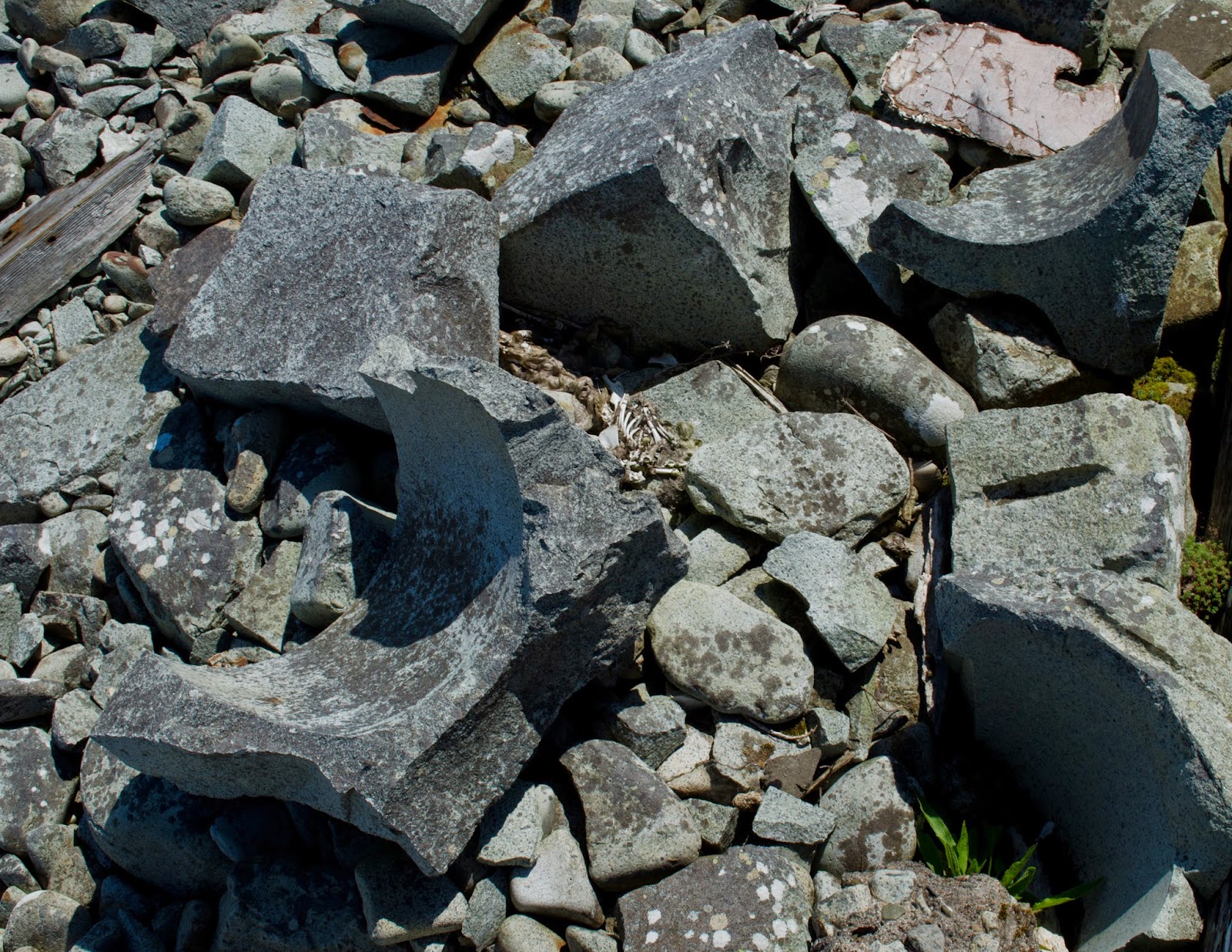
A feature of the area around the quarry and boulder beach near the lighthouse buildings and pier are the shaped offcuts of granite lying around. They are the clue to Ailsa Craig's world-renowned status as the origin for most of the world's Curling stones.
Curling has a long tradition in Scotland and the Netherlands, and when taken abroad by emigrant Scots became a major sport in Canada. Known as "the roaring game" from the noise of the stones rumbling down the ice "sheet", it is still a popular pastime with indoor rinks and also (like in my home village of Alford) outdoor rinks used in winter.
The granite stones have to be of a prescribed weight between 38 to 44 lbs (17 and 20kg) and with a maximum circumference of 36 inches (910 mm). The two principal sources of stones ar Ailsa Craig and Trefor quarry in Wales. The preferred stone is made from a particular type of microgranite known as Blue Hone from just one area on the island, its characteristic fine grain and hardness resist water absorption and makes long-lasting and true running stones. Quarrying ceased for a time between 2002 and 2013 because of the bird reserve status of Ailsa Craig, but in 2013 Kays of Scotland, who have exclusive quarrying rights graned by the island's owner the Marquess of Ailsa, quarried 2000 tons of rock - enough to fill anticpated orders until 2020.
Adjacent to the lighthouse building is the narrow guage tramway which ran from the quarry to the pier to transport the quarried rock. Remarkably, the points on the tramway still function.
We like lighthouses a lot - and Ailsa Craig is a fine example of a Stevenson light built for the Northern Lighthouse Commissioners. The buildings and surrounding area are in separate ownership to the rest of the island, there was a plan to turn the keeper's cottages and storerooms into holiday accommodation but nothing seems to have come of it. Some of the buildings are open and are showing the signs of neglect and exposure to the elements.
The best view of the lighthouse is from a little distance away. Completed in 1886 under the supervision of Thomas and David Stevenson, the light is 18 metres above sea level, flashes white once every 4 seconds and is visible for 17 nautical miles. Prior to the installation of wireless telephone equipment in 1935, the keepers relied upon pigeons to carry messages ashore to a loft at Girvan on the Ayrshire coast. Ailsa Craig was automated in 1990 and converted from gas to solar-electric power in 2001.
We had seen such a lot during our short exploration around the landing area - it was time to get a bit of a higher view!
Friday, 18 July 2014
Ailsa Craig - big rock, small boats
Douglas and I had a plan to do a day's paddle "somewhere in the Firth of Clyde area" - which gives considerable scope! When our available days coincided with a short period of light winds we exchanged texts and a phone call during one afternoon and arranged to meet the following morning.......
...to head out somewhere pretty special. Our starting point at Lendalfoot is a four hour drive from home for me, but the opportunity to get out to Ailsa Craig seemed well worth the effort. Having been on my "must do" list for so long but with timings or conditions not having previously worked, it was great to be in position with a good forecast.
If you are a sea kayaker and the name Lendalfoot seems vaguely familiar, it's because this is where Alastair Wilson developed Lendal Paddles. The brand has been sold on a couple of times and is no longer based in Scotland but Alastair still lives in Lendalfoot.
From the shore, Ailsa Craig looks temptingly close but it's a 14 kilometre open crossing each way, with no guarantee of being able to land on the bouldery shore when you arrive. Any trip out to the island needs careful planning both to get out and, more importantly, to get back.
We had a great forecast and set out soon after 0900. There isn't too much in the way of tidal stream (although we experienced some tidal movement on our return leg) so our transit was a little to the left of the rock itself. At the half way point you start to get a sense of the size of the place and the distance still to paddle. I've passed Ailsa Craig many times onboard ships, a prominent navigational mark which gained the nickname "Paddy's milestone" from its position on the sea route midway between Belfast and Glasgow but ships steer well clear; in kayaks we were aiming straight for it.
The weather had been pleasant if a little cool when we set off but gradually the cloud drew away to leave a hot and sunny morning with almost no wind, which suited our leisurely outward journey perfectly.
Detail began to emerge as we drew closer. Ailsa Craig is the remnant plug of an extinct volcano, the rock which once would have formed the magma chamber cooling to form hard micro-granite and columnar basalt. The cone of the volcano has been eroded away by glaciation and post-glacial processes to leave the distinctive shape we see today. The micro-granite from Ailsa Craig has some unique characteristics and this has allowed glaciologists to trace the routes taken by the glaciers which flowed down the Firth of Clyde and onwards as far as Wales.
At last we arrived under the lighthouse after two and a half hours steady paddling. The only landing places on the island are found here, either to the right of the pier or below the lighthouse. Grey Seals often use the pier area to haul out, but there were none on the beach today so we were happy to land here.
Either way its a bouldery landing on a steep storm beach, but welcome after the long-ish time in the boats. We soon had the kayaks and gear moved up to the top of the berm formed by last winter's storms and walked up to the lighhouse wall to enjoy second breakfast.
Our arrival coincided with that of MFV Glorious, the tour boat operating out of Girvan on the Ayrshire coast. Her passengers disembarked to take a walk around the lighthouse buildings with some curious glances at our little boats, no doubt thinking that the "Glorious" was small enough a vessel to venture out here!
...to head out somewhere pretty special. Our starting point at Lendalfoot is a four hour drive from home for me, but the opportunity to get out to Ailsa Craig seemed well worth the effort. Having been on my "must do" list for so long but with timings or conditions not having previously worked, it was great to be in position with a good forecast.
If you are a sea kayaker and the name Lendalfoot seems vaguely familiar, it's because this is where Alastair Wilson developed Lendal Paddles. The brand has been sold on a couple of times and is no longer based in Scotland but Alastair still lives in Lendalfoot.
From the shore, Ailsa Craig looks temptingly close but it's a 14 kilometre open crossing each way, with no guarantee of being able to land on the bouldery shore when you arrive. Any trip out to the island needs careful planning both to get out and, more importantly, to get back.
We had a great forecast and set out soon after 0900. There isn't too much in the way of tidal stream (although we experienced some tidal movement on our return leg) so our transit was a little to the left of the rock itself. At the half way point you start to get a sense of the size of the place and the distance still to paddle. I've passed Ailsa Craig many times onboard ships, a prominent navigational mark which gained the nickname "Paddy's milestone" from its position on the sea route midway between Belfast and Glasgow but ships steer well clear; in kayaks we were aiming straight for it.
The weather had been pleasant if a little cool when we set off but gradually the cloud drew away to leave a hot and sunny morning with almost no wind, which suited our leisurely outward journey perfectly.
Detail began to emerge as we drew closer. Ailsa Craig is the remnant plug of an extinct volcano, the rock which once would have formed the magma chamber cooling to form hard micro-granite and columnar basalt. The cone of the volcano has been eroded away by glaciation and post-glacial processes to leave the distinctive shape we see today. The micro-granite from Ailsa Craig has some unique characteristics and this has allowed glaciologists to trace the routes taken by the glaciers which flowed down the Firth of Clyde and onwards as far as Wales.
At last we arrived under the lighthouse after two and a half hours steady paddling. The only landing places on the island are found here, either to the right of the pier or below the lighthouse. Grey Seals often use the pier area to haul out, but there were none on the beach today so we were happy to land here.
Either way its a bouldery landing on a steep storm beach, but welcome after the long-ish time in the boats. We soon had the kayaks and gear moved up to the top of the berm formed by last winter's storms and walked up to the lighhouse wall to enjoy second breakfast.
Our arrival coincided with that of MFV Glorious, the tour boat operating out of Girvan on the Ayrshire coast. Her passengers disembarked to take a walk around the lighthouse buildings with some curious glances at our little boats, no doubt thinking that the "Glorious" was small enough a vessel to venture out here!
Subscribe to:
Posts (Atom)


