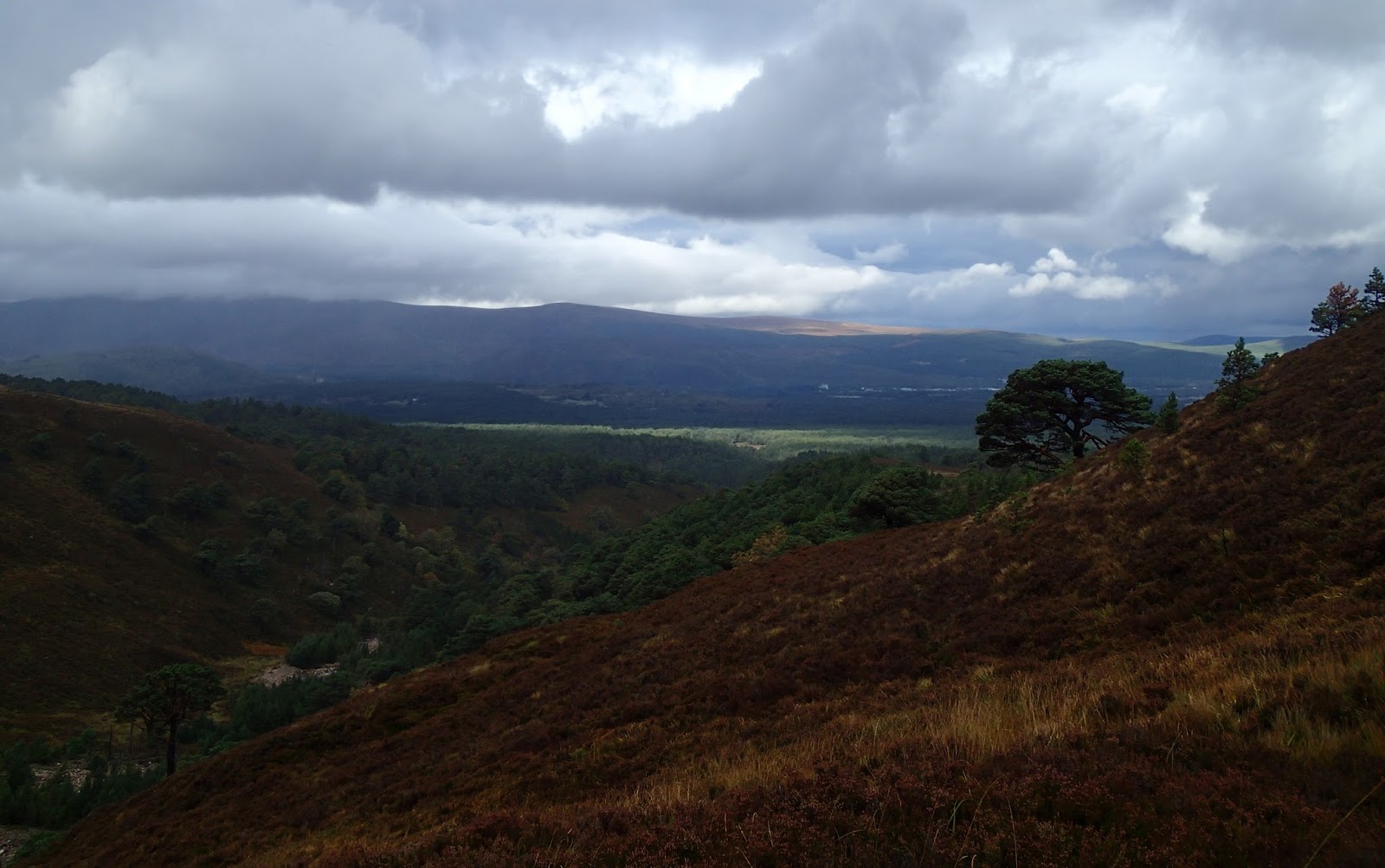
Showing posts with label Speyside. Show all posts

Friday, 14 December 2018

Old friends above the valley of the deer

This is the first of two "catch-up" posts from the end of October.  A bright and breezy day looked good for a hillwalk, and looking at the map I realised that it had been a while since I'd been over the hill to Speyside. I decided to climb Corryhabbie Hill, but not via the usual route.


My route from Donside to Speyside climbs up through high farmland and across the Cabrach, an area of moorland studded with mostly abandoned buildings.  It wasn't always so and there's a good history of the Cabrach on "Lenathehyena's" blog.  The play of light was marvellous on this October morning, rainbows appearing and disappearing as showers passed through.


I started my walk at Bridgehaugh where there's space to park a couple of cars clear of the estate road and entrance.  A steep slope covered with bracken was virtually glowing against a blue sky.


A look at the map in the link above will show that the track leading southwest from Bridgehaugh goes upstream alongside a river which is by no means large, but has a name known throughout the world.  This is the River Fiddich, and this view looks along part of Glen Fiddich.  Downstream the river runs through Speyside's "whisky capital", the village of Dufftown.  Along the banks of the river are some of the best known of Scotland's distilleries; Mortlach, Balvenie and, of course, Glenfiddich among them. Nowhere else in Scotland (or indeed the world) has a higher concentration of distilleries than this corner of Speyside.


I walked alongside the river past the now delapidated Glenfiddich Lodge, a former shooting lodge, and took a track climbing above a bend in the river up into a landscape of rounded hills covered in wind-clipped heather.  the track made for fast walking and I was soon swinging around between two hills and beginning the climb to the broad ridge which forms Corryhabbie Hill's summit.


From the higher ground the views open up to be really expansive.  To the north west, the most distinctive hill in the area, Ben Rinnes, is prominent.  It's a hill which has given some great days.  The "normal" route to climb Corryhabbie Hill from Glen Rinnes comes up the track in this image - my route would only coincide with that one on the summit ridge itself.


To the north, the slopes of the wonderfully named Thunderslap Hill fall to the Dullan water, and rising beyond is the Dufftown "double" of Meikle and Little Conval.  Looking to familiar hills - old friends-  is one of the small joys of hillwalking, and the more hills one climbs, the more joy there is to be had!


On the upper ridge of Corryhabbie Hill I was exposed to a biting north wind - to the north there's no higher ground between these hills and the north pole....and today it felt like it.  I stopped to put on another layer, gloves and a hat. 

Crouching down to sort out my kit I noticed the stunning colour on tufts of Deer Grass (Trichophorum cespitosum).  The name is misleading, it's neither a grass (actually a member of the sedge family) or particularly favoured by grazing deer.  The name derives from the wonderful shade of the plant in autumn, reminiscent of the coats of Red Deer.  There was a theme here too, because "Glenfiddich" is valley of the deer in Gaelic. 

Wrapped up against the chill of the wind, I walked on along the ridge.

Monday, 1 October 2018

Roll out the barrel (s)


On a recent visit to Speyside we called by a cooperage serving the many whisky distilleries in the area.  There were some nice images to photograph, whether quite plain.......


...or full of vibrant colour.  It's possible, with a little knowledge, to guess the origin of some of these barrels - Glen Grant, Glenlivet, The Macallan and many more from Speyside, as well as examples from far and wide such as Islay's Laphroaig.


I liked this image with the end of a huge stack of barrels lit by sunshine with the backdrop of a storm-black rain cloud.


There are so may barrels here and in other cooperages they seem almost uncountable - and these are just the ones not in curent use; there will be many times more maturing in bonded warehouses throughout Scotland.  This seemingly endless supply is a good thing.....


.......or for enjoying the products of the barrels.  Looks like we'll not be running out of the raw materials any time soon!

Thursday, 27 September 2018

Knockando colours

Autumn in Scotland can be a riot of colour, and Speyside is one of the best places to experience the change from summer's green to autumn gold.


We visited the Knockando Woolmill last weekend on a bright and sunny afternoon when the colours were fairly "zinging".  There's been a mill here since 1784;  the present buildings have been renovated and the mill is now manufacturing fine designer tweeds and wool using machinery from the 1870's.


Water power is still utilised via a restored wheel fed by water piped from the nearby stream, though the waterwheel was originally augmented by a paraffin engine and now by electric power.


The restoration of the site has been sympathetic and has recreated a piece of industrial history along with a restored wool dealers shop and workers cottage.  There's a small tearoom and a stylish shop as well as a small interpretative display with a film.  Knockando Woolmill isn't a swish "visitor experience" or sterile museum; it's a working, living business and all the better for that.  Off the beaten track (again, a good thing I think) it's well worth seeking out, but check opening times as the visitor facilities shut for much of the winter.


In the surrounding trees, autumn's glory is beginning; Sycamores glowing in rich shades of plum and amber.


Some of these colours are actually reflected in the tweeds the mill produces, a true representation of place


Above us, green and gold against a stunningly blue sky - truly autumn can be the most dazzling of seasons.

Sunday, 22 October 2017

Cairngorm contrast - the relentless foe


Afte two days of really lovely October conditions the weather broke.  I was staying at Rothiemurchus Lodge and through the night the whole building was shaken by violent gusts of wind - my thoughts were with the Duke of Edinburgh's teams over on Deeside but actually they had quite calm conditions low down in Glen Derry.

I set out into heavy rain and scudding cloud.  What this image can't show is the violence of the wind; tearing gusts which blew sheets of rainwater from the ground and roared through the trees.


Climbing high above the woods of Rothiemurchus, a glimpse on sunlight on the far side of the Spey valley would be the last for some hours.


Ahead, the weather looked particularly challenging as cloud and rain belched out of the jaws of the Lairig Ghru.  The rain now set in with real venom and the wind, dead against me, slowed progress right down.


At some points I simply had to turn my back to the wind and rain as it became too painful to face into the combination of 60mph wind, lashing rain and gravel blown from the path.  The Lairig Ghru is one of the great through-routes of the Cairngorms, and indeed of Scotland.  A huge former glacial breach linking Deeside with Speyside, it slices through the Cairngorm plateau reaching 835m at its highest point.  Today it was perfectly orentied with the wind, which was roaring through, almost stopping progress at times.

In normal circumstances I'd have avoided heading up into such weather, but I intended to meet the D of E teams as they came through the other way.  They would have this weather at their backs but would still find it more challenging than previous experiences in the hills.


Hunkered down at the Pools of Dee, a few small lochans near the high point of the pass, I watched the clouds racing past.  The main plateau lies some 400 metres above the Lairig and I could only imagine the power of the wind up there as it raced unchecked over the dome of the Cairngorms in the first real "blow" of the autumn.

In these conditions, and particularly in winter, the wind is a relentless foe.  I've had some of my hardest fights not too far from this spot, the wind sapping energy, strength and willpower - a fundamental and fierce experience.  There's a wild pleasure in being able to operate on the hills in such conditions though - a feeling almost impossible to explain to someone who doesn't walk or climb in the mountains.


Briefly poking my head up occasionally to scan for folk coming through, I settled down for what might be a long wait.


But remarkably, both teams were keeping good time and going well - impressed but not overawed by the conditions.  It was a relief to put my back to the wind as I headed after them - progress suddenly seemed so much easier and now th trick was not getting blown over.


And then, one of those moments.......the rain ceased and the cloud tore apart as if a curtain had been pulled; we walked into bright sunshine and clear air.  The wind stayed at the same severe gale force, but what a difference!


Looking back up into the Lairig, the cloud was now racing across the pass rather than straight down.  The shif of wind as a front passed had totally altered the conditions in the space of a few moments - a real Cairngorm contrast.

Wednesday, 16 November 2016

Inveravon church and Pictish stones


Off the busy A95 road along Speyside, a small sign points the way to Inveravon Church and Pictish stones  Tucked out of sight well below the present line of the road and above the River Spey itself, the church is in a peaceful spot.  The name "Inveravon" (mouth of the Avon) hints at the proximity of the confluence of two of Scotland's best known rivers, the Avon and the Spey.  The present church is the latest in a series of buildings on the site, which was closer to the old course of the Spey and so on a more prominent spot.  There was possibly a chapel here built by St Drostan in the seventh century, at the height of Pictish power.

The first church proper was built in 1108 and probably incorporated some nearby Pictish stones into its fabric.  A new church with a turf roof was built in 1568, which was re-roofed with slate in 1633.  In 1806 the present church was built in a simple but elegant style and at least one Pictish stone was discovered.


The interior of the church continues the theme of elegant simplicity with a light and airy atmosphere and remains in use as a place of worship.  Early Christian churches were often built on sites of pagan or communal significance and Inveravon seems to have been one of them. 


The kirkyard contains grave markers of great age and a mausoleum for the Grants of Ballindalloch, the local lairds but interesting as these are, the greater interest is to be found in the porch of the church.  Pictish symbol stones found at the site were placed against the wall of the church but have now been protected in the porch, beautifully lit to show them to their best.


There are four impressive carved stones, numbered according to their sequence of discovery.  Inveravon 1 is a slab of blue slate 1.7 metres by 0.9 metres bearing a large but (by Pictish standards) crude carving of an eagle.  Above the eagle is a shape interpreted as a mirror case, and below the eagle and now faintly discernable are a mirror and comb - two of the recurring items found on Pictish stones.


Inveravon 3 is, at first glance, the least interesting, but it is just a fragment of the original as the stone was broken to form building material for the church.  Carved onto the stone is the head portion of a fantastic beast, again a common Pictish symbol and variously interpreted as a dolphin, an elephant or simply a mythological beast.


Inveravon 4 was discovered buried near the church in 1964 and is heavily weathered.  Standing a metre tall and half a metre across, the stone is carved with the same beast motif as Inveravon 3, together with other "standard" Pictish symbols, the crescent and V-Rod.


Perhaps the most impressive of the stones is Inveravon 2 which was unearthed in the 19th century. The carving remains sharp, suggesting it was incorporated into the building of one of the earlier churches.  An array of typical symbols can be made out, the triple-disc, mirror and comb, plus the crescent and V-Rod.

It's remarkable that a people who dominated the north and east of Scotland for many centuries left so little which we can interpret with any certainty.  For me, the fact that we can't understand what these beautiful and impressive stones mean - or what they signified to the Picts - makes them even more special.

In a previous post I wrote that I hoped to explore more Pictish sites, and this is one of the better ones - if you're travelling along Speyside, a turn off the A95 and into the past is heartily recommended.

Friday, 4 December 2015

The tradition, art and magic of a malt whisky


Our guide for the distillery tour was Andrew, who was very knowledgeable and informative - we've been on tours of other distilleries but this was by far the best. What's more we were the only visitors and it felt very much like a personal VIP visit!

As this blog features the occasional enjoyment of a dram, I thought it might be fun to feature some ofthe tradition, art and magic of malt whisky.......

Glen Grant was founded in 1840 when two brothers, James and John Grant, applied for a distilling licence.  They were no newcomers to distilling whisky by all accounts, having been involved in the production and distribution of illicit spirit for some years.  When the tax on whisky was reduced they like others sought licences and turned to legitimate distilling, using the same distribution networks which had served them so well.  Among other achievements, the Grants were involved in bringing steam railways to Speyside which further improved the infrastructure of the area.

By 1872 the founding brothers had died and the distillery was owned by a nephew, James "The Major" Grant.  A real innovator, he introduced new ideas to the distillery (it was the first to have electric light) and introduced the tall slender stills and purifiers which gave Glen Grant whisky the fresh, light character which still defines the house style.

In  1931 "The Major" was succeeded by his grandson Douglas Mackessack who further developed the business.  Notably, he supplied an Italian whisky buyer with 50 cases of Glen Grant to sell in Italy when no other distiller would; the result was that Glen Grant became, and remains, by far the best selling malt whisky in Italy.

During the period from 1972 to 2006 Glen Grant was owned by a variety of big players from the world of whisky distilling and then in turn by multinational drinks companies, reflecting the surge in popularity of Scotch malt whisky.  In 2006 the Italian connection reached a nice conclusion when Glen Grant was acquired by the Campari group.  It remains their only brand of whisky and as such has benefited from a benign ownership with respect for tradition but an eye for the future.

Having immersed ourselves in the history of the brand we moved into the distillery proper to immerse ourselves in the magical sights, sounds and aromas of whisky production.....


The primary ingredients are malted barley and pure water from the stream we'd walked along.  All the barley used for Glen Grant is all sourced from the northeast of Scotland and is first "malted" - partially germinated - in order to release fermentable sugars.  This is done by soaking the barley in water for a few days until it begins to sprout then the sprouting is arrested by drying the grains using heat.

The malted barley is then milled to small size grains called "grist" which are mixed with warm water in a large "mash tun".  The liquid produced is called "wort", the residual grains are either fed to cattle or, in a modern twist, turned over to biomass power generation.


The wort is fed into huge fermentation vessels called "washbacks" and has yeast added to it - starting the fermentation process and the conversion of sugar to alcohol, which takes about 2-4 days.


The washbacks used by Glen Grant are very traditional and are made of Oregon Pine, which they feel is a better material than the stainless steel used at some distilleries.  They are really huge, this image is showing just the very tops; each holds around 90,000 litres of fluid and is two storeys high.


The now alcoholic liquid is called "beer" and is typically around 7% alcohol - the liquid is constantly agitated by revolving blades and the fermentation process is quite energetic, producing a bubbling, heaving froth at the top of the washbacks.  If this part of the process is where the magic of whisky distilling takes places, then the next stage could almost be considered as alchemy .....


In the Still House are four pairs of copper stills consisting of four "wash stills" and four "spirit stills", giving four distillation sets.  The first stage of distillation takes place in the larger wash stills where the fully fermented wash is carefully boiled by passing steam through stainless steel pans within the still.  Alcohol vapours rise to the top of the still and are cooled before the process is repeated in the smaller spirit still (this is the double distillation process).  The alcohol is cooled in condensers on the outside of the Still House wall, cooled by water from the Spey which is diverted then returned to the river.  The residue from this part of the process is collected and used in the production of farm feed.


What sets Glen Grant apart is the addition of a Spirit Purifier between the wash and spirit stills. These were introduced by James "The Major" Grant and allow only the purest vapour to pass from the stills to the condensers, ensuring a light but complex spirit.


The elegant stills at Glen Grant are particularly tall and slender, a shape which gives finer, lighter spirits whereas shorter, fatter stills will produce a fuller and richer spirit. Each is polished and beautifully lacquered as is all the pipework.  The liquid produced from the wash still is known as "low wines", when passed through the purifier and spirit still the resulting condensed spirit is sent across the Still House to spirit "safes" where it arrives in three distinct phases.


Alcohols from the beginning of each distillation are harsh and high in alcoholic percentage, these are technically called "foreshots" but are normally referred to as the "head".  Alcohols from the end of each distillation are weak in alcoholic percentage but pungent, these are technically called "feints" but usually referred to as the "tail".

It is only the alcohol from the middle part of the distillation - known as the "heart" and of about 65-70% alcohol which is skillfully drawn off by the Stillman and collected through the spirit safes.  The head and tail are then combined and passed back to be used with the next distillation run.

So far there's been tradition, magic and a dash of alchemy in the production of the spirit, and what follows takes us into the realms of the mystical........


The spirit is poured into oak casks for storage and maturation. It must be stored in oak, in Scotland for a minimum of three years in order to be legally termed Scotch Whisky.  To be termed a "malt" whisky it must be made only from malted barley and to be termed "single" it must be produced from a single distillery.

The barrels used are of varying sizes and types - Glen Grant use mostly American Oak casks previously used for a fill of Bourbon, and some Spanish oak casks are also used, these having previously held sherry or port and which can add a nuance and character to particular "expressions" from a distillery.  Bourbon aficionados can rest easy that their drink has done its most important job of preparing the casks for a much nobler purpose!

The wood on the inside of the casks is surface charred to enable the whisky to access the character of the oak; it's said that although the water, barley and distillation process all help to determine the nature of the finished whisky, as much as half of the character is determined during the maturation period.  Each cask to be used is individually hand-picked by the Distillery Manager - it's that important.

Whilst maturing the casks allow up to 2% of the whisky to evaporate out through the wood each year, the loss is known as "the Angel's share".  There must be some very well-fuelled Angels around the Speyside area!  The spirit lost through the wood is replaced by air, meaning that the location, temperature and humidity of the warehouse also plays a part in the character of the spirit.  This loss also partially explains why more mature whiskies at 18, 20 or more years old are more expensive to buy; aside from the extra time invested in their production there's simply less whisky in the cask to bottle.  There's also more risk to a distillery with older casks in that there's more which can go wrong over the longer maturation.

The whisky emerges from the wood at "cask strength" alcoholic content which is typically 55-60%.  Some bottlings are made at cask strength but the vast majority of production has water added to take the strength down to the standard 40% alcohol content.

Glen Grant, like most distilleries uses casks three times, so by the time they're sold on they are probably over 60 years old.  We have a particular interest in the casks once they've reached the end of their whisky-making lives.......


...as we buy some staves and barrel ends to make handcrafted items such as candle holders.....


...and practical accessories for the enjoyment of the whisky they once held......... :o)


Ownership by Gruppo Campari has brought investment to Glen Grant in the form of an ultra-modern bottling plant.  The distillery is one of the few to bottle their own whisky on site, and this is the largest bottling plant on Speyside.


Meanwhile, the casks work their magic on the whisky within and they'll lie quietly fuelling the Angels whilst developing fine single malt whisky........


...and we'll all have to exercise patience until it comes out of here and the Excisemen have imposed their tax!


We went from the production area back to the Visitor Centre where we were offered two generous tastings - included along with the tour and entrance to the garden in the £5 per person charge.  Unfortunately I had to drive home, so my tasting was the merest touch on the tongue....

The first was The Major's Reserve, a bottling with no age statement but we were told that it's around 8 years old.  Light, fragrantly fruity and ever so slightly dry - it's a very pleasant dram and a perfect expression of the Glen Grant tradition of light but firm whiskies.

The second tasting was of the 10 year old Glen Grant - and it was a revelation.  Flavours and nose of orchard fruits followed by a smooth intensity with no hint of sharpness and a light body, this is an immensely good whisky and is described by one of the most influential whisky guides as "undoubtedly the best 10 year old official distillery bottling I have tasted"

There are other expressions on sale in the distillery shop at older ages and some really exclusive offerings in limited editions.  Our £5 charge also gave us a £2 discount on a bottle....no prizes for guessing which one we went for!

Glen Grant is a wonderful place to visit - the whole ethos of the place shines through in the pride that's taken, the combination of tradition and innovation and friendliness of the staff we met.  If you take only one distillery tour, make it this one.

So there you have it, tradition, art, magic and a touch of the mystical....Sláinte Mhath!