Showing posts with label winter solstice. Show all posts

Wednesday, 5 January 2022

Short day, short view

Life, work and other things meant that this blog was a little neglected during 2021.  That's not to say that I didn't manage to get out and about though, and there will be some catch-up posts coming in the next few weeks.

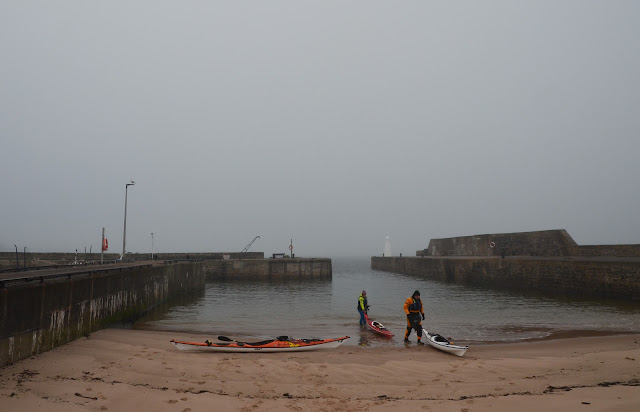
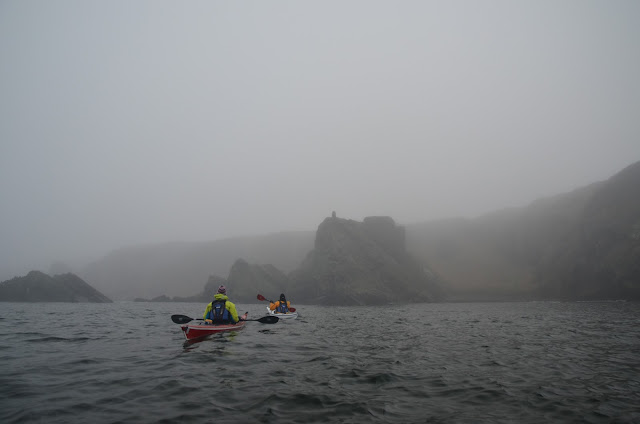
Just a couple of days prior to the winter solstice and there isn't much daylight here in Aberdeenshire, realistically six hours is what we get.  When Allan and Lorna and I left our homes in inland Aberdeenshire we were in bright sunshine with temperatures well below zero Celsius.....just 45 minutes drive north to the Moray Firth coast and things were a lot different; very misty conditions and the temperature a couple of degrees above freezing.  With just a light wind and a low swell we decided to set out from Cullen, paddle east to Sandend and return to Cullen.  It's an area we know very well but we took no chances with the visibility and set up a GPS in case things closed in further.


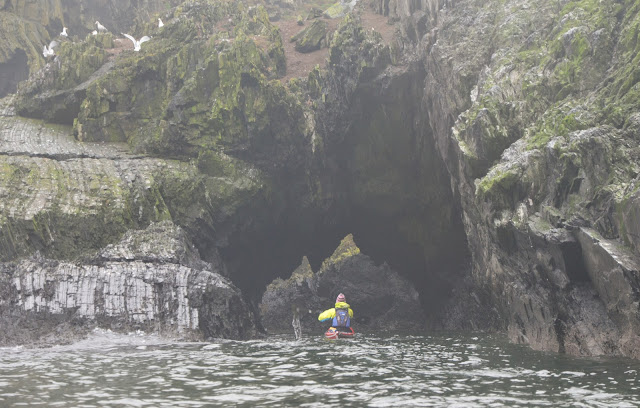
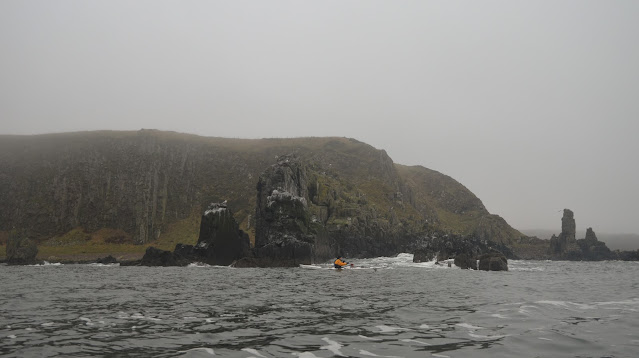
The misty conditions certainly made for an atmospheric journey through the rock stacks which are such a feature of this coast, everything seemed out of scale as towers and rocks loomed out of the mist.  We mentally ticked off known landmarks as we went and had soon warmed up from the chilly start.


The swell was low but long-period and as is typical on this coast had "sets" of two or three much larger swells at regular intervals.  Near to top of the tide this cave-arch doesn't have much headroom, so good timing is a must!


 We took lunch in the tiny harbour at Sandend before heading back around to Cullen.  The mist had started to lift a little and the swell eased to give a leisurely return leg.


An unremarkable paddle of just 13km maybe, but as usual this coast gave plenty of interest, and it was a bonus to be able to get out in our kayaks right on the cusp of the shortest day of the year.

Saturday, 28 December 2019

A short day's sea kayaking


Unusually, the winter solstice fell on 22nd December this year rather than 21st.  The forecast was for a cold and sunny day so Allan and I planned a short paddle on the Moray Firth coast.  We met up at Sandend having driven up on quite icy roads; the temperature was barely above freezing when we got onto the water.  Our relaxed planning for the day extended to not having decided which direction to paddle until we actually got into the boats!  We settled on a round trip west to Cullen, a favourite paddle and one full of interest.


The forecast had been accurate with regards to the weather, and also with regard to the swell, which was over a metre with a 10 second periodicity.  These longer period swells are long distance travellers and they carry enormous power.  The Moray Firth is rarely completely calm, and even with no wind and a deceptively flat sea state the swell deserves respect.  Almost straight away we experienced the energy and noise of surging swell thundering across the jagged rocks near Sandend


We managed to get into some of the wider channels which thread behind stacks and cliffs just west of Sandend, but not comfortably.  It all looks serene in this image but the swell was magnified in these confined spaces.......


...in this narrow gap we estimated a 3 metre rise and fall - and felt disinclined to investigate more closely!


Clear of the channels we were able to enjoy the kayaking with bright sunshine on our backs; welcome if not bringing much warmth.


At Sunnyside beach the breakers were "smoking" as they rolled onto the shore.  This beach looks to be an idyllic place to take a break but landings here are rarely straightforward.  There are reefs and boulders studding the gently shelving approach and the surf has a tendency to break quite late.  Even on the calmest of summer days this beach can spring a surprise!


It took us a little less than two hours to make our way around to Cullen where we pulled in to the harbour to take luncheon.  The iconic railway viaduct is a feature of the town but no longer carries a railway.


The outer harbour has a small sandy beach which is an ideal stop.  Benches on the harbour wall face the afternoon sun and there are public toilets close by.  Another very attractive feature of this harbour is the proximity of an excellent fish and chip shop!  We'd brought our own lunches on this day - featuring mince pies of course, given the proximity to Christmas.  After a leisurely lunch it was time to head back to Sandend.  An advantage of doing a winter trip heading west first then east is that we wouldn't have the sun in our eyes for much of the trip - with one significant exception.


Heading back along the eastern side of Cullen Bay we were treated to a nice view of a group of Long Tailed Ducks (Clnagula hylemalis).  these sea ducks appear in small numbers to winter on the coasts of eastern Scotland and north east England and always seem to be very elegant.


Although we saw no other leisure boaters during our short trip, we weren't the only ones out on the water.  This creeler was working a line of creels close inshore near the Logie Head which is near to the boundary between Morayshire and Aberdeenshire.


We enjoyed a steady paddle back to Sandend, arriving at mid afternoon.  This tiny harbour is really difficult to locate in mid-winter when it's a sunny day - the sun streams directly into one's eyes and makes for locating the correct line of approach surprisingly hard work.  We landed in deep shade with the temperature still hovering around freezing, so we wasted no time in unpacking our boats and loading them onto the cars before heading around the corner into bright sunshine for a warming cup of tea above the beach.


The swell hadn't diminished at all and was being enjoyed by numerous surfers, like us they were getting the best of this winter solstice.  Short it may have been, but we'd enjoyed our paddle on this shortest of days.  From now until mid June 2020 the light will increase day on day - now there's something to celebrate!

Sunday, 23 December 2018

A winter solstice celebration


On the winter solstice, 21st December 2018, we visited Cothiemuir Hill stone circle which is near to our home.  Arriving  before sunrise, we experienced the light gradually seeping in around the stones on this, the shortest day of the year.

Aberdeenshire is very rich in neolithic monuments and has close to a hundred of a type of stone circle found almost nowhere else, the recumbent circle.  Aligned on the midwinter moon, and in particular the major "standstill" midwinter moon which occurs every 18.6 years, the builders aligned the circles to an astonishing level of precision.  Some circles have cup marks incised to mark major lunar events and show where the moon would appear when viewed from the centre of the circle.

Cothiemuir Hill is a great example of a recumbent circle and is almost complete.  The huge recumbent is a 4.2m long basalt monolith, and was brought to the site.  The flankers either side are 2.9m and 2.7m tall - this is an imposing circle. the west flanker (the right hand in this image) is aligned very precisely on the major southern moonset.  I've written about this circle several times before, here and here, and I'm still fascinated by the place.

We try to visit at the winter solstice, not from any pagan leanings but merely from a feeling that this is their time, the point in the year when the circle had most significance to its builders.  Now within a wood, it would have been a prominent viewpoint when in use.


We headed home after visiting the circle to do the jobs which seem to take so much time as Christmas approaches.  The shortest day turned out fine, cold and dry with bright, low winter sun.


Towards sunset (3.25pm at the solstice!) I decided to go back to the circle and see if I could view the sunset from the circle.  It was a very atmospheric afternoon, a smoky sunset and a hard frost setting in.


Walking up to the stones I was delighted to see that a wedding was in progress - timed, it seemed, for the sunset.  No pagan or "New Age" ceremony, this was a straightforward humanist celebration.  I often leave some greenery at the stones at this time of year, and I'm not alone in doing that, but here was a continuity of use for the circle stretching back millenia.  Having waited until the couple were married, I added my congratulations and left quite moved at this simple ceremony in a wood.


Back at home, the solstice full moon was rising over Bennachie, a huge disc growing brighter and colder as it climbed over the Aberdeenshire farmlands.  This is what the circles were built to observe.  Maybe not as striking as the solstice full moon of 2010, it's nevertheless a significant turning point in the year.


The morning of the 22nd was forecast to be fine, with perhaps a little cloud.  I thought it would be good to get out early and see if I could watch the sun rise from Millstone Hill.  Heading out well before dawn, my headtorch picking out the hard glitter of a deep frost, I was near the summit of the hill as the light was beginning to grow.  Below, the valley of the River Don was a cold, frosty place.


To the south east and across the city of Aberdeen, I watched the sunrise over the North Sea.  At first a crimson line, the colour intensified to a searing orange before fading as the sun was obscured by a cloudbank.  There was a warmth to the light, but certainly not in the air - it was very chilly as I sat waiting with a flask of tea. 


Although the sun itself remained obscured, the light crept up and gave a nice view over to  Bennachie's Mither Tap, site of a hillfort.

Despite the short days I felt that I'd experienced the best of the winter solstice - from the continuity of the stones to the first sunrise of lengthening days - something to celebrate indeed!
Thursday, 21 December 2017

Turning point at the solstice stones


The north east of Scotland is rich in neolithic monuments, and in particular there are many hundreds of stone circles and standing stones.  One particular type of circle, the recumbent circle is found only here in Aberdeenshire (nearly 100 examples) and some in the south west of Ireland. 

One of the nearest circles to home is also one of the more complete examples, at Cothiemuir Hill.  I've written about this circle previously here and here, and I continue to find the place absolutely compelling.  Now within a wood, the circle is on a low hill and would have had good open views during its period of use around 2700-2500 BC.


The 2.9 metre tall west flanker is aligned precisely to the midwinter moon when viewed from the centre of the circle.  This is the orientation of almost all the recumbent circles, so it's no coincidence. Even more remarkably, the alignment is designed to frame the standstill moon which occurs every 18.6 years....how did the neolithic people calculate this?!  The movement of the setting sun seems also to have played a part in the alignment, and I've tried to recreate this by taking an image offset from the centre of the circle a few days before the winter solstice.

It really isn't difficult to imagine the people who built this sophisticated and massive undertaking marking out the days shortening, recording the apparent two day standstill at the solstice, and then the slow lengthening of the days as the year is reborn.  Nor is it hard to empathise with why this mattered to them so much.

We try to visit as close to the winter solstice as we can, not from any new-age belief, just from a simple, instinctive feeling that this is their time in the year.

Sunday, 21 December 2014

Continuity - winter solstice at Cothiemuir Wood


At the winter solstice we visited the recumbent stone circle at Cothiemuir Wood, a short distance from home.  Set on a low hill and now surrounded by woodland the circle would have been a prominent monument when constructed - construction has been dated to about 2700-2500 BC. 


 The mild weather this midwinter solstice is quite different from  some previous visits,  this year the shortest day has been overcast and damp, the daylight struggling to impose itself, and by mid afternoon it was already dusk. In the low light, the circle  with its 20 tonne recumbent and its flanking stones aligned precisely to the midwinter moon seemed especially striking and atmospheric.  It exudes permanence and continuity and has marked so many solstices.  We noticed a splash of colour in the angle of the west flanker and the recumbent......


...which on closer inspection was a small spray of greenery and holly, carefully tied and placed.  A simple gesture marking the turn of the year and showing a small but continued use for the stones.


Wednesday, 22 December 2010

Solstice stones

The north east of Scotland is rich in Neolithic and Bronze Age megalithic monuments.  There are many hundreds of standing stones and stone circles, including around forty of a type found only in this corner of Scotland and known as recumbent stone circles.

The Winter solstice seemed an appropriate time to visit one of the circles just a few kilometres from home, Cothiemuir Hill.


This circle is approximately 75 metres in diameter and remains almost complete.  Now hidden in a wood on a low hill, it would originally have been a prominent monument with an open outlook.  The circle stones (orthostats) are of granite, mostly red but occasionally grey.


The defining feature of a recumbent stone circle is the great recumbent itself, flanked by two pillars (the flankers).  The recumbent and flankers are always at the south of the circles, and almost always at the south-southwest.  Where both flankers survive, one is always slender, the other stout - and they are of different heights.  The flankers are usually angled into the recumbent to emphasise the circle. Often the orthostats are graded in height toward the flankers. 

Viewed from the centre of the circle at Cothiemuir Hill, the west flanker (the taller of the two) is aligned exactly to the midwinter sunset.


The flankers are 2.9 and 2.7 metres high, and the great recumbent is a 4.2 metre long slab of dark basalt weighing 20 tons.  This stone has been brought to the circle; the work must have been an immense undertaking for a community before wheel and animal power was in use.  Radiocarbon dating for this circle places its construction at around 2700-2500 BC, contemporary with most other recumbent circles.

At the centre of the circle is a large slab with a pit underneath it.  There is also evidence of a paved area leading from the centre to the recumbent.  There was probably a timber circle here before the stones - evidence seems to be emerging that the stones are the closing moment in a long period of use.


It's clear that these circles were places of great importance to the folk who raised them, and beyond.  Most were in use for well over a thousand years after construction for burials and ceremonies- indeed to this day there are sometimes small tokens left at circles, flowers, ash and the like.

It's almost certain that one of the functions of the circles was to mark out the important lunar events of the year - particularly the midwinter solstice.  In this present spell of unbroken intense frost, it isn't hard to empathise with those who looked to the stones to mark the returning of the light and the retreat of the bitter, dark winter.

A visit at this time of year seemed significant, the stones seem to fit their place, to exude permanence and a faint resonance of the meaning they were raised to convey.  And strange, though I've visited many of the circles, I've never once touched any of the stones - I don't know why, other than superstition; which is perhaps part of their power to this day!

Tuesday, 21 December 2010

"And the moon shall be as blood" - the winter solstice lunar eclipse

A rare and beautiful natural phenomenon occurred this morning, a total lunar eclipse.  This was to be the first lunar eclipse visible from the UK for 3 years, and the first to coincide with the winter solstice for 372 years, last occurring on the morning of 21 December 1638.


There was a noticeable reddening of the moon at 0532 UTC as it began to enter the earth's shadow.  The air temperature was minus 15 celsius and the sky absolutely clear.  During this eclipse the further north, the better the view as the moon would be higher above the horizon.


                     After 0632 UTC the shadow became much more defined as the eclipse approached totality.


  As the moon moved toward the horizon atmospheric refraction made it look larger, the eclipse even more stunning.


Totality at 0740 UTC.  Photographs just can't do justice to the beauty of this scene, the snow covered landscape a perfect setting for the red moon. 

The north east of Scotland is studded with many hundreds of standing stones and stone circles, and many of these are aligned to the winter solstice sunset.  What would the folk who built the circles have made of this?  At one of the most significant days of their year, would this have been seen as a good omen or a bad one? 

I felt priveliged to be able to touch perhaps an inkling of what was of importance to those folk, and to have such a good view of this beautiful event.


Behind me, the sun was rising on the shortest day of the year.  In another unusual alignment, both moon and sun were above the horizon at the eclipse, the phemonenon of selenehelion.