Showing posts with label rock formations. Show all posts

Tuesday, 15 October 2019

Summer sojourn on the Moray Firth - sealed with a kiss

Almost as soon as we'd paddled through the tall cave-arch from among the red towers we were joined by another young Grey Seal (Halichoerus grypus). 


Just as curious and confiding as the one we'd encountered earlier in the day, it swam repeatedly around and behind us before approaching each of our kayaks in turn to investigate us more closely.  As it padded under the bow of my boat there was the faintest kiss from its muzzle and flipper - perhaps trying to figure out what the boat felt like.


The youngster followed us for a couple of kilometres, never far from us but never so close as to cause alarm to either it or us.  Adult Atlantic Grey Seals are Europe's largest native carnivore; bulls can weigh in at up to 300Kg and reach around 3 metres in length - they are animals to respect.  This little seal - we weren't able to tell whether it was male or female, but suspect male - was less than half that, but still a wild animal and the fact that  it chose to accompany us made for a special encounter.


When we stopped, so did it.  Completely relaxed in our company, it seemed to relish the encounter as much as we did.  Whilst I don't lke to anthropomorphise animal behaviour, it really seemed like this young seal which was on its own was enjoying the company.


"Who, me?"


As we approached Pennan harbour the seal pulled up alongside us, then turned and headed back along the cliffs.  It's possible that it was wary of going too near the harbour due to the level of motorised boat traffic, or perhaps it had reached the end of its patch, or just had had enough of accompanying us. We encounter seals almost every time we paddle on the sea, and try as we might we sometimes take sightings a bit for granted.  But when an encounter with a wild animal is so intimate, and especially when initiated by the animal - it's a special experience.


The pretty village of Pennan was our destination for this paddle.  A line of cottages strung along the shore beneath a low cliff, it's one of the most picturesque of Aberdeenshire's many fishing villages.  A claim to fame for the village is in it's role as a setting for the 1983 film "Local Hero".


A development since we last visited is the Coastal Cuppie, a tea shop with a bit of a difference.  Housed in a converted wooden shed, its a bright spot in the harbour.  It looked open, but the sign said "Kettle on the boil, scones in the oven", while another said "open at 1250".  We had a half hour to wait and so took a stroll along the village and back, where the scones were just arriving in a little pull-along cart.  We can report that both coffee and scones were wonderful!


By the time we headed back along towards New Aberdour on our return leg the tide had dropped considerably.  The tall arch we'd paddled through was completely dry and we landed to walk through.  We recommend paddling this section of coast as near to high water as possible, and to save it for very calm conditions in order to get the best of it and to paddle all the caves, stacks and arches.  I've been here in a moderate onshore swell and been unable to get anywhere near the rocks.


Nearby, a cave right through a stack was revealed which would usually be submerged.  I took a look and found the rocks to be very slippery, but the effort was worth it......


.....because inside, several rock pools were lined with what seemed to be coral of a vibrant pink shade.


The final day of our three day's route on the Moray Firth had been different to the preceding two days of a continuous linear route, but had, once again, given so much.  These three days were almost the last of the settled summer conditions - late August and most of September were mostly unsettled, so we counted ourselves doubly lucky!

Friday, 11 October 2019

Summer sojourn on the Moray Firth - among the red towers


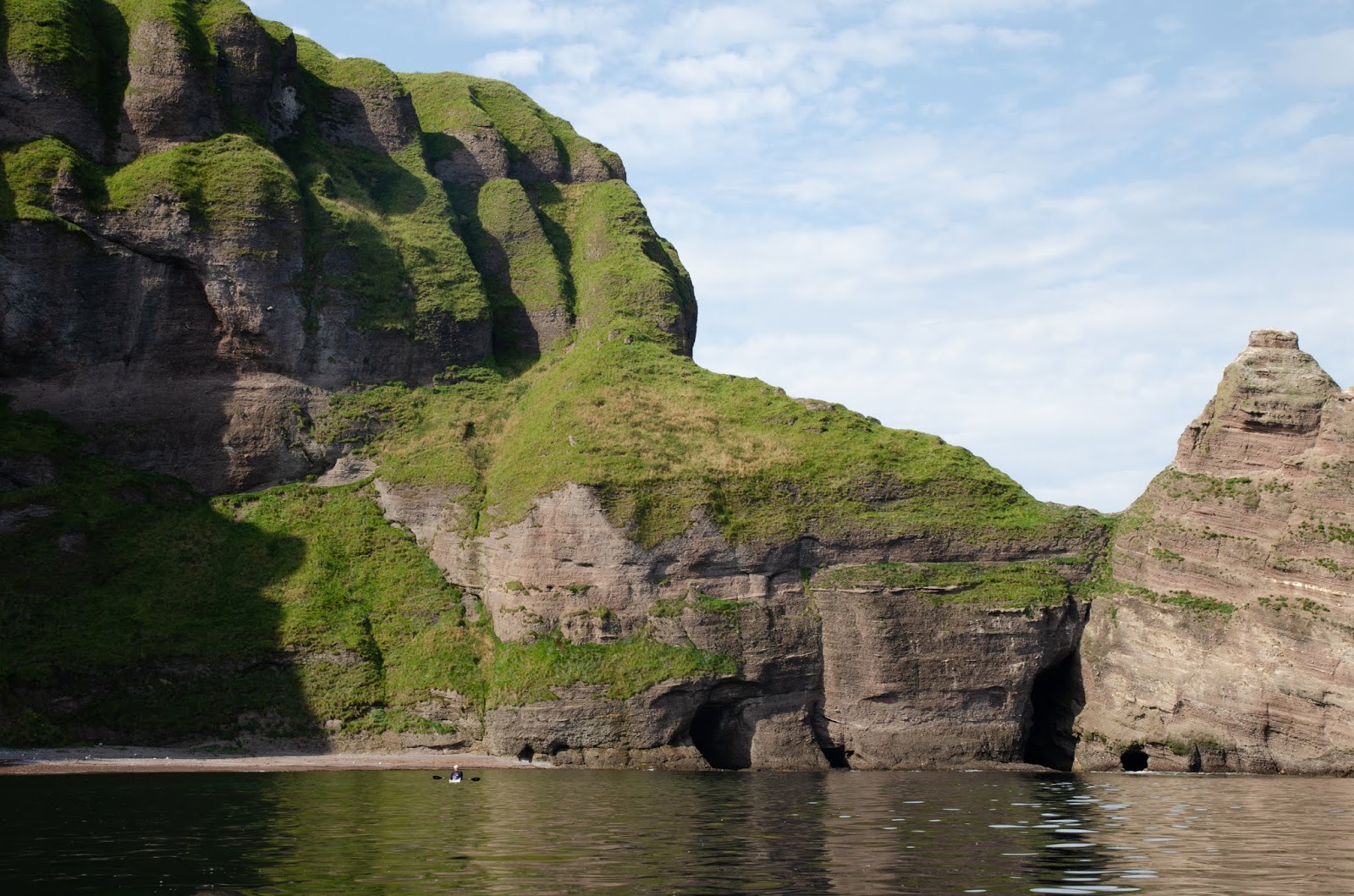
The conglomerate rock arch we passed through is a portal to a very special stretch of coastline.  A wall of red rock capped with verdant green and carved into spires, battlements and stacks, it's like nowhere else on the Moray Firth.  This area between Strahangles Point and Pennan Head never fails to amaze.


The scale only becomes apparent as you paddle close inshore.  These cliffs are over 120m/400ft high and fall sheer to a glacis of the most brilliant green grass overlaying fallen pieces of the cliffs.


There are gaps between stacks of fantastical shape, haunted by seabirds.  Each time we've paddled here we've felt ourselves to be in a privileged place......


....in a landscape that could have been taken straight from a Tolkien book.


On a day of windless calm with the sea a mirror of the cliffs, we paddled into the shade of the north facing cliffs in silence, lost in our own appreciation of this place of soaring red towers.


Our kayaks were dwarfed by the scale of the rock architecture.  Sure, there are bigger cliffs and higher stacks but few places I've paddled have quite the same atmosphere as this double cirque of stone.


We'd entered the place through one arch, and we would leave by another arch, a long cave-arch passable above half tide and in calm conditions.  The entrance is guarded by submerged rocks and needs care. 


The arch leads out to a line of cliffs which anywhere else wold be a highlight of a paddling route.  Here; thoughts almost immediately turn to paddling back through the red towers.

Thursday, 10 October 2019

Summer sojourn on the Moray Firth - underneath the arches

The third day of our trip on the Moray Firth dawned bright and sunny again. Raymond had hillwalking plans for this day and so it would be Allan, Lorna and I paddling. We'd discussed various route options for the day over dinner the previous evening - perhaps setting out again from Whitehills to make a continuous journey, or heading farther east to Aberdeenshire's North Sea coast.  It didn't take much debate before we decided on a trip which would take in some of the best rock architecture on this coast.


It takes longer than you'd think to drive the 30-odd miles from Sandend to Pennan, then take a twisting, hilly road to the pebble beach below the village of New Aberdour.  It's notobvious on this image but this beach is quite steep-to and often has dumping surf which makes launching and landing tricky.  If this is the case, a burn running into the sea is a good guide to some rock channels which can break up some of the swell.  No swell problems on this morning though!  A bit of a cloud sheet had drawn overhead, but it was still warm and there was clear blue sky to the west indicating sunnier conditions on the way


Rather than run a lengthy shuttle which would have been awkward with three kayaks and two vehicles we'd decided to paddle west from New Aberdour to the village of Pennan and return by the same route, perhaps visiting Troup Head if there was time.  Doing an out-and-back isn't always the best option, but given the scenery we knew was on this stretch, paddling it twice would be just perfect.  The rock architecture starts almost straight away, a square-cut arch forming a bridge leading out from a small headland.


This arch is bigger than it appears - we wondered how many people might have casually strolled out to the headland without knowing that this was beneath their feet!


Having passed through the first arch, there's immediately another one, taller and narrower. This would be great paddling in itself, but is just the warm-up for what follows.


Crossing a small rock bay, we headed through a couple of channels between different types of rock - this coast has some really complex geology which is in part the reason it's so interesting.


Ahead of us was the impressive Strahangles Point.  Much less well known than Troup Head farther to the west, it's actually higher than Troup - if not as massive.  The cave-arch at the base of the point goes through one of the spurs of the point, and can be very tricky in less benign conditions.


Having paddled through the cave into the shaded geo beyond, I landed on a pebble beach to see if there were any interesting pieces among the driftwood.  I was surprised to see a young Grey Seal pull up into the shallows right beside me.  It showed no fear, just curiosity and seemed to want to know exactly what I was up to.


When I walked up the beach at the back of the geo, the young seal swam back to investigate Lorna's boat a little closer, following her every move.  The water in the geo was shallow and we could see the seal twisting underneath the kayak.  Although not behaving at all nervously it could have panicked at any time - not really a good thing in this confined place.  Lorna moved out into more open water and the seal followed, allowing me to launch without spooking it.  A lovely close encounter, and it wouldn't be our last of the day.


Beyond Strahangles Point there's another change in the geology to a conglomerate rock with flood-washed pebbles in a red matrix.  Quite a soft rock type, it erodes to form some great features; this narrow arch is the gateway to a place of wonders.....

Wednesday, 2 October 2019

Summer sojourn on the Moray Firth - Findochty to Sandend

In the last week of August a spell of warm and potentially settled weather was forecast. High pressure dominated the weather across the British Isles but there was some doubt as to where the centre would be - and that could mean windy conditions would encroach from the west. Allan, Lorna and I were keen for a multi-day sea kayak trip somewhere and discussed several different locations. In the end we decided that hte best chance of good weather over a period of three or four days was actually quite close to home on the Moray Firth. Wild camping is possible on this coast but it would mean a long linear trip; we opted to use a fixed base at a camp site in a central position.

Our friend Douglas was due to join us but couldn't make it due to an unavoidable engagement but we were delighted that Raymond could join us for two of the three days paddling.


We met up in Findochty on a very warm morning, there was almost no wind and not a cloud in the sky.  Even though the Moray Firth coast gets some of the best weather in Scotland, you never take days like these as a given!  We ran a shuttle ahead to Sandend where we would camp so that we'd just have day kit in the boats and were soon ready to set out.


We left the harbour and turned east.  The coast immediately becomes engaging, the rock architecture dramatic.  The seabirds which nest in their multitudes all along this stretch had mostly completed their breeding cycles, just a few pairs had well-grown chicks still in the nest.....the evidence of their summer occupation was plain to see on the guano-stained rock though.


Looking back to Findochty the most prominent building is the Church of Scotland church, a white painted building on an elevated site overlooking the harbour.  Completed in 1863, it served Findochty when the town was a thriving and busy fishing port.  Until a bell was installed in 1877 worshippers were called to kirk by a foghorn! 

The church would have been a landmark for the fishing fleet, at that time mostly rowed vessels and a magnet for fishermen on Sundays when all the boats would be in port.  We were approaching one of our favourite places - a landmark in its own right and a magnet for any sea kayaker or photographer visiting this area...


The graceful arch of the Bow Fiddle is a highlight of any trip here, and we always paddle it if conditions allow.  As for many folk, Raymond's reaction on turning a corner to look straight through was one of amazement.  As he'd not paddled it previously we hung back to allow him to experience passing under the graceful blade of rock above a smooth slab - it's a fantastic place to be in a kayak!


We all followed Raymond in "stringing the bow" out into open water.  The Bow Fiddle is so named due to its resemblance to the tip of the bow used to play a fiddle.  Nearby is another special place with an evocative name - the "Whale's Mou" (mouth), a huge sea cave with a natural window in one side and a narrow exit at the landward side.  Naturally, we explored that too!


We continued across Cullen Bay in conditions which had now gone from warm to hot, landed for a leg-stretch east of Cullen and then continued around to the Logie Head, a fissured prow of pale grey rock popular with climbers.  The Logie Head marks a change in rock type from the reddish Cullen Quartzite (which is metamorphised sandstone) to Greywacke.  Nearby is another change, the boundary between Morayshire to the west and Aberdeenshire to the east.


East again we landed for a coffee at the beautiful Sunnyside Beach.  Today it was very benign but landing here can be surprisingly difficult.  t higher states of tide the sandy curve of the beach looks very inviting but there are sharp reefs to negotiate, like the one in the foreground in this image, and the surf picks up alarmingly close to the shore.  No such problems today, we landed easily and joined other beach-goers on what was one of the best afternoons of the whole summer.


One of the great features of this part of the Aberdeenshire coast is Findlater Castle which today was lit superbly by the high afternoon sun.  You have to admire the vision of the person who said "I kow, we'll build it right there"!


Just beyond Findlater we met a group of paddle-boarders on a trip out from Sandend.  A cave-arch here is a hidden feature with superb lighting in sunny conditions, the water crystal clear and lit turquoise.


We were now on the last section of our day's paddle.  We think that the section of coast from Findochty to Sandend is the equal of anything in Scotland for variety and features (but we're a bit biased as it's pretty local for us!).  There were still some highlights left to enjoy though....starting with a turn in to a narrow geo.  There are several similar entrances, but once you know the correct way in......


....you enter a series of narrow channels behind masses of rock.  This is paddling right amongst and behind cliffs; one channel is barely shoulder width and is pasable only in perfct conditions.  Most of the others like this one will "go" in most conditions.  It's a great finale to a great stretch of coast for sea kayaking.


All too soon we landed in the tiny harbour at Sandend.  The camp site we'd be using is actually right behind to bech here, but first we drove back to Findochty to recover two cars left there.  The temperature at 5pm was 28 degrees Celsius, one of the warmest days of the year.  Summer sea kayaking doesn't get much better!

Saturday, 29 December 2018

An "ordinary" day to end the year?


The 28th December brought a calm day to the Moray Firth, perfect for a last paddle of 2018.  Arriving at the tiny harbour at Sandend, I set out on my "usual" paddle, west around to Cullen.  An ordinary sort of paddle to end the year I thought.


Straight away it was apparent that whilst the wind was light and the sea calm, it wasn't at all flat......


In fact there was a long-period groundswell from the north running at about a metre and around 11 seconds.  Huge and powerful, mountains of water were roaring against the cliffs and rocks, giving lots of noise and excitement.  There were channels and gaps which I'd usually paddle which were strictly out of bounds on this day as swell surged through.


Low winter sun over a calm sea, fantastic wildlife (over 20 species of birds plus seals today), rocky channels, sandy beaches, picturesque harbours, caves, arches and a ruined castle - an ordinary paddle?  How could any day on this superb piece of coast be "ordinary"?!


Luncheon was taken in the shelter of Cullen harbour, mine were the only footprints today.  I had a decision to make here, back to Sandend or across Cullen Bay to take in the Bow Fiddle Rock. Really it was an easy decision, I had plenty of time to take in the Bow Fiddle.


It all looks calm and serene in this image, but I waited for quite a while before committing to paddling out into the incoming swell.  Having done that, I felt disinclined to go back through as swells ramped up and rolled through the arch.  The nearby cave of the "Whale's Mou" was strictly off limits as the larger swells were closing the inner narrow end completely and bursting out into the shallow bay behind the cave.


I headed back, watching an interesting cloudscape form over the Moray hills as moist air was forced over higher ground.

After an uneventful paddle back and while winding down to finish at Sandend I completely failed to spot a very large swell behind me, rearing up over a submerged rock at Garron Point. The whole weight of the swell broke onto me and instantly capsized the boat.  Quickly recovering, I shook the salt water off my face and drained my sinuses....an "ordinary" paddle my foot! On my last paddle of the year it was the sea which had the last word - which is quite fitting.

Wednesday, 25 April 2018

Springtime on the Moray coast

Spring has arrived in the north of Scotland. After a long and more "normal" winter, the weather is warming as the days lengthen, though there will no doubt be the customary colder spells punctuating the progress towards summer. On two consecutive weekends we headed up to the Moray Firth coast......


Firstly on a day of brilliant warm sunshine, the first properly warm day of the year.  The dark soils of the coastal fields were "smoking" as they absorbed the sun's warmth, giving off their moisture into cool morning air. 

The soundtrack to our walk between Portgordon and Spey Bay was cascading torrents of song from numerous Skylarks. We were treated to really close encounters as the birds took off from close by and climbed into the air, trailing their gorgeous song behind them - "larks ascending" indeed.


On the return leg we kept close to the long pebble beach which forms much of this stretch of coast.  The millions of tons of pebbles are regularly re-arranged by storms and there's usually dumping surf along the whole length of the beach as the waves run up to the steep berm.  This morning things were relatively calm, particularly at a lower state of tide.  Out to sea, great banks of haar drifted in and out, formed by the mix of warming air over a cold sea.


The following weekend we returned to the Moray coast, this time I took a kayak - and since a lively but steady easterly breeze was forecast, a Flat Earth sail.  Heading out from Lossiemouth, the first leg took me out to Halliman Skerries, a reef which is submerged above half tide, marked by a lattice tower.  The sea conditions out in the shallow waters around the skerry were decidedly bouncy with some wind over tide too - there are no photographs from that section!

Turning downwind, I enjoyed a fast run along the shore, maintaining a steady 10 km/h with some faster bursts in a decent breeze.


In no time at all I was approaching Covesea lighthouse, sadly no longer in use as a working light.  On the shore nearby are some of the concrete blocks placed during World War 2 to prevent amphibious invasion on the beaches here.


I made my own amphibious landing some way along the shore in an angle of the beach protected from the swell by a rocky spit.  It was a beautiful day and I was able to sit and relax in the warm sunshine with a flask of tea and some lunch.


There were plenty of folk out enjoying the beach and the spring weather.  The air was crystal clear and the colours seemed to be very vibrant.


Continuing west, I landed again near to the two-legged stack which is a prominent feature on this part of the shore.  I was surprised to see that most of the pebbles have been scoured from the beach around the stack, perhaps moved in the winter storms.


A last look back along the shore to Covesea lighthouse before turning into Clashach cove - a sparkling blue sea fringed with brilliant white surf - the North Sea is often dismissed as grey.......


The creeler "Calypso" has been up on the rocks here since 30th April 2017 when she lost power while lifting pots close to shore - fortunately her owner was able to get off safely.  I was mildly surprised that she hasn't yet been washed off the rocky shelf or completely broken up by big waves.


In Clashach Cove just west of Hopeman there are a number of superb caves cut into the honey coloured sandstone, well worth exploring.  Today, though this image appears calm, there was a fair swell running in and out and I didn't venture into any of them.  All too soon I was turning into the sandy beach inside the harbour to end a great few hours on the water.


It had been really good to have some warm sunshine - and it really feels that Spring has arrived.  Lambs are everywhere and on the 21st April we heard the first Willow Warbler as the summer visitors begin arriving.  We enjoyed an ice cream from the harbour shop to round off a day by the seaside in traditional style....Spring may be here, but as the Hopeman weather forecasting station reminded us - we don't really have a "climate" in Scotland, we have "weather"!