Showing posts with label trees. Show all posts
Friday, 8 May 2020
One good thing - 8th May 2020
There's a change arriving in the weather, but it's been a beautiful few days of sunny Spring weather here in Aberdeenshire.
The blossom on the Gean trees (Wild Cherry - Prunus avium) opened over the course of a couple of days. Branches are hung with sweet smelling blossom bunches.
When a whole tree is seen against a flawless blue sky the effect is dazzling. Standing under one of the Geans at this time of year is a treat for the senses, with the visual of the blossom and the hum of hundreds of bees and other pollinators attracted to this Spring bounty - just marvellous
Monday, 4 May 2020
One good thing - 4th May 2020
After a few days of typical Spring conditions, heavy rain showers and sunny intervals, there's been an explosion of green here in the north east of Scotland; leaves are bursting out everywhere.....
The leaves of Horse Chestnuts (Aesculus hippocastanum) have emerged from sticky buds - they look vaguely alien at this stage.
There's real variation in the progress of the Rowan (Sorbus aucuparia) trees locally. Some like this one in a sheltered setting have come into leaf and the flowers are almost open; those in more exposed places have barely begun to open their leaves.
The Beech (Fagus sylvatica) hedges along one part of our garden are just coming into leaf, the young leaves unfurling from the buds which are carried through most of the winter. Young Beeches are among the trees which keep hold of the spent leaves through the winter, a process known as Marcesence. The reason why some species of young trees or in some cases regions of older trees do this is not fully understood, though thee are a number of hypotheses. The explanation which seems to make most sense to me is that the leaves give a degree of insulation to the young parts from winter wind or deep frost.
The Birch (Betula pendula) we planted in the garden as a tiny seedling some 15 years ago is now an elegant young tree. Birches bear both male and female catkins before the tiny, vivid leaves emerge. the female catkins, if pollinated, will turn crimson and release their seeds in the autumn. I've a real affection for birches generally, and this one in particular. Although we planted it in a less than ideal position, I can't bring myself to cut it down, I'd rather enjoy its light shade and graceful shape.
We planted a mixed hedge along a 50 metre boundary a few years ago and it's now well established. The species were chosen based on their suitability for the soil and climate and also for their value to wildlife. There are a good number of Hawthorns (Crataegus monogyna) in the mix along with Blackthorn, Hazel and Beech. The Blackthorns have had their second year of blossom this year, but so far none of the Hawthorns have blossomed; maybe we'll see some this Spring.
All this fresh Spring green is surely a good thing!
The leaves of Horse Chestnuts (Aesculus hippocastanum) have emerged from sticky buds - they look vaguely alien at this stage.
There's real variation in the progress of the Rowan (Sorbus aucuparia) trees locally. Some like this one in a sheltered setting have come into leaf and the flowers are almost open; those in more exposed places have barely begun to open their leaves.
The Beech (Fagus sylvatica) hedges along one part of our garden are just coming into leaf, the young leaves unfurling from the buds which are carried through most of the winter. Young Beeches are among the trees which keep hold of the spent leaves through the winter, a process known as Marcesence. The reason why some species of young trees or in some cases regions of older trees do this is not fully understood, though thee are a number of hypotheses. The explanation which seems to make most sense to me is that the leaves give a degree of insulation to the young parts from winter wind or deep frost.
The Birch (Betula pendula) we planted in the garden as a tiny seedling some 15 years ago is now an elegant young tree. Birches bear both male and female catkins before the tiny, vivid leaves emerge. the female catkins, if pollinated, will turn crimson and release their seeds in the autumn. I've a real affection for birches generally, and this one in particular. Although we planted it in a less than ideal position, I can't bring myself to cut it down, I'd rather enjoy its light shade and graceful shape.
We planted a mixed hedge along a 50 metre boundary a few years ago and it's now well established. The species were chosen based on their suitability for the soil and climate and also for their value to wildlife. There are a good number of Hawthorns (Crataegus monogyna) in the mix along with Blackthorn, Hazel and Beech. The Blackthorns have had their second year of blossom this year, but so far none of the Hawthorns have blossomed; maybe we'll see some this Spring.
All this fresh Spring green is surely a good thing!
Wednesday, 29 April 2020
One good thing - 29th April 2020
After the rain earlier in the week there's been a real acceleration in growth and greening. The branches on this Larch tree were an intensely bright green against a blue sky.
Overnight the blossom and leaves on some, but not all, Geans (Wild Cherry - Prunus avium) have opened - soon the trees will be a mass of white blossom.
The sunshine and fresh growth on the grass is certainly suiting these little fellows, they're growing fast and noticeably bigger than the fragile newborns of just ten days ago.
Tuesday, 7 April 2020
One good thing - 7th April 2020
On my walk this evening, the Rooks nesting in two tall Scots pines were making a tremendous noise. One of my bird guidebooks describes Rooks calls as "around the nest, deep "comfortable" caws and croaks; typical "craa-craa-craa". Frequent, loud and far-carrying high "crroo-crroo-crroo, choked trumpeting notes, musical squeaks and squeals; deep mechanical wooden rattle in flight" - which is varied for sure!
The naturalist Sir John Lister-Kaye has studied Rooks at his home near Beauly for many years and has identified nearly 30 different types of call made by these fascinating birds, most linked to specific behaviours or situations.
What was happening this evening appeared to be more dispute than comfort calls, and stopping to watch soon revealed the source of the commotion. Whenever a bird or pair left the nest, one particular bird seemed determined to steal sticks from their nest for its own nest. The outraged owners would snatch back the stick and the whole process would start again. Whatever the purpose of this behaviour, it was certainly entertaining for a human!
Sunday, 5 April 2020
One good thing - 5th April 2020
Being restricted to walks from the house has prompted exploration of some of the tracks which lead off my "normal" routes. Some are half-hidden and rarely used except by wildlife. Sometimes they just peter out in the forest, or lead to a dead end.......
...but sometimes after following these forgotten tracks for a distance there's a new angle to explore...
....and a new way to link up routes and tracks which I'd probably never have found otherwise.
Tuesday, 31 March 2020
One good thing - 31st March 2020
Just across from our house a group of Rooks (Corvus frugilegus) have built nests in the upperworks of a Scots Pine tree. We've watched these fascinating and characterful birds in flocks through the winter, then as they re-established their pair bonds - one particular pair use a tree in our garden to display to each other; they are an obvious pair and it's possible to distinguish male and female by appearance as well as behaviour.
The birds usually nest in early February but were held back by the series of violent storms which crossed the UK. Things are well underway now though, and today we thought that we heard the first higher pitched "caah" of a tiny young Rook...new life emerging.
Sunday, 16 February 2020
Treecreeper on a tree
I've been lucky enough to have enjoyed some really great wildlife encounters in Scotland, some of which have featured here on the blog. Multiple White Tailed Eagles, incredible dolphin encounters and huge numbers of Grey Seals all fall into the "spectacular" category. But, fascinating wildlife encounters are also to be had on a much smaller scale.
On a regular walk near the village of Monymusk we'd noticed that a number of small depressions in the bark of several Sequoia or Wellingtonia trees Sequoiadendron giganteum) at about two to three metres height. Having recently read Sir John Lister Kaye's "Gods of the Morning" I suspected that I knew what had made these depressions, but to be sure we had to return after dark.
Sure enough, tucked tight in against the bark of one of the trees was a tiny ball of fluff and feathers - a roosting Treecreeper (Certhia familiaris). Not just one either; there were two birds roosting on the first tree we came to and two more on a tree just ten metres away. These tiny, unobtrusive birds gave us a really intimate glance into their lives; to avoid startling them we used a head torch on low power rather than the camera flash to illuminate them, none of them seemed to notice us at all.
Wellingtonia bark is very soft and fibrous and Treecreepers have discovered that they can easily excavate roosting sites which are roughly egg shape and size into the trees. The choice of height appears to be fairly consistent, and also convenient for observing them. Thermal images of the trunks of these trees shows them to be significantly warmer than the surrounding air and woodlands after dark and the birds take advantage.
Wellingtonia trees were first planted in Britain in 1853, so they're a fairly new opportunity in evolutionary terms. What fascinates me is - how did Treecreepers first discover they could excavate roost sites in the trees - they don't seem to use other species of tree in the same way, opting for natural fissures and loose bark. Even more fascinating is how this knowledge propagated through generations of Treecreepers - the birds live for approximately two years, so if Wellingtonia are roughly 150 years old then that's roughly 75 Treecreeper generations. Given that these endearing little birds seldom move more than 500 metres from where they hatched, and the distance between individual Wellingtonia trees, it's unlikely that the knowledge of how to use them spread so rapidly from individual to individual and yet use of Wellingtonia for roosting is widespread in the UK. Maybe it's an inbuilt trait in Treecreepers, or learned in some way - I'd love to know more!
On a regular walk near the village of Monymusk we'd noticed that a number of small depressions in the bark of several Sequoia or Wellingtonia trees Sequoiadendron giganteum) at about two to three metres height. Having recently read Sir John Lister Kaye's "Gods of the Morning" I suspected that I knew what had made these depressions, but to be sure we had to return after dark.
Sure enough, tucked tight in against the bark of one of the trees was a tiny ball of fluff and feathers - a roosting Treecreeper (Certhia familiaris). Not just one either; there were two birds roosting on the first tree we came to and two more on a tree just ten metres away. These tiny, unobtrusive birds gave us a really intimate glance into their lives; to avoid startling them we used a head torch on low power rather than the camera flash to illuminate them, none of them seemed to notice us at all.
Wellingtonia bark is very soft and fibrous and Treecreepers have discovered that they can easily excavate roosting sites which are roughly egg shape and size into the trees. The choice of height appears to be fairly consistent, and also convenient for observing them. Thermal images of the trunks of these trees shows them to be significantly warmer than the surrounding air and woodlands after dark and the birds take advantage.
Wellingtonia trees were first planted in Britain in 1853, so they're a fairly new opportunity in evolutionary terms. What fascinates me is - how did Treecreepers first discover they could excavate roost sites in the trees - they don't seem to use other species of tree in the same way, opting for natural fissures and loose bark. Even more fascinating is how this knowledge propagated through generations of Treecreepers - the birds live for approximately two years, so if Wellingtonia are roughly 150 years old then that's roughly 75 Treecreeper generations. Given that these endearing little birds seldom move more than 500 metres from where they hatched, and the distance between individual Wellingtonia trees, it's unlikely that the knowledge of how to use them spread so rapidly from individual to individual and yet use of Wellingtonia for roosting is widespread in the UK. Maybe it's an inbuilt trait in Treecreepers, or learned in some way - I'd love to know more!
Monday, 2 December 2019
Sight and sound on Loch Maree
There was absolutely no wind when we headed out onto Loch Maree. Our pace matched the feel of the morning and we spent long minutes just drifting on miror-calm water and absorbing the place.
Our plan was to simply explore a few of the islands clustering the north west end of the loch, so we headed slowly over to the nearest of them. The westernmost islands have good cover of Caledonian Pine with an understory of Birch and Rowan, those to the east have little in the way of tree cover, and there's one island which is quite different to the others. Autumn is a great time to visit these islands; the area is a National Nature Reserve of great importance for the pines themselves which are a genetically intact relic of ancient pinewood and for the rare Divers (Gavidae) which nest here. In autumn there's no risk of disturbance to the birds.
As we paddled between the islands new sightlines opened up at every turn. So complex is this area that one could paddle it dozens of times without taking the same route. A group of kayakers had got on the water after us, but we didn't see them at all in the maze of islands and channels.
Along with sights, there was sound. Although the Red Deer rut was just about finished we heard the occasional powerful roar of a stag from the rugged hillside on the north side of the loch. The primal challenge carried right across the water; it's a most evocative sound of autumn in Scotland and I can testify that close to, the roar of a stag is a sonic experience not to be forgotten!
Sight after sound, a fine view opened up towards Slioch, the light subtly changeing on the hill as the morning wore on and the autumn sun swung through the southern sky.
We felt very lucky to be paddling the loch in conditions like these and to be enjoying colour, scene and sound.....
Thursday, 21 November 2019
Smoke on the water
You certainly won't find a casino on the shoreline, or a stylish town, but in the right conditions you may get to see "smoke on the water" at Slattadale on the shore of Loch Maree. Lorna, Allan and I drove from Gairloch to Slattadale for a second day of paddling in what we hoped would be superb autumn conditions.
Slattadale catches the morning sunshine, which was melting away the frost of a cold night. As the water was retaining some of summer's warmth and was several degrees warmer than the air, conditions were right for the particular sort of mist known as "frost smoke".
Although strictly speaking the term describes frozen water vapour over the sea, sharply cold air over the fresh water of Loch Maree was producing a similar effect. Beautiful and ethereal, the mist dissipated as soon as it was touched by the morning sun.

Autumn was everywhere; bright "hips" on a wild rose bush glowed like beacons, frost on the branches melting to silvered droplets of water.
Over all, the impressive presence of Slioch dominates the far end of the loch. Although the mountain seems close by, it's over 12 kilometres away.
When we got onto the water and paddled away from the shore, the view behind us was of stunning autumnal colour...the purple "bloom" of birches which had already shed their leaves, the green of spruces and the dazzling gold of larches; it was going to be a great day......
Saturday, 14 September 2019
Top to top to Tap
I'm lucky to have Bennachie as a neighbour. One of the most prominent hills in the north east of Scotland, a glimpse of the distinctive outline of the Mither Tap (Mother Top) means "home" to generations of Aberdeenshire folk. Bennachie inspires a real fondness in people and there's even a dedicated band of volunteers known as the Bailies of Bennachie who look after the hill and its environs. I climb it regularly by a variety of routes, but there was one which I hadn't done.
Lorna, Allan and I met up on a bright late summer day to do one of the longest routes on Bennachie, a traverse from one end to the other of what's essentially a long ridge with a number of "tops". They live closer to the hill than me and have a clear view of it from their house - a very desirable feature in any property I feel!
We pre-positioned a car at the end of our intended walk and drove back west to the top of a feature known as the "Lord's Throat", a wooded valley carrying a minor road. A rough track leads to a sand quarry and after a bit of scratching about we climbed above the quarry and onto the open hill above. a view opens up straight away to the furthest tops of Bennachie above the valley of the River Don.
The heathers were all in full bloom, the colours stunning. This is the larger flowered Bell Heather (Erica cinerea).....
...and this is the more ubiquitous Ling heather (Calluna vulgaris). As we walked our boots raised clouds of honey-scented pollen and one of the dominant sounds was that of the bees collecting pollen - we saw several species on this part of the hill.
This is a corner of the hill I hadn't previously walked and I was intrigued by a line of very old and long-disused shooting butts arranged in a line upslope. Drystone built, the may have been turfed on top when in use and each had an offset entrance for the "gun". Interestingly, almost every one harboured a Rowan tree. Rowan (Sorbus aucuparia) seeds germinate in an interesting way; if you plant them they just won't grow. The seeds are contained in a bright red berry which are irresistible to many species of birds. the berry and seed must first pass through the gut of a bird in order to germinate; and of course will benefit from having a blob of guano fertiliser to boost its chances. The berries are irresistible to some humans too - they make a superb jelly to accompany meats and cheeses!
Rowans are one of the most common trees in Scotland, and are the tree which reaches higher altitudes than any other species here - up to 870m/2850ft in a few places. There's a rich folklore surrounding the tree; it's associated with protection and was commonly planted at the gable end of a house to afford protection from witchcraft in particular. Rowans rarely live longer than 150 years so it's possible to guess the dates of some ruins by the Rowans near to them. Here, in a lovely piece of symmetry, the works of man provide protection for the Rowan - the seeds dropped by a bird have fallen into the grouse butts and the seedlings have grown within the circular embrace of the wall, protected from weather and from browsing animals until well established.
From near the summit of the first "top", Black Hill, there's a wide view over the Aberdeenshire countryside. Due to its relative isolation from surrounding high ground such good views are a feature of the whole of Bennachie.
From Black Hill the ridge proper swings into an east-west orientation and as we continued west the views just kept coming. We took a slight detour to the "top" of Hermit Seat (who was the hermit I wonder and what was his story?) and past Hummel Craig. A Hummel is a stag with no antlers and Craig is a derivation of Crag. From the next "top" of Watch Craig we looked over the valley of the River Don to Pitfichie Hill and Cairn William. Allan and Lorna were just able to see their house from this point!
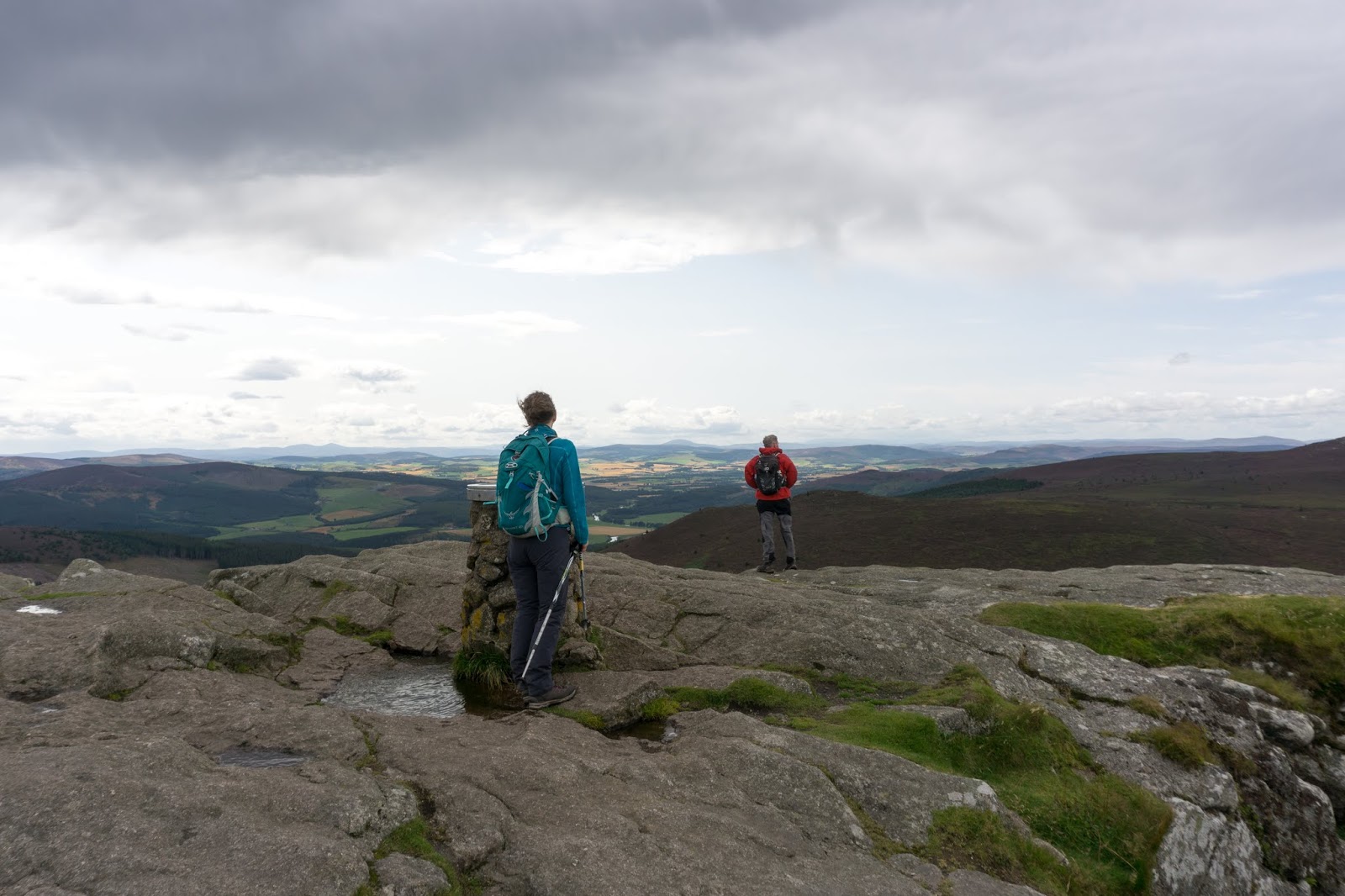
Once up on the higher ground the paths on Bennachie are really good going and distance just reels away. In quicker time than we'd anticipated we found ourselves on the rocky tor of Oxen Craig. At a modest 528m/1736ft this is the highest point of Bennachie but probably visited by only a small percentage of the folk who climb "Bennachie". Behind us rain showers were strafing the land further west...it seemed we'd probably get wet before the day was done.
A view indicator plaque identifies some of the hills and key features to be seen from Oxen Craig, including some at considerable distance. The view ranges from the city of Aberdeen in the east, round to the hills of Angus in the south, to the Cairngorm giants almost 70 kilometres away and round north to Peterhead and the Buchan coast - an enormous sweep of the northeast of Scotland.
We sat out a shower below Oxen Craig and once it had passed headed slightly off the main line of the ridge to another "top", Craig Shannoch.
From Craig Shannoch there's a good view across to the main attraction of any walk on Bennachie - the Mither Tap. In fact the Mither Tap is Bennachie for most folk; the name of the whole hill is a derivation of Beinn a' Chioch (hill of the breast) and it's the Mither tap which is the most visible, most prominent feature. Across a huge swathe of Aberdeenshire you can look for it - the eye instinctively drawn to a familiar outline. Bennachie, always Bennachie - it's what inspires such affection for the hill. The Tap is a granite plug from the heart of a long ago eroded volcano and has considerable steep drops on three sides. I'd guess that only about one in a hundred people who climb the Mither tap go on to walk to the "real" summit of Oxen Craig - such is the draw of the Tap.
We climbed to the summit, almost able to lean on a tearing westerly wind. We'd traversed top to top to reach the Tap, a fitting end to the high ground of Bennachie.
This place has a long history of use. Being so prominent prompted the building a hillfort here. Constructed during the Iron age and possibly occupied as early as 1000BC, it seems to have been developed for a long period and may have been the site of the battle of Mons Graupius (which gave its name to the Grampian region and mountain range) where the Picts were heavily defeated by a Roman army. The aerial pictures on the Canmore site show the extent of the ruins.
The curving entrance to the upper fort is particularly well preserved - here you can really walk through ancient history.
The descent from the Mither Tap to the Bennachie Centre is knee-jarring, steep and in places rough. Although the shortest route in terms of time and distance I've always thought this the least attractive way to climb the Mither tap. There are a number of ways to reach the Tap, as shown on this downloadable map, or you could always do our longer route of around 10kms! We'd enjoyed a superb day doing this route; it's one all three of us will repeat.
Lorna, Allan and I met up on a bright late summer day to do one of the longest routes on Bennachie, a traverse from one end to the other of what's essentially a long ridge with a number of "tops". They live closer to the hill than me and have a clear view of it from their house - a very desirable feature in any property I feel!
We pre-positioned a car at the end of our intended walk and drove back west to the top of a feature known as the "Lord's Throat", a wooded valley carrying a minor road. A rough track leads to a sand quarry and after a bit of scratching about we climbed above the quarry and onto the open hill above. a view opens up straight away to the furthest tops of Bennachie above the valley of the River Don.
The heathers were all in full bloom, the colours stunning. This is the larger flowered Bell Heather (Erica cinerea).....
...and this is the more ubiquitous Ling heather (Calluna vulgaris). As we walked our boots raised clouds of honey-scented pollen and one of the dominant sounds was that of the bees collecting pollen - we saw several species on this part of the hill.
This is a corner of the hill I hadn't previously walked and I was intrigued by a line of very old and long-disused shooting butts arranged in a line upslope. Drystone built, the may have been turfed on top when in use and each had an offset entrance for the "gun". Interestingly, almost every one harboured a Rowan tree. Rowan (Sorbus aucuparia) seeds germinate in an interesting way; if you plant them they just won't grow. The seeds are contained in a bright red berry which are irresistible to many species of birds. the berry and seed must first pass through the gut of a bird in order to germinate; and of course will benefit from having a blob of guano fertiliser to boost its chances. The berries are irresistible to some humans too - they make a superb jelly to accompany meats and cheeses!
Rowans are one of the most common trees in Scotland, and are the tree which reaches higher altitudes than any other species here - up to 870m/2850ft in a few places. There's a rich folklore surrounding the tree; it's associated with protection and was commonly planted at the gable end of a house to afford protection from witchcraft in particular. Rowans rarely live longer than 150 years so it's possible to guess the dates of some ruins by the Rowans near to them. Here, in a lovely piece of symmetry, the works of man provide protection for the Rowan - the seeds dropped by a bird have fallen into the grouse butts and the seedlings have grown within the circular embrace of the wall, protected from weather and from browsing animals until well established.
From near the summit of the first "top", Black Hill, there's a wide view over the Aberdeenshire countryside. Due to its relative isolation from surrounding high ground such good views are a feature of the whole of Bennachie.
From Black Hill the ridge proper swings into an east-west orientation and as we continued west the views just kept coming. We took a slight detour to the "top" of Hermit Seat (who was the hermit I wonder and what was his story?) and past Hummel Craig. A Hummel is a stag with no antlers and Craig is a derivation of Crag. From the next "top" of Watch Craig we looked over the valley of the River Don to Pitfichie Hill and Cairn William. Allan and Lorna were just able to see their house from this point!
Once up on the higher ground the paths on Bennachie are really good going and distance just reels away. In quicker time than we'd anticipated we found ourselves on the rocky tor of Oxen Craig. At a modest 528m/1736ft this is the highest point of Bennachie but probably visited by only a small percentage of the folk who climb "Bennachie". Behind us rain showers were strafing the land further west...it seemed we'd probably get wet before the day was done.
A view indicator plaque identifies some of the hills and key features to be seen from Oxen Craig, including some at considerable distance. The view ranges from the city of Aberdeen in the east, round to the hills of Angus in the south, to the Cairngorm giants almost 70 kilometres away and round north to Peterhead and the Buchan coast - an enormous sweep of the northeast of Scotland.
We sat out a shower below Oxen Craig and once it had passed headed slightly off the main line of the ridge to another "top", Craig Shannoch.
From Craig Shannoch there's a good view across to the main attraction of any walk on Bennachie - the Mither Tap. In fact the Mither Tap is Bennachie for most folk; the name of the whole hill is a derivation of Beinn a' Chioch (hill of the breast) and it's the Mither tap which is the most visible, most prominent feature. Across a huge swathe of Aberdeenshire you can look for it - the eye instinctively drawn to a familiar outline. Bennachie, always Bennachie - it's what inspires such affection for the hill. The Tap is a granite plug from the heart of a long ago eroded volcano and has considerable steep drops on three sides. I'd guess that only about one in a hundred people who climb the Mither tap go on to walk to the "real" summit of Oxen Craig - such is the draw of the Tap.
We climbed to the summit, almost able to lean on a tearing westerly wind. We'd traversed top to top to reach the Tap, a fitting end to the high ground of Bennachie.
This place has a long history of use. Being so prominent prompted the building a hillfort here. Constructed during the Iron age and possibly occupied as early as 1000BC, it seems to have been developed for a long period and may have been the site of the battle of Mons Graupius (which gave its name to the Grampian region and mountain range) where the Picts were heavily defeated by a Roman army. The aerial pictures on the Canmore site show the extent of the ruins.
The curving entrance to the upper fort is particularly well preserved - here you can really walk through ancient history.
The descent from the Mither Tap to the Bennachie Centre is knee-jarring, steep and in places rough. Although the shortest route in terms of time and distance I've always thought this the least attractive way to climb the Mither tap. There are a number of ways to reach the Tap, as shown on this downloadable map, or you could always do our longer route of around 10kms! We'd enjoyed a superb day doing this route; it's one all three of us will repeat.
Thursday, 5 September 2019
Late Summer in a jar
Over the weekend we noticed that the Blackbirds and Starlings were starting to work over the Rowan (Sorbus aucuparia) trees in the garden. As the clusters of red berries ripen it becomes a bit of a race for us to gather a basket before they all get eaten! The berries seem irresistable to all kinds of birds and the Rowan has an interesting adaptation in that the berries need to pass through the gut of a bird before the seeds they contain will germinate.
We cooked the berries with an equal weight of cooking apples until the mixture became a thin orange porridge, then strained the lot through a cloth overnight to extract a couple of litres of rose-pink fluid. This liquid is then boiled up in a 60:40 proportion with sugar until setting point is reached. The whole process is shown here, and the result looks like late summer in a jar!
Rowan and Apple jelly goes superbly well with meats and cheeses and is the secret ingredient in our venison casseroles. It needs to mature for a few weeks and will keep for a year, slowly darkening in colour.
It had been a bit of a surprise to see the birds begin eating the berries in the first couple of days of September - we felt it was earlier than usual. We still had a jar of jelly left from 2018's crop which was dated 15 September, and looking further back over the blog to 2016 and 2012's entries it certainly seems that the "normal" date we've made this preserve has been in the second half of September.
We cooked the berries with an equal weight of cooking apples until the mixture became a thin orange porridge, then strained the lot through a cloth overnight to extract a couple of litres of rose-pink fluid. This liquid is then boiled up in a 60:40 proportion with sugar until setting point is reached. The whole process is shown here, and the result looks like late summer in a jar!
Rowan and Apple jelly goes superbly well with meats and cheeses and is the secret ingredient in our venison casseroles. It needs to mature for a few weeks and will keep for a year, slowly darkening in colour.
It had been a bit of a surprise to see the birds begin eating the berries in the first couple of days of September - we felt it was earlier than usual. We still had a jar of jelly left from 2018's crop which was dated 15 September, and looking further back over the blog to 2016 and 2012's entries it certainly seems that the "normal" date we've made this preserve has been in the second half of September.
Tuesday, 5 March 2019
Bin it
I've driven past the sign on the A96 road near Huntly which points to the Bin forest car park literally hundreds of times and yet not visited - feeling that a walk close to a busy road would be spoiled. I'm pleased to say I was totally wrong.
On a really windy Sunday morning we parked and headed out on one of the waymarked trails which climbs steadily up through the forest.
The Bin was originally planted for timber using seeds brought to Scotland by the great plant collector David Douglas, and while still worked partly as a commercial forest there's much more to it. It's been a long time since I've visited a forest with quite some much variety; open areas alternate with denser woods and mixed stands of wood are much in evidence. In this image there are Spruce, Scots Pine, Birch and Rowan all within a few square metres.
There was plenty of interest in the small scale too, miniature forests of lichen and mosses with just as much variety as the big stuff.
We saw the first frog spawn of the year in a pool beside the path, possibly laid the previous week in the very warm (for February) conditions. Whether this spawn will survive is questionable with sub-zero temperatures and some snow forecast for the first week of March.
A small group of Ladybirds, probably 7 Spot Ladybirds (Coccinella septemunctata) were sunning themselves in a sheltered spot on an old pine branch. We've seen a lot of these bright little creatures this winter, our Christmas tree proved to have large numbers hibernating among the branches which we carefully took outside and placed in similar spots in the garden!
Near the top of the forest the view opens up and our attention switched from the small things at our feet to the wider landscape - this is a view to the Buck, a prominent hill above the Cabrach.
The high point of the Bin forest is the hill after which it's named, the Bin is 313m/1026ft. "Bin" is probably a variant of "Ben", the Gaelic term for hill or mountain - there's another so named close by, the Bin of Cullen, which is almost exactly the same height. There top is an outcrop surrounded by trees offering good views through breaks in the canopy. A nearby pool is known as the "Gallon of Water" and was supposed to have healing powers, especially for children with Whooping Cough. The walk to the summit followed by a "dook" in freezing water probably would have some effect, one way or the other!
We descended back down to the main track through a wood which little ones would recognise as good habitat for Gruffalo, and half glimpsed a strange creature through the trees....we're still not sure, but it may have been?
Other strange sights were present in this part of the wood - great mushrooms of mosses........
....and a split boulder through which the path winds. Our route took the Yellow and White trails through the forest, the longest of the options and circling the hill to arrive back at the car park. In total our walk was 10km and has around 200m of ascent, mostly on good forest rack with some smaller path sections. For variety and interest the Bin has lots going for it - and is certainly not rubbish! As a bonus, the nearby town of Huntly has a number of places to eat.
Subscribe to:
Posts (Atom)