Showing posts with label Pubs. Show all posts
Sunday, 19 August 2018
Eggs for breakfast on the return from Eigg
Mike and I woke after a muggy and warm night to a soft focus morning at our camp on the Sound of Arisaig. The midges were also up and about so we didn't hang around sorting out our gear, having a cup of tea and repacking the boats.
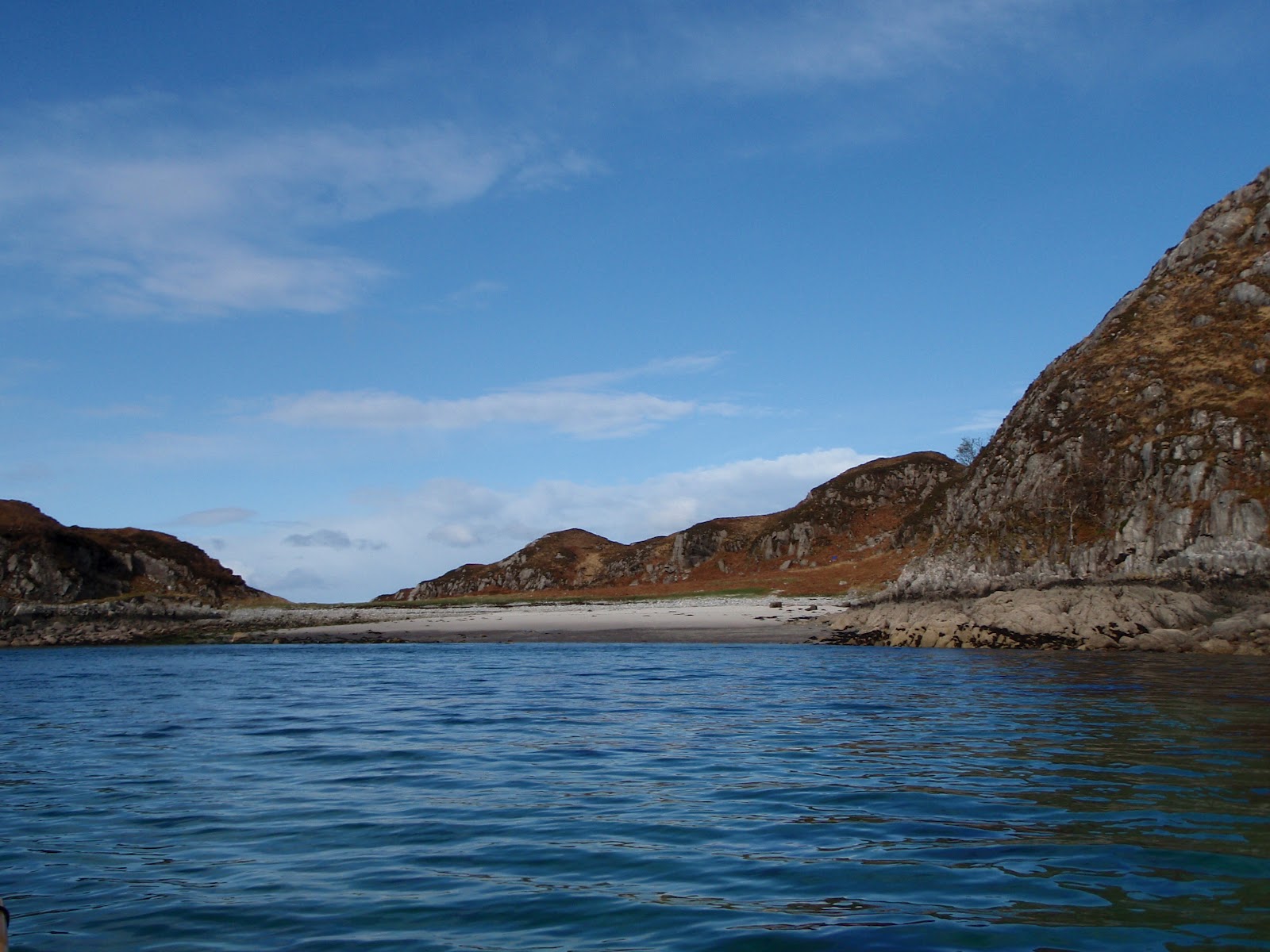
The tide was quite high meaning that there wasn't far to move our boats for launching. The previous night's high water mark was obvious on the stones; we'd parked the boats on the flat patch where our blue bags are in this image. If there had been any swell at all they'd have gone quite a lot higher! The steep slope of the beach is clear in this image; if the weather is from the south or south south west this place can make a tricky launching and landing place.
We headed out onto the Sound of Arisaig and into a gorgeous summer morning. The sun was burning away the early mist and creating some lovely lighting effects. Being out early like this I often feel as if I'm gaining something, and it's such a good time for scenic effect and for wildlife encounters.
There wasn't a breath of wind and the only sound was the rhythmic dip of our paddles as we made our way steadily across the Sound. The view to the east was one of silhouettes........
...and to the west, Mike's boat was lit against the palest of blue in the morning sky; the horizon just becoming visible as the last of the mist burned away.
Our crossing to Glenuig was a little over six kilometres and took just over an hour. Our plan for an early start was rewarded by an arrival at Glenuig just a couple of minutes before high water on a Spring tide. We landed right outside the Glenuig Inn; from where it's just fifty paces to the door......
...and the second element of our plan - breakfast! We tucked in to cereal and fruit juice, and ordered coffee and - of course - scrambled eggs on our return from Eigg.
This was a very fine end to our trip, during which we'd kayaked from Glenuig out to Eigg, paddled around the island and climbed to the highest point at An Sgurr before paddling back via the Sound of Arisaig. We took three days and a few hours to do the 92 kilometre journey (including the climb of An Sgurr), a leisurely pace which very much suited the nature of the trip.
Thursday, 19 November 2015
Solway sojourn - superlative steak sandwiches and a Selkirk saying
We paddled into a steady headwind on our way into Kirkcubright Bay, this would be the only stretch where we'd do so on the whole of our Solway journey. I wasn't quite firing on all four cylinders when we set out and so just put my head down and paddled until gradually I felt better and the easy rhythm returned.
Kirkcubright Bay pretty much matched my preconception of what paddling in the Solway Firth might be; a wide open bay enclosed by mainly low ground with extensive mud and sand flats at low tide.
We'd timed our departure from Little Ross Island to arrive at Kircudbright about an hour before high water. This meant we'd have the flood tide in our favour on the way up, we'd land with a minimum of mud-plugging, have time for luncheon and then have the ebb in our favour on the way back out.
As we entered the River Dee (one of two rivers given this name in Scotland, the other rises in the Cairngorms and flows to the sea at Aberdeen) we felt the insistent push of the flood tide overcoming the river flow and passed this trawler wreck - better days indeed.
We tried to land at the slipway in Kirkcudbright, but found it to be a lethal mix of a steep slope overlaid with slippery mud. I found it difficult to stand when I stepped out of the boat and it was clear that we wouldn't be able to safely move our boats. Instead we backtracked and landed adjacent to the marina pontoons on reeds and more mud, but at least it was flat!
We removed our paddling outer layers and took a stroll in warm sunshine through the streets of Kirkcudbright (pronounced "Kirk-coo-bree" and meaning Kirk of (St) Cuthbert). Saint Cuthbert (c. AD634 – 20 March 687) was a saint of the early Northumbrian church in the Cetic tradition and is mostly associated with northern England, though he grew up near Melrose in the Scottish borders. Cuthbert's remains were kept here for a time after being exhumed from Lindisfarne, they were later re-interred at Chester-Le-Street in the north of England. The town became a Royal Burgh in 1453, so it's fair to say the place has history.
I really enjoyed our stroll around the town; it's neat, tidy and has a well-kept air. Several houses were being whitewashed on the day we visited, and their doors and window frames being repainted in bright and cheerful colours. It's a place I'll re-visit and explore some more.
Probably the most prominent building in the town is the ruin of MacLellan's Castle. Completed in 1582, it was built by Sir Thomas MacLellan, Provost of Kirkcudbright partly from stone recycled following the destruction of Greyfriars Convent in one of Scotland's many religious upheavals. Standing at the head of a broad street, it's a fine sight.
We reached our destination, the Selkirk Arms, just as the doors were opening for luncheon. This hotel has a unique place in history too; for it was here (and not in the border town of Selkirk) that the poet Robert Burns wrote the famous "Selkirk Grace" in 1749:
We were shown to a table with comfortable upholstered seats despite the fact we were clearly in outdoor wear and ordered a round of sports recovery drinks while we perused the menu. We chose different starters, but all chose the Hot Galloway Beef Sandwich on Sourdough bread. It was, quite simply, the best steak sandwich I have ever tasted!
The mark we give to truly exceptional food and drink establishments is 12/10, but the Selkirk Arms gets an an almost unheard of 13/10 because the owner and chef Chris is himself a sea kayaker and came out from the kitchen to chat with us about this and other trips. If you are into superb food, prepared simply from quality local ingredients - the Selkirk Arms should be high on your list to visit!
Replete, we made our way back to the boats just a few minutes after high water. Other vessels were taking advantage of the tide too, the Belfast registered "Mytilus the Mussel" (B-449) was also departing from Kircudbright harbour.
After she passed, we changed back into paddling outer-wear and got back on the water. Already the ebb which would carry us back out into Kirkcudbright Bay was gathering pace.
Kirkcubright Bay pretty much matched my preconception of what paddling in the Solway Firth might be; a wide open bay enclosed by mainly low ground with extensive mud and sand flats at low tide.
We'd timed our departure from Little Ross Island to arrive at Kircudbright about an hour before high water. This meant we'd have the flood tide in our favour on the way up, we'd land with a minimum of mud-plugging, have time for luncheon and then have the ebb in our favour on the way back out.
As we entered the River Dee (one of two rivers given this name in Scotland, the other rises in the Cairngorms and flows to the sea at Aberdeen) we felt the insistent push of the flood tide overcoming the river flow and passed this trawler wreck - better days indeed.
We tried to land at the slipway in Kirkcudbright, but found it to be a lethal mix of a steep slope overlaid with slippery mud. I found it difficult to stand when I stepped out of the boat and it was clear that we wouldn't be able to safely move our boats. Instead we backtracked and landed adjacent to the marina pontoons on reeds and more mud, but at least it was flat!
We removed our paddling outer layers and took a stroll in warm sunshine through the streets of Kirkcudbright (pronounced "Kirk-coo-bree" and meaning Kirk of (St) Cuthbert). Saint Cuthbert (c. AD634 – 20 March 687) was a saint of the early Northumbrian church in the Cetic tradition and is mostly associated with northern England, though he grew up near Melrose in the Scottish borders. Cuthbert's remains were kept here for a time after being exhumed from Lindisfarne, they were later re-interred at Chester-Le-Street in the north of England. The town became a Royal Burgh in 1453, so it's fair to say the place has history.
I really enjoyed our stroll around the town; it's neat, tidy and has a well-kept air. Several houses were being whitewashed on the day we visited, and their doors and window frames being repainted in bright and cheerful colours. It's a place I'll re-visit and explore some more.
Probably the most prominent building in the town is the ruin of MacLellan's Castle. Completed in 1582, it was built by Sir Thomas MacLellan, Provost of Kirkcudbright partly from stone recycled following the destruction of Greyfriars Convent in one of Scotland's many religious upheavals. Standing at the head of a broad street, it's a fine sight.
We reached our destination, the Selkirk Arms, just as the doors were opening for luncheon. This hotel has a unique place in history too; for it was here (and not in the border town of Selkirk) that the poet Robert Burns wrote the famous "Selkirk Grace" in 1749:
- "Some hae meat and canna eat,
- And some wad eat that want it,
- But we hae meat and we can eat,
- Sae let the Lord be thankit."
We were shown to a table with comfortable upholstered seats despite the fact we were clearly in outdoor wear and ordered a round of sports recovery drinks while we perused the menu. We chose different starters, but all chose the Hot Galloway Beef Sandwich on Sourdough bread. It was, quite simply, the best steak sandwich I have ever tasted!
The mark we give to truly exceptional food and drink establishments is 12/10, but the Selkirk Arms gets an an almost unheard of 13/10 because the owner and chef Chris is himself a sea kayaker and came out from the kitchen to chat with us about this and other trips. If you are into superb food, prepared simply from quality local ingredients - the Selkirk Arms should be high on your list to visit!
Replete, we made our way back to the boats just a few minutes after high water. Other vessels were taking advantage of the tide too, the Belfast registered "Mytilus the Mussel" (B-449) was also departing from Kircudbright harbour.
After she passed, we changed back into paddling outer-wear and got back on the water. Already the ebb which would carry us back out into Kirkcudbright Bay was gathering pace.
Friday, 27 March 2015
The Craic at Kames
Having lifted our boats just far enough up the beach to allow luncheon and a frothing sports recovery drink, we adjourned to the bar of the Kames Hotel. Recently decorated and very welcoming, the hotel bar has a fine view of the West Kyle and we struck up a conversation with a group of customers who'd observed our speedy crossing of the Kyle under sail. Remarkably, Phil found that he knew some of the same people and so some lively craic ensued.
Our food order of two vegetarian burgers and two home-made beef burgers was fairly straightforward and before long we were sitting down to luncheon. The hotel is well used to serving yachtsmen, kayakers and divers so a table of four in drysuits didn't even raise an eyebrow.
The folk we'd been chatting with disappeared temporarily, but soon returned with a treat......
....a musical treat. All four were folk musicians and an impromtu session started as we finished our meal. Other diners entering the bar were amused to see a band playing with an audience dressed in drysuits singing along!
Such a spontaneous "session" presented us with some difficulty. It would be great to have another sports recovery drink and listen to the music for a while, but that's how afternoons can become messy! We imbibe very sparingly when kayaking, and anyway our tidal rise versus carrying distance equations had been quite precise......regretfully we said our farewells and headed back down to the boats.
The combination of location, the welcome, the ambience, food and range of beers makes the Kames Hotel a great sea-kayaking establishment - we score it 12/10; if you're lucky enough to be in when there's a band staying the weekend, make that 13/10 !
Back on the water, we lost the strength of the wind once we crossed over to the northern shore of Bute, leaving just a gentle breeze to to carry the sound of music across from Kames.....
Sunday, 24 February 2013
A day in the wild west part 1 - Portuairk to Sanna Bay.
We'd seen a forecast for relatively light winds in a three day window for the west coast of Scotland, coupled with bright sunshine. This was clearly too good to miss!
It will be well worth also following the story of our trip on Douglas' blog - with much better photos than mine! :o)
Douglas, Mike and I convened at the Glenuig Inn on a Sunday evening, nicely in time for a pint of real ale in front of the fire prior to dinner. The Glenuig Inn is both perfectly situated and superbly set up to cater for sea kayakers in comfort, with excellent accommodation and food. The proprietor, Steve, is also a sea kayak guide and has plenty of tips and information.
Our plan was hatched over dinner; to travel just about as far west as it's possible to do, then paddle back along the north side of the Ardnamurchan peninsula. After breakfast, we left a car at our intended finishing point and drove the 40-odd miles to Portuairk. If you do this trip, don't underestimate the drive, the short distance takes around 2 hours to drive on a very twisty road.
There's space to park a couple of vehicles at Portuairk and it's a relatively short carry to the water.
We were soon sorted and prepared to set off on our day's paddle. At Spring tides, a trolley will be pretty much essential for access here.
As soon as we emerged from the sandy channel, a glance to the left showed Ardnamurchan lighthouse a few kilometres to the west, the most westerly point of the British mainland. We also became immediately aware of the low swell and a quite gusty south-easterly wind blowing down off the higher ground of the peninsula.
Our first destination wasn't far way at all. We paddled a couple of kilometres to the east and landed on the beautiful white sand beaches of Sanna Bay.
It may seem strange to have paddled less than half an hour before landing, but we were well aware that this would be our last landing spot for a good way along the route. This is truly the Wild West for sea kayaking and you need to grab every advantage!
Sunday, 29 April 2012
The Slate Islands - Easdale
Easdale is probably the best known of the "Slate Islands" and gives its name to the distinctive rippled slate which was quarried on all the islands. Slate was quarried on Easdale for many years but really took off commercially in 1745, which is quite remarkable given that a Jacobite rebellion and subsequent war started in the same year. The continued operation of the quarry as a commercial venture during and after the rebellion is perhaps testament to the Breadalbane ability to sense which way the political wind was blowing and to concentrate on making money rather than war.
Quarrying continued into the 20th century and the sheer extent of the works can be seen in the aerial image on the island's website . Some of the quarries on Easdale and nearby Ellanabeich (separated by a 200 metre wide channel) reached 80 metres deep.
Transport, Easdale style! As there are neither roads or cars, handcarts continue to be the method used by the present day community of around 70 people move things about. Nearly all of the former quarry cottages have been renovated and are lived in by a permanent community, with a couple of cottages available for holiday rental.
The island is far from being a staid living museum however; it boasts a modern community centre which has multiple uses (including as the headquarters for the World Stone Skimming Championships!)
And also a pub/restaurant, the Puffer. We ate here on two evenings and thoroughly enjoyed both meals. In fact the "Surf and Turf" of venison steak and Langoustines was the best restaurant meal I've eaten in many years. A small wine list, real ales and friendly service add to the experience. When the proximity to the water and the availability of a daytime service of coffee and home baking is considered, the only possible mark that the Puffer could receive as a sea kayaker's eatery and pub is 12/10 - very heartily recommended!
Although Easdale is only a very small island, it supported several quarries.
Men worked in teams of five or six; two quarriers, two splitters and trimmers (nappers) and two labourers would be typical. Initially slate was taken from near the shore where wooden wedges were inserted into faults in the rock and swelled by seawater to split away slate. Later gunpowder and mechanised methods became the norm. It was hard and dangerous work; prior to the introduction of steam pumps and improved transport the quarries couldn't be sunk very deep and slates were carried from the quarries by women and children in creels.
The men were paid only once the slate had been sold and shipped; usually only twice a year. This obliged them to run up accounts at the company store. Accounts for each family or man were kept on a slate and gave rise to the saying "put it on the slate". When the account was paid, "the slate was wiped clean".
The quarries extended to the very edge of the islands and were sometimes sunk too deep to be safe. Inevitably this lead to storms breaching the retaining rock walls, flooding the quarries beyond recovery. Such disasters led to the loss of quarries at both Easdale and Ellanabeich, remarkably both events happened during the night so that there was no loss of life but widespread loss of livelihood.
This view from the sea shows the breach in the wall of the quarry at Easdale's west side.
The ferry from Easdale to Ellanabeich takes just three minutes. It's an open motorboat which can carry just ten people (including a crew of two). It can be sumoned by klaxon, and obviously there are times when the weather interrupts service. The waiting room on Easdale has a unique character, and has the additional attraction of a small colection of animals around the back; rabbits, guinea pigs, chickens and budgies all feature whilst indoors a glass tank with stick insects is an interesting diversion!
There's no getting away from the fact that Easdale, Belnahua and Ellanabeich, "the islands that roofed the world", are industrial landscapes, the evidence is just everywhere. They are fascinating places though, each with its own special atmosphere, and as this view from Easdale to Ellanabeich shows, industrial doesn't mean that they're not very scenic.
Monday, 16 April 2012
A blessing in the Loch of Heaven
Continuing along the north shore of Loch Nevis (the name is possibly derived from the Gaelic for "heaven") I landed on the shore at Inverie Bay. I'd planned to land near high water to avoid a long portage with the boat as the tide recedes some distance in the shallow bay, though I'd brought a trolley just in case.
Inverie is the most remote mainland village in Scotland and is accessible only by sea or on foot over one of the mountain passes in one of the roughest areas of the country. The land around the village is now owned by the community and managed by the Knoydart Foundation. The foundation was set up to effect the community purchase of the estate made possible by the Scottish Government Land Reform Act. It's been a great success story and is a fine example of why land ownership in Scotland matters so very much.
We stayed at the Foundation Bunkhouse, which is both comfortable and well equipped. I was met by the warden, Anna, and shown around. Dave and I had stayed here just after the bunkhouse opened and the progress has been considerable.
On my way into the bay, I passed this strange sculpture which is semi-immersed at high water. It seems to be a figure and made of a single piece of wood.
After a meal and a couple of beers in The Old Forge (Britain's most remote mainland pub), we walked back in heavy rain, counting our blessings that we weren't returning to wet tents.
We were even more glad we weren't camping when we woke to snow showers!
Dave, Karen, Diane and Andy still had three days of their backpacking trip to go, but for me this would be the last day. I paddled across the bay towards the entrance of the loch, only realising how much snow had fallen overnight when I could see through to the bigger hills.
Once the snow eased the sun warmed things a little and I passed close to the hulk of the "Serene", a Mallaig registered trawler which now sits in a corner of the bay minus her superstructure.
At Rubha Raonuill (Ranald's Point), a statue of the Madonna (marked as a monument on the map) seems to offer a blessing to those entering the Loch of Heaven.
Certainly the bay and beach she stands above are a small piece of earthly paradise.
All is not completely heavenly in Loch Nevis though; there are a couple of quite large fish farms along the south shore. There are deep divisions in the Highlands between those who see the salmon farms as a source of employment in a harsh economic location and those who point out that the industry is far more polluting than it should ever be. Loch Nevis was the first recorded site in Scotland where Infectious Salmon Anaemia was recorded in the 1990's.
Once out of the shelter of the loch I was exposed to the north wind and the resulting swell coming down the Sound of Sleat. I had a bouncy and entertaining ride back in a beam, then quartering sea.
Entering Mallaig, the bustle and activity of a working port were a contrast to the previous couple of days. My drive home was also entertaining; several roads were blocked by heavy snowfall as winter made a temporary return to the Highlands. It had been a good little trip, and good to share part of my friends adventure.
Monday, 3 October 2011
A rainy day, let's go to the pub!
The rain and strong wind which had battered us overnight showed no sign of easing by mid morning. I made a dash back out from the bothy to take down my tent and hung it to dry indoors. A glance over towards the Crowlins and Raasay decided our itinerary for the day - we had shelter from the easterly wind along the Applecross shore. Along the Crowlin shore we could see the sea crashing against the cliffs; it didn't look a fun place to be in a kayak.
It was still raining and blowing quite strongly when we set out. We planned to head north to Applecross village and have lunch in the Applecross Inn. Descriptions of various menu items had us hungry before we even set out!
At first we were in pretty wild conditions, particularly crossing the mouth of Loch Toscaig where the wind was coming in violent gusts from behind our right shoulders. I was finding the short, quartering sea a bit of a challenge, but a piece of advice from Gordon in his usual calm and reassuring manner made all the difference and I became much more comfortable.
Soon we were sheltered by the shoreline again, the rain stopped and the wind eased dramatically. This was to be the pattern for the whole trip; strong wind alternating with absolute calm as a really complex series of very small but deep low pressure systems passed overhead.
Arriving at Applecross, we landed right in front of the Applecross Inn. Our chances of getting a table didn't seem great; everyone for miles around seemed to have decided that it would be the ideal place to have lunch on a wet day. Morag went inside to ask - and we were in!
To their eternal credit, Judith and her staff didn't even bat an eyelid at our wet and windswept state. We left wet paddling jackets and trousers under a chair near the door and sat down to a fantastic meal. The food was superb (particularly the half pints of prawns), and though we didn't sample it on this occasion, the selection of real ale looked great. As a sea kayaking pub, this one gets 11/10!
We left Applecross well fed and started our journey back down to the bothy. Our plan to either head over to Raasay or further north to Loch Torridon would have been difficult in the forecast weather, so we left our kit in the bothy to await our return. It's one of the really nice things about bothying; kit can be left in the pretty certain knowledge that nobody will steal it.
Soon after leaving Applecross Bay the centre of one of the low pressure systems arrived. The wind died to a complete calm and the rain just hammered down. As (unusually in Scotland!) the heavy rain wasn't wind-blown it was actually quite pleasant to paddle along with the hiss of raindrops hitting the sea the only sound.
We intended to gather driftwood for the bothy fire on our way back. Hopefully we could find some under the rocky outcrops which was out of the rain or it would be a poor fire!
Subscribe to:
Posts (Atom)