Thursday, 31 March 2022

A noisy morning and a quiet day

I slept fairly well at our first camp site, but only until the first hint of light.  the clear, fluting song of a Blackbird singing solo was the start of the dawn chorus, and was a strikingly beautiful sound in the quiet dawn.  What was neither beautiful or quiet were the many geese, a Raven, a Pheasant and several Oystercatchers who joined in soon afterward, a more discordant dawn chorus would be difficult to imagine!

No matter, it was a lovely morning when we emerged from the tents, and surprisingly there was absolutely no condensation on the tents or the ground - quite unusual for this time of year.  The sunrise was a slow and stately affair, the forecast for overcast and hazy but warm conditions looked pretty accurate.  I never underestimate the privilege of waking up in places like this....we were less than 60km/40 miles from the very centre of Glasgow, Scotland's busiest and most populous city and yet we might have been in another world.


The party would split here; Douglas and Mike would head back to Portencross on the Ayrshire coast, Donny would head off to explore in his F-RIB with the possibility of joining up with us later in the day.  Raymond, Allan and I would head back north into Loch Fyne.  It had been great to catch up with everyone - I've so missed these journeys with good friends during the pandemic.


As we paddled back up the west side of Inchmarnock we were accompanied by the noisy neighbours; a flock of Canada Geese and small groups of Greylag Geese.  They allowed us to get fairly close, then splashed their way airborne in noisy indignation to land just ahead and repeat the process - why they didn't just fly around behind us I've no idea!


This was a strange day of weather; neither cold nor warm, calm with absolutely no wind, dry and with soft-focus light.  I'm sure that the conditions subconsciously affected our pace and energy - we all remarked on being a bit lethargic during the day.


At the mouth of Loch Fyne the Ardlamont buoy sat on top of its reflection, perfectly still


I'd had a very distant view of dolphins - which Donny later confirmed as Common Dolphins.  For some years a lone Common Dolphin nicknamed "Kylie" (as he frequented the Kyles of Bute) had made a permanent home near the buoy and had, it seems, been able to communicate across a species boundary with Harbour Porpoises but there was no sign of him when we paddled past.


Near to Ardlamont Point we heard a familiar high pitched chatter and looked along the cliffs to get a great view of a Peregrine Falcon (Falco peregrinus) arcing out over the water before returning to the crags - a really lovely sight.


I got quite tired paddling during the afternoon, maybe out of practice, maybe the strange weather, and took almost no photographs.  We trimmed our plans to head right up into Loch Fyne and instead headed to a beach recommended by Donny as a potential camp site.  Arriving mid afternoon after meeting up with Donny gave us plenty of time to select the best spot and to gather driftwood for our evening fire.


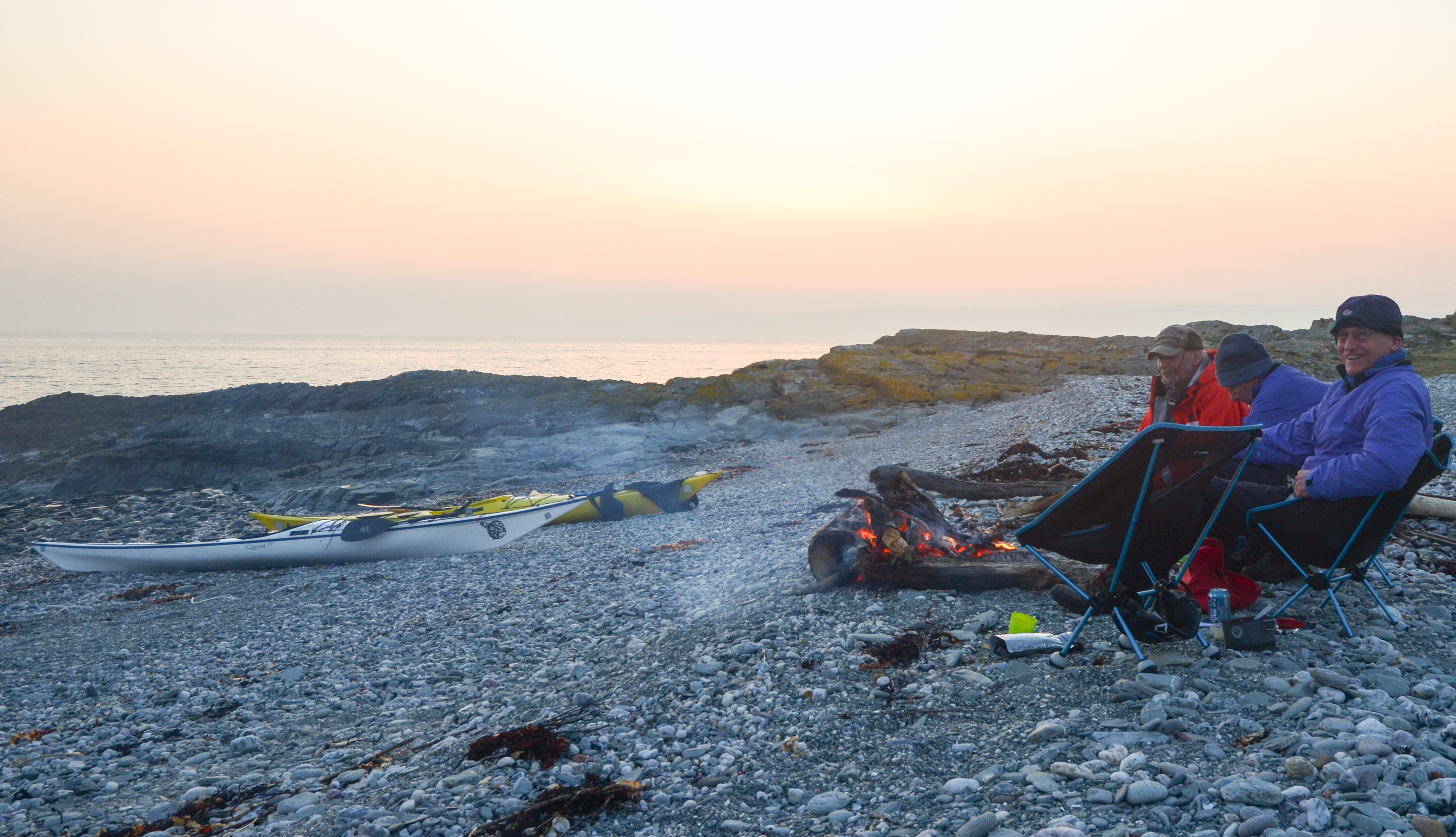
The wood was very dry and lit immediately, soon developing into quite a hot fire.  Purists can relax, the apparent proximity of the can of Brewdog sports recovery drink to the fire is an effect of the camera - the can (chilled in a nearby burn) was well out of range and no Brewdog was harmed during the making of this blog post.


 Dinner was Allan's excellent Venison Casserole, eaten around a fine fire (a Fyne fire?!).  All of us were tired and we headed to the tents pretty early with the promise of another fine Fyne day to come.

Wednesday, 30 March 2022

A very special induction

The third week of March promised some very fine and warm weather in Scotland.  Having studied the forecasts and checked availability we decided on a sea kayak trip over four days and three nights in the Firth of Clyde and Loch Fyne.  Allan, Raymond and I would start near Tighnabruaich in the West Kyle, Donny would launch his F-RIB from the same spot and Douglas and Mike would kayak from Portencross on the Ayrshire coast to join us for an overnight camp.

Our planning was very flexible, there was no fixed itinerary other than getting out on the water for a journey and to enjoy the fine weather.  From previous knowledge of the area we had several potential wild camp sites in mind for our first night and were able to keep in touch through the day to decide which one would work best for our varied starting points and times.

It's a fair drive from Aberdeenshire to Tighnabruaich, but Allan and I made good time and after stopping for brunch en route we were packing the boats shortly after 1pm - Raymond arrived a few minutes after us from his home near Stirling. We noted Donny's car in the parking area so he was on the water already, a message from Douglas and Mike indicated that they had set off late morning and the weather could not have been better....the plan was coming together!


We paddled south down the West Kyle of Bute and past Ardlamont Point into open water at the mouth of Loch Fyne, it was a cracking day to be on the water.


The slight breeze dropped completely as we crossed to the north end of the island of Inchmarnock - a couple of messages exchanged just as we set off had confirmed our meeting point as the south end of the island where we knew we'd get a good camp site provided that it wasn't inhabited by cattle.


We couldn't quite believe the conditions we paddled in...warm sun on the face, a heat haze and perfect reflections on mirror calm water.  All the more remarkable, conditions were due to be similar for the whole week - and the clocks hadn't even gone forward!


We landed at the shingle spit at the north end of Inchmarnock for coffee and a leg-stretch, greeted by this bright orange Seven Armed Starfish (Luidia ciliaris) which was a very neat colour match with the deck of my Cetus MV.  

"Inchmarnock" means Marnoc's Island and is named for the Celtic monk St Marnoc.  His name appears in several other place names in south west Scotland including the town of Kilmarnock.  Near where we landed a stone "cist" or burial container was excavated to reveal the remains of a Bronze Age lady buried with a jet bead necklace and a finely made dagger.  the remains were carbon dated to about 3500 BC and the lady (subsequently named the "Queen of the Inch") re-interred beneath a heavy glass pane.


Rested and refreshed, we paddled at a relaxed pace down the west side of Inchmarnock, sighting deer and a Peregrine Falcon along the cliffs.  It didn't feel like an afternoon to be rushing along.


In fact, quite the opposite, this was an afternoon to take things very easily and to enjoy the beautiful weather.


A call on the VHF radio from Douglas alerted us that we were just a few hundred metres from the beach above which we'd camp for the night.


Image courtesy of Dr Douglas Wilcox

Douglas took this wonderful panoramic image of Allan, Raymond and I just about to arrive at the camp site; I think it really sums up the day and the superb position.


From the water the position is no less superb, a gently shelving shingle and pebble beach with an area of flat turf above.  This place is sometimes frequented by the herd of Luing cattle which are grazed on Inchmarnock - this breed can be aggressive and don't make good neighbours if camping.  It's their home, so if they're around we go elsewhere to camp!


 After putting up our tents and settling in we joined Douglas, Mike and Donny for dinner around the camp fire.  this early in the Spring there was plenty of driftwood for a fire to be lit below the high water mark.  Raymond, Allan and I had each cooked a fresh meal for one night of this trip - we started this evening with a chilli con carne and rice, accompanied with a glass of red wine - no need to rough it!

This trip was significant for a couple of reasons, the first being that this was the first time we'd been out together for some time, and the first overnight trip of the year for most of us.  The second reason was that all the people on the trip apart from me are retired or semi-retired....and I was imminently to retire.  So, this was a very special induction into the club!


Sat by the fire on a lovely evening in a superb location, sharing a dram with good friends....I think I could get to like this retirement thing! 😊

Saturday, 22 January 2022

Equipment Review - Kahtoola Microspikes

In icy conditions the soles of walking boots and shoes are seriously compromised in terms of grip, and some form of traction is very desirable.  On steep ground or on the hill, especially in the mixed conditions typical of Scotland I use 12-point articulated crampons with stiff mountain boots but this combination is not well suited to tracks, forest roads or footpaths.

In autumn 2020 I purchased a set of Kahtoola Micropsikes to use on my regular walks when things got icy.  This review is based on regular use through winter 2020-21 which proved to be exceptionally cold and prolonged even by Aberdeenshire standards.  The Microspikes have been used in temperatures from 3 Celsius down to -20 Celsius and in underfoot conditions ranging from hard, frozen turf, iced forest fire-roads, refrozen snow, in hard, clear ice and melting ice.

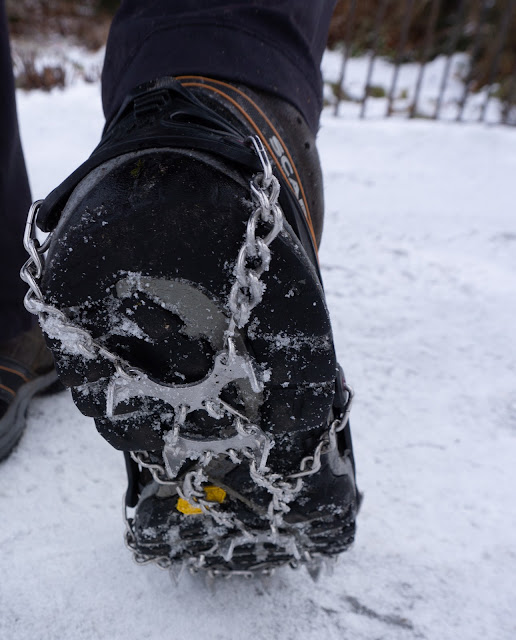
The Microspikes don't require stiff or rigid soled boots which means they should fit a range of footwear (indeed many folk use them on trail running shoes).  The upper part is a shaped Thermoplastic Elastomer (TPE) harness with reinforced eyelets which is claimed to retain its elasticity down to -30 Celsius.

The Microspikes are quick and easy to fit with a little practice and don't require footwear to be removed in order to put them on and take them off.  The technique is to place the forefoot into position then use a raised tab on the rear of the harness to pull the heel into place.  I found that I was able to easily fit and remove the Microspikes on-the-go, which is useful when they may not be needed for all of a walking route.

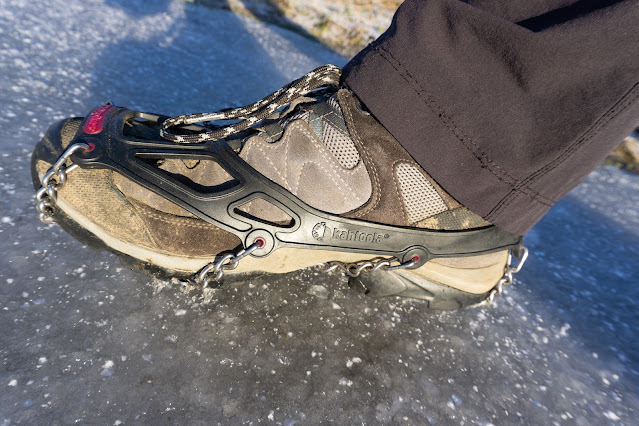
The design of the harness holds the spikes in place nicely and there is no tendency for the footwear to slide out even on quite steep descents.  A real positive is that I haven't experienced any pressure points or "cold spots" from pressure as can happen with some crampons.  In the image above the Microspikes are being used with a walking shoe on hard ice.


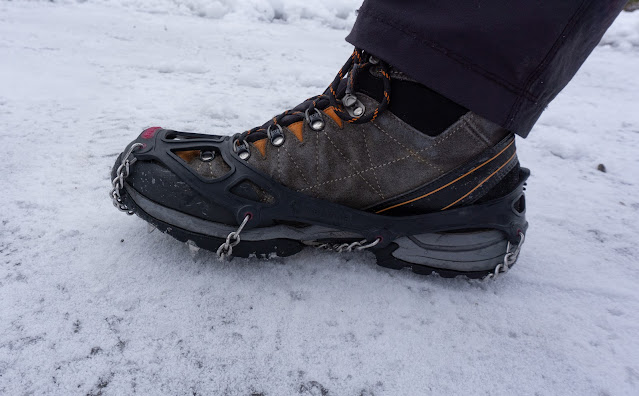
In this image they are being used with a general purpose walking boot in mixed conditions with heavy frost and frozen patches of forest road.  Unlike with crampons, it's not necessary to use a "duck waddle" modification to your natural walking style when using the Microspikes, due partly to the much shorter length of the spikes compared to crampons and also because there are no front points which could catch the ground.


 The chain and harness hold the Microspikes in place very well, I've not experienced any misalignment when walking across level or rough terrain.  Sometimes with articulated crampons strapped tightly to stiff winter boots and secured with toe bail and heel fastener there can be cold spots on the feet from the pressure.  I haven't experienced any cold spots with the Microspikes as they aren't holding the foot rigid and any pressure is distributed across the harness.

So, although for mountain walking my preferred combination is and always will be stiff winter boots and 12-point articulated crampons, the Microspikes definitely bring benefit in winter walking for lower levels, making otherwise inaccessible icy paths easy to walk.  I can also see a place for them in Spring mountain walking when most of the snow is off the hills and there are just occasional patches to be crossed which don't require front-pointing technique.

The Microspikes retail for around £50 in the UK, and I think that they're very good value at that price.  If you walk regularly on icy tracks and paths, live in an area which has winter conditions most years or walk on hills with some icy patches, they're well worth considering as part of your kit.  I purchased my set from Icegripper, a main UK importer of Kahtoola products.  The Microspikes arrived quickly, and I can vouch for the customer service - the initial set sent out were the wrong size and when I informed the company the correct size were sent out before I returned the original set.

Conflict of interest statement:  I purchased my set of Microspikes at full retail price an have no connection with either Kahtoola or Icegripper other than being a satisfied customer.

Wednesday, 5 January 2022

Short day, short view

Life, work and other things meant that this blog was a little neglected during 2021.  That's not to say that I didn't manage to get out and about though, and there will be some catch-up posts coming in the next few weeks.

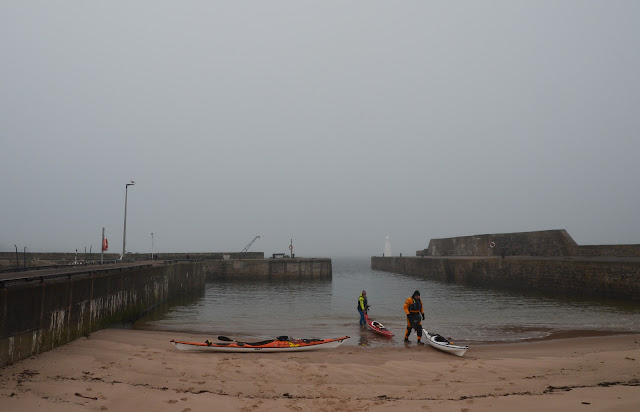
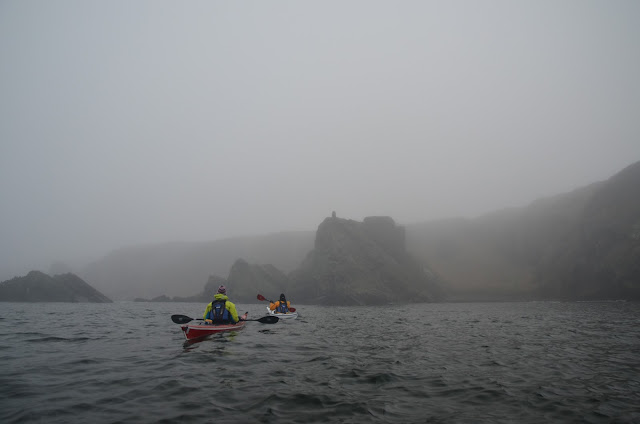
Just a couple of days prior to the winter solstice and there isn't much daylight here in Aberdeenshire, realistically six hours is what we get.  When Allan and Lorna and I left our homes in inland Aberdeenshire we were in bright sunshine with temperatures well below zero Celsius.....just 45 minutes drive north to the Moray Firth coast and things were a lot different; very misty conditions and the temperature a couple of degrees above freezing.  With just a light wind and a low swell we decided to set out from Cullen, paddle east to Sandend and return to Cullen.  It's an area we know very well but we took no chances with the visibility and set up a GPS in case things closed in further.


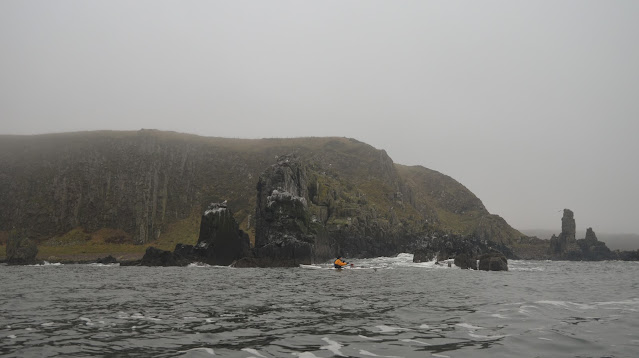
The misty conditions certainly made for an atmospheric journey through the rock stacks which are such a feature of this coast, everything seemed out of scale as towers and rocks loomed out of the mist.  We mentally ticked off known landmarks as we went and had soon warmed up from the chilly start.


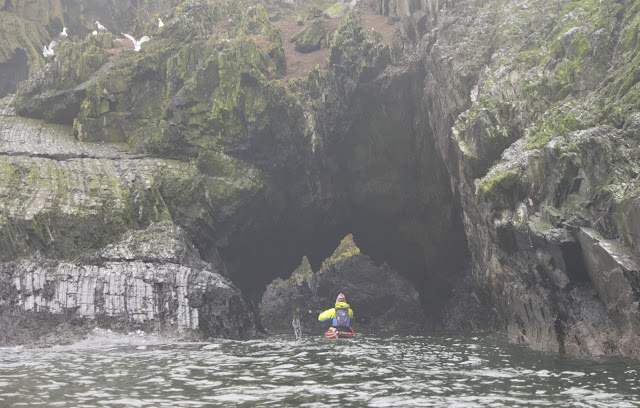
The swell was low but long-period and as is typical on this coast had "sets" of two or three much larger swells at regular intervals.  Near to top of the tide this cave-arch doesn't have much headroom, so good timing is a must!


 We took lunch in the tiny harbour at Sandend before heading back around to Cullen.  The mist had started to lift a little and the swell eased to give a leisurely return leg.


An unremarkable paddle of just 13km maybe, but as usual this coast gave plenty of interest, and it was a bonus to be able to get out in our kayaks right on the cusp of the shortest day of the year.

Wednesday, 29 December 2021

An atmospheric walk on the Correen Hills

When Allan, Lorna and I made plans to meet for a walk over the Correen Hills the forecast suggested a misty start - and that's what we got.  We'd taken a hand-saw to cut away some of the branches from trees fallen during Storm Arwen and which were making progress up the forest and onto the ridge hard going - a 45 minute spell of trimming has made the route a good deal easier.

Emerging onto the ridge we had visibility of just a hundred metres or so for three quarters of the way around the broad, curving ridge.  But as we approached the path junction near Edinbanchory Hill which marks the turn towards Lord Arthur's Hill the mist began to thin and we strode on in ethereal light.


Looking across the valley of the River Don, Coiliochbhar Hill emerged from swirling mist.  This hill has given it's own wonderful misty conditions in the past.


Our pace sowed right down as we stopped frequently to watch the changing scene; ridges and hills appearing and disappearing as the mist boiled, dissipated and re-formed - the effect was quite magical.


We seemed to be in an area of relatively clear air, in each direction a thick cloudbank was evident.  Underneath everything was grey and monotone, around us the light was superb.


 We made the final pull up onto the summit of Lord Arthur's Hill in bright sunshine.  The lack of wind allowed us to sit for half an hour and enjoy the changing views in comfort - in late December!  As we went down the hill towards Tullynessle the air chilled and the mist began to re-form - but what an atmospheric walk it had been!

Saturday, 25 December 2021


 Wishing you peace, health and happiness, wherever you may be this Christmas


Thursday, 11 November 2021

Remembrance - 11th November


 In remembrance of all those men and women who have lost their lives in the service of their countries, those who still suffer the physical and mental scars of the conflicts in which they served; and those who are left with loss and grief.


"At the going down of the sun, and in the morning, we will remember them"

Saturday, 23 October 2021

Leuchan, Looking


October in Scotland can have some stunningly good weather, and a warm, clear early October day was too good to miss.  Allan, Lorna and I met up in the Deeside town of Ballater for a round of a hill suggested by Lorna, and one which I hadn't previously walked.  We left the town and crossed the River Dee on the fine stone Royal Bridge and left the road to join an old track through pines and larches, the track a cushion of fallen needles dappled with sunshine.


The track climbs very steadily at an easy-to-walk angle out of the wood and takes a curving line towards a distinct notch on the skyline.  Below us (to the left in this image) a very large "parcel" of red Deer hinds moved across the grassy ground with two huge stags in attendance.  the stags were roaring repeatedly and one charged the other, sending it trotting away.  In reality one stag has absolutely no chance of keeping a group of over fifty hinds through the rut - he has his hands full!  As we climbed further we saw numerous groups of hinds marshalled by stags, the hill slope echoing to their roar.

A chat with an estate stalker who was driving down the track gave an excuse to pause on the climb and we got some really interesting insight into management on this piece of ground.  A group of clients were out with the head stalker shooting grouse, we asked whether our route would be a problem - which it wasn't.

The views were really starting to open up as we reached the skyline notch and climbed above it towards the summit of our hill, Cairn Leuchan.  On a knoll above the path, the distinctive shape of a mountain hare could be seen...but something didn't seem right....it was stock-still.  we walked up to investigate....


..and found this fine fellow called "Leuchan" from the hill, looking fixedly across Glen Muick to the distant Lochnagar.


Leuchan appears to be made from resin or a similar construction and even has his own stone name plate.  I've come across a similar sculpture on a hill the other side of Glen Muick previously and I still have no idea who installed them - but as pieces of art in the landscape they're fine by me!

We left Leuchan, looking, to his contemplation and continued towards the summit of Cairn Leuchan.


It's a short but steep climb to the outcrop forming the summit of Cairn Leuchan.  At 700m/2297ft it's neither a high hill or on any particular list of hills, but it is a very fine viewpoint.  The object of Leuchan the Hare's gaze, Lochnagar, is very prominent and draws the eye to the south west.


To the south east is another Munro, Mount Keen, the most easterly of Scotland's 3000ft hills.  The path which leaves the traditional "Mounth" route between Deeside and Glen Mark to climb to the summit is clearly visible as a pinkish line.

After resting a while and taking in the view we headed back down to the skyline notch, passing the shooters at their lunch.  We exchanged pleasantries with the head stalker and his staff but were roundly ignored by the clients.


We intended to keep to the high ground and took a short detour onto Craig Vallich, which is a fine viewpoint above Ballater.


The final high point of the day was the 601m/1972ft Pannanich Hill, which was possibly the best viewpoint on the walk.  A wide view through the northerly arc with the glacial lochans of Loch Davan and Loch Kinord as foreground with our "home hill" of Bennachie as backdrop made a super panorama while we sat and enjoyed a coffee.

It had been a great day, with lovely weather - t-shirts on high ground in October is definitely not the norm!  The walk had a final treat for us too.....


Another hare sculpture, also looking towards Lochnagar - maybe there's a pattern here, it's an intruiging puzzle!


The descent from Pannanich Hill back down to the valley of the River Dee is very steep and hard on the knees - we felt that our ascent route had been much the better way.  Soon though the roofs of the town and the fine church tower were in view and we strolled back along more level ground through a lovely wood.

What a great day it had been, another "wee hill" which had given a route of real quality and interest - a good choice by Lorna!