Saturday, 24 December 2011


Friday, 16 December 2011
Preparing for a pleasant shock to the system

After four months working in the heat and humidity of the Middle East, I'll be going home soon to a Scottish winter. This image was taken in mid December 2010 during a very cold spell which lasted several weeks, bringing severe frost and heavy snow.
It usually takes a little while to re-acclimatise, but I love the turn of the seasons and the variety of weather we get in Scotland. It may be a shock to the system at first, but I've missed clear, sharp mornings like this one!
Wednesday, 16 November 2011
Days like these, a winter day in Torridon

Looking through some images on a memory stick, I came across two from an outstanding day's hillwalking in February 2006. I'd set off from Kinlochewe well before dawn on a clear, frosty morning and walked down the Torridon road. Approaching Loch Clair as dawn was breaking, I detoured to the loch shore to take this picture of Liathach (the grey one). This viewpoint is a popular one with photographers but I had it to myself that morning while the whole mountain was bathed in pinkish sunlight. In the shadows where I was, my fingers were sticking to the camera in the frigid air - which may have gone some way to explaining why nobody else was around!
Liathach is a tremendous hill, steep and challenging with multiple summits. It has its standard routes but also some superb quieter routes to the summit ridges. Composed of Torridonian Sandstone and quartzite, the whole mountain is, in geological terms, upside down with older rock overlaying the younger - an amazing thought.

Liathach wasn't my objective that day though. I headed past the eastern end of Liathach and up into Coire Mhic Fhearchair (Farquharson's Corrie), also known as Triple Buttress Corrie from the stupendous rock architecture on the corrie headwall. A very steep climb of a further 550 metres (you earn your hill summits in Torridon as nearly all routes start from near sea level) got me up above 1000 metres on Beinn Eighe (hill of the file).
The view from here is simply breathtaking. A sweep of bold, primeval looking hills backed by the blue of the Minch and spattered with glistening lochans. Just magical.
This view shows (from left to right) the end of Sail Mhor (the big heel) which is the western summit of Beinn Eighe and forms one of the arms of Coire Mhic Fhearchair; the Corbett of Beinn Dearg (red hill) and beyond to the distinctive chisel summit of Mullach an Rathain, part of Beinn Alligin (jewelled hill). Across the trench of Loch a' Bhealaich (loch of the pass) is another Corbett, Baosbheinn (wizard's hill) and on the far right, Beinn an Eoin (hill of the birds).
All evocative names for hills of great individual quality. The memory of that view is as clear as the winter air near the summit of Beinn Eighe.
I turned northeast to walk the quartzite ridges of the "hill of the file". Soon I was in a strange mist through which the sun shone, making everything appear soft and pale. No more photos,but a magical and strange experience. By the time I reached the base of Beinn Eighe near the road I was very tired and it was just about dark. All along the final few kilometres of road back to Kinlochewe my headtorch picked out the golden reflections in the eyes of Red Deer browsing the grass at the roadside.
Days like these; they live with you for ever.
Friday, 11 November 2011
Armistice Day

I'm away from home at work this November, but last 11th November I was paddling between Kyle and Plockton. The day was calm and still, perfect for a moment of quiet reflection at 1100, the date and time at which the Armistice brought the carnage of the First World War to a close in 1918.
The Poppy which grew in such profusion on the battlefields of Flanders was adopted as a symbol of remembrance and it continues to be a resonant image both in the UK and elsewhere, worn to remember those who have lost their lives in the service of their countries in all wars.
Today at 1100, our ship in common with thousands of other places and millions of other people will observe a two minute silence ; a simple Act of Remembrance.
"They shall not grow old as we that are left grow old
Age shall not weary themor the years condemn
At the going down of the sun, and in the morning;
we shall remember them"
Tuesday, 18 October 2011
Morning calm at the Cairngorm lochs

Late summer and Loch Morlich at the foot of the northern Cairngorms was mirror calm. A dawn mist had just about burned off in the sunshine. It's a busy spot in summer with visitors walking, cycling and picnicking, but for now all was quiet.

Not too far away, on the Rothiemurchus estate is the beautiful Loch an Eilein (Loch of the Island) with its island castle. Here too the air was still and the reflections of the surrounding hills were painted across the water. Mornings like this encourage a slow pace to take in the scenery - but not too slow - calm, overcast conditions in summer bring the midges out in force!
Tuesday, 11 October 2011
Reflecting
From the Leopard Man's House in the perhaps appropriately named Loch na Beiste (loch of the beast) we headed back across the Kyle to the ferry slip and the delights of Buth Bheag.
We couldn't decide whether it was time for second breakfast or first luncheon, so we opted for coffee and cakes as "elevenses". Once again your testers can report that the quality, quantity and price from this wonderful wee deli are exceptional; and it's situated just 10 metres from a safe landing place. As a refreshment stop for hungry sea-kayakers, Buth Bheag scores 11/10! We'd certainly eaten well, whether from pub, deli or the meals we cooked ourselves. No need for dried food on this trip!

After passing under the Skye Bridge we turned west and paddled back towards Broadford. We would finish the trip in similar weather to that we'd started in, a glassy calm.

The bow of Morag's new boat made a nice reflection as we paddled leisurely along, not really wanting our small expedition to end.
We'd done a little over 80km in three days plus an evening's paddling; Janice and I had added about 20km to that during our "pre paddle paddle". So in terms of distance this was quite a short trip, but distance wasn't the point. Our trip, dictated as it was by the weather, had been all the better for having no schedule or firm plan.
Our lives are too much ruled by schedule and deadline. Perhaps the best thing about this trip was that we'd just kicked back and gone with the flow.
We couldn't decide whether it was time for second breakfast or first luncheon, so we opted for coffee and cakes as "elevenses". Once again your testers can report that the quality, quantity and price from this wonderful wee deli are exceptional; and it's situated just 10 metres from a safe landing place. As a refreshment stop for hungry sea-kayakers, Buth Bheag scores 11/10! We'd certainly eaten well, whether from pub, deli or the meals we cooked ourselves. No need for dried food on this trip!

After passing under the Skye Bridge we turned west and paddled back towards Broadford. We would finish the trip in similar weather to that we'd started in, a glassy calm.
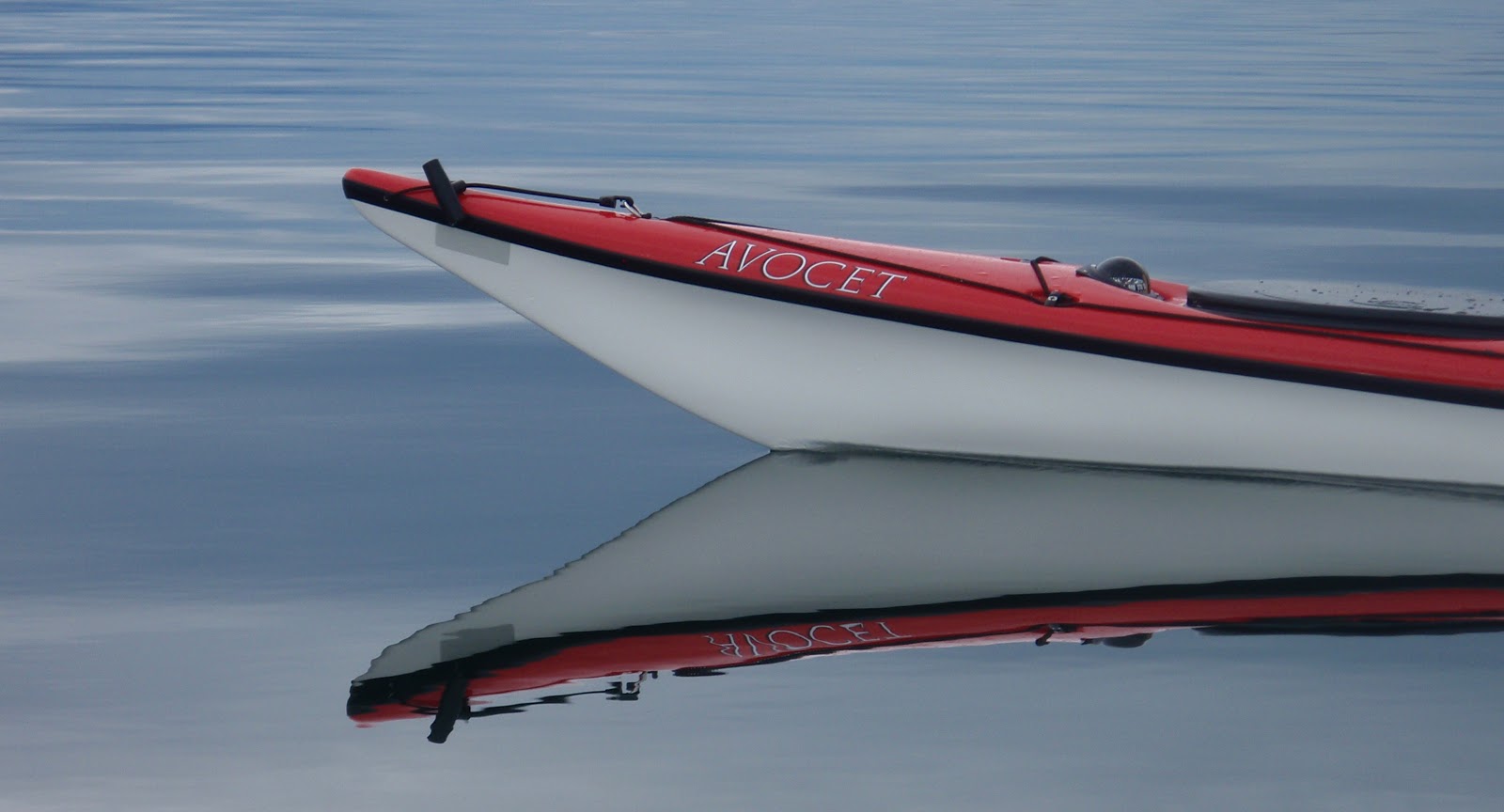
The bow of Morag's new boat made a nice reflection as we paddled leisurely along, not really wanting our small expedition to end.
We'd done a little over 80km in three days plus an evening's paddling; Janice and I had added about 20km to that during our "pre paddle paddle". So in terms of distance this was quite a short trip, but distance wasn't the point. Our trip, dictated as it was by the weather, had been all the better for having no schedule or firm plan.
Our lives are too much ruled by schedule and deadline. Perhaps the best thing about this trip was that we'd just kicked back and gone with the flow.
Monday, 10 October 2011
A wreck and a life less ordinary

As we paddled towards Kyleakin, the first point of interest we came to was the wreck of HMS Port Napier. A 9600 ton merchantman, Port Napier had been converted to a minelayer by the Admiralty and was loaded with 550 mines when she began dragging her anchor in a gale on 26 November 1940. As was common practice, the detonators for most of the mines had been inserted whilst at anchor as it was such a difficult task at sea with the ship pitching and rolling.
To make matters worse, fire broke out in the ships machinery spaces and there was a realisation that if the mines detonated the resulting explosion would probably flatten most of Kyle of Lochalsh and Kyleakin. The ship was towed well out into Loch Alsh and with incredible bravery a party of sailors returned onboard and began removing detonators from the mines and deploying them down the chutes to get them clear of the ship. With the fire worsening, the crew abandoned the ship and retreated.
Some time later there was a huge explosion from the engine room which fortunately didn't detonate the mines. It was big enough to blow out a huge section of the starboard side of the ship and send the superstructure up into the air, it landed on the shore nearby. The ship rolled onto her starboard side and sank quickly in 20 metres of water. The remaining mines were removed later and today the Port Napier is a popular dive site.

Our next stop was a place I've wanted to visit for a long time. On the Skye shore, blending into the landscape is the house built by Tom Leppard, otherwise known as the "Leopard Man". Tom moved here in 1987 and spent three years building a home constructed entirely of drystone and items beachcombed from the shore. The media became fixated with his appearance - understandably since he is tattooed in leopard markings from head to foot (he was in the Guiness Book of Records as the world's most tattooed man), and described him as a recluse who shunned human contact. This isn't really the case though as Tom used a kayak to cross to Kyle each to draw his pension (he is an ex-military man), to do his shopping at the Co-Op and to have a beer.
His lifestyle was certainly unconventional, but he was no survivalist hermit. The house seems to grow organically from the spit of land he chose, there are gravelled paths, trees planted and nurtured in just the right way, stone retaining walls, a hollow made parallel to a stream bed to serve as a bath. And decoration too, natural and pleasing. Tom spent much of his pension money on bird food and had feeding stations all around his house. I've been told that many of the birds were hand tame and that the deer didn't seem to see him as a threat.

The interior of the house is tight and compact but very functional. An obvious amount of care and thought went into making it as comfortable as possible.

Storage areas are made from wooden boxes and built flush into the drystone walls. The floor has drainage channels to allow any rain water to escape.

Tom Leppard left his house in 2008 after nearly 20 years of living close to the land. He was 73 and had begun to find crossing the Kyle an increasing challenge. He still lives in Skye, in a retirement home in Broadford. His possessions are largely still here though.
The Leopard Man's House deserves to be kept in good condition - sadly it's seen some abuse recently. If you visit, pull a few weeds from Tom's beautifully winding gravel paths, or take some rubbish away with you.
Tom Leppard "The Leopard Man of Skye" has lived a life less ordinary; the world is all the richer for folk like him
Sunday, 9 October 2011
A Loch Alsh camp
We once again woke to a strong easterly wind, though it was at least dry. We felt that the weather would moderate during the day and so spent the morning at the bothy, cleaning and tidying, breaking wood for the next visitors and drying out damp kit. We packed at lunchtime as the wind was quickly easing and set out in the early afternoon to head over to Kyle of Lochalsh

After a slightly bouncy crossing of the mouth of Loch Kishorn we got into the shelter of the Duirinsh peninsula. This is a cracking area to paddle, the islands between Plockton and Kyle are a great spot for wildlife. We passed under the Skye Bridge and landed at the old ferry slip at Kyle to buy lunch at "Buth Bheag" (the wee shop), the fabulous deli housed in the former ferry ticket office. The prawn rolls, coffee and cakes come highly recommended by your testers!
We'd intended to head back to Gordon & Morag's at Lower Breakish, but as the weather had improved we decided to spend another night out on our trip.

We headed along the south shore of Loch Alsh and found a campsite at the northern entrance to Kyle Rhea, on a grassy shore below Glas Bheinn (the green hill). The wind which had hampered our plans died to calm during the evening, which brought the midges out. Fortunately enough breeze returned to deter the little devils and we were able to cook and eat our evening meal in comfort.
Another wildlife visitor at this campsite were Earwigs (Forficula auricularia). There were hundreds under our tents in the morning, and many more hiding around the hatch rims and cockpits of our boats.

I found this bird skull on the shore and thought it would make a nice image against a gnarled log. The skull was quite delicate - I thought it may have been a Kittiwake or Black-Headed Gull.

After breakfast we headed out in calm conditions to paddle back to Kyle. Crossing the mouth of Kylerhea we felt the tidal pull of the ebb as it started to run south into the narrows. It was a relaxing morning, the sky was overcast, but a shaft of sun picked out the Skye Bridge. We were aiming for a notable wreck and then the former home of one of Skye's most intruiging characters.

After a slightly bouncy crossing of the mouth of Loch Kishorn we got into the shelter of the Duirinsh peninsula. This is a cracking area to paddle, the islands between Plockton and Kyle are a great spot for wildlife. We passed under the Skye Bridge and landed at the old ferry slip at Kyle to buy lunch at "Buth Bheag" (the wee shop), the fabulous deli housed in the former ferry ticket office. The prawn rolls, coffee and cakes come highly recommended by your testers!
We'd intended to head back to Gordon & Morag's at Lower Breakish, but as the weather had improved we decided to spend another night out on our trip.

We headed along the south shore of Loch Alsh and found a campsite at the northern entrance to Kyle Rhea, on a grassy shore below Glas Bheinn (the green hill). The wind which had hampered our plans died to calm during the evening, which brought the midges out. Fortunately enough breeze returned to deter the little devils and we were able to cook and eat our evening meal in comfort.
Another wildlife visitor at this campsite were Earwigs (Forficula auricularia). There were hundreds under our tents in the morning, and many more hiding around the hatch rims and cockpits of our boats.

I found this bird skull on the shore and thought it would make a nice image against a gnarled log. The skull was quite delicate - I thought it may have been a Kittiwake or Black-Headed Gull.

After breakfast we headed out in calm conditions to paddle back to Kyle. Crossing the mouth of Kylerhea we felt the tidal pull of the ebb as it started to run south into the narrows. It was a relaxing morning, the sky was overcast, but a shaft of sun picked out the Skye Bridge. We were aiming for a notable wreck and then the former home of one of Skye's most intruiging characters.
Subscribe to:
Posts (Atom)