Friday, 11 October 2013

A room with a view at Ryvoan


On a recent visit to Speyside, I walked up from Glenmore Lodge to spend the night at Ryvoan Bothy above the Pass of Ryvoan and its famous Green Lochan.  Ryvoan is fairly well accessible from Glenmore, but on a fiercely windy October evening was deserted.  It's a bothy I've often sheltered in and stayed in a couple of times previously - it sits at a crossroad of routes crossing the Cairngorm range and heading north to Abernethy.

An MBA bothy, Ryvoan has a rather unique feature in that a piece of poetry has by tradition been attached to the inside of the door.  Missed by many casual visitors who look in but don't close the door to see it, the poem was written by a lady called A.M Lawrence in the 1950's.  She lived in Cumbria but spent much of her childhood in Nethy Bridge.  The text of this very evocative piece is here


The view down through the Pass of Ryvoan in the late evening was particularly fine, the only drawback being the gale of wind  blowing through the pass which drew tears from the eyes!


The sleeping platform is conveniently sited under the window.  Settled in with a hot drink, I was quickly asleep and slept well apart from hearing occasional ferocious gusts rattling the roof of the building.

In the pre-dawn light, a glance from the window revealed one of Scotland's more intimate wildlife spectacles.  Below the bothy, across the track,  is a small flat green area which is used as a lek (display) site by Black Grouse (Tetrao tetrix).  The main lekking activity is in the Spring when the females attend to observe the males dance and parade before pairing, but there's another less intense lek in Autumn attended only by the males themselves.  There are less than 5000 breeding pairs of Black Grouse in the UK and I felt priveliged to watch about a dozen birds soocialising and displaying just a few metres away - all from the comfort of my sleeping bag and with a cup of tea in my hand.....now that's a room with a view!

Note: The ground on which Ryvoan Bothy stands is at the edge of two National Nature Reserves and is managed by the RSPB.  A polite and discreet sign near the lek site asks visitors not to camp on this seemingly perfect tent site in order to avoid disturbance or damage- a perfectly reasonable request I think, particularly as an alternative location is suggested on the sign.

Tuesday, 8 October 2013

October in Glen Feardar

Autumn can be portrayed as a season of decline and decay but I've never felt that way - rather seeing it as a blaze of glorious hues, of change in the natural world, as a preparation for the winter to come and as possibly my favourite of the seasons.

Over the last week the autumnal shades have really developed in the north east of Scotland. An early October trip to the head of Glen Feardar above the valley of the River Dee near Invercauld was a colourful affair.  


The ground below the pinewoods lower down in the glen was a blaze of dazzling red as the carpet of Blaeberry (Vaccinium myrtillus) colours up.  The effect is really quite dazzling and the leaves go through several shades of red as they change colour before falling.


Moving up the glen the habitat changes from pine woods to an open Birch wood with heather and  Bracken (Pteridium aqulinum) covering the ground below, the bracken at generally lower altitudes than the heather.  Almost overnight it seemed, the fronds had changed from faded green to a vibrant yellow - a brief phase before the leaves and stems dry out to a warm russet colour.


The effect when seen across areas of the Birch wood was very striking; the air itself seemed to take on a shade of yellow.  In the next week or two the bracken will turn brown and the birches themselves will blaze with yellow as the palette of autumn moves on.


Above the main treeline the heather moors are already wearing autumnal browns.  I listened for the first signs of the Red Deer rut, but nothing yet.  Perhaps the warm weather is delaying things, or perhaps it's just a little early.

The colours of the wood and the hills above were a pure joy, and yet, even in this riot of autumnal extravagance.......


....some elements of the landscape just seem made to be seen in monochrome

Monday, 7 October 2013

A lively Fiddle tune


A bright and breezy afternoon on the Moray Firth saw Allan and I heading out from Cullen and heading west across towards Portknockie.  Just before the village is the well known landmark of the Bow Fiddle Rock - a favourite place to paddle in the right conditions.


This photo makes the passage of the arch seem nice and calm - it wasn't particularly calm at all!  A metre of swell was roaring up against the cliff on the outside of the arch and the far side, making for a bouncy and noisy exit as the fiddle played us a lively tune.


Safely through and we continued westwards past Portknockie, enjoying super rockhopping around Tronach Head.  I've not paddled this section as often as I should; it's an intricate coastline with cliffs, stacks and has some of the best rockhopping around.


Not much further along is Findochty, the harbour itself sometimes being known as Crooked Haven, perhaps as it has a distinct right angle to enter the inner part.  Quite large for a Moray Firth harbour, its still well used by boats of all types.


After a short rest we headed back to enjoy more of the rockhopping to be found on the stretch between Findochty and Portknockie.  Hours could be spent here threading stacks and skerries.  The low swell meant that occasionally we were in places surrounded by roaring surf and yet in sheltered, calm patches among the rocks - really enjoyable paddling.


As a bonus, we had a warm sun on our backs as we headed back around to Cullen.  The swell had increased markedly around the Bow Fiddle and we took a brief look before leaving the passage until next time - the tune now a wild reel!.....

Back at Cullen harbour, we sat in the afternoon sunshine and enjoyed a handy sized container of  Guinness Sports Recovery Drink (thanks Allan!).  This paddle is just 16 km but packs in a whole lot of fun on the way......

Friday, 4 October 2013

The "Hutchie"


A walk up Glen Derry always has interest - and normally has great views too.  A long and wide glen, it nevertheless has twists and turns which allow the scenery to reveal itself slowly.  The glen also takes the traveller from the rich Caledonian Pinewoods of the lower glen through montane scrub to true mountain habitats. 

Above the pinewood proper are occasional "sentinel" pines; either colonisers, or as in the case of this tree, survivors.  Until recently these woods were in decline with any regeneration being browsed away by deer. A controversial but effective policy of culling large numbers of deer on the NTS Mar Lodge estate is now reversing the decline with healthy regeneration of pine, birch and rowan evident across the area.  In the medium and long term this is good news for the deer too as their habitat will be more akin to the natural state of things.


My destination for the night was a bothy in one of the high corries near the head of Glen Derry.  Climbing away from the main Lairig an Laoigh (pass of the calves) track, a small path leads over a footbridge and up towards the lip of Coire Etchachan, the hill of Stob Coire Etchan beyond.


Tucked into the corrie at about 700 meters and in a quite spectacular position is "the Hutchie" - or The Hutchison Memorial Hut to give the place its full Sunday name.  Behind the hut rises the grand 120 meter face of Creagan a' Choire Etchachan. 

Theis crag contains some of the best mountaineering style climbing routes in the Cairngorms including Corridor (on the left), Quartzvein Edge, Djibangi, The Dagger and the obvious Crimson Slabs.  The northeasterly aspect of this crag and the seepage lines from the high ground above makes for an outstanding winter climbing venue too with classic routes - the main issue being that it's 15km from the road!  This is when the Hutchie comes into its own.


Constructed in 1954 as a memorial to Dr A.G. Hutchison of Aberdeen who was killed in a climbing accident, this bothy often seemed cold and draughty, the bare stone walls did little to insulate and it was a regular battle to keep snow from drifting under the door.  A night at the Hutchie could be a cold experience.

But not any more.  A truly remarkable renovation project was undertaken in 2012 to repair and improve the bothy and the results are really impressive.  an enclosed porch facing away from the weather has been constructed in place of the open porch, the roof has been replaced and the interior......


...would be worthy of a feature on one of the television restoration programmes!  Dry lined and insulated, floor replaced, proper window fitted (with curtains!) and a stove installed - it's a really impressive piece of work.

All who use the hills and frequent bothies either by design or out of necessity due to foul weather owe the Mountain Bothy Association work parties a huge debt of gratitude.  All volunteers, their "payment" for toil and effort in a harsh environment is simply the satisfaction of putting something back into the hills.  All the materials have to be obtained and transported by an organisation which has no employees or "business" and who don't own any of the buildings they look after so diligently- a truly unique institution.

The story of the renovation and the somewhat trying conditions in which it took place are told on Neil Reid's excellent "Cairngorm Wanderer" blog here, here and here - really well worth a read.


The setting for the "Hutchie" could scarcely be more dramatic.  My goal for the evening was to get over to Loch Avon by the path leading to the bealach (col), then climb back over to spend the night at the bothy.  It was well past dark when I arrived back at the Hutchie to cook my dinner and sort myself for the night.  I can report that it was warm, comfortable and the view of a star filled sky was beautiful, as was the one from the window as the morning sun streamed in.

A huge thank you to all who were involved with this project  :o)

Monday, 30 September 2013

Autumnal Avon

At Cock Bridge, start of the "Cock Bridge to Tomintoul" section of the A939 road which features with regularity on the winter road closure reports, a track leads off past the Hanoverian barracks of Corgarff Castle.   I had arranged to meet with a group undertaking a Duke of Edinburgh's Award venture at some point on their route; cycling in would be the best way for me to do this and to perhaps include a short walk too.


An estate road gives quick access westwards along the headwaters of the River Don, then descends steeply alongside a ravine.....


....to arrive at the impressive Inchrory Lodge, now only occupied during the shooting season.  Inchrory sits near a bend in the River Avon (pronounced A'an and meaning "the bright one")


A little way upstream of Inchrory is the beautiful series of waterfalls forming the Linn of Avon.  The water here was clear and the level quite low following the dry summer.  It's one of my favourite spots......


The banks of the river below one of the falls had a tiny beach of warm brown sand formed by granite grains and had interesting patterns.


Early autumn is a fine time to visit; the colours of the vegetation just beginning to turn.  The warm sun made it doubly pleasant.  The volume of water was quite a contrast to my last post about the Linn.


With plenty of time in hand, I decided on climbing the nearby hill of Cnap Chaochan Aitinn (lump of the juniper stream).  My intention of walking up the twisting Glen Loin before climbing the hill had to be changed as there was a grouse shoot underway in the glen and I had no desire to either get in the way or to spoil the shooters day.  Instead, a steady climb up an access track reaches a broad ridge which leads easily to the 715 metre/2346 ft summit.  The scene looking up Glen Loin is undeniably glacial, and the cloud which had closed in robbed the scene of colour.


Across Glen Avon, the impressive and massive Ben Avon dominates the skyline.  The cloudy, cool conditions made it pretty chilly; I didn't linger long before returning back down to Glen Avon to meet the group.


Cycling back to Cock Bridge from Inchrory, the watershed between the rivers Avon and the Don is crossed.  As I came over the rise, a warm wash of late sun lit the slopes to the east - the colours definitely those of autumn.

Friday, 27 September 2013

Reflections


As forecast, the morning turned overcast as I paddled back towards the mouth of Loch a' Chairn Bhain.  Whilst exploring in a bay which I'd passed the previous day, I found this sheltered beach. Time for second breakfast........


The shore was composed of beautiful banded gneiss pebbles with occasional quartz and red sandstone ones; a fair representation of the local geology.


Immediately behind the top of the shore lay this lochan, a perfectly still reflecting pool fringed with lillies and rushes.  Salt and fresh water are just a few meters apart here, but seem totally separate as there's no obvious outflow from the lochan to the sea.

With the seaward view in one direction and the lochan in the other, this would have made a lovely spot to spend some time except for one small thing  - well actually millions of small things!  The midges waited until I'd got my stove going before making a ferocious attack.  I was sufficiently "motivated" to take my cup of tea and balance it on the foredeck of the boat whilst backing off the shore to leave the biting hordes behind.  I sat in the bay and enjoyed a midge-free second breakfast.....


The still and overcast conditions, whilst ideal for midges, also made for great reflections as I headed back towards Kylesku.


Scree fans reflected in the still water made for interesting patterns......


...including this delta-wing shape.


The sun was beginning to burn away the cloud as I neared the Kylesku Bridge, which itself was making a nice symmetrical reflection.


I arrived back at the old ferry slip at Kylesku just as the sun burned away the last shreds of cloud from Quinag - the mountain which had been my constant companion on this short journey.  Just less than 100 km in the three days, but I could add my own reflections of a superb few days to those on the waters of the loch.

Wednesday, 25 September 2013

Northlight

One of the features of the far north of Scotland which is shared with the Northern Isles and the Hebrides is a remarkable quality of clear, sharp light. This quality is difficult to describe adequately, but it can dominate everything in effects from astonishing clarity to a light which seems almost to penetrate solid objects and light them from within. The view from my camp site had some of this effect.....


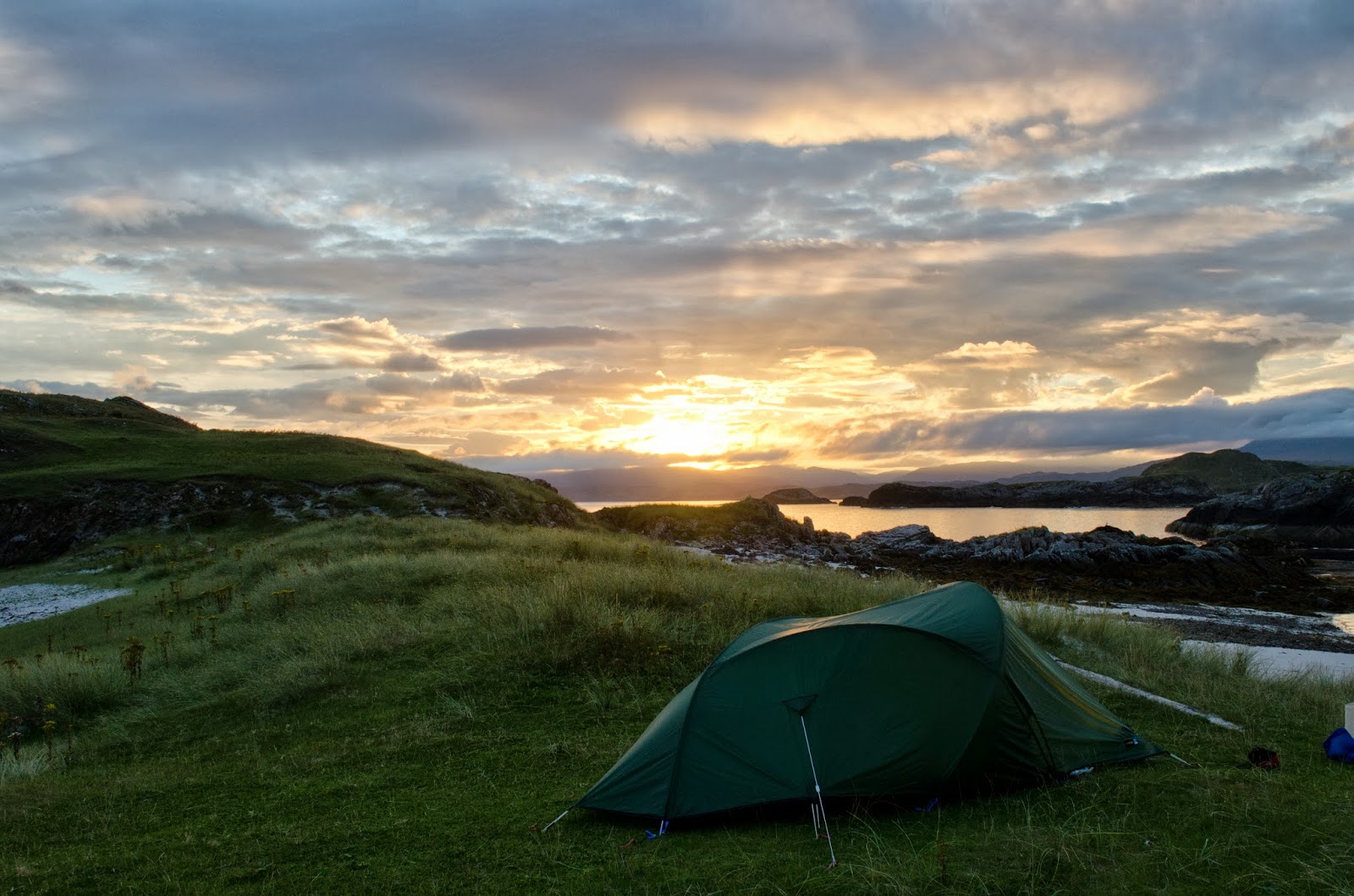
The evening shade was  pure and clear and seemed to amplify the warm glow struck from the flanks of Quinag by the dipping sun.  My tent (in the lower right of this image) had a great view, but the real grandstand effect could be had by climbing a small hill.

It was, quite simply, stunning and I sat long into the evening just absorbing the slow change of light.


A glance from the tent first thing in the morning after a cool night puntuated by the sighing of seals and the gentle talk of deer hinds grazing nearby revealed cloud streaming off the flanks of another of Assynt's distinctive mountains, Canisp.


There was the promise of a fair day to come in the early sunshine, though the forecast was for a cloudy morning followed by a brighter afternoon prior to a spell of windy weather.


I took breakfast after packing up the tent, a sequence which proved beneficial.  As the rising sun passed behind a cloud bank, a barely discernible noise started......  it was the sound of tens of thousands of midges reacting to the lower light levels and shouting "Get him!!"  Truly, bright sunshine and a breeze are the kayakers friend!

I still had to pack the boat, so one of these proved once again to be worth its weight in gold......


After finishing breakfast from inside my midge-armour I got on the water as the northern light played another dazzling trick.  Searing sunlight streamed through the thin cloud and fired it with white light,  creating a lace-like effect.

It was just 7.30 am and the day had already given so much.

Tuesday, 24 September 2013

Oldany Island and Clashnessie Bay


Immediately west of the Culkein Drumbeg area is the tidal Oldany Island.  My original plan had been to camp here, then to head across to Point of Stoer the following day before heading back towards Kylesku.  Unfortunately the weather was due to deteriorate quite rapidly towards te evening of the next day so my plans would have to be modified.

I decided on a circumnavigation of Oldany Island with a trip along to Clashnessie Bay before camping for the night at wherever looked good.

The channel separating Oldany Island from the mainland is another narrow and shallow affair, but it would be navigable by kayak at all but the lowest tides.  It was quiet here apart from the calls of Curlews and Redshanks, those two most distinctive of bird sounds.


After emerging from the channel, the coast on towards Clashnessie is quite rugged and has some nice features including this arch.  At the low state of tide when I approach, any attempt at passing through it lookedtoo tight for comfort.


A steady hour of paddling brought me to Clashnessie Bay where I was relieved to be able to land and stretch my legs.  I'd already paddled 30 kilometers during the day and still had to find a spot to camp.  Grazing land extends to the shore here and I knew that it wouldn't be a good spot.


Besides, I'd only paddled one side of Oldany Island!  I headed back northeast across the bay,  serenaded all the while by a whole choir of seals on Eilean Chrona.  The west and north coasts of Oldany Island are a complete contrast to the sides facing the mainland.  Rocky and exposed to swell from the Minch, there are no realistic landing places and clapotis can be expected even in calm conditions.

That said, it's a great place to paddle!


This is the view back along the north east coast to Poll na Cuile.  A number of small islands need to be threaded beyond here - the route taken will be very dependent upon the height of tide.......


...... but whichever route is taken there are landings available in sheltered corners.