Saturday, 5 January 2013

First paddle of 2013


After a run of windy and inclement weather, conditions on the Moray Firth settled to relative calm, with a low swell forecast as a bonus.  Time to get back on the water!

I met up with Allan and Lorna at Portsoy for a leisurely first paddle of 2013.  We headed out of the harbour and turned west, rock-hopping along the cost towards the West Head.  Conditions were pretty much perfect; very little wind, mild temperatures and a low swell which gave some interest without being a problem.


A feature of the day was the number of Long-Tailed Duck (Clangula hyelamis) we saw.  These birds are fairly numerous winter visitors on the Moray Firth, but are normally shy and quick to take flight.  Today most seemed content to allow a closer approach.


Then we came across this female which was clearly struggling to stay upright in the water.  I fished her out and put her on deck - she just sat without struggling and was obviously in some difficulty.  We carried her for a couple of kilometres along the coast to a beach where we could put her close under a ruined croft - above the tideline and away from any passing Gulls.  Sadly, we didn't hold out much hope she'd survive and wondered if the reluctance of the other birds to fly indicated an illness in the ducks.


Having landed our passenger we decided to push on over Sandend Bay to Sandend for lunch.


A small wind got up during the short crossing to Sandend, the strongest that it got all day.  Even this small breeze died away whilst we had lunch above the tiny harbour.


After lunch we headed back around the West Head to Portsoy Bay and checked out this arch.  The tide had been too low to paddle it on the way out, but with a nextra couple of feet of water it was now an easy passage.  It's a strange "disappearing" arch in that it is almost invisible until you're rit next to it.

As the weather was continuing to be so benign we decided to extend our paddle by going a little to the east of Portsoy.

Wednesday, 2 January 2013

"First footing" on the Correen Hills

"First footing" is the term given to the tradition of visiting a house early in the New Year. The 1st January dawned bright and cold - a good chance to first foot some local hills.


The Correen Hills form a broad horshoe ridge separating the Howe of Alford and Strathbogie.  The ascent is relatively gentle and the going underfoot good on grassy tracks and short heather - perfect to do some distance on a winter day.

20 minutes walk from home and I started the climb up Contlach Shank, a broad spur leading to an old quarry site.  The view back down to the valley shows the bleached winter grass of the farmland contrasting with the spruce plantations of Knockespoch forest.  A thin veil of cloud had appeared, but not for long.


Up on the ridge near Badingair Hill the northwesterly wind was bitingly cold and was discharging volleys of snow and stinging hail.  To the north is the distinctive hill of Tap o' Noth which has a large Pictish hillfort on the highest point - which must have been a cold place on a day like today!

Near to here I got a nice view of a Snow Bunting (Plectrophenax nivalis).  Not common locally, they are sometimes seen at valley level in hard winter weather.  The small bird was a brave sight and seemed perfectly at home amid the wind and hailstones.


A few stunted pine trees dot the ridge between Brux Hill and Edinbanchory Hill, clearly showing the way the prevailing wind blows.


The day's highest point, Lord Arthur's Hill (at just 518 metres/1700 feet) looks a long way from Edinbanchory Hill, but the walking is easy on a grassy track and the distance just reels off - a feature of the Correen Hills as a whole really.


I was glad to turn south east and put the wind at my back - the tears were streaming out of my eyes it was that strong and cold.  Looking straight south east, the backdrop is Bennachie and Millstone Hill.


From the summit of Lord Arthur's Hill, the start of the ridge at Contlach Shank was lit by shafts of sunlight in an almost stroboscopic effect.  The light was deceptively warm looking where it touched the russets of the heather.  The quarry spoil heaps are clearly visible, and the dotted lines up the hillside are grouse butts, concealment for grouse shooters.  Both aspects of the former use of these hills.

I'd been the "first foot" for three hills, but a couple of walkers descending Lord Arthur's Hillhad enjoyed the year's first ascent of that hill.  No matter; first, second or whatever number, this was a fine way to start the new year.


Already the sun was getting low, just skimming the southern horizon at a visible rate. 


My descent from the summit goes across the heather dome of Black Hill and on down towards the Howe of Alford, which seemed to have been in sunshine most of the day.

A good hillwalking start to the year with 21 kilometres walked and some great views just a short walk from home.

Monday, 31 December 2012

Happy New Year


The last sunset of 2012 seen from the hills above our home.  Wherever you happen to see the Hogmanay sun set on the old year, I wish you health and happiness in the new.


Wednesday, 26 December 2012

The second best way to enjoy Christmas turkey?


At last, the weather seems to have settled for a few days. Boxing Day dawned clear and fine; a good day to walk off the Christmas dinner.

We chose Geallaig, erroneously marked as "Geallaig Hill" on the map.  This fine wee hill would give a good walk with great views and the opportunity to extend the day by descending to meet an old drove road, following it to the River Gairn and making a 16 km (10 mile) circuit.

A good track heads up the hill from our starting point at Braenaloin.  It's a steady rather than a steep ascent and we stopped frequently to enjoy the view south west to Ben Avon and Beinn a'Bhuird.


The temperature was near or just below freezing all day, but with no wind it was really very comfortable.  Even in the middle of the day the midwinter sun is very low at this latitude, we threw long shadows all day.


Less than an hour and a half's walk saw us at the 743 metre (2438 ft) summit, where a circular cairn encloses the trig point.  Despite the lack of height, Geallaig commands fine views, particularly southward over the Dee valley


Undoubtedly the best way to eat Christmas turkey is with family around the table.  But Alan and I agreed that this may well be the second best way to enjoy it, in winter sunshine with a view like this!


South across the valley of the River Dee, Lochnagar had been enveloped in a cloud bank but as we sat and ate lunch the cloud dissipated and the distinctive, graceful silhouette of this great mountain appeared through the frosty haze in the air.


We descended as the sun dropped below the cloudbank.  The temperature quickly dropped below freezing but we still had very pleasant walking along the track to the Gairn and back to our car.

Monday, 24 December 2012

Happy Christmas


                            Wherever you may be,  I wish you peace and happiness at Christmas

Sunday, 23 December 2012

Raining


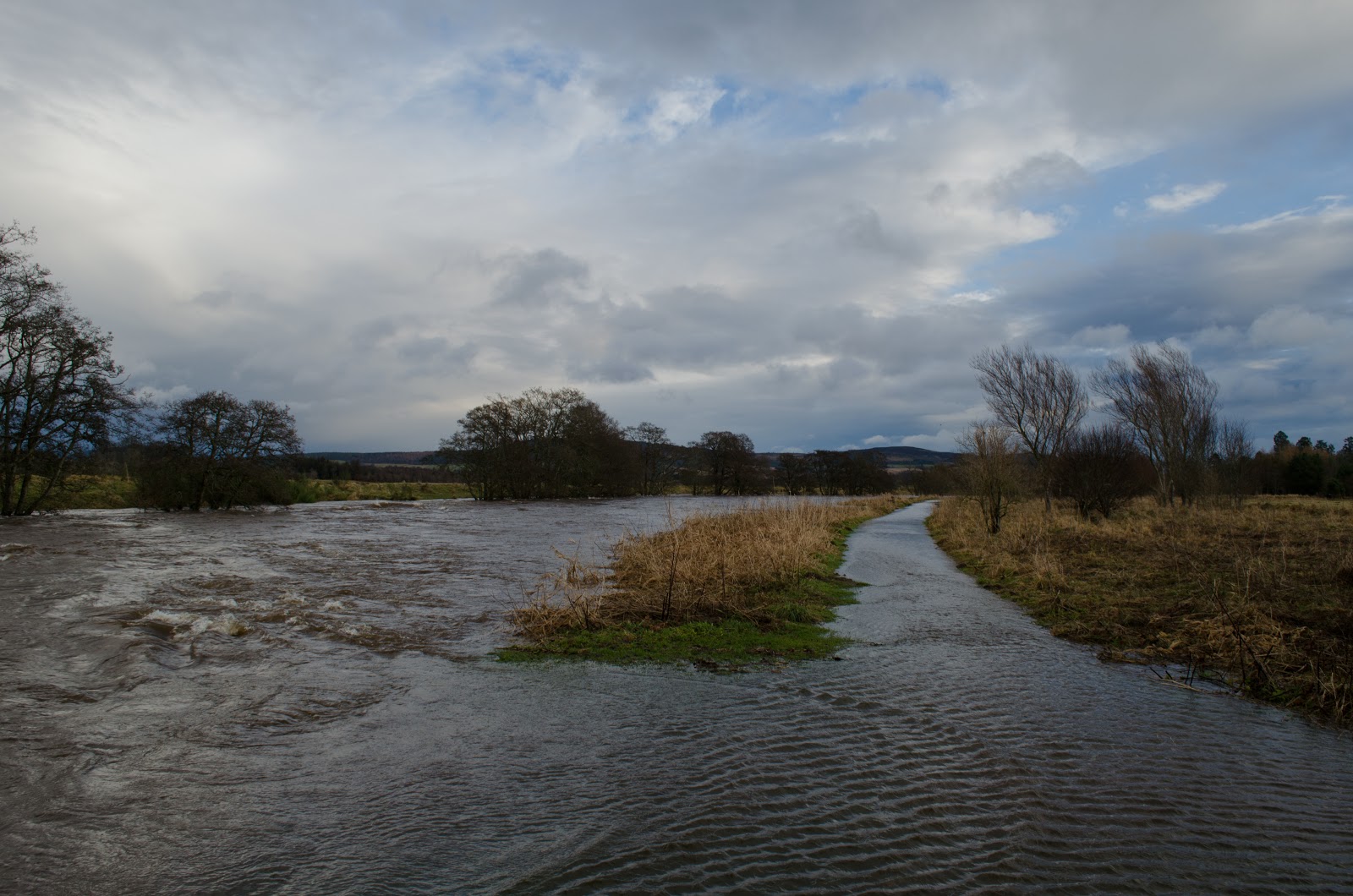
The last few days have seen incessant heavy rain in the north east of Scotland as successive weather fronts stacked up against a high pressure area over Scandinavia.  Unable to progress eastward, the fronts stalled and the rain just kept coming.  On each of the last three days rainfall totals on my weather station have been above 25mm (an inch), with the three day total near to four inches, driven on by very strong southeasterly winds.

On all three days the low cloud level and heavy rain meant that it didn't really get light at all.  Even a short walk was an unpleasant experience in wind, lashing rain and temperatures of about 3.5 Celcius - truly the very worst of all weathers.

The rivers are absolutely roaring, the fields saturated and flooded.  The level at the bridge over the River Don at Montgarrie is very high - further downstream the river has burst whre it enters flatter country.


 The volume of water coming down the Don is astonishing.  There's no massive noise because all the normal features of the river are submerged, just an unsettling sloshing, sucking sort of sound


At last, this morning was rain-free although heavy showers set in later.  In unaccustomed daylight we went to look at the river.  Looking upstream,  it's obvious that much more volume will cause the river to burst here too.  The water coming down the Esset Burn (on the right of this picture) is backing up as it tries to enter the flow.


Looking downstream the width of the river has more than doubled - the flood guage is about three feet below the surface.  The tributary on the right here is actually the riverside path.

Hopefully there will be a respite in the rainfall.

Tuesday, 18 December 2012

A winter wood


Early winter snowfall had come and gone whilst I was away from home working, washed away by a violent weather system which caused damage along the length of eastern Scotland.  In the days which followed the weather was quieter with temperatures a few degrees either side of freezing.

On a calm, cool morning I took a walk in Murray Park, a mixed woodland bequeathed to the community by the poet Charles Murray.  A pale winter sun was struggling to burn away the mist and dampness.  At first, all seemed to be monochrome - a dead winter woodland.


But there's life in the wood even at this time of year, close to the winter solstice.  Lichens festooning the Birch trees with delicate and complex growth, a signal of good air quality.


Colour too. The conifers retain a rich green colour among the brons and greys of the deciduous trees; a branch of this fir catching the light and glistening with moisture.


Stopping to absorb  the wood and to look around, other colours peep through.  The hips of this wild rose bush caught in a shaft of sunlight were fairly glowing.


And nearby, a leaf still clinging to an oak (Quercus petraea) and beautifully backlit.

Green, red and gold, here are all the colours of Christmas in a seemingly lifeless winter wood.

Monday, 3 December 2012

Equipment Review - Lomo Kayak Trolley

This is the first gear review to appear on the blog. I hope to post occasional reviews in the  future, so here's a bit of context:

I consider that I'm a fairly average user of outdoor equipment whilst hillwalking, kayaking and other outdoor activities, and my gear does get regular use.  Inevitably, although I try to look after gear, given that I'm out regularly in Scottish conditions, things do sometimes get used to death - usually by simply wearing out.

 My preferences are for uncomplicated items which do a particular job well; if a piece of gear can perform more than one function, so much the better. Durability and useability are more important to me than saving a few grams. Function is much more important to me than the latest colour or version. Unless otherwise stated, I don't have any connection with the manufacturers or retailers of the kit I use other than being a normal customer/consumer.


A sea kayak trolley is a really useful item to move a loaded boat, for example when the launch point is some way from the nearest road access, when the tide goes out a long way (like here at the head of Loch Hourn),  for getting a boat onto a ferry or for a portage between two pieces of water.  A trolley can open up all sorts of possibilities!

The Lomo Kayak Trolley is a folding design made of anodised aluminium tubing with stainless steel fittings.  Lomo recommend a maximum loading weight of 60kg; the construction is both solid and of good quality.  You need to supply the straps for securing the boat to the trolley; I use the same straps which are used for securing the boat to the car roof.  The Lomo trolley retails at £37.99, which is very good value compared to similar designs.

So, is it any good?


In a word, yes. Loading and using the trolley is easy and it has proved robust and practical. The trolley has foam pads on the upper tubes to prevent movement when loaded.  Once secured (I found that just aft of the cockpit was a comfortable position for balance and ease of pulling along), there is little or no movement even over bumpy terrain.

The wheels are 26cm "wheelbarrow" type plastic wheels with pneumatic tyres.  The tyres have Schraeder valves for inflation.  In typical use it's best not to inflate the tyres too hard in order to find a balance between performance on soft sand and rocky ground.

The 26cm wheels won't fit in a typical round kayak hatch, but fit easily into an oval hatch.  The body of the trolley folds flat for storage or transport - it's unlikely that this will fit into any hatch.  When carrying the trolley on a trip, I detach the wheels and put the folded trolley with wheels into a waterproof bag on the back deck, secured with one of the straps. 


A folding arm helps with solo loading of a boat onto the trolley.  Once loaded, this arm is swung back up out of the way.


The wheels secure to the frame using gate hinge pins.  The ones supplied (left) seemed a bit fiddly, so I replaced them with larger items bought from my local hardware store for 80p each.  The larger pins will catch the Schraeder valve on the wheel, to avoid this simply mount the wheels with the valves toward the inside of the trolley.


I've used the Lomo trolley for about two years without problems.  It's a comparatively simple design and like just about all Lomo products is solidly built.  The fittings and tubing look like they will last for a good long time.  In use, the trolley has performed well on a variety of terrain and has gone easily over some really challenging rocky ground.  If you're looking for a trolley, I can recommend taking a look at this one.