Showing posts with label Kyles of Bute. Show all posts

Wednesday, 13 April 2022

The end of a fine Fyne journey

I woke to birdsong and warm sunshine at our camp near Ardlamont Point.  We ate breakfast while enjoying the sights and sounds of the place.


Donny left earlier in his F-RIB than we did in our kayaks, he wanted to get back to the launch point at Kames at a relatively high tide which would considerably reduce the carrying distance with his boat, kit and outboard engine.  It had been great to do another trip with Donny; his film of the journey is here.


After a leisurely breakfast while waiting for the dew to dry off our tents we packed up too and got underway.  We erased all trace of the previous night's fire, which was lit below the Spring high water line.   There was remarkably little plastic washed up here; it's possible somebody has carried out a beach clean.  We scoured the length of the beach and removed the few bits of plastic bottles and a fish-farm feed bag to take away with us. This beach makes a fine camp site, it's one we'll return to in the future.


The paddle back to Kames was remarkable for the very warm and still conditions we experienced.  We sweated profusely even at a slow pace of travel - in March!  We returned to our launch site late morning and packed up - it was the end of a fine Fyne journey.


 Our journey to Inchmarnock and around lower loch Fyne had been comparatively short in distance - we travelled 64km over two half days and two full days, but had been packed with good things, the most important of which was getting out on a multi-day trip again with good friends and in a great location.  The weather had played a big part in the trip and had encouraged us to arrive at camping spots in the mid afternoon rather than cranking out distance; it was a routine which worked very well.

Ordnance Survey 1:50K Landranger maps 62 (North Kintyre and Tarbert) and 63 (Firth of Clyde) cover the area in which we paddled.  We launched from the concrete slipway at Blair's Ferry where there is parking for several cars across the road from the slip.  The slip itself was built during the Second World War for operating landing craft in preparation for the D-Day landings.  The car parking is on concrete slabs which were the vehicle muster and turning area and the imprint of the I Corps insignia can still be made out, pressed into the concrete ramp.

There are no significant tidal streams to be concerned about on this trip, but Ardlamont Point and Inchmarnock can be difficult places to paddle in strong wind, being exposed to most wind directions.  Ardlamont Point in particular can be a challenge.

Thursday, 31 March 2022

A noisy morning and a quiet day

I slept fairly well at our first camp site, but only until the first hint of light.  the clear, fluting song of a Blackbird singing solo was the start of the dawn chorus, and was a strikingly beautiful sound in the quiet dawn.  What was neither beautiful or quiet were the many geese, a Raven, a Pheasant and several Oystercatchers who joined in soon afterward, a more discordant dawn chorus would be difficult to imagine!

No matter, it was a lovely morning when we emerged from the tents, and surprisingly there was absolutely no condensation on the tents or the ground - quite unusual for this time of year.  The sunrise was a slow and stately affair, the forecast for overcast and hazy but warm conditions looked pretty accurate.  I never underestimate the privilege of waking up in places like this....we were less than 60km/40 miles from the very centre of Glasgow, Scotland's busiest and most populous city and yet we might have been in another world.


The party would split here; Douglas and Mike would head back to Portencross on the Ayrshire coast, Donny would head off to explore in his F-RIB with the possibility of joining up with us later in the day.  Raymond, Allan and I would head back north into Loch Fyne.  It had been great to catch up with everyone - I've so missed these journeys with good friends during the pandemic.


As we paddled back up the west side of Inchmarnock we were accompanied by the noisy neighbours; a flock of Canada Geese and small groups of Greylag Geese.  They allowed us to get fairly close, then splashed their way airborne in noisy indignation to land just ahead and repeat the process - why they didn't just fly around behind us I've no idea!


This was a strange day of weather; neither cold nor warm, calm with absolutely no wind, dry and with soft-focus light.  I'm sure that the conditions subconsciously affected our pace and energy - we all remarked on being a bit lethargic during the day.


At the mouth of Loch Fyne the Ardlamont buoy sat on top of its reflection, perfectly still


I'd had a very distant view of dolphins - which Donny later confirmed as Common Dolphins.  For some years a lone Common Dolphin nicknamed "Kylie" (as he frequented the Kyles of Bute) had made a permanent home near the buoy and had, it seems, been able to communicate across a species boundary with Harbour Porpoises but there was no sign of him when we paddled past.


Near to Ardlamont Point we heard a familiar high pitched chatter and looked along the cliffs to get a great view of a Peregrine Falcon (Falco peregrinus) arcing out over the water before returning to the crags - a really lovely sight.


I got quite tired paddling during the afternoon, maybe out of practice, maybe the strange weather, and took almost no photographs.  We trimmed our plans to head right up into Loch Fyne and instead headed to a beach recommended by Donny as a potential camp site.  Arriving mid afternoon after meeting up with Donny gave us plenty of time to select the best spot and to gather driftwood for our evening fire.


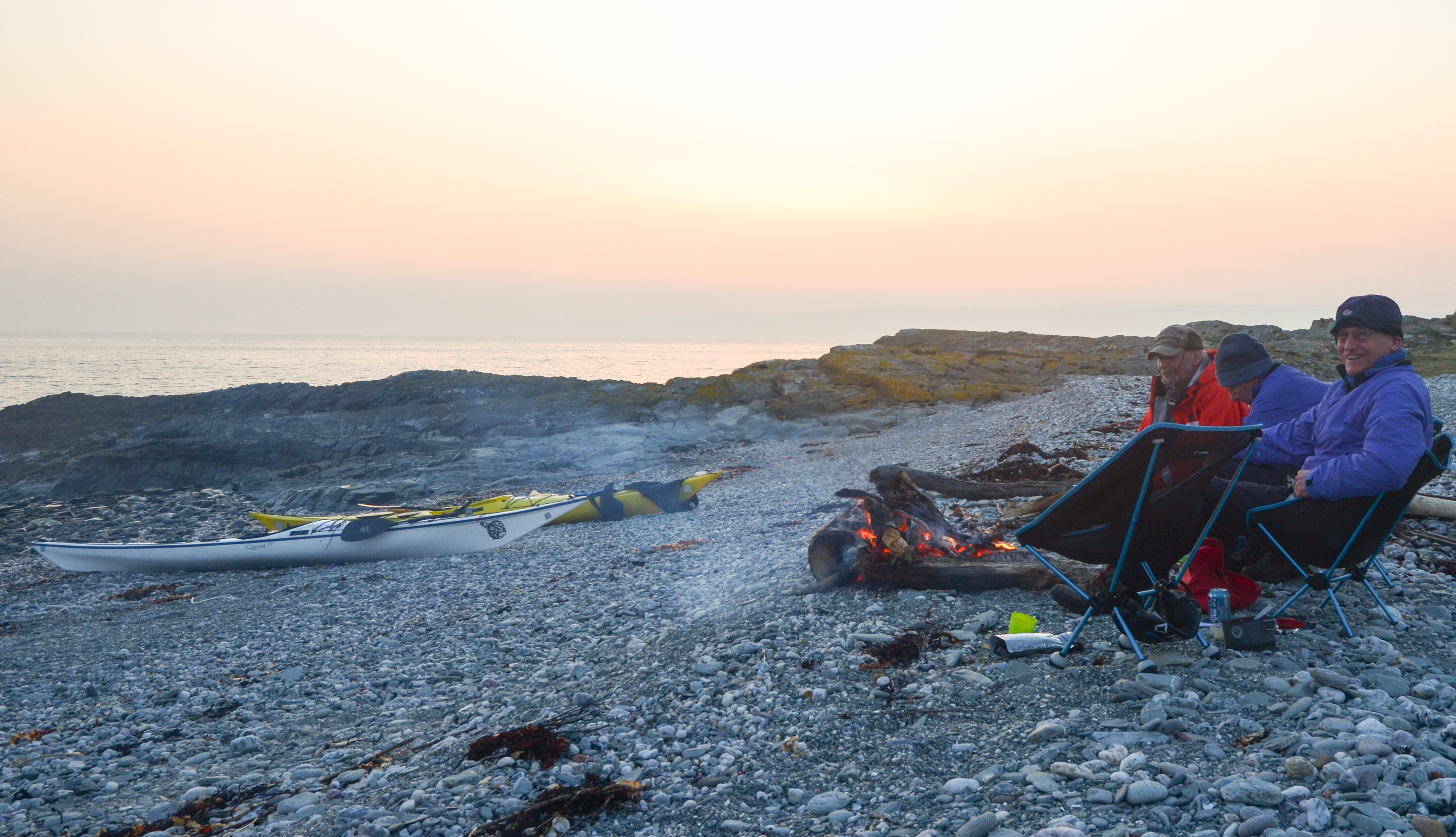
The wood was very dry and lit immediately, soon developing into quite a hot fire.  Purists can relax, the apparent proximity of the can of Brewdog sports recovery drink to the fire is an effect of the camera - the can (chilled in a nearby burn) was well out of range and no Brewdog was harmed during the making of this blog post.


 Dinner was Allan's excellent Venison Casserole, eaten around a fine fire (a Fyne fire?!).  All of us were tired and we headed to the tents pretty early with the promise of another fine Fyne day to come.

Wednesday, 30 March 2022

A very special induction

The third week of March promised some very fine and warm weather in Scotland.  Having studied the forecasts and checked availability we decided on a sea kayak trip over four days and three nights in the Firth of Clyde and Loch Fyne.  Allan, Raymond and I would start near Tighnabruaich in the West Kyle, Donny would launch his F-RIB from the same spot and Douglas and Mike would kayak from Portencross on the Ayrshire coast to join us for an overnight camp.

Our planning was very flexible, there was no fixed itinerary other than getting out on the water for a journey and to enjoy the fine weather.  From previous knowledge of the area we had several potential wild camp sites in mind for our first night and were able to keep in touch through the day to decide which one would work best for our varied starting points and times.

It's a fair drive from Aberdeenshire to Tighnabruaich, but Allan and I made good time and after stopping for brunch en route we were packing the boats shortly after 1pm - Raymond arrived a few minutes after us from his home near Stirling. We noted Donny's car in the parking area so he was on the water already, a message from Douglas and Mike indicated that they had set off late morning and the weather could not have been better....the plan was coming together!


We paddled south down the West Kyle of Bute and past Ardlamont Point into open water at the mouth of Loch Fyne, it was a cracking day to be on the water.


The slight breeze dropped completely as we crossed to the north end of the island of Inchmarnock - a couple of messages exchanged just as we set off had confirmed our meeting point as the south end of the island where we knew we'd get a good camp site provided that it wasn't inhabited by cattle.


We couldn't quite believe the conditions we paddled in...warm sun on the face, a heat haze and perfect reflections on mirror calm water.  All the more remarkable, conditions were due to be similar for the whole week - and the clocks hadn't even gone forward!


We landed at the shingle spit at the north end of Inchmarnock for coffee and a leg-stretch, greeted by this bright orange Seven Armed Starfish (Luidia ciliaris) which was a very neat colour match with the deck of my Cetus MV.  

"Inchmarnock" means Marnoc's Island and is named for the Celtic monk St Marnoc.  His name appears in several other place names in south west Scotland including the town of Kilmarnock.  Near where we landed a stone "cist" or burial container was excavated to reveal the remains of a Bronze Age lady buried with a jet bead necklace and a finely made dagger.  the remains were carbon dated to about 3500 BC and the lady (subsequently named the "Queen of the Inch") re-interred beneath a heavy glass pane.


Rested and refreshed, we paddled at a relaxed pace down the west side of Inchmarnock, sighting deer and a Peregrine Falcon along the cliffs.  It didn't feel like an afternoon to be rushing along.


In fact, quite the opposite, this was an afternoon to take things very easily and to enjoy the beautiful weather.


A call on the VHF radio from Douglas alerted us that we were just a few hundred metres from the beach above which we'd camp for the night.


Image courtesy of Dr Douglas Wilcox

Douglas took this wonderful panoramic image of Allan, Raymond and I just about to arrive at the camp site; I think it really sums up the day and the superb position.


From the water the position is no less superb, a gently shelving shingle and pebble beach with an area of flat turf above.  This place is sometimes frequented by the herd of Luing cattle which are grazed on Inchmarnock - this breed can be aggressive and don't make good neighbours if camping.  It's their home, so if they're around we go elsewhere to camp!


 After putting up our tents and settling in we joined Douglas, Mike and Donny for dinner around the camp fire.  this early in the Spring there was plenty of driftwood for a fire to be lit below the high water mark.  Raymond, Allan and I had each cooked a fresh meal for one night of this trip - we started this evening with a chilli con carne and rice, accompanied with a glass of red wine - no need to rough it!

This trip was significant for a couple of reasons, the first being that this was the first time we'd been out together for some time, and the first overnight trip of the year for most of us.  The second reason was that all the people on the trip apart from me are retired or semi-retired....and I was imminently to retire.  So, this was a very special induction into the club!


Sat by the fire on a lovely evening in a superb location, sharing a dram with good friends....I think I could get to like this retirement thing! 😊

Tuesday, 31 March 2015

A melted fort on a Burnt Island


The final part of our day in the Kyles of Bute was visiting the Burnt Islands, a collection of three small islands at the top of the East Kyle.  We arrived at the largest of the three, apropriately named Eilean Mor (Big Island) just as the tidal stream was turning, but didn't land as the gulls were already in residence and it's a noisy place in the Spring.


The short crossing to the second largest island crosses the narrow navigable channel, marked by red and green conical buoys.  The tide runs strongly here; just five minutes after slack water and the west going stream was already beginning to take effect.


We landed on the smallest of the islands, Eilean Buidhe (yellow island) simply because none of us had done so previously.  The rock on the shore has some wonderful textures and patterns.


The remains of a vitrified hillfort can be found on this island, though the visible evidence isn't too obvious - a low bank enclosing a flattened area.  It must have once been in a very strategic position to control sea traffic through the Kyles although defensivley it doesn't seem to have been very strong.  The main defence now is the profusion of brambles across the whole island - a few weeks later and we wouldn't have been able to reach the fort at all.

In the distance the Colintraive - Rhubodach ferry can be seen leaving the mainland for the short crossing to Bute, a few hundred metres only at this point.  Our cars were waiting at the parking area adjacent to the ferry slip and our short day out was nearly over.   We paddled and sailed just 16 kilometres on this trip, but managed to pack in two luncheons, musical entertainment, great kayak sailing conditions and good company.........


Monday, 30 March 2015

An Caladh - the harbour


On the crossing from Kames back towards Bute we got into the wind shadow of the hills at the north end of the island and the wind died away completely.


The Highland Boundary Fault passes through the centre of Bute along the trench of Loch Fad (Long Loch) and divides the island's geology and landforms markedly.  South of the fault line the land is comparatively low-lying with rolling, fertile farmland pierced by volcanic rocks.  North of the fault line the landscape is most definitely Highland in character with steep slopes, craggy hills and much poorer soil.  We kept close along the shore enjoying the quiet atmosphere and the wader calls as we went.


Near the northernmost point of the island stand the Maids of Bute, two large rocks which were first painted over 100 years ago.  When I first saw the Maids they were decorated in simple red and white colour bands but lately the decoration has become garish, the rocks painted to resemble cartoon creatures.  They're still an interesting and unusual feature of the landscape though!


Turning away from Bute as we passed the Maids, our next destination was An Caladh (the harbour), a protected bay near the mouth of Loch Riddon formed by the close proximity of Eilean Dubh (Black or Dark Island).  The island has been overrun by Rhododendron originally planted on the Caladh estate as decorative shrubs, but the larger trees rising above the choking vegetation host a large heronry.  Any visit here in late Spring is accompanied by the unearthly clamour, shrieks, clacking and hissing of the young herons.


The entrance to An Caladh is marked by a stone light tower which once held an oil lamp, again dating from the heyday of the big estates.  Nowadays the bay is a popular anchorage for yachtsmen transiting the Kyles of Bute. 


At one end of the bay is the jetty once used by Caladh estate, which was latterly owned by the Clark family (of Clarks shoes).  The boathouse and harbour cottages are now holiday homes but one former occupant was an inspiration for the author Neil Munro when he wrote the series of stories featuring Peter Macfarlane, the Gaelic-speaking skipper of a Clyde Puffer - better known as Para Handy


As the houses were unoccupied at the time of our visit we landed on the slipway and took second luncheon on the manicured turf of the jetty.......


           ...including the soup du jour, home-made  Sweet Potato, Butternut Squash & Chili


The jetty is complete with a remarkably well-preserved derrick crane.  Aside from Puffers, yachts and kayaks, other vessels have used the shelter of An Caladh.  During the Second World War, Glen Caladh Castle was commissioned into the Royal Navy as HMS James Cook.  The area around the Kyles and Loch Riddon was utilised to train beach landing and coastal navigation to Landing Craft crews, the name of the establishment is a reference to the new techniques which Captain James Cook introduced to the Navy.

The area was also utilised for the training of X-Craft crews.  Based at Port Bannatyne on Bute and headquartered in the Kyles Hydro Hotel which was known as HMS Varbel, X-Craft miniature submarines were designed to attack shipping in harbours and anchorages, and were used in attacks on the German battleship Tirpitz as well as the sinking of two Italian cruisers.  The four-man crews of these 35 tonne vessels displayed incredible skill and bravery both in training and on operations; in total 39 men were killed serving in X-Craft and 68 awards for bravery were made, including four of the Victoria Cross.  A memorial to the service is displayed at St Ninian's church in Port Bannatyne.

An Caladh is a place which nowadays has a calm and tranquil atmosphere; there are woodland walks nearby and it's well worth a visit whether by water or on foot.


Friday, 27 March 2015

The Craic at Kames


 Having lifted our boats just far enough up the beach to allow luncheon and a frothing sports recovery drink, we adjourned to the bar of the Kames Hotel.  Recently decorated and very welcoming, the hotel bar has a fine view of the West Kyle and we struck up a conversation with a group of customers who'd observed our speedy crossing of the Kyle under sail.  Remarkably, Phil found that he knew some of the same people and so some lively craic ensued.


Our food order of two vegetarian burgers and two home-made beef burgers was fairly straightforward and before long we were sitting down to luncheon.  The hotel is well used to serving yachtsmen, kayakers and divers so a table of four in drysuits didn't even raise an eyebrow.

The folk we'd been chatting with disappeared temporarily, but soon returned with a treat......


....a musical treat.  All four were folk musicians and an impromtu session started as we finished our meal.  Other diners entering the bar were amused to see a band playing with an audience dressed in drysuits singing along!


Such a spontaneous "session" presented us with some difficulty.  It would be great to have another sports recovery drink and listen to the music for a while, but that's how afternoons can become messy!  We imbibe very sparingly when kayaking, and anyway our tidal rise versus carrying distance equations had been quite precise......regretfully we said our farewells and headed back down to the boats.

The combination of location, the welcome, the ambience, food and range of beers makes the Kames Hotel a great sea-kayaking establishment - we score it 12/10; if you're lucky enough to be in when there's a band staying the weekend, make that 13/10  !


Back on the water, we lost the strength of the wind once we crossed over to the northern shore of Bute, leaving just a gentle breeze to to carry the sound of music across from Kames.....

Wednesday, 25 March 2015

A blast in the Kyles of Bute


Whilst visiting relatives on the island of Bute I was able to meet up with David, Phil and Douglas for a paddle.  The weather forecast predicted southeasterly winds of F4-5 so we chose to start our trip at Kildavanan on the west coast of Bute, paddle up the west Kyle and through to finish at Rhubodach at the top of the east Kyle where we'd pre-positioned our cars.  It was a tricky launch through rocks at low water, but this was preferable to carrying the boats for half a kilometre across the sands at nearby Ettrick Bay.


There was already a steady breeze blowing when we started out, so the sails went up as soon as we were clear of the shore.  We made a gentle passage north for a couple of kilometres before I needed to stop at a small sandy beach to adjust the seat in my boat; also the perfect opportunity for a hot drink to warm us up a little....


Back underway and the wind was picking up nicely to give us a good push along. This is sea kayak sailing rather than plain sailing so we kept up a steady paddle cadence but in terms of effort expended it really felt like kiddy-on kayaking in the Kyles!  This seems to me to be the real advantage of a sail on a sea kayak; the opportunity for the sail to assist rather than replace the paddle, increasing speed and decreasing effort in suitable conditions.


We had decided to cross to the Argyll (mainland) side of the west Kyle for a rather specific reason and as the wind continued to rise so did our speed.  Shortly after I took this image we got a sudden increase to the F5 predicted in the weather forecast and simply flew along on a broad reach straight towards the village of Kames.  I enjoyed this downwind blast enormously; the maximum speed we recorded was 14.5km/h or nearly 8 knots; more than twice the maximum sustained speed we could have achieved by paddling alone - and it was such exhilarating fun too!


We sped like arrows towards the Kames Hotel, the large sign outside provides a great aiming point, our speed slackenening only slightly as we neared the shore......


.......indeed David approached at such a lick that we thought he might be aiming to sail straight up the beach and into the hotel....


Once we were landed and the sails were stowed, complex mathematical calculations were conducted to determine just how far up the beach the boats should be carried to allow a relaxed luncheon - conservation of energy being key on a kayak sailing trip :o)