Showing posts with label Flat Earth Kayak Sail. Show all posts

Sunday, 21 July 2019

Home run


The wind was already quite brisk when we got on the water, the warming effect of the mid morning sun more than countered by the cool easterly wind pouring out of Loch Moidart's North Channel.  We've found this to be an area which often funnels wind between the mainland and Eilean Shona, most noticeably in a easterly.


Although our day's paddle would be quite short there was still plenty of time for a stop along the way - white sand beaches are hard to pas by!  This one's a regular stop for us and was one of the camping options we'd considered, but not used.  There's good reason for this; any time in the "season" (although for us this is year round!) the place gets over used by groups.  As this was the second day of a holiday weekend we'd anticipated that it would be busy......


.....and we were't mistaken in that guess.  There were at least eight tents, guides with clients, walkers and a couple of dogs, one of which raced up to us snarling and barking.  Any sense of solitude or a wilderness experience would have been absent here and we were doubly glad we'd chosen Shoe Bay for our final camp.


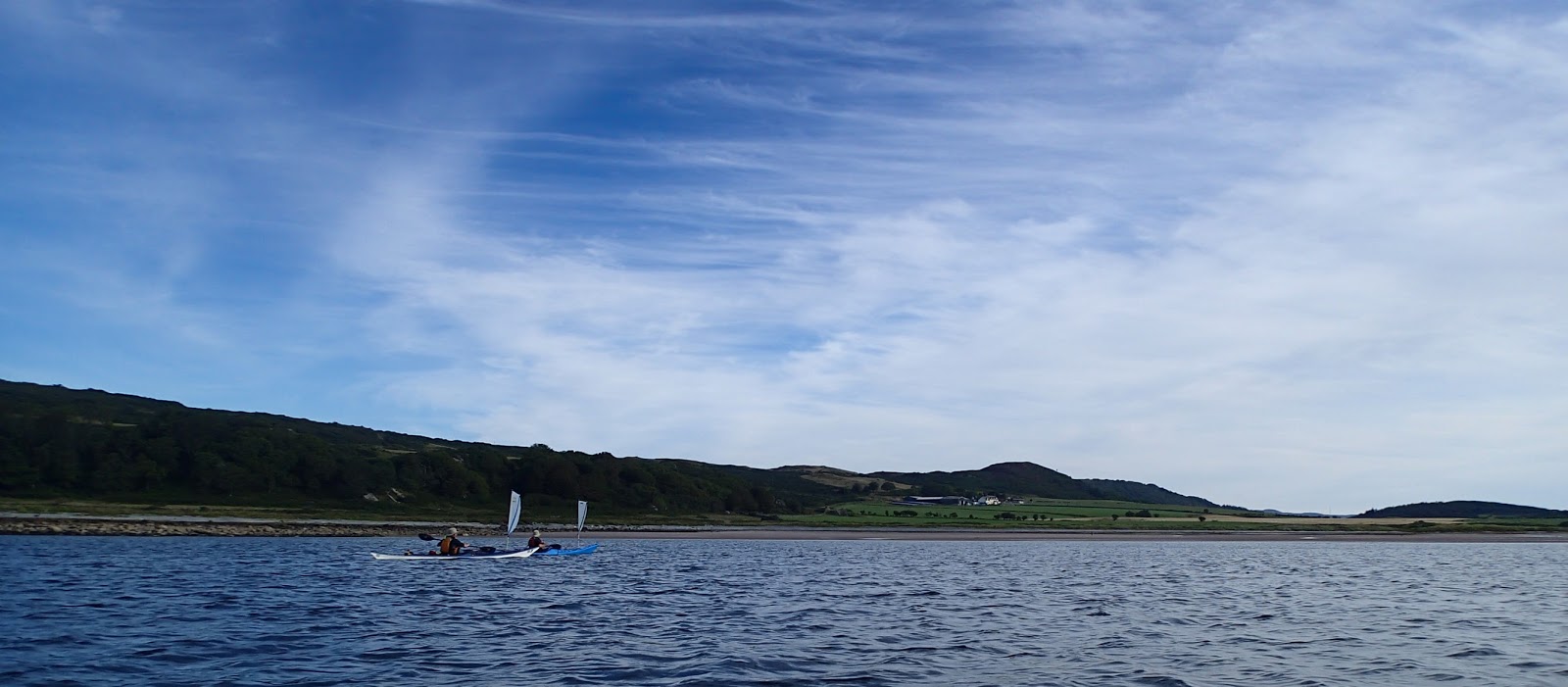
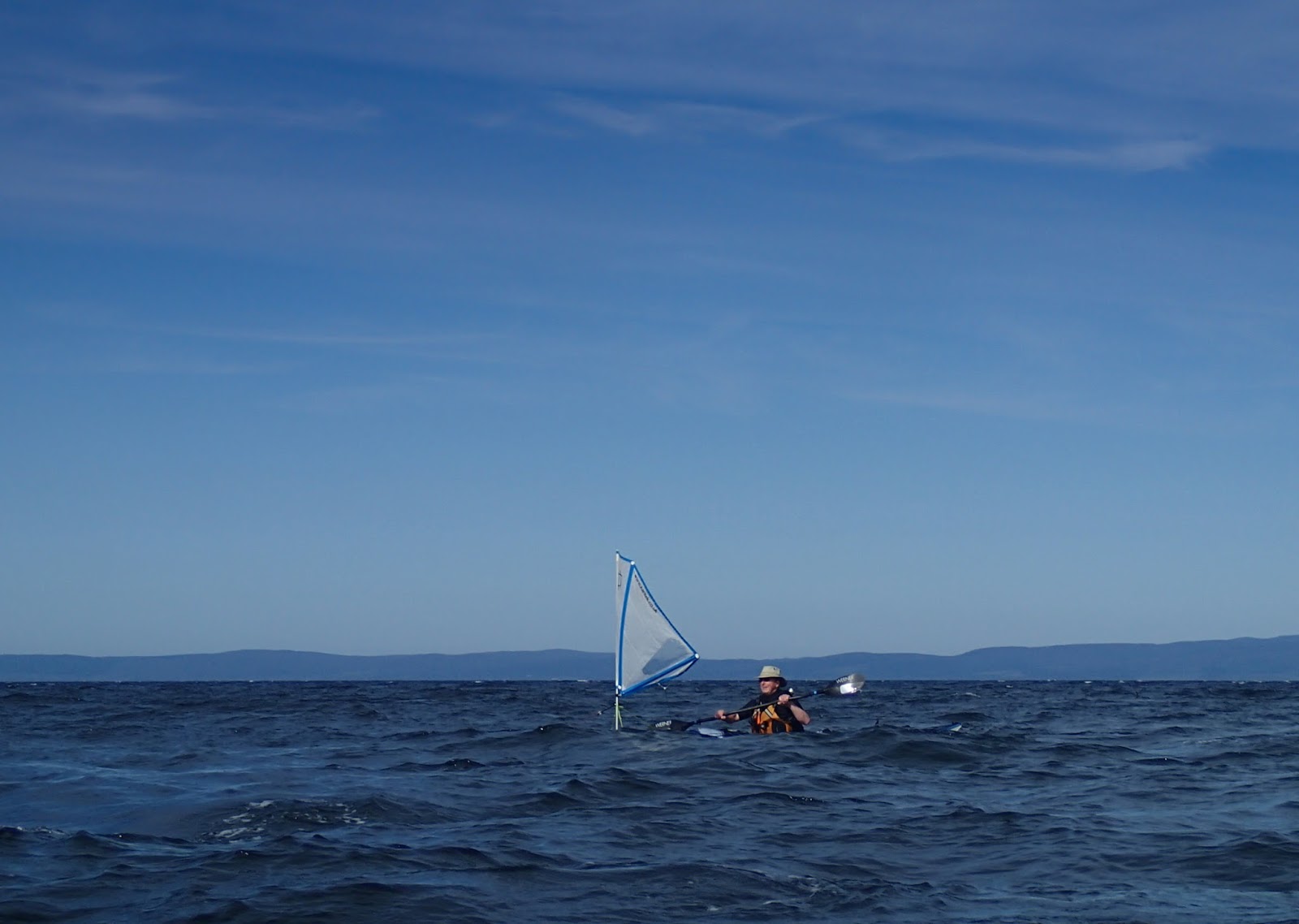
After a break for coffee we continued north, the breeze now at our backs and pushing us up the coast into the Sound of Arisaig.  Douglas was testing the new model of kayak sail from Flat Earth Sails and was driving along at a very brisk rate.  The air seemed very sharp in the southeasterly wind - it was a great morning to be out but we could detect the first signs of the forecast increase in wind speed as whitecaps began to appear to seaward of us.


All too soon we pulled around the corner into the familiar surroundings of Samalaman Bay.  Our trip was over, and it had been another great journey from the head of freshwater Loch Shiel down to the salt of Loch Moidart and the to Loch Ailort. This is a trip we've now enjoyed several times, and it continues to be full of interest.  We've paddled in Spring, late winter and early autumn - and undoubtedly we'll do this journey again, perhaps as a full winter expedition.

We'd run a shuttle down here at the start of our trip and had capacity to take all of us and our boats back to the start at Glenfinnan to recover the other vehicle.  We were very glad we hadn't planned to bring just one vehicle and rely on bringing the others from Glenfinnan.....


...because on the holiday weekend the place was busier than we've ever seen it.  At least two kayak clubs and several small teams were all setting out on their own journeys, there's very limited parking and the road was almost blocked with cars. 

We heard later that the wind had indeed got up during that afternoon and into the following day, pinning some groups where they'd landed and causing others to alter plans, but that all had enjoyed this brilliant sea kayaking area.

Wednesday, 15 May 2019

The colours of St Finan's Isle


We enjoyed a relaxed evening on the shore of Loch Shiel, talking late into a clear evening.  There was a cover of high cloud when we emerged from the tents which merged into mist towards the head of the loch.


Breakfasts of various types were prepared, tents taken down and boats repacked.  We were in no particular hurry but soon enough were getting back on the water.


Not far from our camp site the loch narrows and takes a twist; the water is here between the moraines of the glacier which carved out Loch Shiel.  The shoreline on the north side is used as rough grazing for sheep and cattle, the south shore is quite rocky and forested with spruce.  Gorse was in full bloom, making for a colourful backdrop


As we passed through the narrow twist of the loch a view opened up to Eilean Fhianain (St Finan's Isle).  We wouldn't dream of doing a trip on Loch Shiel and not visiting this fascinating island, so full of interest and history.  You'll notice that in this image it appears greener than the surrounding hills - seen with the eye this is even more marked and the island is a green jewel among the highland scenery.


We landed on a narrow strip of shingle near to the pier on the island to spend some time exploring.  If landing here, it's worth knowing that this little strip of shingle drops very steeply into deeper water really close to the shoreline and can make for an awkward landing if the water level is low.  There's something quite pleasing about the colourful sight of a group of kayaks on a beach!


We left our sails rigged as the breeze was both light and onshore.  All of our small flotilla were rigged with Flat Earth sea kayak sails made in Australia, and we noticed that there was almost a full range of Mick MacRobb's production designs, two versions of the Code Zero, a Tradewind .80, a Footloose .80 and an early prototype sail are all represented in this image.  If you haven't yet tried sea kayak sailing, we can all vouch for how much fun there is to be had!


Our boats weren't the only splashes of colour on the shore of St Finan's Isle - the bright yellow stars of Lesser Celandine (Ficaria verna) flowers studded the grassy shore......


.....while the whole of the steep west slope of the island was carpeted in a mist of Common Bluebells (Hyacinthoides non-scripta) which were just coming into full bloom - a wonderful sight. 

Friday, 2 June 2017

Snakes alive....


We woke at our camp on the Jura shore to a bright morning with a light ENE'ly breeze, just about  perfect weather for a crossing to Colonsay.  Our camp had been on the shore at the left of this image.  Glenbatrick Lodge is on the right, a property owned by Lord Astor and used as a summer house - it's the only real habitation on the entire west coast of Jura.  We kept well away from the house to respect the privacy of anyone staying there, and there's plenty of space to do that.  Up the glen, the iconic Paps of Jura make a striking backdrop.

The previous day had been a fairly long one.  We'd all had long journeys to get to the starting point at Carsaig and had then done a 25Km paddle with a portage across Jura.  A late finish had been rewarded though, we were in a great position to cross to Colonsay and to make our planned camp for the following night.


 The first stage of our journey to Colonsay would take us to Rubha an't Sailein - the name is possibly point of the sea-inlet and it's sometimes named as Ruantallain.  We planned to take a leg stretch and a comfort break there prior to the crossing to Colonsay.


 The north shore of Loch Tarbert has more splendid examples of raised beaches - once they're recognised as raised beaches the shape of the land during the ice age can be glimpsed.


 We landed at a sandy beach backed by grassy ground.  This had been considered as a camp site but Douglas was reluctant to camp here, on a previous occasion he'd seen many Adders.  Sam wandered up to take a look at the private bothy, and Maurice and I were following when, just above the beach, I glimpsed movement as I was about to put my foot down on a female Adder.....

The beautifully marked snake had curled into a defensive posture and I just managed to hop aside without standing on her. A relatively small Adder at about 30cm, she stayed stock-still for a few moments before darting into longer grass.  I'm not at all scared of snakes, but we decided not to venture further through the grass as there would likely be others warming up in the morning sunshine.  Adders are Britain's only venomous species of snake, and this was no place to be dealing with a painful bite!


 The crossing from Ruantallain to Oronsay, the tidal island at the south of Colonsay, is 15 km.  A breeze from across our right shoulders and low swell gave perfect kayak sailing conditions, and we enjoyed a great sail with spray bursting from our bows in the bright sunshine.

The sailing rigs meant that we completed the crossing in under two hours at an average speed approaching 8 Km/h, much quicker than if we'd paddled without the sails


 Sam doesn't (yet) have a sail, but with his youth and strength plus a background in marathon paddling he was able to stay with us.  As the breeze was fairly steady, we could drop our speed occasionally in order that we didn't get separated.

We headed straight for a prominent white sand beach, seen from right at the start of the crossing, and gradually it gained detail as we approached.  We were soon in turquoise water with white sand visible beneath the boats.......


 ....pulling around a reef we made first landfall on Oronsay.  We had arrived!  Sea kayaking to a new island is always a special thrill for me, and these islands have been high on my "must do" list for some time.  We found a spot out of the breeze with a view back to the Jura skyline and enjoyed a leisurely luncheon in the warm sun.


 The tide was approaching low water and it was nearly Springs - there was no possibility of paddling between Oronsay and Colonsay as the channel dries to reveal a large expanse of sand.  Besides, the paddle around Oronsay promised to be great.

The east side of the island is largely white sand beach backed by machair - stunning in the bright sunshine.


 At the south of the island we were able to pick our way through a series of rocky channels to gain the west coast.  A deep thrumming noise from astern proved to be a Coastguard helicopter overflying the island.


"G-MCGG" is a Sikorsky S-92 operated by Bristow's on behalf of HM Coastguard, operating from Prestwick in Ayrshire.  With a crew of four and an endurance of over four hours, it's an impressive aircraft.  I reflected that in the worst case, if I'd not avoided that Adder I might have required to be a passenger in her rather than a spectator as she flew over!

Monday, 2 May 2016

Small sails and tall sails on the west coast of Jura


From Shian Bay we continued south along the coast towards the mouth of Loch Tarbert, the large west-facing sea loch which almost bisects the island of Jura


The light breeze helped us along a coast full of interest


Towards Rubh an t-Sailein (point of the inlet) at the northern side of the mouth of Loch Tarbert the hills recede and the shoreline is littered with remnant basalt dykes.  From a distance these looked like chortens built on a huge scale.


Ahead, the Paps of Jura were coming into view and would be our companions for the next two days.  There's a bothy near the point but it was still early and we had a different destination in mind. And anyway, the afternoon sun was high and warm, the sea sparkling.......


......and occasionally stunning aquamarine shades as variety to the blue.  What a place this was to sea kayak!


We passed small beaches squezzed between the walls of dry coves; pretty much inaccessible from the landward side.


Ours were not the only sails in use off Jura that day, a fine looking tall ship was emerging from the Sound of Islay on the flood tide, making good progress under a minimum of sail. 


She's the "Stavros S. Niarchos", a 60 metre, 635 tonne brig (a two masted sailing ship with square sails on each mast).  She can carry 18 sails with a total sail area of 1,162 square metres - slightly more area than our 0.8 square metre Flat Earth Kayak Sails!

The Stavros Niarchos is owned and operated by the Tall Ships Youth Trust, and is used for sail training and also for voyages by fare-paying crew which help to subsidise the work of the trust.  Despite her very traditional looks, Stavros Niarchos is a comparatively new vessel, being completed and entering service in 2000.  She made a really fine sight on a sparkling sea against the Islay shore.


As we crossed the mouth of Loch Tarbert we could look over our shoulders to a huge raised beach on the northern shore of the outer loch.  We could clearly see what the coastline must have looked like at the end of the last Ice Age with pebble beaches and rocky inlets.


Once across the entrance to Loch Tarbert we could slow our pace.  The flood tide which had carried the Stavros Niarchos through the Sound of Islay had some time to run, and we planned to use the ebb to speed our own passage once the tide turned.  Time for a leg stretch on a little sandy beach which would be a stand-out spot in many places, but here on the coast of Jura was just one of many glorious beaches.

We'd enjoyed a superb paddle already, and it was still only early afternoon - explored the wild and lonely NW coast of Jura in superb weather; and if anything the features on this wonderful coast were about to get even better!

Monday, 24 August 2015

Blue boats blasting back from Bute


We woke at our camp on the west coast of Inchmarnock to a bright blue day with a WNW breeze to keep the midges away; it looked a perfect day for sea kayak sailing.  After breakfast we moved the boats down to the water - one portage strap is a really useful aid to allow three people to move a loaded boat - and prepared to get going.  Starting the day in a location like this is one of the real joys of camping from a kayak :o)


Straight from getting launched we hoisted sails to catch the light breeze.  The colour palette on this morning was most definitely blue; sky, sea and Douglas & Mike's boats all in harmony!


A relaxing and gentle sail downwind took us directly to Ardscalpsie Point on the island of Bute and then around Scalpsie Bay with its resident seal population.  The name "Scalpsie" indicates a place where scallops (shellfish) can be found and that's certainly the case.  When we lived on Bute the beach was a favourite walk and there's a seal viewing point on the road above the point.

As we came out of the bay we immediately noted a freshening of the breeze from a F2-3 to much more like F3-4.......


...let the fun begin!  Our speed rapidly increased with the wind strength while the quickly building small swell was the perfect height and length to enjoy some surfing rides.


I'm by no means an experienced paddle sailor but do have some dinghy sailing experience from many years ago.  My immediate impression of the FEKS Trade Wind sail was that in these conditions it pulls hard and strong and with a bit more drive than the Code Zero I'd previously borrowed from Douglas.  The drive was steady and predictable...and a whole heap of fun!  This is when sea kayak sailing really comes alive - continue to paddle hard and the boat speed can be adjusted to catch each swell.  The blue boats blasted back past Bute.....


......flying past the distinctive volcanic outcrops at the south end of the island; this one reallylooks like the dorsal fin of the porpoises we'd seen the previous afternoon.


The swell had built quite quickly as the wind blew across the Sound of Bute.  Mike had recently completed some rather skillful fibreglass repairs to his Cetus MV, and although at times we lost sight of his boat, Douglas and I were confident that he was just temporarily between swells!


As we rounded Garroch Head at the south end of Bute we came into the wind shadow and out of the swell - thins slowed from the exciting run we'd enjoyed and we paddled ashore at Glencallum Bay for second breakfast.  As we left, a couple of folk camping on the shore were lighting their fire using what appeared to be a fairly incendiary material....


The wind dropped to a very light breeze as we headed past Rubh'an Eun (point of the birds). The small light here marks the port hand side of the main channel for vessels bound for the upper Clyde and flashes red every six seconds.


The blue theme of the day continued as we headed across the Clyde towards Great Cumbrae in what had become a glassy calm and very warm afternoon. A large submarine headed down the Clyde and out to sea as we paddled along the coastline.  It had an escort of two large RHIB's which we thought might be manned by Royal Marines.  This thought was reinforced when both boats roared back up the Clyde having escorted the submarine out of the Cumbrae Gap with Meat Loaf's "Bat Out of Hell" blasting from a speaker system!


Our final stop was on the pebble shore of Fintray Bay where we enjoyed first luncheon before rounding the north end of Great Cumbrae for a final gentle sail down to the marina at Largs.

We'd been out for a fraction over 24 hours but what a great mini-trip!  In twenty four hours we'd enjoyed the wildlife of the Clyde with porpoises, Gannets and Shearwaters aplenty; had a super wild camp in a place which seems utterly remote from the bustle of a big city just 45 kilometres distant; we'd visited four islands and had the most superb "blue day" blast under sail. You'll be able to read about this trip in "Sea Kayak Stereovision" at Douglas' blog starting here.

To just head out with a couple of like-minded friends on small trips like this is absolutely one of life's joys.  I'd been away a long time...it was so good to be back.


Saturday, 16 May 2015

Blasting back to Morar


I'd previously only paddle sailed in open water, but now we threaded our way through the maze of channels in the Airsaig skerries under power from the wind.  A new experience but very rewarding and great practice for me; my 40-years-ago dinghy sailing skills were slowly recalled and put to use as we went from beam reach to dead run to broad reach around the rocky islands.


Turning out of one rocky channel we were about to pass a tiny sandy beach backed with a rocky shelf.  Too good to miss, time for second - or perhaps third - luncheon.  Our sails remained hoisted as we were sheltered from the breeze in the lee of the rocks.  It's not so easy to see but there are three different versions of the Flat Earth Kayak Sail (FEKS) on display here - the biggest difference can be seen at the head of the sails where they meet the roach (the rear part of the sail away from the mast).


We were soon back on the water and heading out through the last of the Arisaig skerries towards the open water beyond Eilean Ighe.  Our route down from Morar had been entirely against a steady southwesterly breeze and had at times been quite hard work, but all that effort was about to be repaid.....


Image by Douglas Wilcox

......as we were simply blasted back northwards along the Morar coast.  The wind was at the bottom end of F4 and relatively steady in direction and speed, just perfect for sea kayak sailing.  We made excellent time, covering the 7km run from the north end of the Airisaig skerries to the mouth of the River Morar in a shade over 45 minutes, giving an approximate speed of around 10km/h, or double "normal" paddling speed.

I'd already pretty much decided that I'd be getting my own sail, all my sailing until this point having been done using a rig borrowed from Douglas.  This superb run just confirmed things - a sail is on order :o)

The major thing for me when considering whether or not to take up sea kayak sailing was that the advantage had to outweigh the faff of rigging a sail and the extra clutter on deck. As a professional seafarer, loose bights of line really trigger my OCD! Safe to say, the advantage (and sheer fun) most definitely does outweigh the faff/clutter. Oh, and don't listen to anyone claiming that sea-kayak sailing is somehow "cheating" (cheating what exactly?!) - these will likely be the same folk who buy a kayak with hull speed as a major consideration.....


All too soon we turned the corner back into the estuary of the River Morar and into the shelter of high ground.  As we paddled back up to our starting point in serene sonditions and in a light rain we reflected on not only what a great day we'd had, but what an outstanding trip it had been, starting at Glenfinnan and journeying to the head of Loch Ailort (taking in a solar eclipse en route) before tagging on this super day trip.