Showing posts with label skyscapes. Show all posts

Wednesday, 3 January 2024

A Winter Light Show

In late December there was a wonderful display of Nacreous Cloud in the skies over Aberdeenshire.  From before sunrise the ethereal colours and effects were evident and continued to varying degrees all day.


Nacreous (mother of pearl) clouds need really specific conditions and are consequently rare phenomena:  the cloud needs to be very high at 10-20 miles above the earth's surface, the air at that height needs to be very cold (below -80 degrees Celsius) and a very low sun angle.  They're also known as Polar Stratospheric Cloud (PSC) and the particular ice crystals forming the clouds refract the low sun at an angle down to earth.  Because of these specific conditions, nacreous clouds are usually only seen in northern polar regions in winter, or when the polar upper atmosphere vortex sinks south, which was what gave rise to this lovely display.


The ice crystals in Nacreous clouds are smaller than those in lower cloud types and can often be composed of atoms of nitric acid and water ice - this combination can combine to release chlorine atoms, so they're not entirely good things!

That said, as the sun began to set in mid-afternoon the colours of the clouds intensified and the shapes changed...it was a captivating sight.


 The most intense colours happened well after sunset when the clouds were still being lit by the sun which had left the surface and was shining at just the right angle - simply stunning!

Saturday, 22 August 2020

Clouds and colours - a morning on Loch Ewe

The first paddling day of our trip to Loch Ewe started with a mirror flat sea reflecting an amazing cloudscape - I think these are altocumulus clouds.  The effect built quite quickly and then the cloud began to dissipate just as rapidly.


By the time we set out from Firemore the cloud had largely broken up.  We paddled out into the loch and straight away a long view opened up to the distinctive skylines of the Torridon mountains.


It was a marvellous morning to be out on the water!  Our route took us northwards along the west shore of Loch Ewe towards the open sea, which looked to be as calm as the loch - our boats simply slid along with little effort.


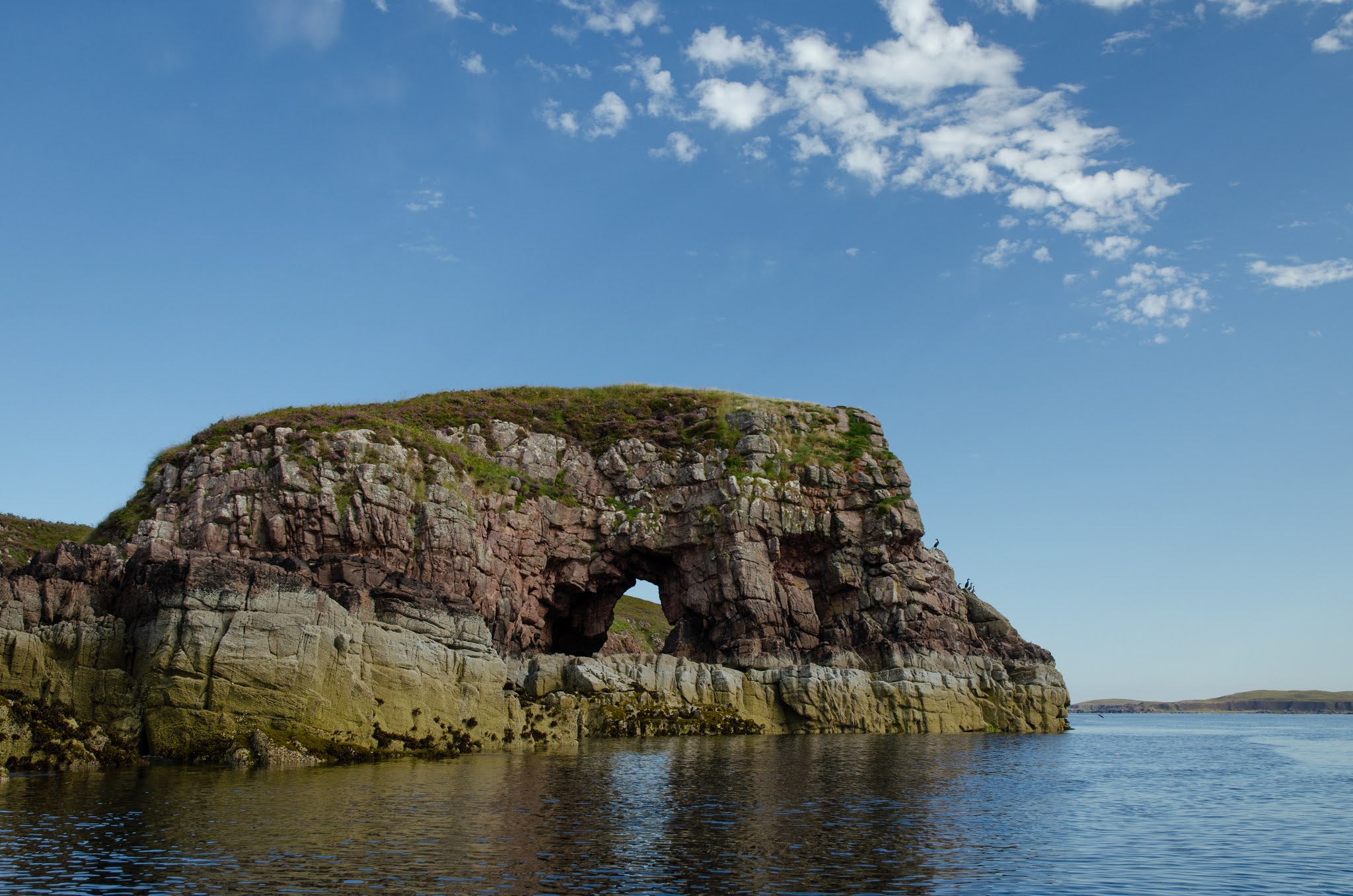
We enjoyed exploring some rocky channels below Meallan Na Gamha (also named Stirkhill on the map - the meaning is the same in Gaelic and Scots, "little hill of the yearling cattle") and then across the bay came upon this arch, high and dry.  As we were here near low water, we noted the place to explore on our way back when the tide would be somewhat higher.


As the morning progressed and the sun move higher the colours were simply stunning.  Most of this area is composed of Old Red Sandstone which is a warm reddish-brown - against a deep blue sky and the vivid colours of yellow lichens and green summer growth it was a very colourful.


Allan found this tiny cave, not more than half a metre across, which was half submerged but seemed to go back a fair way into the rock.  When the gentle swell from the open sea washed in, there were all kinds of gurgles and hisses before a plume of water shot out, expelled from the back of the cave - which I totally failed to capture on camera!


We soon found ourselves at Rubha nan Sasan, which has the remains of a coastal battery and searchlight battery dating from 1941 when Loch Ewe was one of the main assembly points for the Arctic convoys which headed from here up to Murmansk and Archangel in northern Russia.  Two 6-inch guns, other lighter calibre guns and two searchlight emplacements were mounted here to protect the shipping within the loch.  In 1999 a memorial stone was erected at Rubha nan Sasan to mark the sacrifice of those from allied navies and merchant seamen lost on these perilous convoys.

Wednesday, 20 May 2020

One good thing - 18th and 19th May 2020


The sunset on the evening of 18th May was nothing short of majestic.  What began as a faint pink blush in the sky suddenly developed into stunning shades of amber and molten gold.  The sunset is now in the northwest here in Aberdeenshire, the bearing approximately 310 degrees or 40 degrees north of west.  In a month, at the solstice the sun will hardly dip below the horizon before it skims up again in the northeast.


The development of colour in this sunset was really quick; presumably an effect of underlighting as the sun dropped below the higher ground. Whatever the cause, the effect was marvellous!


This image was taken at 21.32 - just five minutes later the light show was all over and the colour had drained from the sky.  On a beach facing west with a horizon view on the west coast, the colours would have lingered for hours; here it had been fleeting, but very special.

Monday, 27 April 2020

One good thing - 27th April 2020


After more than five weeks with no rain, the sunset on 26th April promised a change in the weather - and so it's proved.  A cold northerly airstream has taken temperatures down and it's been a day of heavy showers and bright sunshine - typical for April really.  This should turbo-charge growth in the fields and gardens - and, unusually for Scotland, rain is a good thing and welcomed!

Wednesday, 15 April 2020

One good thing - 15th April 2020


The skyscapes over the last 24 hours have been absolutely beautiful.  Sunset on 14th April was characterised by streaks of cloud lit to vivid shades of orange, pink and gold.


The final crescendo a searing ember glow which perfectly silhouetted a stand of Larch trees on the skyline.


Today's skies saw an unusual pattern of high clouds, I think Cirrus and Cirrostratus, forming bands across a blue sky.


Near the edge the clouds were starting to form a pattern which looked more like Cirrocumulus.  These patterns were above us most of the day as a cold front approaches the north of Scotland - I expect tomorrow's skyscape will be somewhat greyer!

Monday, 6 April 2020

One good thing - 6th April 2020


The best thing about today has been the variety and quality of light throughout the day and into the evening......


Early morning saw showers and stroboscopic lighting effects in the wake of a cold front which passed over northeast Scotland overnight.  Clouds racing overhead alternately lit the view with dazzling, intense colours, then switched off the light to leave a muted version of the same scene.


After a mainly bright and breezy day the wind dropped towards evening and a slow-burn sunset underlit a cloudbank with gold and bronze.


Tonight's full moon was high in the sky before sunset, adding pale light to the most delicate of pink shades in the air.


While back to the west the cloudbank dissipated in the cooling air as if it had never existed, leaving just a hint of the sunset projected into the sky.

As I type this post a full hour after sunset, the same piece of sky is a colour somewhere between jade green and lemon; gorgeous but beyond the camera to capture.  The light (in Gaelic "solas") has absolutely been one good thing about today.

Tuesday, 7 January 2020

Skyscape spectacular

The skyscapes above Aberdeenshire have been really spectacular over the last week, providing colour and drama in equal measure.


The last sunset of 2019 was a thing of delicate beauty washing the sky with mauve and pink - on a Hogmanay walk we stopped often just to watch as the quiet shades subtly changed.


On 2nd January the palette seemed the same at dawn, but this is looking west - away from the sunrise.  To walk around the house was to experience something really special......


...an absolute riot of pyrotechnic colour and dramatic cloudscape.


Unusually, the colour deepened as the sun rose and began to be diffused by horizon cloudbanks.  It was an absolutely gorgeous sight and seemed unbeatable.  Sunrises here in the northeast can be more spectacular than sunsets as we're closer to the east coast and have less high ground to block the view.  But this sunrise was to be matched in glory by the sunset of 5th January. 

The western and southern parts of Scotland were generally overcast but over Aberdeenshire the edge of a weather front was really clearly defined in a cloud edge.  We were driving home from a trip south and watched as the sun fired this cloud front, colour raging across the sky......


It was almost apocalyptic!  This series of images were taken on a smartphone and like those above have had no post-processing at all, they're just as they came from the camera.


It's hard to put into words the sheer majesty of this skyscape.  We pulled to the side of the road to watch and to take photographs, as did most of the other cars travelling at that time, it was such a special sight.  Turbulence in the cloud was picked out by the low sun and the whole thing seemed to pulse and ripple with fiery intensity.


As the sun sank lower the colours changed subtly but the scale didn't diminish at all.  Flocks of Rooks wheeled up off the farmland as dusk rapidly approached and started to head for their tree roosts, which sparked a thought.  We drove on a little and stopped where we hoped to enjoy the last of the sunset.


By the side of Loch of Skene we stood and watched the intensity of the colour burn from gold to copper to deep bronze and then to purple, all reflected in the water.  Then, the sound we'd hoped for to go with the visuals: geese in small groups and then hundreds and then in their thousands winged in from the surrounding countryside to roost safely on the water.  Long after the light had dimmed we heard their wild calls and splashes as they flew in.  Although too dark for photographs, the last of this exceptional sunset was still a wash of deep bronze an hour after sunset.  In these two sunsets and one glorious sunrise we'd been treated to a real show of Solas (light) in the middle of winter.  Nobody can convince me that this season is a dark and dreary time!

Friday, 27 July 2018

Laid down at Bay of Laig


The west coast of Eigg is just as spectacular as the east side, great cliffs providing a backdrop to the shoreline. We had a spot in mind to camp and paddled steadily southward towards it.


A party of kayakers had set up camp on level ground above a boulder beach - a great location with a good view, but neither Mike or I thought it would make a good landing or launching spot with heavy boats, and would be difficult to leave if the swell got up on this exposed coast.


Our firs option for camping was at Camas Sgiotaig, but as we rounded the point which forms the north side of the bay, we became aware of a low but powerful groundswell pushing up the Sound of Rum from the open Atlantic.  The swell was roaring across the reef of Bogha na Brice-nis - which I didn't capture very well in this image.  We were already noting that the swell direction was straight into Camas Sgiotaig when we spotted that a lone kayaker was already camped on the shore above the beach.  A slight concern for the swell combined with not wanting to disturb an idyllic camp for someone else made our decision - we would push on a little further to our second potential camp,with the option to return here if necessary.


A couple of kilometres further on we landed at Bay of Laig in flat calm, the swell wasn't reaching around into this bay.  It had been a long day of paddling, some 36km and nine hours since leaving Glenuig, but what a great day it had been.  We quickly found an ideal camping spot and pitched our tents before the slight breeze died completely and the first midges we'd seen this year came out to play - the warning of the Yellow Flag Iris had been correct!

The houses in the distance are at Cleadale, and I was able to pick out Lageorna, the wonderful B&B which Douglas and I had stayed in on our winter trip.


As the sun set, the outline of Rum was reflected in beautiful shades below a soft cloudscape, just lovely.


We gathered a little driftwood to add to some logs we'd brought with us, and with the use of a Wilcox Ignition Aid(TM) we soon had a fire lit, the smoke going some way to deter the midges. 


We lit the fire well down the beach to avoid any risk of stray sparks igniting the tinder-dry ground; and due to the location of our other camps on this trip it would be the only fire we'd light. Fire lit, sports recovery drinks to hand and dinner consumed, life was particularly agreeable -  the midges even gave up after an hour or so to allow us out of our protective mesh jackets.


Our last view before turning in was the faint afterglow of a sunset reflecting on the wet sand in the late evening dusk.  I was asleep almost as soon as I lay down and slept soundly in this wonderful spot.

Thursday, 4 January 2018

A big sky day on Culblean Hill

My last hillwalk of 2017 had been on Morven above Cromar in Aberdeenshire. Whilst descending from Morven I'd looked over to a lower hill which I thought would give some great views. Culblean Hill isn't on any main hill listing, and there are very few references to it on the usual internet sites.

On 3rd January, Allan and I planned to climb Culblean Hill as our first hillwalk of the year and drove the short distance to near Loch Davan.  The roads were very icy and tricky, as was the track heading up to Redbush and onto the moor - the same initial route I'd used to climb Morven six days previously.


The freezing rain which was making conditions slippy on lower ground had been falling as snow higher up the hill - Morven looked splendid in dazzling white; the cloud off the top unlike my ascent just prior to the turn of the year.


An estate track leads high onto the moor between Morven and Culblean Hill - at the highest point we left it and headed SW up a gentle dome of short heather.  The view as the high point of the track is reached opens out suddenly - a real "wow" moment, and just kept getting better as we climbed higher.


The cloud moved away from Morven's summit to leave a simple colour scheme of brilliant white and sky blue; we were in bright sunshine but now in a chilly breeze so didn't linger too long, despite the frequent stops for me to take photographs......


.....and really, the views were worth stopping for!  The giant sprawl of Ben a'Bhuird and Ben Avon  to the west were flawlessly white under deep snow cover, thoughts of ski touring came straight into our heads!


To the south, Lochnagar's corrie looked magnificent, the line of my most recent climb on that queen of mountains clearly visible where the low sun brushed the ridgelines.


Culblean is in no way a high hill, but it has in abundance the "big sky" feel of the hills hereabouts.  We were able to stroll across the gentle slopes of the summit area on frozen ground with a covering of powder snow, under a huge expanse of sky.


I'd guess that this hill is pretty rarely climbed - we were certainly the first walkers of the year to come here.  The 604 m/1982 ft summit itself is marked by a small cairn of pink granite blocks.......


......a nice contrast against the blue and white of Morven across the bealach.


The combination of small stature and being separated from nearby hills, the summit still gives super views.  A cloud sea rolling over Lochnagar as fresh snow swept in.......


In the eye of a searing winter sun, the most easterly of the Munros, Mount Keen was a distinctive silhouette. It's been several years since I've climbed Mount Keen - I made a mental note to try and rectify that in 2018!


There's a Trig Point on Culblean Hill, but it's some 2 kilometres north east of the summit and some 127 metres lower....which we figured must mean that there would be an equally good view from there.  We headed off to find out, stopping en route on a sunny slope out of the breeze to have our lunch.

Each trig point was specifically sited where it would have sight lines to at least two others, mostly on prominent points.  This one (S8709 for those who "bag" the trigs!) commands a great view of the Dee valley.....


......especially upstream to the west over Ballater and beyond to the high Cairngorms.


Below our feet was Loch Kinord on the Muir of Dinnet, one of two shallow lochs (the other is Loch Davan) formed when giant pieces of ice from the Dee valley glacier were stranded and melted out to form "kettle lakes".

Loch Davan was our aiming point back to the road and we headed downhill on an ESE line.  We can't claim this was the best descent - thick heather on a steep slope led to a boggy area then dense woodland before we met the track back to the road.  A much better descent would have been ENE to the north edge of a wood, then down the heather slopes to the track.

Our first hillwalks of the year had been to a hill which seems almost unfrequented - but which offers superb views and is well worth the modest effort to climb it.

Our route was just less than 10 kilometres with 490 metres of ascent.  We started and finished at the track leading from a minor road connecting the B9119 and the A97 at NJ 431023 - the whole route is on OS Landranger map 37 (Strathdon & Alford).