Showing posts with label Grahams. Show all posts

Friday, 1 January 2021

First footing

New Year's Day dawned raw and cold, but mainly dry - a contrast to the grim conditions of the previous day.  Whilst "first footing"  family, neighbours and friends isn't allowed this year due to Coronavirus restrictions, first footing a local hill could certainly go ahead.

I chose Lord Arthur's Hill, the highest of the Correen Hills, partly because it's very close to home but mostly because during the most restrictive part of 2020's lockdown when travel was severely curtailed these were my "go to" hills and gave such a lot of space and exercise.


The approach track was very icy, higher up on the hill the snow was quite deep but sugary.  Sub-zero temperatures forecast for the first week of January will harden it and make for easier going than I experienced. Snow showers came and went as I climbed into the cloud.


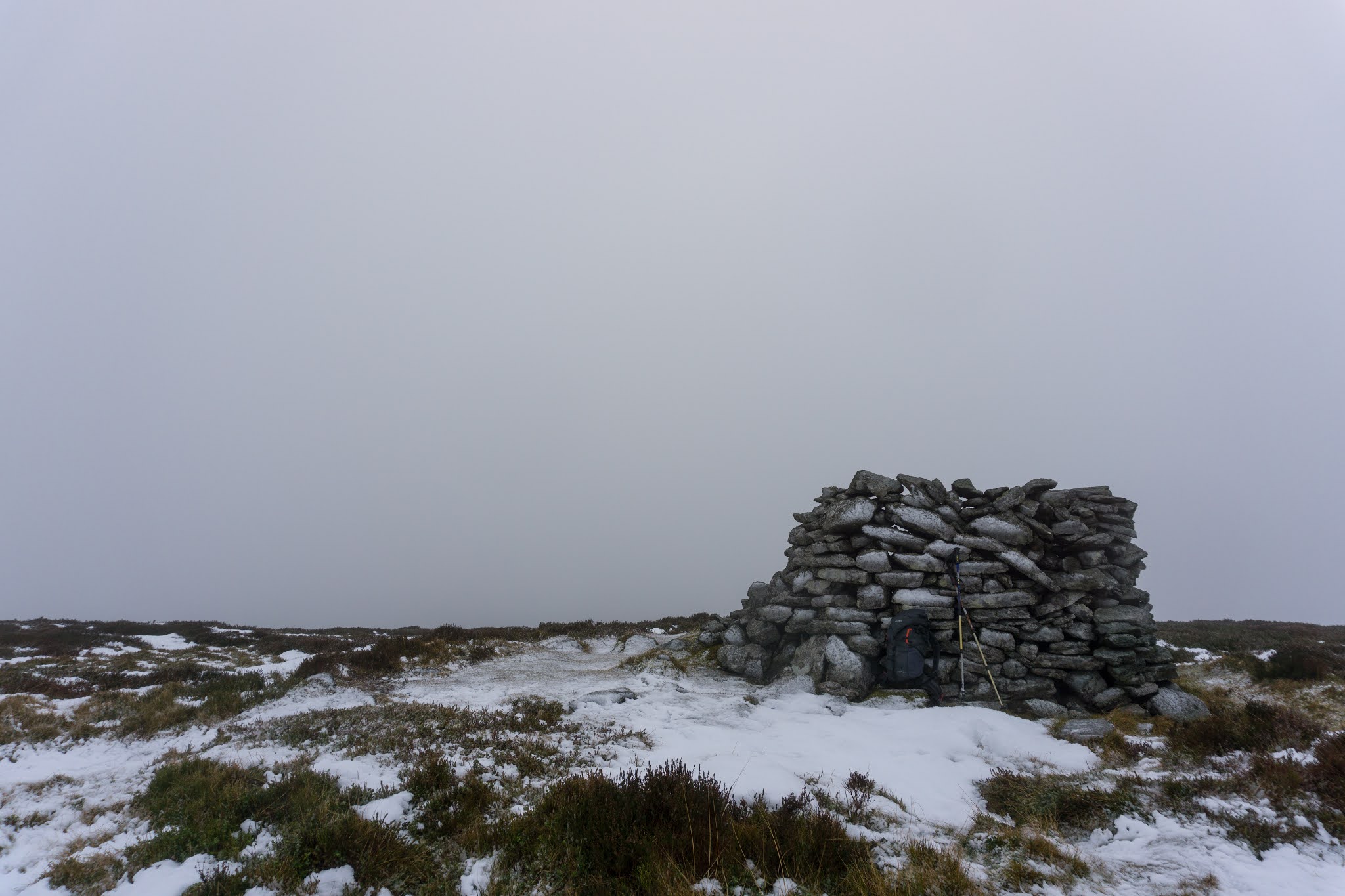
It was bitterly cold at the summit with a raw northerly wind - and no place to linger; especially since there wasn't a view.  The new year was barely 10 hours old and I was definitely the first visitor of the year.  After a few minutes I headed off the summit by a different route than that I'd climbed to give a partial circuit.


 I headed down to a wood on the Fouchie Shank where I knew I'd find shelter from the northerly wind and where I've previously camped.  In under the trees it was calm if not particularly warm and I could sit and make cup of tea, pleased to have been the first foot on this "home" hill.

Monday, 18 May 2020

One good thing - 17th May 2020


The weekends give opportunity for longer walks, and once again routes on the Correen Hills have been the logical choice, walking directly to and from home on long circuits.  Both days had similar weather with early rain clearing to give bright and breezy conditions, flotillas of clouds racing overhead and clear air.  The freedom and space these hills have offered through the lockdown will be long remembered, great striding routes where other people are seldom seen.


One of my routes over the weekend was this 21 kilometre circular walk which could be started and finished from quite a few different points, there's around 500 metres of ascent involved and it covers a nice variety of moorland, wood and farm tracks - there's a good track the whole way around.  One of the features of these hills is that distance just seems to reel away.


Alternating cloud and bright sunshine made for some dramatic lighting effects as in this view from the summit of Lord Arthur's Hill over to Bennachie, the hill dark in shadow and lower ground covered in gorse making for a brilliant contrast - it was all good.

Monday, 30 September 2019

Creag Dhubh - a little cracker

The route from home which I use most to access the sea kayaking and hillwalking on Scotland's west coast goes up towards the source of the River Don, crosses the shoulder of the Cairngorm massif to the broad valley of the Spey at Grantown, then runs south to Newtonmore before cutting through to Spean Bridge on the A86 road. This route gives fantastic and varied scenery - the great mountains of the Cairngorms, Creag Meagaidh, the Grey Corries and Ben Nevis, two of Scotland's finest rivers, long fresh water lochs and finally to the sea lochs of the west coast. Amongst all the grandeur of the big mountains, there's one small but very distinctive hill above the A86 which has long been on my list to climb.

A short way  south west of Newtonmore there is a small parking area opposite the picturesque Lochain Uvie, which is the only parking opportunity for quite a long stretch of road.  There's a gate into the wood at the parking area itself used by climbers accessing the crags above - a better point to start out for the summit can be found by walking 400m south west along the road to a gate opposite the gatehouse for Creagdhubh Lodge.


A green track curves up through a lovely stretch of natural birch wood to emerge onto a heathery shoulder west of the crags.  On the day I did this walk a pair of Peregrine Falcons were shrieking their displeasure at a group of climbers who were inspecting the crags for possible routes.  In the end there was too much water seeping down for them to climb - probably just as well given the Peregrines clearly had young in the nest somewhere above.  There's actually a full-blown waterfall on this crag which is in freefall for much of its height; in a drier winter it might give good winter climbing.

From this shoulder the summit of Creag Dhubh (Black Crag) can just be made out as the highest step of a rugged ridge.  There are a couple of options to gain the ridge - either cut directly across above the wood to skirt the end of the crag or take a wider sweep on an old track to gain the ridge above a grassy (and quite wet) hollow.  The direct route went through chest-high bracken and looked likely to be really hard work so I elected for the more circuitous route on the track.


As soon as the ridge proper is reached a tiny scratch of a path can be found right on the crest and its best to stick to the path for both the views and to work through some steep ground ahead.  For a comparatively small hill Creag Dhubh offers superlative views, it has a central position and is reasonably well isolated from surrounding high ground giving a sense of space and long horizons.  To the south and west the eye is drawn along he upper reaches of the Spey valley to the hills of the central highlands.


Looking further again the hills of the Ben Alder, Rannoch and Mamore ranges can all be made out - a view all the way to Scotland's western ramparts.


Nearer at hand the ridge continues up a steep and loose section where a little care is needed, then drops slightly before the final summit cone.  One of the reasons this hill is so distinctive is that it's a rocky, rugged and craggy individual amongst more rounded and grassy domes.


The summit views are really fine.  North and east the Spey is joined by the waters of the Truim and the River Calder as it gains power to push through to the Moray Firth.  The town of Newtonmore is laid out below and the horizon is dominated by the distant Cairngorm giants.


To the north west there's a great view over Glen Banchor to the Monadhliath, a huge expanse of remote plateau.  Glen Banchor's hills and glens are an area I've not explored - I intend to rectify that!


A substantial built cairn marks the summit of Creag Dhubh.  At 756m/2480ft this is not a high hill, indeed it is 6 metres or 20 feet shy of reaching Corbett status.  Like most "Grahams" though, it is a very fine hill and a real miniature mountain.  The distinctive nature of the hill gives it unique character, which possibly explains the origin of the battle cry of Clan Macpherson who have their roots in this area of Badenoch - "Creag Dhubh!"  One chief of this clan went on the run after the shambles of the 1745 rebellion and hid from government forces for nine years.  There are several legends about his hiding place - or places - including one cave on the face of Creag Dhubh known as "Cluny's Cave".  Macpherson eventually slipped the net and made his way to France to join the exiled Charles Edward Stuart.  He never returned to Badenoch or Scotland and died in 1764 in France.


For the descent route one can continue north east to Biallaid on the outskirts of Newtonmore but this would require either two cars or a 5 kilometre walk along the fast and twisting A86 road. I chose to return via my outward route, but took the more direct line skirting the edge of the crags to the road at the parking area.  This route is steep and rough and would take a bit of determination if used for the ascent!  The view from the ridge down to Lochain Uvie is impressive; so steep is this ground that it seems right below one's feet.

Creag Dhubh is a cracking little hill and one I'd definitely recommend.  I had originally thought of climbing it as a "leg-stretcher" on the way to or from somewhere else, but deserves much more respect than that and I'm glad I made it the objective of the day.  My images don't actually show how rugged the hill is, but the image below by "Gaffr" and posted here with his kind permission, captures the atmosphere and nature of the hill really well


8 HPIM6874 (640x481).jpg
Image by Gaffr


Low down in the wood I met with this group of goats - smelt before seen!  They seemed unperturbed by my wandering towards them and merely moved aside before going back to their browsing.  I've seen the occasional one on the A86 hereabouts too, something to bear in mind when speeding along!

Tuesday, 23 April 2019

Backs to the wind above the Don

A catch up post from late March, when a run of bitterly cold northwesterly winds was established over the north east of Scotland.  Allan and I looked for a half day hillwalk which could accommodate the weather - we didn't intend to walk against a freezing 50mph gale!


We chose the Mona Gowan ridge as we'd be able to use two cars and make a linear walk with the wind at our backs.  It's a hill I've climbed previously and enjoyed; this would be a different route for me.  At 749m/2457ft, Mona Gowan itself is a Graham and there are a couple of other smaller summits along the ridge.


From the west there are a couple of logical starting points, one on the summit of the old military road (now the A939, but don't expect a "proper" main road!)connecting Donside with Gairnshiel.  A long layby on the east side of the road has some granite steps which lead up to a scratch  of path climbing to the summit of Scraulac. 

The other good starting point from this side of the hill is further along the A939 at Glen Fenzie from where one can take a slightly longer route to Scraulac with a bit more ascent .  This starting point could also be used to make a circuit from the south....there's a good circuit from the north too; chacon a son gout!

We were glad of the hill's relative lack of height as the wind was both strong and chilling with a cloudbase just a hundred or so metres overhead.  We put our backs to the wind and plodded on up to the ridge.


The weather forecast had indicated the passage of a cold front during the day.  We thought we might mange to complete our walk before this crossed the area, but it seemed that we'd be right in the firing line as ominous grey sheets of  rain built to the west.


The summit of Scraulac came easily enough and we remained just below the scudding cloudbase.  I think this name translates as "scree place", and there's certainly some marble type scree here which is relatively uncommon in the granite dominated local rocks.  An estate boundary marker adjoins the cairn - I think it marks the boundary between Candacraig and Invercauld estates.


The walk from Scraulac to the next bump on the ridge, Craignagour Hill, gives great going on clipped heather - it's the type of terrain found on many areas of high ground in the area and can allow really long distances to be reeled off. There's a nice feeling of being on a broad rooftop on this walk as the ridge is separated from higher ground by distance and so gives really spacious views.


Continuing east there's a dip to a peaty bealach before a short climb up to Mona Gowan; a fence gives a useful guide down to this bealach in poor visibility.


The cairn on the 749m summit of Mona Gowan is huge and visible for many miles - it was erected in 1887 to mark the jubilee year of Queen Victoria's reign.


Allan and I ate lunch in the lee of the cairn which gave good shelter from the biting wind.  the view to the south east is dominated by Morven (big hill), a prominent landmark across much of this part of Aberdeenshire. 

The weather caught up with us as we descended north from Mona Gowan, if anything the wind increased and there was a spell of quite heavy rain.  I took no pictures as we hurried down to the shelter of the forest above Culfork on the River Don.


The rain stopped just as we reached the forest track and we sat to have a cup of tea before walking down the pleasant couple of kilometres to Culfork where we'd left a car.  Our route was quite short at approximately 10 kilometres but had given a good walk from unpromising weather.


As we recovered a car from the start, the weather was already clearing after the cold front passage....but the wind certainly wasn't any warmer!

Wednesday, 21 March 2018

Drifting along on Pressendye


The easterly wind was roaring across the upper ridge of Pressendye, louring clouds alternating with shafts of sunlight in a stroboscopic effect.


A deer fence is a useful guide towards the summit in poor visibility.  Today it was decorated with frost feathers and buried to half its height in wind-packed snow.


There was real exhilaration in being up here in such wild weather; the wind was absolutely freezing and driving along spicules of snow in whirling drifts.  Underfoot there was no more of the deep powder of lower down the hill - here the ground was either packed snow or iron-hard ice, grey with a dull sheen and requiring crampons for safe movement.  Full winter conditions and I wasn't yet above 2000ft!


At the corner of the deer fence a large drift had enveloped the 2 meter fence completely.  Packed hard by the wind, it offered no obstacle to deer or anything else.  Conditions like this are just one small example of why Paul Lister's plan to fence 50,000 acres of the highlands to create a "game reserve" in order to make money is so robustly opposed.  Anything inside a fence would, eventually, simply walk over the top in a bad winter.


Where the snow had been scoured away the heather was encased in ice; each clump resembling a coral reef or a glass sculpture.  This winter has, after a run of mild years, brought "proper" conditions and a reminder of the capability of the weather to create beauty from savagery.


The 619m/2031ft summit was touched with weak sunshine, the light all the more remarkable against a graphite grey sky - I was so glad that I'd pressed on through the heavy snow to reach the top.  I was absolutely the only person on Pressendye on this day, and it was no worse for that.


To the west the broad ridge undulates across Broom Hill, Green Hill and (appropriately) Frosty Hill and White Hill.  It would have been good to follow the ridge, but it would have made for a long day in these conditions.


Heading back to the angle of the fence, the view over Cromar was very wintry and it looked that there was more snow inbound.


A change in the light brought out the striations on the top of a frozen wave of snow - it looked delicate but was really unyielding


Descent to the top of the forest was quick, and in comparison to the climb, effortless.  Crampons bit into the surface and provided all the traction required until the snow became a little deeper.


A very grand sky overhead, a snow covered landscape all around; it was a really fine afternoon to be out and about on the hill.


I took a different line down through the forest than the one I'd used on the climb - partly to make a bit of a circular route and partly because it just seemed better to walk through undisturbed snow.  Across the Dee valley Mount Keen was prominent in sunlight; a useful headmark on the drop to the B9119 road a kilometer or so from the car, ending a great short walk.  The contrast between conditions on this wee hill in late Spring and in "early Spring" just a couple of days short of the vernal equinox had been very marked!

Monday, 19 March 2018

Pressing on to Pressendye


On Saturday 17th March whilst driving into the village of Tarland, we remarked on how good the hills to the north looked.  This broad and undulating ridge separates the Howe of Cromar from upper Donside and is a fine viewpoint, particularly the "Graham" of Pressendye - the highest point in this image.

I decided that if the weather held on the following day, I'd climb Pressendye - normally a couple of hours walk with a modest amount of ascent.


Overnight into Sunday 18th March there was another dump of snow, the latest in a run of weather systems borne on a cold easterly airstream.  An additional 10cm fell, turning the whole landscape back to winter.  Nevertheless, it was a bright and breezy day and I drove the short distance to the start of a route I've used before.

The route goes initially up a farm access road, past the farm of Pett.  I stopped to chat with the farmer who was loading sheep feed pellets for his animals.  This latest blast of winter could scarcely have come at a worse time for him as his ewes are just starting to lamb - getting them in safely and keeping them sheltered will be a constant worry for the next few weeks.

Above the farm the track enters a pine forest and the snow lay a little deeper.


The higher up the forest I went, the deeper the snow became.  At about 400m height it was above my knees and progress began to be really laborious.  I emerged through a particularly deep drift onto the broad forest road which takes a curving line west then north towards the higher ground.  The prints of Roe deer crossed the track at various points - and, thrillingly, the tracks of a Wildcat; one of the rarest and most elusive of Scotland's mammals.


The track continued to climb, the snow continued to get deeper.....


...and in parts was thigh deep.  Progress slowed to less than a kilometer an hour as each step sank deep into the unconsolidated snow.  On this flank of the hill I was sheltered from the strong easterly wind, which was in part why the snow was lying to such a depth.  I estimated that there would be much less above the treeline where the wind would have been getting at it.


The scene was outstandingly beautiful though, and taking photographs every couple of hundred meters at least gave an excuse to pause from what was becoming really hard going.


On the final rise out of the forest the snow was at its deepest and I was more wading than walking, each uphill step a real effort.  I pressed on, hoping that my theory about the wind having removed most of the snow from the higher ridge would prove accurate - any kind of distance in this depth of snow would be a real battle.  Another gasping stop - purely to admire the beauty of snow covered trees against a blue sky of course!


At last I got above the treeline and onto more open ground - almost immediately there was a change underfoot.  Less depth of snow and what was left was packed into a consolidated, squeaky consistency like polystyrene.  On steeper and more exposed ground I'd have been concerned about the formation of windslab, a layer of such snow that can shear away from the layers of snow underneath and avalanche.  There was no risk of that here fortunately, and I made better progress though still with an occasional jarring when the surface layer broke and my leg plunged through to the thigh.

At about this point I changed hat and gloves to the warmest I had with me and battened down.  The wind was about 40mph from the ENE and absolutely frigid, the still-air temperature at this height of about 500m was minus 5 Celsius.


The steady direction and strength of the wind over a couple of weeks has created some great snow sculptures.  In the lee of each dwarf pine (this one bent to the ground by weight of ice) graceful waves and fins of snow extended downwind.  They looked fragile but were surprisingly well bonded.

Above, a white banner against the gunmetal grey of a passing snow shower showed the effect of the wind as it whirled a groundstorm across the flank of the slope.  The contrast between the conditions I was experiencing today and the gentle nature of a summer walk on this hill could scarcely be more pronounced.  In winter, every Scottish hillwalk can be a mountaineering outing; even those on the smaller hills.

Thursday, 27 April 2017

Under a Spring sky


I'd planned to do jobs around the house, but a bright early April morning was too tempting.  The Correen Hills form a curving sweep of broad backed ridges and are accessible straight from home - perfect for a half day's hillwalking.  A track above the farms at Terpersie leads to open ground below the ridge.


 There are lots of Larch (Larix decidua) trees in this area - an interesting tree as it's the only deciduous conifer native to Europe, though not originally native to Britain. Larches are a really colourful tree, the bright pink female "flowers" eventually become cones, the male flowers are tight clusters of cream coloured anthers.  The needles start out a striking bright lime green, mature to a bottle green and in the autumn turn stunningly golden yellow before falling.


 In an old quarry on the end of the ridge, this old shooters hut seems to throw off whatever the weather throws at it.  It's almost taken on the russet and brown shades of the hill it stands on.....


 ...and reflects the sky too.....


Once on the ridge there's a sense of great space and distance.  Though not high, the Correen Hills offer some good views over to the Cairngorm giants of Beinn a'Bhuird and Ben Avon, unusually snow-free at this time of year.   The other feature of the ridge is that it's great walking country, distance just seems to reel away effortlessly underfoot.


 There are also great views over the farmlands of Cromar to Morven and beyond to the crags of Lochnagar.


My descent went back down through the trees, with a view to Tap o'Noth crowned by its distinctive hillfort.  Further down again and I could pick up a farm track leading around the hill to right above home.

A half day under a big Spring sky and a half day well spent - I should walk it more often......