Showing posts with label Traditions. Show all posts
Sunday, 12 April 2020
One good thing - 12th April 2020 Easter Sunday
A great thing about today was that the Easter Bunny (having been given "essential worker" status in some parts of the world) was able to get around and leave eggs for the smaller members of our community to find whilst on their daily exercise. :o)
Tuesday, 17 December 2019
A wish fulfilled on Loch Maree
All but one of Loch Maree's islands are vegetated either with Caledonian Pine or with low wet-ground scrub. But one island is strikingly different...
In autumn, Isle Maree positively glows with colour. Birch, Beech, Oak and Holly predominate on this small but special island.
We landed on a gravel shore below a very old but vigorous Holly tree, which had a fine crop of berries. The fruits will provide food for birds as winter begins to tighten its grip, but there are stranger fruits on Isle Maree.
On a west facing slope near to the highest point of the island is the remains of a "wishing tree". Coins have been inserted into the tree for hundreds of years in a tradition that goes back way longer. A famous visitor was Queen Victoria, who hammered in a coin in 1877. The wishing tree on Isle Maree is associated with curative properties, of all kinds of ailments including what as formerly known as "madness". The tradition is that the unwell person's illness was transferred to the tree by the offering of a coin, particularly if combined with bathing the person in the water from a well on the island or in the waters of the loch.
The tradition also cautions against taking anything from the island, including pebbles in case the illness is brought back out into the wider world. It may be folklore, but I refrain from my usual habit of taking a souvenir pebble from beaches when visiting Isle Maree.
On a previous visit I found that a storm had brought down a large branch which had broken what remains of the wishing tree into sections; the tree was an oak but is long dead from copper poisoning from all the old pennies inserted into the trunk. I reported this to SNH who sent out a work party to clear away the branch and place the parts of the wishing tree in one place; they've done a great job.
In the space below the trees oak saplings are beginning to emerge, taking advantage of the space and light. In time, this sapling or one of its neighbours may become the next wishing tree........
....which made it even more special that Allan was able to visit Isle Maree having spent many months of the previous twelve hospitalised. Douglas is back in action too, but unfortunately couldn't make this trip, so there's a good reason to visit again.
Isle Maree has a very old burial ground at its highest point, surrounded by an even older wall. A chapel here is believed to have been associated with the seventh century abbot St Maol Rubha (from which the name "Maree" is derived).
It's a fascinating place to explore with some very old grave markers and more recent gravestones. A rich carpet of leaves and moss covers the whole area. Having spent a very pleasant hour exploring Isle Maree and walking under the tree canopy......
....the sudden view of the oakwoods on the northern shore of the loch seemed ablaze with brilliance - what a day to be out on the water!
In autumn, Isle Maree positively glows with colour. Birch, Beech, Oak and Holly predominate on this small but special island.
We landed on a gravel shore below a very old but vigorous Holly tree, which had a fine crop of berries. The fruits will provide food for birds as winter begins to tighten its grip, but there are stranger fruits on Isle Maree.
On a west facing slope near to the highest point of the island is the remains of a "wishing tree". Coins have been inserted into the tree for hundreds of years in a tradition that goes back way longer. A famous visitor was Queen Victoria, who hammered in a coin in 1877. The wishing tree on Isle Maree is associated with curative properties, of all kinds of ailments including what as formerly known as "madness". The tradition is that the unwell person's illness was transferred to the tree by the offering of a coin, particularly if combined with bathing the person in the water from a well on the island or in the waters of the loch.
The tradition also cautions against taking anything from the island, including pebbles in case the illness is brought back out into the wider world. It may be folklore, but I refrain from my usual habit of taking a souvenir pebble from beaches when visiting Isle Maree.
On a previous visit I found that a storm had brought down a large branch which had broken what remains of the wishing tree into sections; the tree was an oak but is long dead from copper poisoning from all the old pennies inserted into the trunk. I reported this to SNH who sent out a work party to clear away the branch and place the parts of the wishing tree in one place; they've done a great job.
In the space below the trees oak saplings are beginning to emerge, taking advantage of the space and light. In time, this sapling or one of its neighbours may become the next wishing tree........
That previous visit had been in autumn 2018 and I left two coins in the tree for two friends. Douglas had been suffering from a debilitating condition and Allan was in hospital with a very serious illness. The care both received from the NHS and the medical technology available in diagnosis and treatment of both have been very successful, but maybe, just maybe the wishing tree helped too....
....which made it even more special that Allan was able to visit Isle Maree having spent many months of the previous twelve hospitalised. Douglas is back in action too, but unfortunately couldn't make this trip, so there's a good reason to visit again.
Bright blue sky above a canopy of gold and green - this was autumn at its very best
Isle Maree has a very old burial ground at its highest point, surrounded by an even older wall. A chapel here is believed to have been associated with the seventh century abbot St Maol Rubha (from which the name "Maree" is derived).
It's a fascinating place to explore with some very old grave markers and more recent gravestones. A rich carpet of leaves and moss covers the whole area. Having spent a very pleasant hour exploring Isle Maree and walking under the tree canopy......
....the sudden view of the oakwoods on the northern shore of the loch seemed ablaze with brilliance - what a day to be out on the water!
Thursday, 25 October 2018
The penny drops on Isle Maree
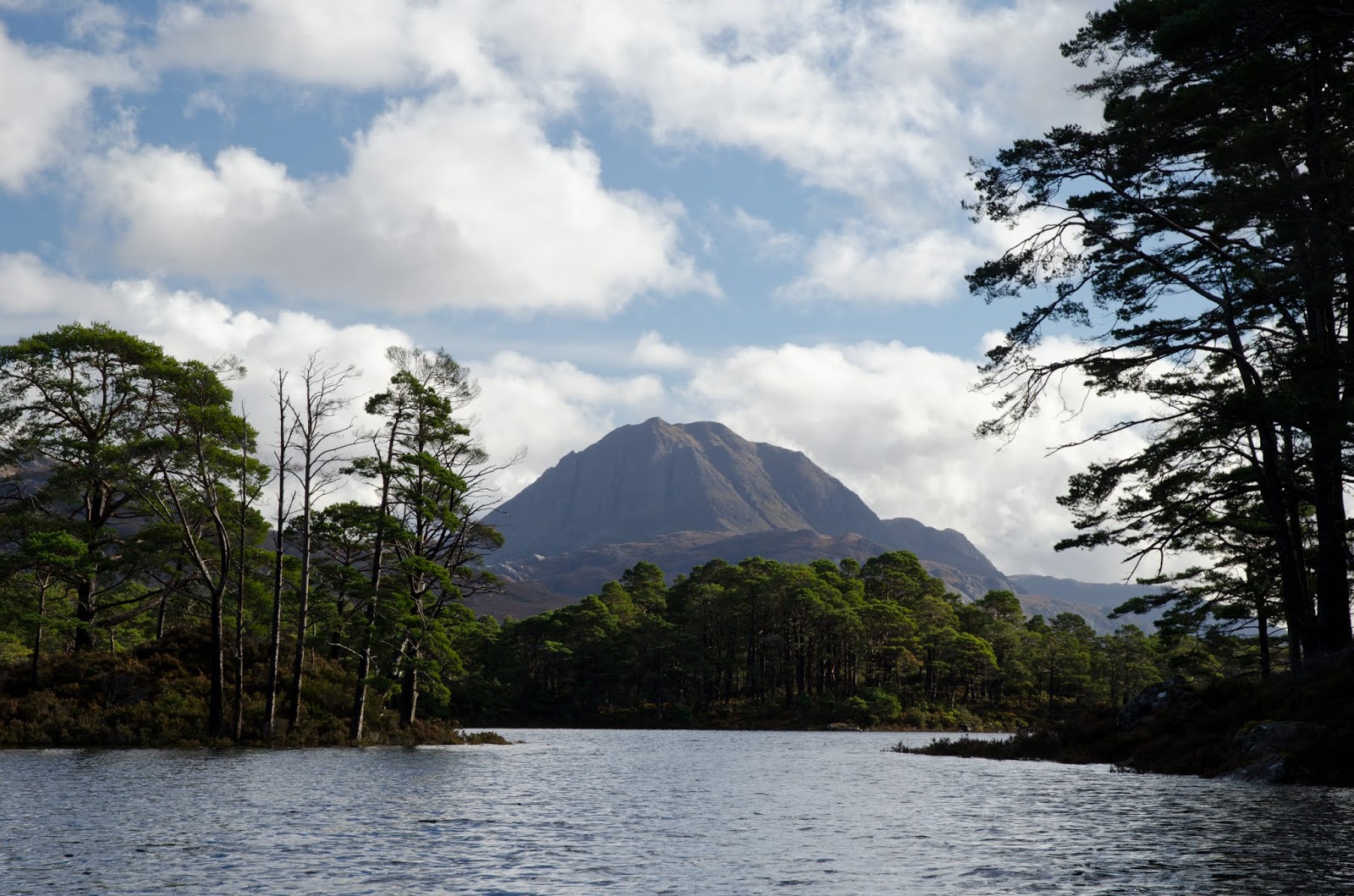
Following a stop for second breakfast I headed back among the islands of Loch Maree. The improving weather had extended to the length of the loch and the flanks of Slioch (the spear) were now lit with morning sun.
My next planned stop would be on Isle Maree, perhaps the best known of the loch's islands, but by no means the largest. The closest island to the north eastern shore, Isle Maree differs from all the other islands in being wooded mainly with deciduous, rather than pine trees including some very old stands of oak and holly.
Isle Maree has a long history of usage as a ritual site; it seems to have been used for the pre-Christian tradition of sacrificing a bull - which reportedly continued into the 17th century; the crags on the northern shore are named Creag an Tarbh (crag of the bull) which recalls this tradition. In the 8th century a chapel and hermitage was established by St Maelrubha, centred around a well.
A very ancient wall encloses a graveyard on the highest part of the island. Some of the gravestones are very old and there are two grave slabs incised with crosses which date from the 8th century. It's a peaceful, atmospheric place in which to spend a little time.
One more modern memorials is a broken cross stone with very fine carving which sits in a prominent spot - but seems a little out of place among the more modest graves. Nearby, and not so easy to find is a relic of the pre-Christian tradition here.
An oak tree has been used for centuries as a "wishing tree" - where people travelled to the island specifically to hammer in a coin as an offering, in the hope of curing illness or fulfilling a wish. The oak tree died hundreds of years ago due to copper poisoning from all the pennies driven in, but the tradition persists.
I found the tree difficult to find, because a nearby Horse Chestnut tree has come down in the gales which raged across Scotland in early October and landed on top of the wishing tree - I reported this to Scottish Natural Heritage who were hoping to get out and assess what could be done. If trying to locate the tree, look to the south west of the graveyard.
I'm fortunate to enjoy good health, but two of my good friends are experiencing significant health issues, so on their behalf I tapped in two copper coins, with a wish for full recovery for them both. Traditionally the island was associated with curing insanity - but I didn't have a third coin for myself!
The tradition warns against taking anything, even a pebble, from the island in case the insanity or illnesses are brought away as well, so I didn't keep to my own habit of taking a small pebble from the landing place.
Isle Maree is one of those very special places where the long spiritual traditions seems to add to an atmosphere of peace and tranquility - I left the island feeling noticably calmer.
Back on the water, the weather was developing; on the north eastern shore all was colour and bright sunshine.....
...while to the south west impressive shower clouds were building over the hills of the Flowerdale Forest. It was turning into a wonderful day to be out on the water.
Thursday, 27 September 2018
Knockando colours
Autumn in Scotland can be a riot of colour, and Speyside is one of the best places to experience the change from summer's green to autumn gold.
We visited the Knockando Woolmill last weekend on a bright and sunny afternoon when the colours were fairly "zinging". There's been a mill here since 1784; the present buildings have been renovated and the mill is now manufacturing fine designer tweeds and wool using machinery from the 1870's.
Water power is still utilised via a restored wheel fed by water piped from the nearby stream, though the waterwheel was originally augmented by a paraffin engine and now by electric power.
The restoration of the site has been sympathetic and has recreated a piece of industrial history along with a restored wool dealers shop and workers cottage. There's a small tearoom and a stylish shop as well as a small interpretative display with a film. Knockando Woolmill isn't a swish "visitor experience" or sterile museum; it's a working, living business and all the better for that. Off the beaten track (again, a good thing I think) it's well worth seeking out, but check opening times as the visitor facilities shut for much of the winter.
In the surrounding trees, autumn's glory is beginning; Sycamores glowing in rich shades of plum and amber.
Some of these colours are actually reflected in the tweeds the mill produces, a true representation of place
Above us, green and gold against a stunningly blue sky - truly autumn can be the most dazzling of seasons.
We visited the Knockando Woolmill last weekend on a bright and sunny afternoon when the colours were fairly "zinging". There's been a mill here since 1784; the present buildings have been renovated and the mill is now manufacturing fine designer tweeds and wool using machinery from the 1870's.
Water power is still utilised via a restored wheel fed by water piped from the nearby stream, though the waterwheel was originally augmented by a paraffin engine and now by electric power.
The restoration of the site has been sympathetic and has recreated a piece of industrial history along with a restored wool dealers shop and workers cottage. There's a small tearoom and a stylish shop as well as a small interpretative display with a film. Knockando Woolmill isn't a swish "visitor experience" or sterile museum; it's a working, living business and all the better for that. Off the beaten track (again, a good thing I think) it's well worth seeking out, but check opening times as the visitor facilities shut for much of the winter.
In the surrounding trees, autumn's glory is beginning; Sycamores glowing in rich shades of plum and amber.
Some of these colours are actually reflected in the tweeds the mill produces, a true representation of place
Above us, green and gold against a stunningly blue sky - truly autumn can be the most dazzling of seasons.
Wednesday, 18 July 2018
Portsoy Traditional Boat Festival
Portsoy Traditional Boat Festival is held annually and has grown from a small event to a large celebration of food, drink, music, coastal rowing and of course traditional boats. This year's event was held on 30th June and 1st July and was the 25th festival, a notable landmark. The staff of Mountain and Sea Scotland visited on the Sunday with a family group ranging from 8 to 80 something years old. The festival occupies the whole harbour area, surrounding streets and the village green - and there really was something for everyone to enjoy.
We arrived quite early, and at low water which gave an opportunity to view some of the vessels in the harbour.
There were some absolutely beautiful craft on show, many of which would have been a regular sight when Portsoy was at its busiest as a fishing port. Fish are still landed, processed and sold here; a fish seller has a shop in the newer part of the harbour.
The coastal rowing races were a real draw, featuring crews from all around the UK and further afield - a Dutch crew were very much in evidence in the races. This sport has really caught on and the numerous small harbours of Scotland's north east coast nearly all have rowing clubs and boats.
Boats are crewed by four rowers and a cox'n and race over a variety of distances. A strong breeze and choppy conditions had limited the races to shorter distances arranged as out-and back legs....
.....which resulted in some close and exciting racing. Crews are of all ages and compositions, coastal rowing seems to be one of the most inclusive of sports.
In the boatsheds near the harbour examples of traditional boatbuilding and nautical skills were much in evidence. But the festival isn't all about boats....
It's also a celebration of the best of local food, drink and music. Two full areas were dedicated to food and drink, with lots of food vendors on site to refuel hungry visitors. On the harbour side, spars full of haddock tied in pairs await the magic which will transform them into....
.....Arbroath Smokies. The haddock are cleaned at sea, then salted for a time to draw excess moisture from the flesh before being smoked in a half whisky barrel over a fire of beech or oak shavings, when the time is right the barrel is covered with a hessian sack to retain the smoke. The result is sensational; tasty, fresh and healthy.
What these images don't show is the crowds of people at the festival. We'd arrived early to avoid the busiest time but it was still a busy, vibrant day of sights, sounds and tastes. The music stage featured some great performances and by all accounts the Saturday night had been a real party. 2019's festival is scheduled to take place on 22nd and 23rd of June - it's a great day out.
And if all this nautical theme isn't for you.......
We arrived quite early, and at low water which gave an opportunity to view some of the vessels in the harbour.
There were some absolutely beautiful craft on show, many of which would have been a regular sight when Portsoy was at its busiest as a fishing port. Fish are still landed, processed and sold here; a fish seller has a shop in the newer part of the harbour.
In the very traditional harbour setting, the boats look entirely "in their place"
The coastal rowing races were a real draw, featuring crews from all around the UK and further afield - a Dutch crew were very much in evidence in the races. This sport has really caught on and the numerous small harbours of Scotland's north east coast nearly all have rowing clubs and boats.
Boats are crewed by four rowers and a cox'n and race over a variety of distances. A strong breeze and choppy conditions had limited the races to shorter distances arranged as out-and back legs....
.....which resulted in some close and exciting racing. Crews are of all ages and compositions, coastal rowing seems to be one of the most inclusive of sports.
In the boatsheds near the harbour examples of traditional boatbuilding and nautical skills were much in evidence. But the festival isn't all about boats....
It's also a celebration of the best of local food, drink and music. Two full areas were dedicated to food and drink, with lots of food vendors on site to refuel hungry visitors. On the harbour side, spars full of haddock tied in pairs await the magic which will transform them into....
.....Arbroath Smokies. The haddock are cleaned at sea, then salted for a time to draw excess moisture from the flesh before being smoked in a half whisky barrel over a fire of beech or oak shavings, when the time is right the barrel is covered with a hessian sack to retain the smoke. The result is sensational; tasty, fresh and healthy.
What these images don't show is the crowds of people at the festival. We'd arrived early to avoid the busiest time but it was still a busy, vibrant day of sights, sounds and tastes. The music stage featured some great performances and by all accounts the Saturday night had been a real party. 2019's festival is scheduled to take place on 22nd and 23rd of June - it's a great day out.
And if all this nautical theme isn't for you.......
...then check out Hamish the "Coo Van" at the Visit Scotland stand!
Subscribe to:
Posts (Atom)