Showing posts with label Bay of Culkein. Show all posts
Friday, 8 November 2013
An Old Man's warning
Pushing south against the ebb tide from the Point of Stoer wasn't too difficult and I soon reached the Old Man of Stoer. A 60 metre sea stack formed of Torridonian Sandstone, it's an instantly recognisable landmark. Climbed in 1966 by the Aberdonian climber Dr Tom Patey, it remains a popular though committing climb. There are several stacks prefixed with "Old Man" in Scotland - the similarly named Old Man of Storr in Skye and the Old Man of Hoy in Orkney are the best known. In each case the term "old man" refers to the priapic appearance of the stack - though another well known and priapic stack (on which Tom Patey was killed whilst abseiling) is known as A' Mhaighdean (the maiden) !
I'd looked across to the stack from the cliffs opposite, but not been this close up before. From seaward the whole edifice seems to be leaning out gently to the west. It is possible at certain states of the tide to paddle behind the stack, but not today.
A look to the south showed that the sky was dark grey and lowering, a sign of the approaching weather front which would bring strong wind and rain. Suddenly, I didn't feel comfortable - a powerful and urgent feeling of unease gripped me.
Perhaps it was a combination of the strangely distorted verticals in the stack and the cliffs, coupled with the unusual motion of the swell which lifted the boat but slid it northwards with each surge. Whatever, the uneasy feeling and the clear warning in the sky to the south decided the issue; I'd not continue south to Stoer Head lighthouse, but get back around the Point of Stoer as quickly as I could.
This inner, instinctive alarm system has served me well in the past on both mountains and on the sea; I've learned to listen. I took no photographs on the way back around the point and found the paddling more difficult. A tense half hour got me around, out of the strong tidal stream in the vicinity of the headland itself and into the relative shelter of the eastern side.
To the south east, Quinag lay under a threatening grey sky, the weather clearly beginning to make felt its presence.
In the boat, I was beginning to feel a sense of euphoria and an easing of tension, but this is no place to relax, there was still several kilometres of paddling along a cliff-girt shore and a tricky headland to pass before I could rest.
I did have time to appreciate the cliff scenery more fully on the way back though. Contorted and weathered sandstone beds have been tilted and exposed to form some grand formations
It's an exceptional piece of coastline to paddle.
A bay of translucent green water backed by a purple-red boulder beach was a tempting place to try to land but the still powerful swell was a bit too big for comfort - one to save for another day.
Around the point of Rubh an Dunain (which was still as tricky as on the way out) and I could finally land next to the small jetty in Bay of Culkein. Now the euphoria could be indulged - the rush of endorphins drained the strength from my legs and I felt a little shaky as I walked up to find a seat on the rocks and make a cup of tea.
I'd managed to round Point of Stoer twice in a day, achieved more than I'd thought possible in the day and extended myself to deal with something which intimidates me. I had no sense of "conquering" the headland, I'd merely stepped out of my comfort zone, into the "elastic zone" and had a fantastic experience. Had I backed off the point I'd have still had a great day - retreat would be no defeat at all and my decision would have been right for the day and the situation. Solo sea kayaking puts these choices to a paddler in a very fundamental and direct way; it's part of the solo experience.
But I still had a couple of hours paddling to do, daylight was short and it was time to go.....
The rainstorms were sweeping northwards in grand curtains as I crossed towards Eilean Chrona (the dark, low island in this image). I've often heard the otherwordly singing of Atlantic grey Seals here and today as I approached the song reached out across the water.
Grey Seals pup in November and it's possible that this is a breeding site because there were large numbers of rather portly seals hauled out. I didn't want to disturb the animals and decided to give the island a good wide berth - but not wide enough. A truly huge bull seal launched from the rock and swam purposely towards me, his body language and huffing an unmistakeable warning to stay away. Somewhat less subtle than my inner system, this "old man's" warning was very effective and I put on a spurt to get clear of his patch!
Soon I was threading the Oldany Island channel and picking through the low tide skerries to arrive back at Culkein Drumbeg as the weather closed in and the wind picked up. I'd been right to heed the signs at the Old Man. During the night the wind and torrential rain battered Assynt and washed away hopes of a climb of either Suilven or Stac Pollaidh the following day. No matter.
Wednesday, 6 November 2013
Psychology and commitment - the Point of Stoer
The thing is, I have a bit of an issue with big headlands - they intimidate me.
They're exposed, energetic places where wind, sea and tide are amplified and concentrated; they are nearly always challenging and for the solo sea kayaker they can be lonely and committing places.
My plan was to paddle around Point of Stoer, one of the six big mainland Scottish headlands (and one of the more exposed) not once but twice. I hoped to round the point and head south to Stoer Head lighthouse before returning back around the point. The Imray Yachtsman's Pilot for this area notes that
"Two of the headlands, Rubha Reidh and Point of Stoer, are notorious for heavy seas, caused mainly by their exposure and the strength of the tidal streams around them. Seas around these headlands are particularly dangerous with wind against tide and they should be given a berth of several miles if it is necessary to pass them under such conditions"
Clearly this paddle isn't something to attempt on a whim! I'd had the trip in mind for some time but the three factors I needed in my favour (wind, sea and tidal state) hadn't coincided neatly enough.
This time I had a chance. The wind was southerly at about F2 but was forecast to increase rapidly to F4-5 by late afternoon which gave me a window in which to work. The swell was reasonably low at a metre from the north, which I felt I could manage. The one nagging doubt was the state of the tidal stream. In this area the ebb runs north and whichever way I planned it I'd be arriving at the point three hours after high water at Ullapool which would mean that it would be at the end of the strongest part of the stream. At a day or so after Springs, the Admiralty Tidal Stream Atlas showed that the stream offshore would be 0.6kts. Close in at the point this would be about 2kts. Waiting for the tidal stream to slacken risked being caught by the strengthening wind and also the shorter day length.
As a precaution against my being able to get around the point but not back I had walking kit in the boat which would enable me to walk and hitch the miles back to either Lochinver or to my starting point of Culkein Drumbeg from where I could sort out recovery of my boat. I'd done what I could; it was now a matter of whether the conditions would be suitable.
Imediately north from Bay of Culkein there's an arch set in the point of Rubh an Dunain (headland of the fort). The point itself would give a hint as to conditions at the Point of Stoer, and it wasn't encouraging. Clapotic water near the arch and a heavy swell running up the angled sandstone reefs below the point had me feeling very twitchy and uneasy. In hindsight this was undoubtedly in part due to the tension in my head transmitting itself to my body and then through the boat; although the conditions here were pretty tricky.
Beyond Rubh an Dunain the sandstone cliffs get markedly higher. There are no realistic landing places between Bay of Culkein and (probably) getting back to Bay of Culkein so I was as prepared as possible for a few hours without landing.
Passing along under these 80 metre cliffs I was in shelter from any wind but aware of the swell. Normally I'd have been enjoying the proximity of the cliff scenery but today I was focused entirely on the potential difficulties ahead. At Geodha na Leth-Roinn (Geo of the half-seal; perhaps Selkie?) I was just 600 metres from the point itself. A good stretch out of muscles, then I put on the paddle leash (one less thing to think about if things went wrong), a check to make sure my VHF was on Channel 16 and set to high power (purely psychological), a drink of water and a biscuit. Good to go.
400 metres, then 200 metres to the point and all looked well. My inner "contract" stipulated that if conditions looked rough at the point, any breaking water in the tidal stream, it could wait for another day. So far, so good and I began to feel that this might be OK.
The weather chose this moment to add some "interest" and a truly torrential downpour began as the Cloud Lever (TM) set itself to "fully closed". For the 15 or so minutes it rained the dominant noise was a static hiss of rain on sea and the rather louder roar of rain on my hood. At least I couldn't hear the breakers now! Once the rain passed, leaving the surface strangely calm and a complete absence of wind, I pressed forward. 50 metres, then.....
........I was level with the Point of Stoer. The swell was large and powerful, but nothing was breaking outside the surf zone. A clear line on the surface ahead showed where the tidal fun would begin. Decision time - commit or back off.
This is where all the psychology of solo paddling is tested - at least it is for me. Risk needs to be assessed against reward, a brutally honest assessment of one's abilities and weaknesses needs to be undertaken, reserves both mental and physical need to be brought forward and a big breath needs to be inhaled! Using all this and some self-talk (thanks Gordon - it rarely fails!) gave a positive result. I dug the paddle in and powered forward. Approaching the line of tidal activity a strange cushion of water seemed to slightly lift the boat and suddenly twist it - I was now both engaged and committed.
In truth, it wasn't as bad as I'd feared. I could make ground easily through the turbulence around the point and although the swell was larger on the seaward side it was manageable. And then suddenly, I was around......
...and to the south, beyond a line of bursting surf, one of the most distinctive of landmarks on the Scottish coast came into view.
They're exposed, energetic places where wind, sea and tide are amplified and concentrated; they are nearly always challenging and for the solo sea kayaker they can be lonely and committing places.
My plan was to paddle around Point of Stoer, one of the six big mainland Scottish headlands (and one of the more exposed) not once but twice. I hoped to round the point and head south to Stoer Head lighthouse before returning back around the point. The Imray Yachtsman's Pilot for this area notes that
"Two of the headlands, Rubha Reidh and Point of Stoer, are notorious for heavy seas, caused mainly by their exposure and the strength of the tidal streams around them. Seas around these headlands are particularly dangerous with wind against tide and they should be given a berth of several miles if it is necessary to pass them under such conditions"
Clearly this paddle isn't something to attempt on a whim! I'd had the trip in mind for some time but the three factors I needed in my favour (wind, sea and tidal state) hadn't coincided neatly enough.
This time I had a chance. The wind was southerly at about F2 but was forecast to increase rapidly to F4-5 by late afternoon which gave me a window in which to work. The swell was reasonably low at a metre from the north, which I felt I could manage. The one nagging doubt was the state of the tidal stream. In this area the ebb runs north and whichever way I planned it I'd be arriving at the point three hours after high water at Ullapool which would mean that it would be at the end of the strongest part of the stream. At a day or so after Springs, the Admiralty Tidal Stream Atlas showed that the stream offshore would be 0.6kts. Close in at the point this would be about 2kts. Waiting for the tidal stream to slacken risked being caught by the strengthening wind and also the shorter day length.
As a precaution against my being able to get around the point but not back I had walking kit in the boat which would enable me to walk and hitch the miles back to either Lochinver or to my starting point of Culkein Drumbeg from where I could sort out recovery of my boat. I'd done what I could; it was now a matter of whether the conditions would be suitable.
Imediately north from Bay of Culkein there's an arch set in the point of Rubh an Dunain (headland of the fort). The point itself would give a hint as to conditions at the Point of Stoer, and it wasn't encouraging. Clapotic water near the arch and a heavy swell running up the angled sandstone reefs below the point had me feeling very twitchy and uneasy. In hindsight this was undoubtedly in part due to the tension in my head transmitting itself to my body and then through the boat; although the conditions here were pretty tricky.
Beyond Rubh an Dunain the sandstone cliffs get markedly higher. There are no realistic landing places between Bay of Culkein and (probably) getting back to Bay of Culkein so I was as prepared as possible for a few hours without landing.
Passing along under these 80 metre cliffs I was in shelter from any wind but aware of the swell. Normally I'd have been enjoying the proximity of the cliff scenery but today I was focused entirely on the potential difficulties ahead. At Geodha na Leth-Roinn (Geo of the half-seal; perhaps Selkie?) I was just 600 metres from the point itself. A good stretch out of muscles, then I put on the paddle leash (one less thing to think about if things went wrong), a check to make sure my VHF was on Channel 16 and set to high power (purely psychological), a drink of water and a biscuit. Good to go.
400 metres, then 200 metres to the point and all looked well. My inner "contract" stipulated that if conditions looked rough at the point, any breaking water in the tidal stream, it could wait for another day. So far, so good and I began to feel that this might be OK.
........I was level with the Point of Stoer. The swell was large and powerful, but nothing was breaking outside the surf zone. A clear line on the surface ahead showed where the tidal fun would begin. Decision time - commit or back off.
This is where all the psychology of solo paddling is tested - at least it is for me. Risk needs to be assessed against reward, a brutally honest assessment of one's abilities and weaknesses needs to be undertaken, reserves both mental and physical need to be brought forward and a big breath needs to be inhaled! Using all this and some self-talk (thanks Gordon - it rarely fails!) gave a positive result. I dug the paddle in and powered forward. Approaching the line of tidal activity a strange cushion of water seemed to slightly lift the boat and suddenly twist it - I was now both engaged and committed.
In truth, it wasn't as bad as I'd feared. I could make ground easily through the turbulence around the point and although the swell was larger on the seaward side it was manageable. And then suddenly, I was around......
...and to the south, beyond a line of bursting surf, one of the most distinctive of landmarks on the Scottish coast came into view.
Saturday, 2 November 2013
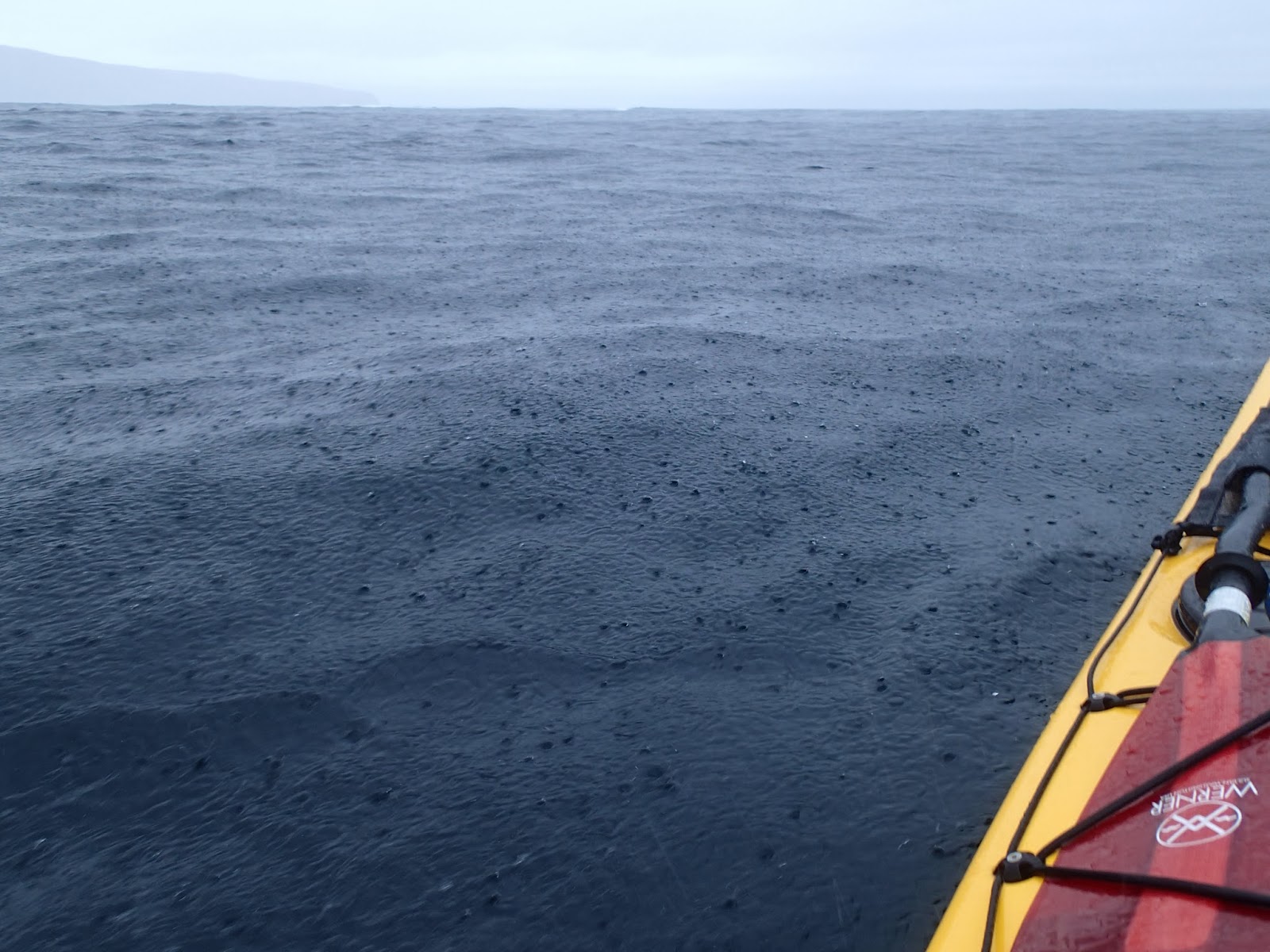
Grey sky and pouring rain - a great day on the water!
The morning after I'd experienced a glorious display of changing light and colour dawned grey and wet. A partial clearance at breakfast time was encouraging, but the forecast was for a fairly narrow window during the first half of the day followed by deteriorating conditions later. The twenty-odd miles from Lochinver to Culkein Drumbeg are on very narrow and twisty roads through a spectacular landscape - expect it to take over an hour.
At the tiny jetty of Culkein Drumbeg there's space to park a couple of cars considerately; noting that this is a working jetty. For the passing sea-kayaker it's worth knowing that there is a water tap at the jetty too, it's on the Assynt Crofters game larder (the left hand, green building in this image). It was only a few weeks since I'd paddled in this area, though the changed weather and different state of the tide made it all seem completely new.
It was just after high water one day past Springs, and after exploring around some of the islands and inlets I headed for the channel which separates Oldany Island from the mainland. This time there was lots of water in the channel and it made a pleasant passge with plenty of birdlife for company.
At this early stage of the morning there was almost no wind and I was in very sheltered water. If my plan for the day was to come to fruition I'd be paddling in much more open conditions later.
Heading over the open mouth of Clashnessie Bay I once again crossed the geological unconformity which places Lewisian Gneiss adjacent to much younger Torridonian sedimentary rock. The sedimentary layers of low cliffs and outcrops on the west side of the bay were clearly visible with their shallow dipping strata well defined.
It's been claimed that Douglas and I have some sort of "Cloud Lever" (TM), or, scandalously, that we only venture out in good weather! Whilst we are of the opinion that you can sometimes make your own meteorological luck, often it's a case of taking what's on offer. This day was punctuated with spells of very heavy rain and had a forecast of rapidly rising wind towards the late afternoon. Nonetheless, it was a great day to be out on the water and I found myself really enjoying the conditions :o)
My onward plans relied on the coincidence of three conditions - relatively low sea states/swell, light winds and favourable tidal conditions. So far I had two of these, but waiting for the optimum tidal state would risk being in a very exposed place when the wind and sea increased.
I pulled into the shore at bay of Culkein for second breakfast and to consider the options. It was a wet stop in pouring rain, but over a rapidly diluting cup of tea I worked out a plan I thought would work and formed a "contract" inside my head which would give me the parameters in which to attempt the rounding of one of the best of west coast headlands.
Subscribe to:
Comments (Atom)