Showing posts with label Sound of Jura. Show all posts
Thursday, 10 August 2017
A ride down the tide on the Sound of Jura
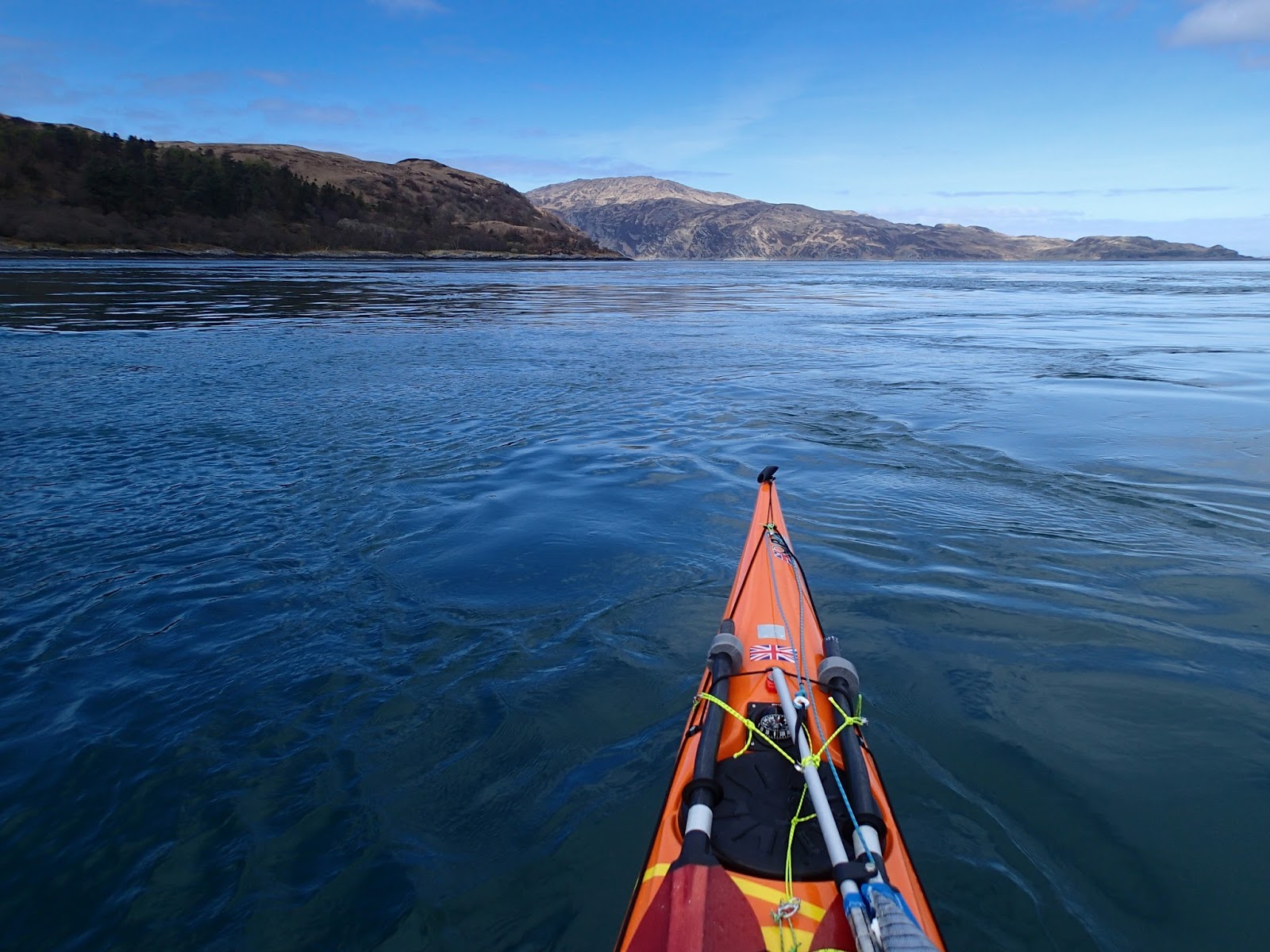
As we moved out from the Gulf of Corryvreckan into the Sound of Jura the tidal stream was increasing and our GPS confirmed that feeling. Pretty soon we were travelling south at 10 Kph with very little paddling effort.
At the very end of the trip and the end of a lengthy day of paddling, this was a pleasant way to travel! We headed across towards the mainland side of the Sound, taking transits as we went to make sure we passed to the east of Ruadh Sgeir (Red Skerry), a small island in mid channel which splits the tidal stream.
As we approached, the true speed of the flow became apparent and we were slung around the north of the island at a terrific rate........
....into flat calm water - but even here we were getting a great ride down the tide. The view down the Sound to the distant Paps of Jura under a huge cloudscape was very fine.
We passed inside Carsaig Island into a lagoon reflecting the blue of the sky and the vivid green of early summer vegetation.
A familiar yacht was anchored in Carsaig Bay - we'd last met with "Wild Rose" on the west coast of Iona - and she looked just as good in her home bay!
The last few hundred metres into Carsaig seemed to pass quite slowly, we were out of the tidal assistance and we were all tired at the end of a long day.
David and Maurice were heading home the same due to work commitments while Douglas, Sam and I had intended to stay on the water and paddle a little way south to find a wild camp for the night. In the event, we elected to join David and Maurice for dinner at the Tayvallich Inn - which we can heartily recommend - we ordered identical meals - fish and chips all round! From the Inn it was just a few metres to the Tayvallich camp site which we three stayed on for the night.
What a trip it had been! We paddled 135 Km over four days and camped for three nights on some of the wildest and most remote beaches on Scotland's west coast.
A second trip to Jura in two years just reinforced my view that it's amongst the very best of sea kayaking destinations - wild scenery, wildlife, remoteness, grandeur and fast tidal streams make for a potent mix. Colonsay and Oronsay exceeded the very high hopes I had - this was my first visit to both those islands and it most certainly won't be the last.
As ever though, it's the people who really make trips special. To David, Maurice, Sam and Douglas - thank you so much - and Slainte!
Day 1 - Carsaig to Jura, the Jura Portage and West Loch Tarbert
A change of plan sets the wheels in motion across Jura
A Jura salute for a Jura sunset
Day 2 - West Loch Tarbert to Oronsay and the west coast of Colonsay
Snakes alive
Oronsay Priory - a place of peace
Out on the edge - Colonsay's wild west coast
Day 3 - North and east coast of Colonsay and crossing back to Jura
Under a perpetual summer sun
Stocking up at Scalasig
Boules - Hebridean style
The shining sands of Shian
Day 4 - West coast of Jura, Gulf of Corryvreckan and Sound of Jura to Carsaig
The bones of the place
All in the timing at the Gulf of Corryvreckan
A ride down the tide on the Sound of Jura
Wednesday, 31 May 2017
A change of plan sets the wheels in motion across Jura
Early May often brings some great weather for outdoor activities - and May 2017 didn't disappoint. Douglas and I had been carefully watching as a ridge of high pressure built over Scotland. The question was....how far would it extend and where would give the best conditions for a multi-day trip?
As usual we had several trips in mind, it was just a case of which would be best. As the forecasts increased in confidence, we started to plan in some detail for a trip around the Small Isles (Rum, Eigg, Muck and Canna) - the best conditions were forecast for the north of Scotland's west coast. We were delighted that Maurice, David and Sam were able to make the trip too. We planned to set out from Mallaig on Sunday 7th May, returning on Thursday 11th May.
So what on earth were we doing loading kayaks at Carsaig Bay in Argyll on Sunday morning- some 120 km south of Mallaig ?!
Well, 24 hours prior to setting out, the forecast position of the ridge of high pressure had altered subtly. The revised forecasts indicated strengthening winds around the top of the "high" in the northwest, with much lighter winds and sunshine now forecast further south. After a re-evaluation we changed our plan for a trip to the islands of Jura and Colonsay.
This area is well known for remote coasts and very fast tidal streams - I was very grateful that Douglas was able to undertake the revised tidal planning as I was in the middle of a journey home from the south of England when we agreed the new plan. Jura had made a lasting impression on me during a previous trip and I was very keen to visit Colonsay - so despite a busy evening of packing and another long drive to Carsaig on Sunday morning, I simply couldn't wait to get going!
We packed our boats for a five day trip in very warm sunshine under brilliant blue skies - there was hardly a breath of wind. Our flexibility in changing seemed to have worked out- and this was later confirmed when we heard from one friend who experienced very windy conditions in the Small Isles and another who was on a club meet in the far northwest in cold NE'ly winds of F5 which effectively restricted their outings to the sea lochs rather than the open coast.
You'll be able to follow our journey to Jura, Oronsay and Colonsay in "Sea Kayak Stereovision" by reading Douglas' blog, starting here.... :o)
Our trip would involve four significant crossings - the first of which was right at the outset, heading over from Carsaig to the east coast of Jura. Our boats were well laden with supplies and kit, and each of us carried a trolley on the back deck.
A tiny breeze soon died away and we paddled out into the Sound of Jura on a mirror sea reflecting the intense blue of a Spring sky - sea kayaking heaven!
Tidal streams in this part of the Sound reach up to 3.5 knots (7km/h) so any crossing needs to take account of this. As it happened, our crossing would neatly span the turn of the tidal stream, so we were able to aim straight for our destination and allow the tide to move us first one way then the other, pretty much cancelling out the drift.
We reached Tarbert Bay on Jura's east coast at mid afternoon, just after high water. The last time Douglas and I had been in this bay it had collected a deep barrier of rotting weed which had decayed to a stinking slime. We approached with trepidation, but to our relief the beach was clean sand. The place name "Tarbert" is quite common on the west coast of Scotland and indicates a narrow neck of land between tow bodies of water. It derives from Old Norse and means "draw boat" - literally a place where longboats could be pulled overland.
In the hot afternoon sun, our portage promised to be hard work. We helped each other lift the kayaks onto their trolleys and set out.....
...on the track which leads across the island of Jura. Our boats were at the heaviest they'd be for the whole trip - packed with food and water (plus sports recovery drinks) so the climb up to the summit of the portage was taken at a steady pace; our ages ranged from late twenties to mid-seventies, and we were in no particular rush. At the top - 40 metres above sea level - there was a glimpse ahead to West Loch Tarbert.
The descent was a little easier, but the track is everywhere rough and stony - it's a notorious test for sea kayak trolleys. Happily all survived - most of us were using the KCS Expedition trolley which has been proved across this portage before. A shoulder strap definitely helps on these longer portages, whether a bespoke item or improvised with a strap and sling/Karabiner. Having now done this portage both ways - it seems to me that the east-west direction is slightly less strenuous as the ascent isn't as steep. It may only be 1.6Km with 40 metres of ascent - but it's a fair pull!
We got back onto the water at 1715 with three hours until sunset. The ebb tide was now pouring out of the inner part of West Loch Tarbert and a breeze had started up, both of which would assist us. If our plan to circumnavigate Colonsay was to be realised, we needed to put ourselves in the best possible position to cross from Jura the following morning....we still had some distance to go before camp.
As usual we had several trips in mind, it was just a case of which would be best. As the forecasts increased in confidence, we started to plan in some detail for a trip around the Small Isles (Rum, Eigg, Muck and Canna) - the best conditions were forecast for the north of Scotland's west coast. We were delighted that Maurice, David and Sam were able to make the trip too. We planned to set out from Mallaig on Sunday 7th May, returning on Thursday 11th May.
So what on earth were we doing loading kayaks at Carsaig Bay in Argyll on Sunday morning- some 120 km south of Mallaig ?!
Well, 24 hours prior to setting out, the forecast position of the ridge of high pressure had altered subtly. The revised forecasts indicated strengthening winds around the top of the "high" in the northwest, with much lighter winds and sunshine now forecast further south. After a re-evaluation we changed our plan for a trip to the islands of Jura and Colonsay.
This area is well known for remote coasts and very fast tidal streams - I was very grateful that Douglas was able to undertake the revised tidal planning as I was in the middle of a journey home from the south of England when we agreed the new plan. Jura had made a lasting impression on me during a previous trip and I was very keen to visit Colonsay - so despite a busy evening of packing and another long drive to Carsaig on Sunday morning, I simply couldn't wait to get going!
We packed our boats for a five day trip in very warm sunshine under brilliant blue skies - there was hardly a breath of wind. Our flexibility in changing seemed to have worked out- and this was later confirmed when we heard from one friend who experienced very windy conditions in the Small Isles and another who was on a club meet in the far northwest in cold NE'ly winds of F5 which effectively restricted their outings to the sea lochs rather than the open coast.
You'll be able to follow our journey to Jura, Oronsay and Colonsay in "Sea Kayak Stereovision" by reading Douglas' blog, starting here.... :o)
Our trip would involve four significant crossings - the first of which was right at the outset, heading over from Carsaig to the east coast of Jura. Our boats were well laden with supplies and kit, and each of us carried a trolley on the back deck.
A tiny breeze soon died away and we paddled out into the Sound of Jura on a mirror sea reflecting the intense blue of a Spring sky - sea kayaking heaven!
Tidal streams in this part of the Sound reach up to 3.5 knots (7km/h) so any crossing needs to take account of this. As it happened, our crossing would neatly span the turn of the tidal stream, so we were able to aim straight for our destination and allow the tide to move us first one way then the other, pretty much cancelling out the drift.
We reached Tarbert Bay on Jura's east coast at mid afternoon, just after high water. The last time Douglas and I had been in this bay it had collected a deep barrier of rotting weed which had decayed to a stinking slime. We approached with trepidation, but to our relief the beach was clean sand. The place name "Tarbert" is quite common on the west coast of Scotland and indicates a narrow neck of land between tow bodies of water. It derives from Old Norse and means "draw boat" - literally a place where longboats could be pulled overland.
In the hot afternoon sun, our portage promised to be hard work. We helped each other lift the kayaks onto their trolleys and set out.....
...on the track which leads across the island of Jura. Our boats were at the heaviest they'd be for the whole trip - packed with food and water (plus sports recovery drinks) so the climb up to the summit of the portage was taken at a steady pace; our ages ranged from late twenties to mid-seventies, and we were in no particular rush. At the top - 40 metres above sea level - there was a glimpse ahead to West Loch Tarbert.
The descent was a little easier, but the track is everywhere rough and stony - it's a notorious test for sea kayak trolleys. Happily all survived - most of us were using the KCS Expedition trolley which has been proved across this portage before. A shoulder strap definitely helps on these longer portages, whether a bespoke item or improvised with a strap and sling/Karabiner. Having now done this portage both ways - it seems to me that the east-west direction is slightly less strenuous as the ascent isn't as steep. It may only be 1.6Km with 40 metres of ascent - but it's a fair pull!
We got back onto the water at 1715 with three hours until sunset. The ebb tide was now pouring out of the inner part of West Loch Tarbert and a breeze had started up, both of which would assist us. If our plan to circumnavigate Colonsay was to be realised, we needed to put ourselves in the best possible position to cross from Jura the following morning....we still had some distance to go before camp.
Thursday, 26 May 2016
Time and tide - a sea kayaking trip to Jura
Time and tide - heading to Jura
Day 2 - West Jura, Glengarrisdale to the Sound of Islay
Day 3 - Sound of Islay - West Loch Tarbert - Cruib Lodge
Day 4 - West Loch Tarbert - Tarbert portage - Sound of Jura - Loch Sween
Labels:
Argyll,
beaches,
Bothies,
Corryvreckan,
Islay,
Jura,
kayak sailing,
Loch Sween,
Loch Tarbert (Jura),
portages,
rock formations,
sea kayaking,
Sound of Islay,
Sound of Jura,
Wild Camping,
Wildlife
Tuesday, 24 May 2016
A brew and a banjo
As we cleared Tarbert Bay we picked up a tiny breeze and hoisted our sails to get some assistance across the Sound of Jura.......
...but it soon died and we paddled on in a flat calm in hazy but very warm conditions. To the south, the Kintyre peninsula and the outline of Cara were just visible, reminding of us of a great October trip around Gigha and Cara.
We expected to be set to the south as we crossed the sound of Jura and so headed north along the Jura coast before striking out across the sound. The tidal flow is stronger towards the east (mainland) side of the channel and we felt the push as we passed arraig and Daimh (Stag rock). The Knapdale coast hereabouts is a series of low "fingers" projecting south and it's quite difficult to distinguish one "finger" from another. Soon though we turned to land......
...in a sandy bay on the tidal "island" of Danna. We all felt that this little bay was something of an anticlimax after the superb beaches of Jura......
...but as the sun came out and we got our second breakfast underway, the feeling was a bit more positive......
...it's amazing what a "brew" of tea and a bacon & egg "banjo" can achieve!
When we set out from Danna we looked back over the Sound of Jura to the island which had granted us to us an outstanding few days of sea kayaking in magnificent surroundings - it will not be too long until we return.
A plan to visit the MacCormaig Islands was reluctantly abandoned given that time was marching on and we all had long journeys home once we finished the paddling. Turning north, we began the last leg of our journey.
Saturday, 21 May 2016
Per mare per terram - across an island
We slept well at Cruib Lodge, waking at at 0500. After packing our boats and tidying the bothy ready for the next visitors we were pleased to be on the water as planned by 0600. Unusually for us, first breakfast was postponed in order to get to the head of Loch Tarbert at high water. The last morning of our Jura adventure began with a searingly bright sunrise......
...and a lovely quality of early morning light. There was no sign of life on the yacht anchored in the bay, the only sounds were the dip of our paddles and the distinct calls of shorebirds creating a slight echo from the hills surrounding the middle part of the loch.
The channel connecting the middle section of West Loch Tabert with the hidden inner section is called the Cumhann Beag (Little Narrow) and that just about sums up this unlikely passage. The entrance is very difficult to see and the passage itself is more like a canal than a channel. Tidal streams can run at up to 8 knots (16 km/h) on Spring tides, one of the main reasons we'd started so early was to get the last of the flood through here.
The stream was still pushing though as we paddled the narrows; remarkably in this age of digital charts and maps when everything would seem to be well explored, the first survey of the Cumhann Beag was only undertaken in 2006 and even that may not be comprehensive. The inner loch was historically used as a concealing base for longships and their Scottish equivalent, the Birlinns of sea raiders. It's more peaceful today but remains a challenging anchorage for adventurous yachtsmen.
This tree growing from the west side of the channel clearly shows that it's not always calm in this part of the world!
We reached the head of inner Loch Tarbert right on the time of high water, although the tide actually rose for some 40 minutes after this. We were pleased to have avoided having to carry the boats over the mud which is revealed at lower states of the tide - this day was going to be energetic enough without an additional "plowter" through sticky mud!
The most important priority was to get tea and coffee brewed, after which our belated first breakfast was taken. Then we rigged our boats for the next stage of the journey and changed out of drysuits into walking gear.
Between Loch Tarbert and Tarbert Bay, the island of Jura is less than 2km wide. The name "Tarbert" is found in several places around the west of Scotland and derives from a Norse phrase meaning "draw boat"; a Tarbert being a place where a longship could be hauled overland from one body of water to another. In at least one place, pulling a boat over a Tarbert was used to gain control over a large area of the mainland following an agreement that a Norse king could claim ownership of anything he could take his longship around!
This amphibious ability would have been most useful to seafarers in case of stormy weather, or as a flanking manoeuvre. The Norse warbands were true "marine" fighters, using their shallow draught and manoeuvrable ships to access far inland, an amphibious ability which led them from their Scandinavian bases as far as North America, across the Arctic, down the Atlantic and Mediterranean coasts of Europe, to the Middle East and even far into Asia via river systems. The motto "per mare per terram" (by sea and by land) is that of the UK's elite Royal Marines, and sums up this amphibious fighting capability.
In addition to sea raiding, the Tarbert was used to transport a range of goods and even bodies bound for burial on Iona as it avoided the fast tidal streams of the Corryvreckan and the Sound of Islay which flank Jura to north and south.
We aimed to emulate the Viking example (minus the raping, burning and pillage or course!....) by putting our boats onto the trollies for the 2km pull. Douglas has been testing an Easy Haul Portage Strap made by Kayak Carrier Systems this year, and it works really well on a long portage such as this. I tried out an arrangement using the short tow-line attached to the deck of my boat (which is one of those things which can be used in all sorts of ways) attached to a spare portage strap. Once I'd adjusted for legth I found this worked very well, but is obviously less adjustable than the KCS shoulder strap.
The track across the Jura Tarbert is notoriously rough. The track is bumpy, stony and rises to around 30 metres above sea level before heading down to the east side of the island. It's a noted destroyer of sea kayak trollies, but I'm pleased to report that our KCS Expedition trollies once again proved their worth; the addition of the rear extension prevented any movement of the trolley beneath the boat and all three made the crossing without a hitch - a truly tough piece of kit.
After crossing the high point of the crossing the track descends to cross the island's only road and enters the narrow strip of good agricultural ground on the east coast. The underlying rock here is a schist which breaks down into much more fertile soils than the volcanic rocks elsewhere on the island. It's land which has been farmed and lived on for thousands of years. This slender 2.5m high standing stone is aligned N-S and is at the end of a low ridge near the remains of a later chapel and burial ground, indicating an ancient, continuing use.
Soon after, we arrived at Tarbert Bay on the east coast of Jura, and although the portage itself had been strenuous, it had presented little difficulty. The final 10 metres to the sands of Tarbert Bay were another matter altogether though.....
Barring the way to the water was a wide swathe of rotting seaweed which was a calf-deep slime and absolutely stank - quite the worst example I've experienced for years. We changed into drysuits and paddling boots before attempting this obstacle. The stench was such that it attacked in a multisensory way and I found myself having to resist the urge to retch as we crossed it six times to move our three boats - fairly minging! As soon as we reached the water we washed our drysuits and equipment clean of the vile residue.
At last cleaned off, we set out from Tarbert Bay into the Sound of Jura "per mare" for the final leg of our adventure...
Tuesday, 26 April 2016
Corryvreckan - "a depe horlepoole quhairin if schippis do enter thair is no refuge but death onlie".....
At 1525 we launched from Port nam Furm to make our transit of the Gulf of Corryvreckan, intending to take advantage of the slack water period as the flood tide subsided.
This narrow channel running between the islands of Scarba to the north and Jura to the south has a fearsome reputation - the quote in the title of this post is from a 16th century "rutter" or pilot book compiled by Alexander Lyndsay, the pilot on James Vth's voyage around his kingdom. In the days of sailing ships the Admiralty Pilot warned against attempting the passage and even today in the age of powerful vessels and GPS, the current Admiralty West Coast of Scotland Pilot states that it is "very violent and dangerous" and that "no vessel should attempt the passage without local knowledge".
The Corryvreckan (speckled cauldron), third largest tidal whirlpool in the world, is only part of the problem. Huge volumes of water pass through the channel on both flood and ebb tides, on the north-going flood the water pours up the Sound of Jura and is forced through narrow passages to the north and west, the Corryvreckan taking a significant part of the stream. On the south-going ebb the process is reversed and water is forced through the channel from west to east.
The seabed in the channel approaches and the channel itself is very complex and accelerates the flow of water, producing tidal streams of up to 8 knots (16 kph). A complicating factor is a pinnacle on the north side of the channel which rises from a 219m deep "hole" to within 29m of the surface, with a very steep face on its eastern side. On the flood tide particularly, this topography combined with the speed of the flow causes a massive upthrust of water which surges past the pinnacle and sets up an enormous whirlpool with vortices spinning off downstream to the west. If you then combine this dynamic water with a wind and swell from the western entrance to the channel, the resulting conditions can be truly elemental with standing waves of up to 9 metres and a roar which can be heard up to 20 kilometres away.
As we set out, we met the tour boat "Sea Leopard II" coming eastward from the channel. As soon as he saw us, the captain throttled right back to minimise his wash - a courtesy we were grateful for; a wash in confused water can produce quite difficult waves. The video embedded on Craignish Cruises website is an excellent explanation and film of the Corryvreckan - and if you don't fancy kayaking the strait then the Sea Leopard II would be by far the best way to experience the whirlpool and the wildlife of the area. To get an idea of the power of the tidal stream at Spring tides, this video shows the RNLI lifeboat in the main flow.....
We were very cautious because from Port nam Furm it isn't possible to see what conditions are like in the Gulf itself. We expected some swell from the west due to strong winds in the preceding days, so it would have been unseamanlike and foolish to have attempted the passage when the flood tide (3 days before Springs) was running strongly.
As we entered the channel and gained a clear view to seaward we were relieved to see quiet conditions and no breaking swell - it appeared that our prospects would be somewhat brighter than "death onlie" ! As if stage-managed, the sunny conditions were replaced with a grey cloud sheet as we entered...
In the narrowest part of the channel the water was swirling and forming gentle hydraulic cushions, but our timing had been good and we passed through easily on slack water. One factor in our planning of time and tide for this passage was that if we encountered nasty conditions at the west side of the Corryvreckan we could wait a short time for the ebb to build and push us back through the channel to safer water in the Sound of Jura.
However, the timing needed to be calculated accurately - slack water lasts just minutes and the flow picks up very quickly. By the time we reached the west entrance the east-going flow could already be felt and paddling became a bit more strenuous.
On the Jura side of the western entrance are a couple of small islands and skerries. We passed inside Eilean Beag (little island) as the ebb began to really get started and had to PLF for a good 15 minutes to escape being drawn back through the Corryvreckan. For a good five minutes we were paddling at maximum output but making good just over 1kph against the strengthening tide. To see how strongly this section can run at full flow, the same bit of water is featured from the 9 minute mark in the HebrideanWild video.
After a strenuous pull we won safely clear of the Corryvreckan.......the wild west coast of Jura was now ours to explore.
This narrow channel running between the islands of Scarba to the north and Jura to the south has a fearsome reputation - the quote in the title of this post is from a 16th century "rutter" or pilot book compiled by Alexander Lyndsay, the pilot on James Vth's voyage around his kingdom. In the days of sailing ships the Admiralty Pilot warned against attempting the passage and even today in the age of powerful vessels and GPS, the current Admiralty West Coast of Scotland Pilot states that it is "very violent and dangerous" and that "no vessel should attempt the passage without local knowledge".
The Corryvreckan (speckled cauldron), third largest tidal whirlpool in the world, is only part of the problem. Huge volumes of water pass through the channel on both flood and ebb tides, on the north-going flood the water pours up the Sound of Jura and is forced through narrow passages to the north and west, the Corryvreckan taking a significant part of the stream. On the south-going ebb the process is reversed and water is forced through the channel from west to east.
The seabed in the channel approaches and the channel itself is very complex and accelerates the flow of water, producing tidal streams of up to 8 knots (16 kph). A complicating factor is a pinnacle on the north side of the channel which rises from a 219m deep "hole" to within 29m of the surface, with a very steep face on its eastern side. On the flood tide particularly, this topography combined with the speed of the flow causes a massive upthrust of water which surges past the pinnacle and sets up an enormous whirlpool with vortices spinning off downstream to the west. If you then combine this dynamic water with a wind and swell from the western entrance to the channel, the resulting conditions can be truly elemental with standing waves of up to 9 metres and a roar which can be heard up to 20 kilometres away.
As we set out, we met the tour boat "Sea Leopard II" coming eastward from the channel. As soon as he saw us, the captain throttled right back to minimise his wash - a courtesy we were grateful for; a wash in confused water can produce quite difficult waves. The video embedded on Craignish Cruises website is an excellent explanation and film of the Corryvreckan - and if you don't fancy kayaking the strait then the Sea Leopard II would be by far the best way to experience the whirlpool and the wildlife of the area. To get an idea of the power of the tidal stream at Spring tides, this video shows the RNLI lifeboat in the main flow.....
We were very cautious because from Port nam Furm it isn't possible to see what conditions are like in the Gulf itself. We expected some swell from the west due to strong winds in the preceding days, so it would have been unseamanlike and foolish to have attempted the passage when the flood tide (3 days before Springs) was running strongly.
As we entered the channel and gained a clear view to seaward we were relieved to see quiet conditions and no breaking swell - it appeared that our prospects would be somewhat brighter than "death onlie" ! As if stage-managed, the sunny conditions were replaced with a grey cloud sheet as we entered...
In the narrowest part of the channel the water was swirling and forming gentle hydraulic cushions, but our timing had been good and we passed through easily on slack water. One factor in our planning of time and tide for this passage was that if we encountered nasty conditions at the west side of the Corryvreckan we could wait a short time for the ebb to build and push us back through the channel to safer water in the Sound of Jura.
However, the timing needed to be calculated accurately - slack water lasts just minutes and the flow picks up very quickly. By the time we reached the west entrance the east-going flow could already be felt and paddling became a bit more strenuous.
On the Jura side of the western entrance are a couple of small islands and skerries. We passed inside Eilean Beag (little island) as the ebb began to really get started and had to PLF for a good 15 minutes to escape being drawn back through the Corryvreckan. For a good five minutes we were paddling at maximum output but making good just over 1kph against the strengthening tide. To see how strongly this section can run at full flow, the same bit of water is featured from the 9 minute mark in the HebrideanWild video.
After a strenuous pull we won safely clear of the Corryvreckan.......the wild west coast of Jura was now ours to explore.
Monday, 25 April 2016
Time and tide - heading to Jura
My spell of several months working away was finally over. Douglas and I had discussed various trips by email through the preceding couple of weeks - everywhere from the far north to the south west of Scotland - but as ever our planning would be informed by the weather.
A large high pressure system rooted over the UK gave us a great opportunity to explore somewhere exposed and remote, but there was the complication of strong westerly winds in the days before the high pressure calmed things down. After considering various options we settled on an exploration of the west coast of Jura, one of the large islands of the Inner Hebrides. You'll be able to follow our adventure in "Sea Kayak Stereovision" by reading Douglas' account starting here.
Planning for any trip to Jura is complex. The island is surrounded on threee sides by water with fast tidal streams, including the notorious Gulf of Corryvreckan to the north. The only coast with relatively beningn tidal streams is the exposed, wild and uninhabited west side of the island. All this meant that our usual two texts and a phone call wouldn't suffice at all! Time and tide would be critical for almost every stage of the journey we intended to undertake. Our planning remained flexible and as it turned out we altered our plan significantly during the trip. Our initial plan was for a four day adventure leaving from the Argyll coast and heading anticlockwise around the north of Jura, right down the west coast to Islay and then back to explore the loch which almost bisects Jura before crossing back to Argyll. We also retained a possible option of heading over to the island of Colonsay should conditions allow it.
Our first time-critical element was a departure from the mainland in sufficient time to allow a transit of the Corryvreckan around slack water. Douglas, Mike and I met up at Carsaig Bay near Tayvallich at mid-morning to pack the boats and prepare at a measured pace.
And then we were off - another adventure was underway! Using the light breeze we started straight across the Sound of Jura in order that we didn't get caught in the main stream of the flood tide heading north up the channel - which had the potential to carry us well beyond Jura and would be impossible to paddle against.
The Paps of Jura dominate the view across the Sound - and if our plans were successful we would be on the opposite side of these fine hills two days later.
After a steady 8 km crossing of the channel we made landfall on Jura at a pebble beach to stretch our legs. We could now afford to take our time as we had a couple of hours to wait for slack water in the Corryvreckan
Heading north along the coast we passed the farmhouse of Barnhill. In 1946-47 an author named Eric Blair lived here while writing a novel, partly to improve his fragile health. On 19th August 1947 Blair led a boating trip during which their boat was swept into the Corryvreckan and overturned. Fortunately all of the party managed to scramble ashore to a rock where they were later picked up by a passing fishing boat. Blair is better known by his nom de plume, George Orwell, and had he perished in the Corryvreckan the modern literary classic "1984" would have been lost with him.
In order to retain control over when we entered the Gulf of Corryvreckan it was necessary to break out of the main stream and into slower moving water close inshore where boils and swirls marked the surface.
It was quieter here and we drifted along for a while as the island of Scarba grew closer, marking the left turn into the Corryvreckan strait. The nearest headland is the point where we needed to get off the water to wait for the strength of the flood to subside prior to attempting the Corryvreckan.
The tiny pebble beach at Port nam Furm provided an easy landing and we set up our lunch things in the sun to watch the changing face of the sea as the tidal movement continued running into the channel between Jura and Scarba. Very appropriately, the name Port nam Furm translates as Port of the Seat. Clearly we were the latest in a long line of mariners to sit here and wait for the right conditions before entering the Corryvreckan. An alternative translation might be Port of the Last Chance!
While we drank coffee in the pleasant sunshine an Otter fished across the bay in front of us, coming really quite close to inspect the boats on the shore. Gradually the speed of the flood reduced towards slack water at a little after 1600. By 1525 we were ready to get back on the water to take advantage.....
A large high pressure system rooted over the UK gave us a great opportunity to explore somewhere exposed and remote, but there was the complication of strong westerly winds in the days before the high pressure calmed things down. After considering various options we settled on an exploration of the west coast of Jura, one of the large islands of the Inner Hebrides. You'll be able to follow our adventure in "Sea Kayak Stereovision" by reading Douglas' account starting here.
Planning for any trip to Jura is complex. The island is surrounded on threee sides by water with fast tidal streams, including the notorious Gulf of Corryvreckan to the north. The only coast with relatively beningn tidal streams is the exposed, wild and uninhabited west side of the island. All this meant that our usual two texts and a phone call wouldn't suffice at all! Time and tide would be critical for almost every stage of the journey we intended to undertake. Our planning remained flexible and as it turned out we altered our plan significantly during the trip. Our initial plan was for a four day adventure leaving from the Argyll coast and heading anticlockwise around the north of Jura, right down the west coast to Islay and then back to explore the loch which almost bisects Jura before crossing back to Argyll. We also retained a possible option of heading over to the island of Colonsay should conditions allow it.
Our first time-critical element was a departure from the mainland in sufficient time to allow a transit of the Corryvreckan around slack water. Douglas, Mike and I met up at Carsaig Bay near Tayvallich at mid-morning to pack the boats and prepare at a measured pace.
And then we were off - another adventure was underway! Using the light breeze we started straight across the Sound of Jura in order that we didn't get caught in the main stream of the flood tide heading north up the channel - which had the potential to carry us well beyond Jura and would be impossible to paddle against.
The Paps of Jura dominate the view across the Sound - and if our plans were successful we would be on the opposite side of these fine hills two days later.
After a steady 8 km crossing of the channel we made landfall on Jura at a pebble beach to stretch our legs. We could now afford to take our time as we had a couple of hours to wait for slack water in the Corryvreckan
Heading north along the coast we passed the farmhouse of Barnhill. In 1946-47 an author named Eric Blair lived here while writing a novel, partly to improve his fragile health. On 19th August 1947 Blair led a boating trip during which their boat was swept into the Corryvreckan and overturned. Fortunately all of the party managed to scramble ashore to a rock where they were later picked up by a passing fishing boat. Blair is better known by his nom de plume, George Orwell, and had he perished in the Corryvreckan the modern literary classic "1984" would have been lost with him.
The flood tide ran north at full pelt and with a breeze behind us we fairly belted along at 14km/h.
In order to retain control over when we entered the Gulf of Corryvreckan it was necessary to break out of the main stream and into slower moving water close inshore where boils and swirls marked the surface.
It was quieter here and we drifted along for a while as the island of Scarba grew closer, marking the left turn into the Corryvreckan strait. The nearest headland is the point where we needed to get off the water to wait for the strength of the flood to subside prior to attempting the Corryvreckan.
The tiny pebble beach at Port nam Furm provided an easy landing and we set up our lunch things in the sun to watch the changing face of the sea as the tidal movement continued running into the channel between Jura and Scarba. Very appropriately, the name Port nam Furm translates as Port of the Seat. Clearly we were the latest in a long line of mariners to sit here and wait for the right conditions before entering the Corryvreckan. An alternative translation might be Port of the Last Chance!
While we drank coffee in the pleasant sunshine an Otter fished across the bay in front of us, coming really quite close to inspect the boats on the shore. Gradually the speed of the flood reduced towards slack water at a little after 1600. By 1525 we were ready to get back on the water to take advantage.....
Subscribe to:
Comments (Atom)