Showing posts with label Ships. Show all posts

Tuesday, 20 September 2022

Pinned on Pabay

The morning weather was as lovely as the evening had been, clear and calm.  The view to the Cuillin of Skye was our constant companion on this trip and one of the highlights with changing light and angles subtly altering the colour and form.  We've all got great memories of climbs on that great arc of ridge - exhilarating and sometimes downright frightening!
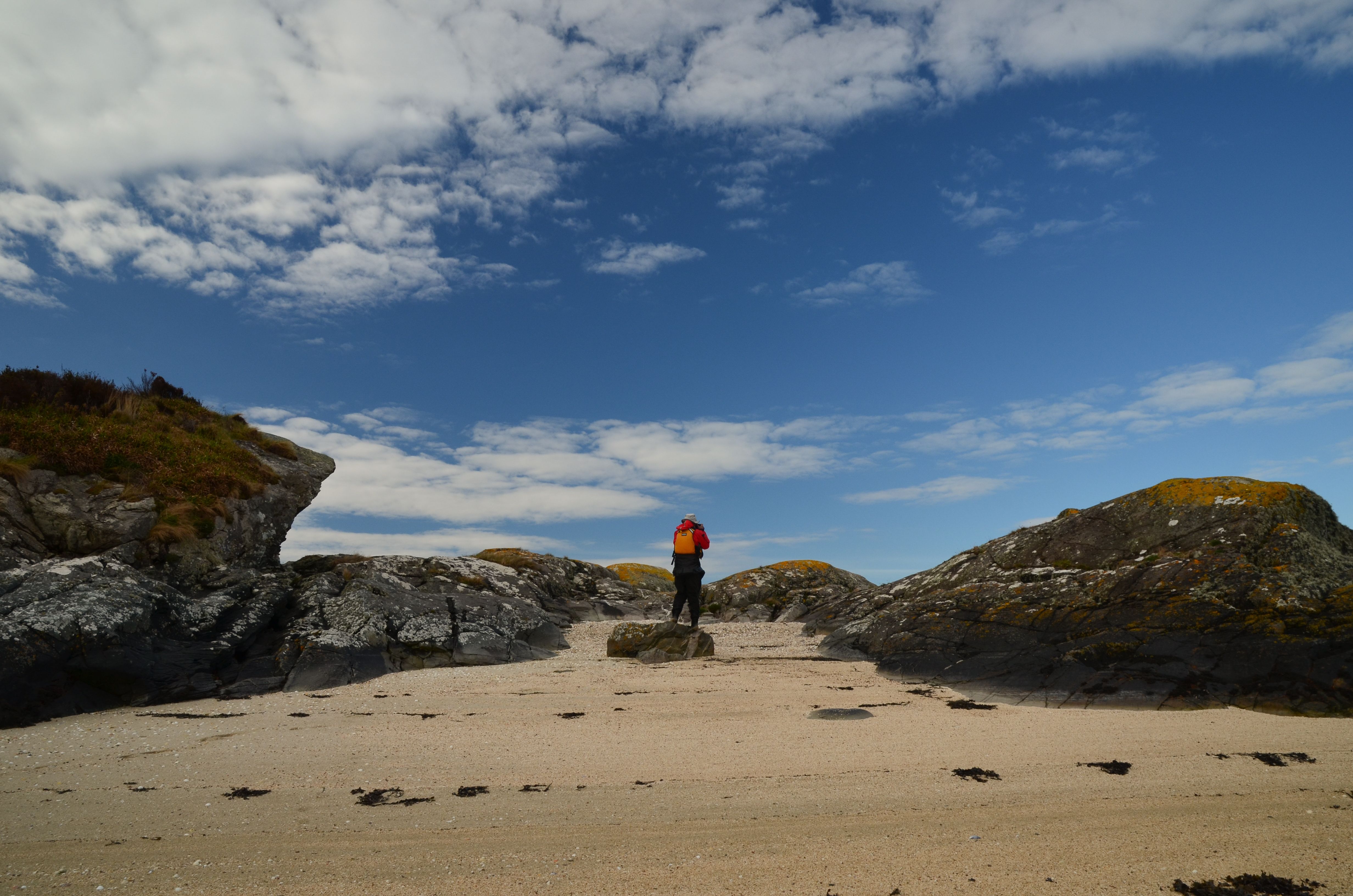


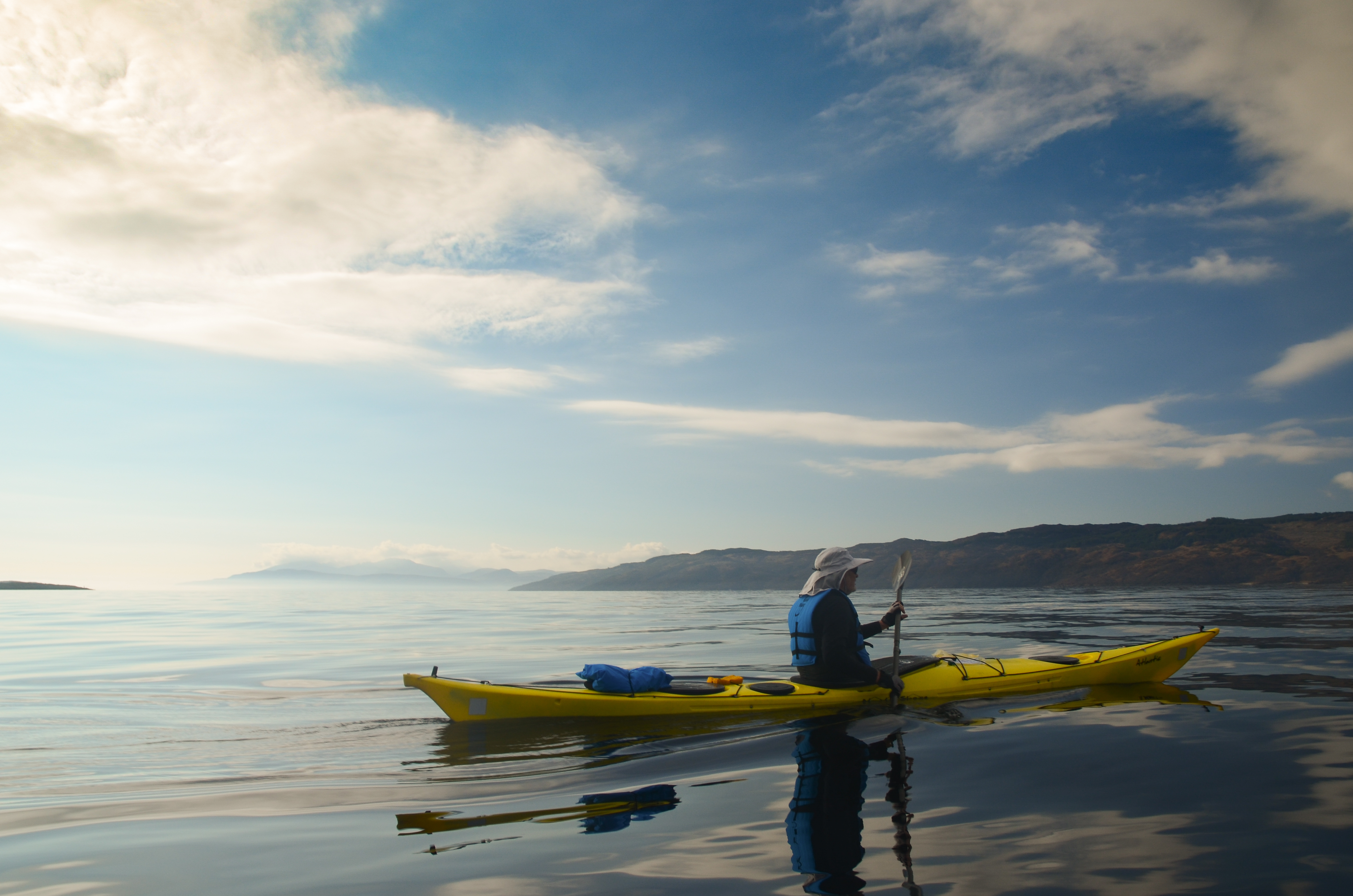
We had a leisurely breakfast and got on the water - within a few minutes we were back ashore on a tiny island with a "now you see it, now you don't" sandy beach which disappears at higher states of the tide.  We'd wanted to stop here because it's rather a fine viewpoint; the first image in this post was taken from the beach.
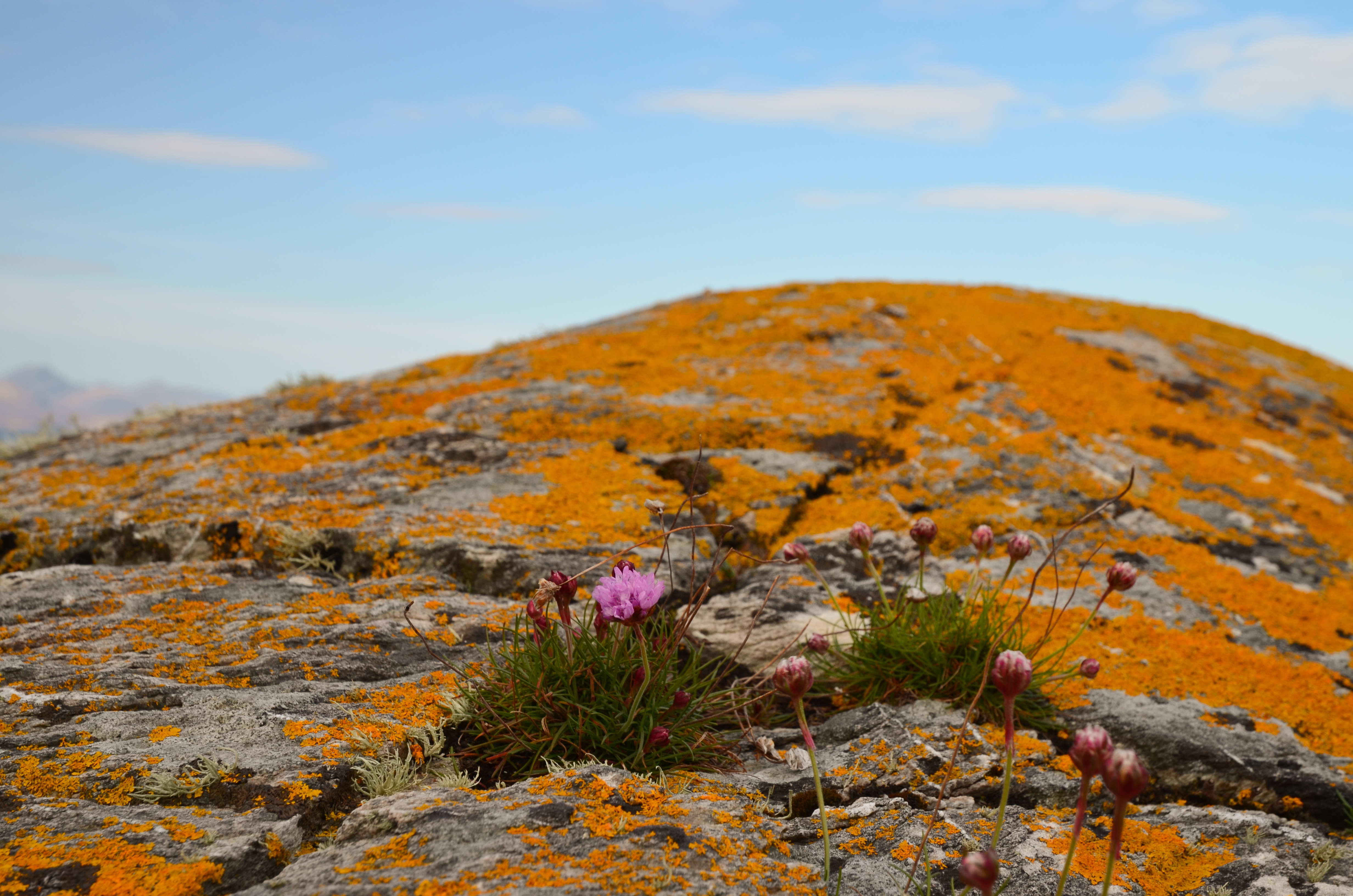


The view near to hand wasn't bad either - vivid orange lichens glowing in the morning sunshine, set off by a few Thrift flowers.


Orange seemed to be the theme of the morning; we returned briefly to Kyleakin to collect some things and whilst preparing to get back underway we noticed a bright orange vessel passing under the Skye bridge.


She's the "Mikal With", a 67 metre long palletised cargo vessel.  On most marine vessel websites she has a blue hull and a different owner than recently.  She's either owned or on charter to MOWI, a Norwegian aquaculture company.


We set out again from Kyleakin and aimed for the island of Pabay, which we intended to use as a stepping stone on our way to an intended camp on Scalpay.  The breeze had been slowly building and once clear of Kyle Akin it became quite strong from straight off the Skye coast (our port quarter).

We put our sails up to take advantage of the push and were absolutely blasted across towards Pabay.  I found this a really great sailing run, but was certainly not prepared to stop paddling in order to take photos!  Our average speed on this blast was 9.4km/h, or nearly twice cruising speed.....


Although a fast passage, it had been an energetic one - it is paddle sailing rather than just sailing!  We were all ready for a lunch stop by this point.


Approaching Pabay the wind seemed to ease  a little and we dropped our sails to paddle into the tiny harbour area.  Donny had motored along to Broadford in his F-RIB and made a direct crossing from there to Pabay; he had a pretty wet ride!
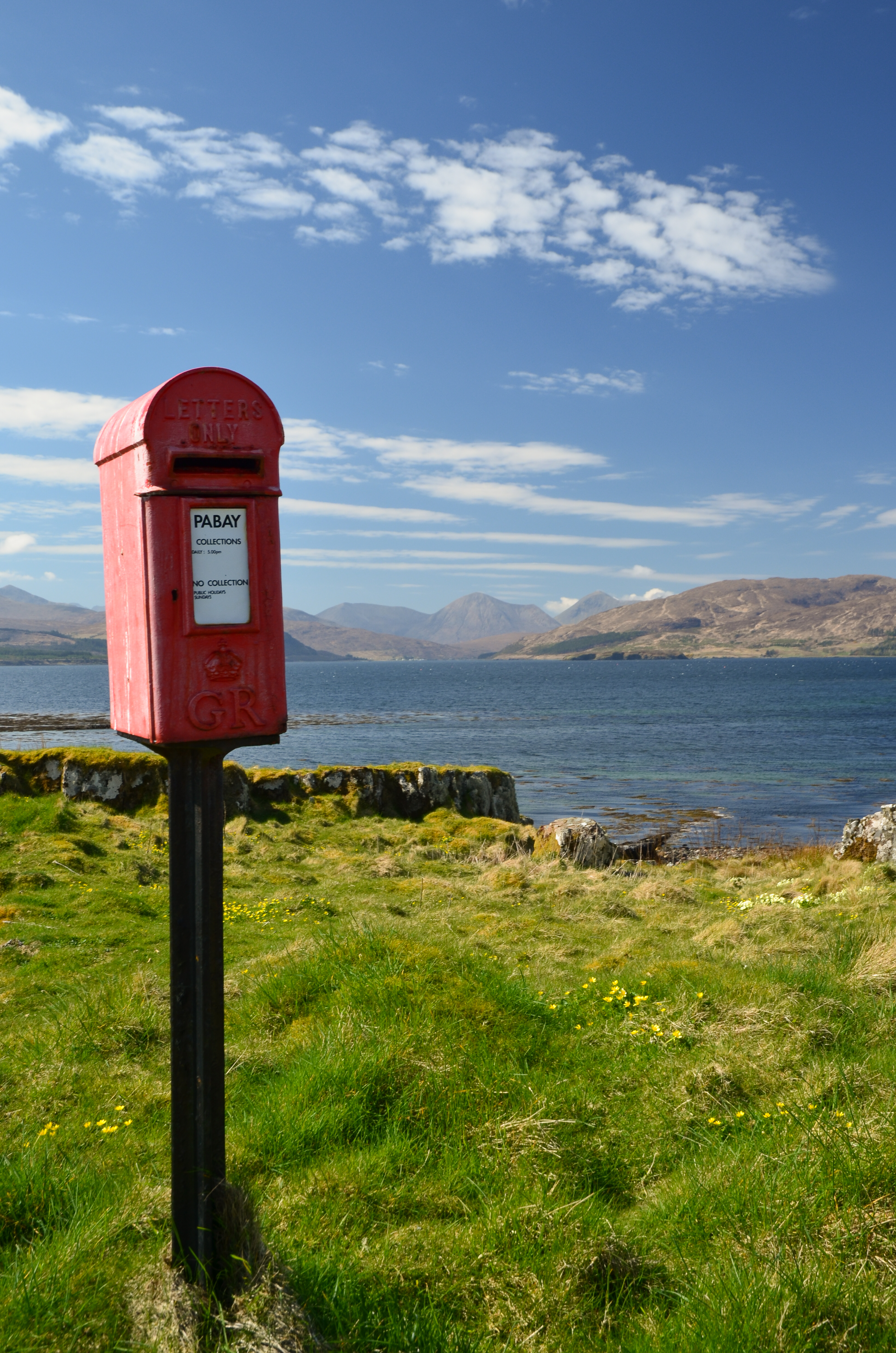


One of the iconic sights on Pabay (Norse: Priest Island) is this post box.  It seems incongruous since there are only a couple of houses on the island but is here because the island issues it's own postage stamps for mail which is transferred into the Royal Mail system in Skye (from where it needs Royal Mail stamps).


Sheltered from the breeze (which was becoming stronger) we lazed in warm sunshine, surrounded by clumps of Primroses.  The pale yellow of the flowers set against the blue of sky and sea was gorgeous.


Above where we lunched a pair of Bonxies (Great Skuas) watched us warily.  These impressive piratical predators had picked a nest site with a great view over the low lying island.


One of the features of Pabay is its geology which is shales intersected by dykes of harder rocks.  The whole island is almost flat and nearly doubles in size as the tide falls from high to low water, leaving the geometric patterns of dykes.

Another feature is that, despite being flat the island has virtually no wild camping spots accessible from the water.  The rock layers from a barrier and the softer rock gives good growing conditions for brambles and tangled low undergrowth.

This gave us a problem; we were pretty much pinned on Pabay.  The wind had continued to rise and in the Sound between Pabay and Scalpay was approaching a Force 6.  None of us was keen on trying the paddle across unless we really had to, but despite trying along the sheltered parts of Pabay by kayak we could find nowhere to camp.  We returned to the harbour to have a re-think.  Douglas and I walked up to the "big house" which is undergoing renovation by a new owner of the island.  We explained our situation and asked if we might camp near the harbour.  The Access provision in the Land Reform (Scotland) Act is wide ranging but does not cover access near to houses or infrastructure.  The owner was most kind in allowing us to camp for the night and it was really appreciated by us.


We pitched our tents in areas which wouldn't affect access to and from the harbour itself and found a spot out of the wind to cook dinner - preceded by fresh soup.  The day had been recovered but our plans would need to be altered.  The forecast was for the wind to drop almost completely by morning, so we decided on a paddle to the Applecross shore via the Crowlin Islands.


As the sun set, the wind came around a couple of points and seemed to drop by several degrees in temperature - it was pretty cold within minutes.  Dinner done, we retired to the tents (which we'd pinned very securely to Pabay) for an early night.
 

Thursday, 7 April 2022

Fyne, just fine....

The morning sun on the tent woke me early at our camp on the shore of Loch Fyne.  Up and about, I made breakfast and enjoyed the sunshine on what was clearly going to be a fine Fyne day.


We left our tents up until the last minute as there was quite a bit of condensation from the cool night air, but by 0900 we were packed and ready to carry three kayaks and one F-RIB down the pebble beach to the water.


And what a morning!  Our plan was to head over to Tarbert for second breakfast and we made the 6km crossing of Loch Fyne in idyllic conditions.


To the south the Arran hills were cloud-capped - in fact they had cloud cover throughout the four days we were in the area, even when everywhere else was in bright sunshine.


We stayed on the north side of East Loch Tarbert so that we wouldn't be in the way of the ferry which sails on a very regular route to Portavadie from here.  On this beautiful morning all of the Isle of Cumbrae's passengers seemed to be sat outside to enjoy the weather and we got a cheery wave from some smaller passengers.


Tarbert is in a very strategic position and has a long history.  The name is shared with several other places and indicates a place where boats could be dragged across a narrow isthmus between to bodies of water - from the Old Norse/Gaelic "Tairbert" or draw-boat.

This Tarbert has a narrow neck of land less than 2km wide separating East and West Lochs Tarbert; being able to portage a boat here avoids the long and potentially hazardous passage around the Mull of Kintyre.  The strategic value of the tairbert was demonstrated spectacularly in 1093 when King Magnus "Barelegs" was ceded all the land on the western seaboard of Scotland which could be circumnavigated in a longship.  He sat in his longship as it was dragged from one Loch tarbert to another and so claimed the entire Kintyre peninsula!

The castle was first constructed in the 13th century, subsequently strengthened by Robert Bruce, was captured by James IV from the Lords of the Isles and last changed hands in the 17th century before falling into disuse.


Tarbert is a busy port used by fishing vessels and leisure craft as well as two ferry services.  We looked at landing near the harbour head but the receding tide had left some evil looking mud, so settled for a slip near the yacht club which also has a signboard about the Argyll Sea kayak Trail; this being a prominent stop on the trail.  You can buy shellfish direct from the processor at the top of the ferry slip, so all in all a good place to pause!

We couldn't see where Donny had landed in his F-RIB, he seemed to have disappeared.  The mystery was solved when he strolled around the harbour to meet us having blagged a berth on the best pontoon in the marina - for free - for a couple of hours stopover!

We wandered into town (don't expect a metropolis!) and settled on the excellent Cafe Ca'Dora for second breakfast.  We were just in time before breakfast serving turned to lunch serving and enjoyed an outstanding "Full Scottish" accompanied by great coffee - Cafe Ca'Dora is rated as 12/10 as a sea kayaking food destination by us!


We returned to the slipway and whilst repacking our boats took a closer look at this graceful craft beached at the top.  She's the "Freydis", a 40ft/12 metre replica Viking longship built by volunteers in Tarbert to take part in the annual Loch Fyne Viking festival.  Named after Freydis, daughter of Erik the Red and sister of Leif Erikson, who has various claims to fame in the Norse sagas as an explorer, not all of them savoury!

Sadly, Freydis has seen "better days"; some of her planks are sprung and she'd need some TLC to be seaworthy again, but what a fine Fyne vessel!


 Freydis' dragon prow is particularly impressive, carved from a single piece of wood and adorned with metal "scales" and a fearsome tongue....now, I wonder what a scaled-down version of a dragon prow would look like on a sea kayak?!

Monday, 5 October 2020

Coming back to Ewe


We left Camas Mor with some reluctance.  It's a wild and beautiful spot and we'd been lucky enough to experience the place at its best in calm, sunny conditions.


We had a good distance to paddle back to our starting point in Loch Ewe and it was now hot in the afternoon sun. Our pace was steady, and why would we rush in such superb conditions?


Our friend the White Tailed Eagle was still in the same spot as we passed one of the higher points on the coast, taking off to become a huge shape just after we passed below.


At the mouth of Loch Ewe we landed on a skerry to take a break; it wouldn't be possible to land here on most days with swell running onto the angled slabs.  It was near here that the American liberty ship "William H Welch" was wrecked in a gale and snowstorm in the early hours of 26th February 1940.  Of her 74 crew only 12 survived.


We saw several other kayakers on our way back, like us taking advantage of a lovely summer afternoon.


The last leg into Loch Ewe was made much easier for us when an onshore breeze started up.  We had our sails up immediately and were soon scooting back towards our launch pint at a very satisfactory 8km/h with very little effort.


 Our route had been 27km and we'd enjoyed a simply superb day's sea kayaking in a fantastic location.  At the fourth time of trying I'd managed to paddle out to Rubha Reidh, and it had been so worth the wait!

Sunday, 9 October 2016

How to remove a hill - one load at a time


We paddled on down the Morvern coast past Loch a'Choire and took a short break for first luncheon on a beach of pale pink granite pebbles. 


The shoreline here drops steeply into Loch Linnhe and feels quite wild, until.........


...a corner is turned and the landscape is instantly industrial.  Glensanda quarry is, quite simply staggering. The operators, Aggregate Industries describe it as a "superquarry" and it really is that, in every sense of the term.

A few statistics:

Glensanda produces ten million tonnes of crushed granite each year.  There are estimated to be 760 million tonnes of rock still to be quarried.  The rock is quarried from the mountain 600m above the shore and the super-sized hole is masked by leaving the face intact, thus minimising visual intrusion.  A 1.8km conveyor grades and washes the quarried stones, placing them into a pile of up to half a million tonnes, where the aggregate can be washed and further graded.

Whatever your view of the environmental pros and cons, Glensanda is impressive.  Of course, having quarried all this aggregate, you need something big to put it into.....


...and this is it.  MV Yeoman Bridge at 200m long, 38m beam and drawing some 15m is a very big ship.  Her size is matched by an impressive capability - she is able to carry 97,000 tonnes of aggregate at a time and has a self-discharging capability of 6000 tonnes per hour.  The granite she carries is so hard that her holds need a very specialist coating to withstand the abrasion of loading and unloading.  In service since 2006, she's carried some 35 million tonnes of granite away from Loch Linnhe so far.


Yeoman Bridge's bow gives a hint of just how big she really is when seen close up from the water.....


....and paddling past her was like travelling alongside a red wall.


The granite from Glensanda is used across the UK and Europe - some recent projects such as motorways in Poland, ballast for a high speed rail link in southern France, the Elbe tunnel in Hamburg, the Channel Tunnel and a new port on the Thames are detailed in the quarry brochure.


Just past the heavy industrial landscape of the quarry, the ruin of the 15th century Glensanda Castle is a  more traditional use of the local granite.  A one-time MacLean stronghold, Glensanda looks out over Loch Linnhe and almost seems to have its back to the quarry.


Slowly, as the quarry receded behind us the scene returned to something more natural, and as we turned another corner....


.....the quarry and deepwater facility were no longer visible - just the view back up Loch Linnhe.  The process of removing a whole hillside one shipload at a time is never going to be either gentle or unobtrusive, but I'm guessing that few people guess the true scale of Glensanda, or even know it's there at all as little is visible from across the loch. 

Tuesday, 20 September 2016

A fire on Kintyre


The coast north of Carradale is wooded right to the edge of the water and feels quite remote as the minor road leaves the coast and goes inland.  


Near to Eilean Grianain (sunny island) we stopped for luncheon and watched the "Ronja Challenger" manoeuvring alongside the salmon cages of a large fish farm.  A newly built vessel, the Ronja Challenger is Norwegian registered and is on a five year contract with Marine Harvest Scotland.


Described as a "wellboat", her job is to transport live fish from fish farms for either transfer to another location or to a processing plant.  She is 70 metres long and has a capacity of 1800 cubic metres - that's a lot of fish! 

Beyond the fish farm the hills of Arran remained resolutely in cloud, but we thought we detected a slight lifting of the cloud base as the afternoon went on.


Our next stop was on the inviting sand of the beach at Grogport - great name but sadly no grog seemed to be available other than that safely stowed in our kayaks for the evening.


The mica rock on this beach is featured in thin layers almost like scales - this half buried boulder resembled a huge seashell. 


Underway again, the seabed beneath our boats was lit with beautiful shades of green in the pale sunlight. During the next hour or so we looked at various camping spots on the shore which we'd marked as "possible" on our maps, settling on a rather fine spot.......


...where we could land on a shingle beach usable at all states of the tide......


...with a good bit of level ground behind on which to pitch our tents.  The ground was a little stony for the pegs but we both got good spots and put up the tents, the green colours blending unobtrusively with the vegetation.


Before dinner we gathered a quantity of driftwood, and after dinner we lit a fire below the highest tide line utilising a "Wilcox Ignition Aid" TM


Keeping the fire small and contained meant that we could generate a good heat.......


...and sit in comfort in our Helinox camp chairs with a Sports Recovery Drink and warmed by both fire and a small dram of our favoured Jura whisky - life seemed particularly agreeable!......


....and continued to be agreeable as we chatted long into the evening.  Baked potatoes were placed in the embers at "Log Mark 6" for the requisite 40 minutes and eaten with salt and butter under a sky which had cleared to show a swathe of the Milky Way.  All in all it was a pretty perfect evening, and it was as well that we enjoyed it as the following evening would be quite a contrast....