Showing posts with label bennachie. Show all posts

Monday, 18 May 2020

One good thing - 17th May 2020


The weekends give opportunity for longer walks, and once again routes on the Correen Hills have been the logical choice, walking directly to and from home on long circuits.  Both days had similar weather with early rain clearing to give bright and breezy conditions, flotillas of clouds racing overhead and clear air.  The freedom and space these hills have offered through the lockdown will be long remembered, great striding routes where other people are seldom seen.


One of my routes over the weekend was this 21 kilometre circular walk which could be started and finished from quite a few different points, there's around 500 metres of ascent involved and it covers a nice variety of moorland, wood and farm tracks - there's a good track the whole way around.  One of the features of these hills is that distance just seems to reel away.


Alternating cloud and bright sunshine made for some dramatic lighting effects as in this view from the summit of Lord Arthur's Hill over to Bennachie, the hill dark in shadow and lower ground covered in gorse making for a brilliant contrast - it was all good.

Saturday, 14 September 2019

Top to top to Tap

I'm lucky to have Bennachie as a neighbour. One of the most prominent hills in the north east of Scotland, a glimpse of the distinctive outline of the Mither Tap (Mother Top) means "home" to generations of Aberdeenshire folk.  Bennachie inspires a real fondness in people and there's even a dedicated band of volunteers known as the Bailies of Bennachie who look after the hill and its environs.  I climb it regularly by a variety of routes, but there was one which I hadn't done.


Lorna, Allan and I met up on a bright late summer day to do one of the longest routes on Bennachie, a traverse from one end to the other of what's essentially a long ridge with a number of "tops".  They live closer to the hill than me and have a clear view of it from their house - a very desirable feature in any property I feel!

We pre-positioned a car at the end of our intended walk and drove back west to the top of a feature known as the "Lord's Throat", a wooded valley carrying a minor road.  A rough track leads to a sand quarry and after a bit of scratching about we climbed above the quarry and onto the open hill above.  a view opens up straight away to the furthest tops of Bennachie above the valley of the River Don.


The heathers were all in full bloom, the colours stunning.  This is the larger flowered Bell Heather (Erica cinerea).....


...and this is the more ubiquitous Ling heather (Calluna vulgaris).  As we walked our boots raised clouds of honey-scented pollen and one of the dominant sounds was that of the bees collecting pollen - we saw several species on this part of the hill.


This is a corner of the hill I hadn't previously walked and I was intrigued by a line of very old and long-disused shooting butts arranged in a line upslope.  Drystone built, the may have been turfed on top when in use and each had an offset entrance for the "gun".  Interestingly, almost every one harboured a Rowan tree.  Rowan (Sorbus aucuparia) seeds germinate in an interesting way; if you plant them they just won't grow.  The seeds are contained in a bright red berry which are irresistible to many species of birds.  the berry and seed must first pass through the gut of a bird in order to germinate; and of course will benefit from having a blob of guano fertiliser to boost its chances.  The berries are irresistible to some humans too - they make a superb jelly to accompany meats and cheeses!

Rowans are one of the most common trees in Scotland, and are the tree which reaches higher altitudes than any other species here - up to 870m/2850ft in a few places.  There's a rich folklore surrounding the tree; it's associated with protection and was commonly planted at the gable end of a house to afford protection from witchcraft in particular.  Rowans rarely live longer than 150 years so it's possible to guess the dates of some ruins by the Rowans near to them.  Here, in a lovely piece of symmetry, the works of man provide protection for the Rowan - the seeds dropped by a bird have fallen into the grouse butts and the seedlings have grown within the circular embrace of the wall, protected from weather and from browsing animals until well established.


From near the summit of the first "top", Black Hill, there's a wide view over the Aberdeenshire countryside.  Due to its relative isolation from surrounding high ground such good views are a feature of the whole of Bennachie.


From Black Hill the ridge proper swings into an east-west orientation and as we continued west the views just kept coming.  We took a slight detour to the "top" of Hermit Seat (who was the hermit I wonder and what was his story?) and past Hummel Craig.  A Hummel is a stag with no antlers and Craig is a derivation of Crag.   From the next "top" of Watch Craig we looked over the valley of the River Don to Pitfichie Hill and Cairn William.  Allan and Lorna were just able to see their house from this point!


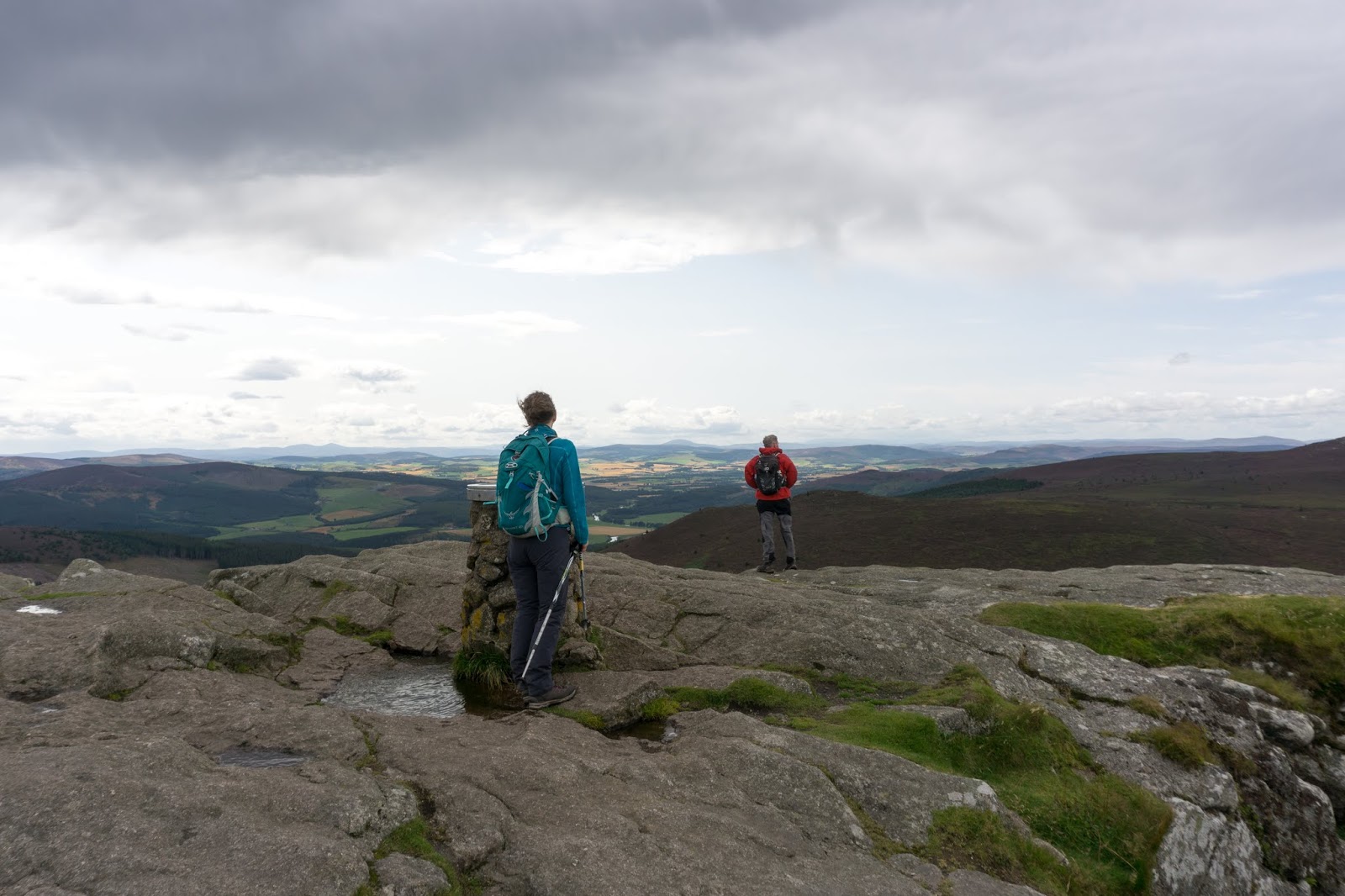
Once up on the higher ground the paths on Bennachie are really good going and distance just reels away.  In quicker time than we'd anticipated we found ourselves on the rocky tor of Oxen Craig. At a modest 528m/1736ft this is the highest point of Bennachie but probably visited by only a small percentage of the folk who climb "Bennachie".  Behind us rain showers were strafing the land further west...it seemed we'd probably get wet before the day was done.


A view indicator plaque identifies some of the hills and key features to be seen from Oxen Craig, including some at considerable distance.  The view ranges from the city of Aberdeen in the east, round to the hills of Angus in the south, to the Cairngorm giants almost 70 kilometres away and round north to Peterhead and the Buchan coast - an enormous sweep of the northeast of Scotland.


We sat out a shower below Oxen Craig and once it had passed headed slightly off the main line of the ridge to another "top", Craig Shannoch.


From Craig Shannoch there's a good view across to the main attraction of any walk on Bennachie - the Mither Tap.  In fact the Mither Tap is Bennachie for most folk; the name of the whole hill is a derivation of Beinn a' Chioch (hill of the breast) and it's the Mither tap which is the most visible, most prominent feature.  Across a huge swathe of Aberdeenshire you can look for it - the eye instinctively drawn to a familiar outline.  Bennachie, always Bennachie - it's what inspires such affection for the hill.  The Tap is a granite plug from the heart of a long ago eroded volcano and has considerable steep drops on three sides.  I'd guess that only about one in a hundred people who climb the Mither tap go on to walk to the "real" summit of Oxen Craig - such is the draw of the Tap.


We climbed to the summit, almost able to lean on a tearing westerly wind.  We'd traversed top to top to reach the Tap, a fitting end to the high ground of Bennachie.


This place has a long history of use.  Being so prominent prompted the building a hillfort here.  Constructed during the Iron age and possibly occupied as early as 1000BC, it seems to have been developed for a long period and may have been the site of the battle of Mons Graupius (which gave its name to the Grampian region and mountain range) where the Picts were heavily defeated by a Roman army.  The aerial pictures on the Canmore site show the extent of the ruins.


The curving entrance to the upper fort is particularly well preserved - here you can really walk through ancient history.


The descent from the Mither Tap to the Bennachie Centre is knee-jarring, steep and in places rough.  Although the shortest route in terms of time and distance I've always thought this the least attractive way to climb the Mither tap.  There are a number of ways to reach the Tap, as shown on this downloadable map, or you could always do our longer route of around 10kms!  We'd enjoyed a superb day doing this route; it's one all three of us will repeat.

Sunday, 23 December 2018

A winter solstice celebration


On the winter solstice, 21st December 2018, we visited Cothiemuir Hill stone circle which is near to our home.  Arriving  before sunrise, we experienced the light gradually seeping in around the stones on this, the shortest day of the year.

Aberdeenshire is very rich in neolithic monuments and has close to a hundred of a type of stone circle found almost nowhere else, the recumbent circle.  Aligned on the midwinter moon, and in particular the major "standstill" midwinter moon which occurs every 18.6 years, the builders aligned the circles to an astonishing level of precision.  Some circles have cup marks incised to mark major lunar events and show where the moon would appear when viewed from the centre of the circle.

Cothiemuir Hill is a great example of a recumbent circle and is almost complete.  The huge recumbent is a 4.2m long basalt monolith, and was brought to the site.  The flankers either side are 2.9m and 2.7m tall - this is an imposing circle. the west flanker (the right hand in this image) is aligned very precisely on the major southern moonset.  I've written about this circle several times before, here and here, and I'm still fascinated by the place.

We try to visit at the winter solstice, not from any pagan leanings but merely from a feeling that this is their time, the point in the year when the circle had most significance to its builders.  Now within a wood, it would have been a prominent viewpoint when in use.


We headed home after visiting the circle to do the jobs which seem to take so much time as Christmas approaches.  The shortest day turned out fine, cold and dry with bright, low winter sun.


Towards sunset (3.25pm at the solstice!) I decided to go back to the circle and see if I could view the sunset from the circle.  It was a very atmospheric afternoon, a smoky sunset and a hard frost setting in.


Walking up to the stones I was delighted to see that a wedding was in progress - timed, it seemed, for the sunset.  No pagan or "New Age" ceremony, this was a straightforward humanist celebration.  I often leave some greenery at the stones at this time of year, and I'm not alone in doing that, but here was a continuity of use for the circle stretching back millenia.  Having waited until the couple were married, I added my congratulations and left quite moved at this simple ceremony in a wood.


Back at home, the solstice full moon was rising over Bennachie, a huge disc growing brighter and colder as it climbed over the Aberdeenshire farmlands.  This is what the circles were built to observe.  Maybe not as striking as the solstice full moon of 2010, it's nevertheless a significant turning point in the year.


The morning of the 22nd was forecast to be fine, with perhaps a little cloud.  I thought it would be good to get out early and see if I could watch the sun rise from Millstone Hill.  Heading out well before dawn, my headtorch picking out the hard glitter of a deep frost, I was near the summit of the hill as the light was beginning to grow.  Below, the valley of the River Don was a cold, frosty place.


To the south east and across the city of Aberdeen, I watched the sunrise over the North Sea.  At first a crimson line, the colour intensified to a searing orange before fading as the sun was obscured by a cloudbank.  There was a warmth to the light, but certainly not in the air - it was very chilly as I sat waiting with a flask of tea. 


Although the sun itself remained obscured, the light crept up and gave a nice view over to  Bennachie's Mither Tap, site of a hillfort.

Despite the short days I felt that I'd experienced the best of the winter solstice - from the continuity of the stones to the first sunrise of lengthening days - something to celebrate indeed!

Sunday, 2 December 2018

An autumnal gem


On a crisp and sunny mid November day we drove a short distance to the pretty village of Monymusk for a walk.  Monymusk has an interesting history, the estate has been owned by the Grant family since 1712 and many of the cottages in the village square are estate properties.

Sir Archibald Grant inherited the estate in 1719 and set about transforming the agricultural land surrounding the House of Monymusk.  When the Grants took ownership the land was boggy, poorly drained, had little in the way of crop or stock capacity and was almost bare of trees.

Archie Grant had a colourful life.  He was a speculator, sometime mine owner and was expelled from the House of Commons after a financial scandal.  However, he proved to be one of the great agricultural "improver" lairds.  He ordered the clearing of ground with stones being used to make field enclosures, introduced crop rotation to the estate including the use of clovers and rye grasses to condition the soil, he planted millions of trees on the estate and was one of the early adopters of growing turnips - a humble crop today but a game changer in cattle rearing practice at the time.  Using turnips which could stay in the drill until winter, cattle could be fed through the year rather than having to be sold.  All these improvements meant a change to the old subsistence farming methods which had existed in Aberdeenshire, and many folk had to move but this was not a clearance in the sense of evicting people to make way for sheep or sporting estates.  His legacy and that of his descendants is a rich mixture of productive agricultural ground, woodland and the origins of the village of Monymusk we see today.


The most important building in Monymusk isn't the estate "big house" but the church.  A stone church has stood here since the 12th century, and it's believed that this replaced an even older Celtic church.  The origin tale concerning the building of the church records that the future King Malcolm III prayed here on his way to a battle with Macbeth near Lumphanan in 1057.  He stated that if he was successful he would build a church to replace the already old building in Monymusk. Malcolm defeated Macbeth's army, captured and summarily executed him on the battlefield, then honoured his promise to build a church.

The church seems very large for a small rural community but was originally built to serve a nearby priory.  The tower was originally somewhat higher than the present one but has been lowered twice, firstly to counteract an unsound wall.  A spire was added which in turn became unsound so the whole tower was lowered further.

The church contains an important Pictish symbol stone and two 6th century grave slabs.  Despite living just a few miles away, we've yet to see these - something to rectify!


Our walk took us out of the village and up through a wood containing some huge Douglas Firs, perhaps planted by Archibald Grant.  The path through the wood climbs gently up to Clyan's Dam.....


.......which proved to be a bit of an autumnal gem.  A path goes over the earth dam and around the small lake, which was probably a mill pond.  The last of the autumnal colours were reflected beautifully in the still water, it's a peaceful spot and several benches offer the chance to sit and enjoy the setting.


At the dam a small burn emerges out to wind down through the wood to the River Don below, rushing through mounds of beech leaves had been piled up by the wind.  We headed the same way, back down through the wood and along the minor road to reach a track which heads back towards Monymusk alongside the River Don.


As from so many places in Aberdeenshire, the distinctive shape of Bennachie's Mither Tap is prominent above the farmland and woods.


In mid November when most of the glory of autumn is finished, the Larch trees have their moment.  This image doesn't do justice to the intense yellow and gold strips interspersing the dark greens of  the spruces in Bennachie forest.  Add in a blue sky and you have another autumnal gem.

In the three weeks since the images in this post were taken a series of autumnal gales, sluicing rain and a little snow have stripped the trees of their remaining foliage.  The colours diminished, it's more about form now.


We soon arrived back at Monymusk but took a short diversion to get a view of the House of Monymusk.  Originally built by the Forbes family and developed by the Grants, it's one of the grander examples of a Scottish estate "big house" and is harled in the pink shade often used in the castles and estates of Aberdeenshire.

Our walk around Monymusk had lasted less than two hours, but on a lovely crisp day had been something of an autumnal gem!

Sunday, 18 February 2018

Twa landmarks frae the sea

It's been some time since I last climbed Clachnaben, a small but prominent Aberdeenshire hill. With a forecast for bright, cold and very windy day, I spent an hour one evening looking over maps for a hillwalk relatively close to home.

My eye kept coming back to Clachnaben - the hill sort of chose itself.  My previous climbs had both been from the north, so I looked for a different route and worked out a circuit that would work with, rather than against the wind.


A small quarried area off the B974 (the Banchory to Fettercairn road over the Cairn o' Mount, which on this day was closed higher up due to snow) has been made into a parking area from where the shortest route to Clachnaben starts.  The first part of the walk rises gently through open woodland and was very pleasant with sunlight dappling the woodland floor.


Emerging from the wood there's the sudden "reveal" of Clachnaben ahead.  The granite tor which forms the true summit is very prominent from miles around, particularly as the hill sits in isolation at the end of a ridge above the lower ground of the Dee valley.  Sheltered from the strong northwest wind, and with views like this, it was a superb morning to be out.


My route diverged from the "normal" path to the summit and continued around the slopes of Netty Hill into Glen Dye.  The view down to the Water of Dye was an unexpected delight, and would make a great short walk by itself. A quicker way to this point is by parking near to the narrow road bridge at Spital of Glen Dye, but parking is limited, and on a difficult bend.

The ground was so frozen that I'd put two sets of boots in the car, plus crampons.  On looking at conditions on the drive over I'd opted not to use my heavy boots and crampons.  This was the right choice for the hill, but further along the Glen Dye track I was wishing for a third option....ice skates!  The whole track was covered in thick blue-grey ice...there aren't any photographs from this part of the walk as I concentrated on staying upright.


I managed to reach Charr with only one or two "skitey" moments, one of which had me doing a fair impression of Bambi on Ice.......  


Charr is now an MBA bothy, and sits in a wild and lonely place; it seems much more isolated than the distance from the road would suggest.


The bothy occupies three rooms in part of the building, the remainder is retained by Fasque estate.  There's no fire or stove here but the place is clean, dry and bright.  I've visited previously but not (yet) stayed here.  I met another walker heading home to Fettercairn over the hills having been dropped at Spital, Charr is on a number of potential routes between Deeside, the Mearns and the Angus glens - which is food for thought for future walks.


After lunch and a "brew" of tea in the bothy ("Char" at Charr?!) I headed back out and tackled the steep climb up the track beside the Bracky Burn.  Emerging onto the open hill at the top exposed me to the wind, which was absolutely biting.  This was the only leg of the walk where I'd be heading into the wind; I'd planned the route to have it with me on the high ridge leading to Clachnaben.


To the west there's a wonderful view of wild, open country with the higer hills leading to the Cairngorm plateau beyond.  It is, essentially, a view of absolutely nothing - and that's a precious thing.  There's word that a windfarm is planned near here with giant turbines; if the planning application goes ahead I will be objecting - this is a landscape which shouldn't be industrialised.


The climbing continues to meet a track between Mount Battock and Clachnaben, where I was really glad to turn and put the wind from my starboard bow to my port quarter, it was searingly cold as well as strong.  Clachnaben's tor is well seen from here, but the view is of the shorter side rather than the full height.  The ground on this ridge is bare and broken, and marked by ATV tracks - it's better under snow than not for this reason.


This is one of the hills where the trig point isn't the actual summit.  The scramble up onto the tor is easy in most circumstances but with a combination of ice and the gusting wind I elected not to stand up on the very top block!


On te direct descent (which is the usual ascent path) the tor is seen at its best. A granite plug, the tor has been plucked by ice and from most angles appears as a "wart" on the slope of the ridge.


Away to the north there's a good view of that other much loved Aberdeenshire landmark, Bennachie. The distinctive shapes and proximity to the coast of these two fine hills gives rise to the old rhyme :

"Clachnaben and Bennachie, are twa landmarks frae the sea"

 On the way back down Clachnaben this set me thinking - would it be possible to climb both hills in a day using a bike to get between them?  A long day for sure, but just maybe......

My circular route was 16 kilometres with around 500 metres of ascent.  I took a little over four and a half hours including a brief stop at Charr bothy.  Other circular routes are possible from the north which can take in Mount Battock and the connecting ridge.  The shortest route is a simpe up-and-down from the B974, but in my opinion this fine hill deserves more than that.

Sunday, 17 December 2017

A disproportionate reward


 My friend Duncan has recently written about the fact that when difficult things are attempted, the rewards are all the greater.  It's a sentiment that I wholeheartedly agree with, but sometimes - just occasionally - there's reward out of all proportion to the effort expended.

A weekend morning shortly before Christmas, and a busy day of preparations ahead.  I took a morning walk in intensely cold air, just as the sun was rising.  Near to the solstice, there's precious little daylight here and if it dawns fair like this, it's a bonus.


 The morning sun flushed the hills and forest behind our house a delicate pink shade, the air was still and this was to be the last day of clear, cold weather before a run of Atlantic low pressure systems.  It would have been perfect for a mountain day, but family commitments come first.  I resigned myself with the thought that the hills are always waiting, and headed home.


 By early afternoon the things we'd planned were done, and it was suggested that maybe I'd like to go for a walk.....  There was just two hours until sunset and initially I thought to walk close by.  But then I remembered how good the hills had looked that morning; I hastily packed a rucksack and headed the few miles towards the car park for Millstone Hill.    Setting off an hour before sunset I climbed steeply up the path through trees which were sparkling with ice on every twig.


 A brief pause at a favourite viewpoint looking west along the valley of the River Don and I continued uphill, hoping to beat the sunset to the summit.


 Although my pace was fast, there were scenes which just couldn't be rushed past.....


 ....including some rather festive looking Spruce trees.....


 The summit of Millstone Hill is reached easily in less than an hour, and as the domed top is reached there's one of the great "reveals" of the north eastern hills as the Mither Tap of Bennachie comes suddenly into view, rearing into the sky and always looking far higher than its 518m/1700ft height.


 To the southwest, the sun was setting in a searing blaze, the movement clearly discernable as it skimmed below the skyline.  Here was reward far in excess of what I could have expected for the 300m climb - and there was more to come.


Well after sunset, when I was getting chilled by a sharp wind from the north west, the sky once again flushed pink, this time the clouds lit by a sun below the visible horizon.


 Gradually the colour faded and Bennachie seemed to stand even further forward in the twilight.  I briefly considered climbing to the Mither Tap, but this would have made me late home and we had a Christmas tree to decorate.....


 So instead I headed down to the bealach between Millstone Hill ad Bennachie, known as the Heather Brig, before taking the track which circles around the western flank of Millstone.  As the temperature plummeted below freezing there was a subtle change in conditions underfoot.  The soft swish of unconsolidated snow changed within a few minutes to the squeal and crunch of icy powder,  To the west, the last of the sunset smouldered away - and an Owl called from nearby.  It was truly a beautiful evening to be out on the hill.

 My entire winters evening walk took a little over two hours, and had given me a disproportionate reward for the outlay of effort.  I got home energised yet calmed - and ready for decorating the Christmas tree!