Showing posts with label Equipment Reviews. Show all posts

Friday, 13 May 2022

Jottnar Grim Hard Shell Jacket - Long Term Review

A hard shell waterproof jacket is one of the staple items of any outdoor kit list - especially when you operate in Scotland.  I have used a variety of waterproofs over the last 40 years, a period which has seen the development of "breathable" fabrics which have so enhanced comfort and usability of jackets.

This review is based on long-term use of the Jöttnar "Grim" hard shell jacket which was purchased in January 2021 and has been extensively and regularly used for walking, backpacking and ski touring since purchase.

Jöttnar aren't perhaps the best known outdoor brand, but have increasing visibility among mountain users, and for good reason.  The brand name sounds Nordic but Jöttnar are a small British company based in Cardiff.  The company was formed in 2013 by Steve Howarth and Tommy Kelly, two former Royal Marine Commandos who served in the Mountain Leader branch, a specialist group within the Royal Marines trained for mountain, arctic and harsh environment operations.  For more about the company's story, there's a very informative article and short video on the Jöttnar website.

The company philosophy and "house style" seems very much a reflection of the founders' background and of the Commando ethos - the kit they produce is streamlined, tough, designed-for-purpose, innovative and has fantastic attention to detail.  I heard of Jöttnar through word-of-mouth, was shown some of their kit by a friend and was veryy impressed by what I saw.

Conflict of Interest statement:  I own several items of Jöttnar clothing, all of which have been purchased at full retail price or in a limited time sale with a small reduction.  I don't have any connection with the company other than being a very satisfied customer.
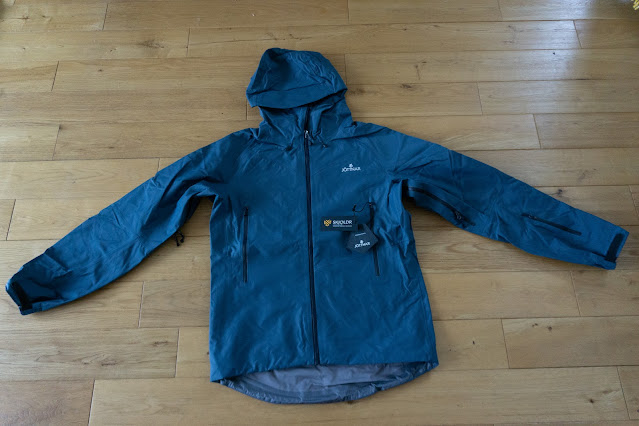


Jöttnar describe the Grim as: "a fully featured hard shell technical mountain jacket. Grim protects you in the most severe conditions, without sacrificing those features which lend it versatility for all-year use".  I was looking to replace a very well-used mountain jacket which had started to delaminate and fail after several years of hard use and the Grim seemed to be a good option.

You won't find Jöttnar products in outdoor stores, the company sells directly to customers via their website.  While this does mean that you can't try on garments, the customer advice is very responsive and helpful, and there's free standard shipping on all UK orders.


The Grim, like all of  Jöttnar's full-spec hard shell jackets, is constructed using a fabric called "Skjoldr" (Shield) which is their own fabric developed in collaboration with a japanese fabric technology company.  Skjoldr is a 3-layer highly breathable 80 denier fabric with a membrane and DWR coating.  The full specification and information on this fabric are available here.  The 171gm/m2 Skjoldr used in the Grim has a fairly stiff handle and feels very robust.  I like these characteristics very much - you're left in no doubt that this is a fortress of a jacket, and the slightly stiffer fabric means that it doesn't flap madly in strong wind as lightweight fabrics tend to.

In use, the Grim has been a revelation.  Noticeably more windproof than Goretex XCR, ProShell or the eVent fabric used in kit I've recently owned, it just shrugs off weather.  The main zip has a substantial storm flap behind it (with a very well designed chin guard).  this is a feature I've always looked for in mountain jackets - 3000ft up on a Scottish hill, head down into lashing rain and half a gale is no place to be exploring the difference between "water resistant" and "waterproof"!

The pockets are positioned really well so that they don't get obstructed by rucsac hip belts or climbing harnesses.  The Grim jacket has a near-twin in the range which is the Odin which is essentially the same jacket but with chest pockets.  There's also the Hodr jacket with four pockets.  The Grim's pockets are large and the zips run faultlessly.  On one walk of several hours in truly biblical rain there was slight water ingress to the pockets, but absolutely nothing came in via the main zip.
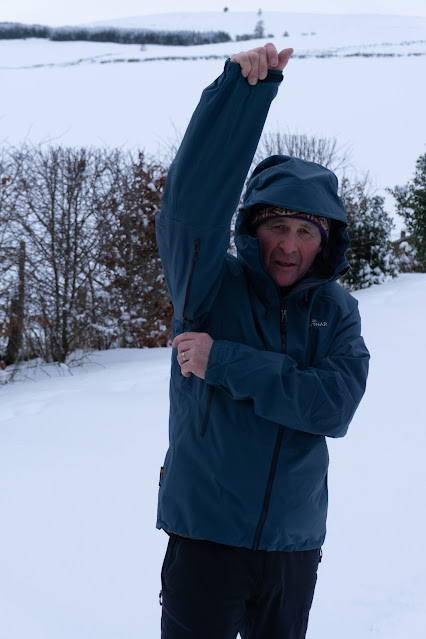
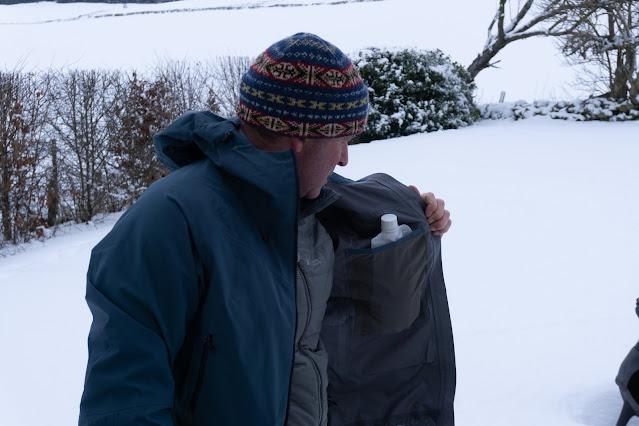
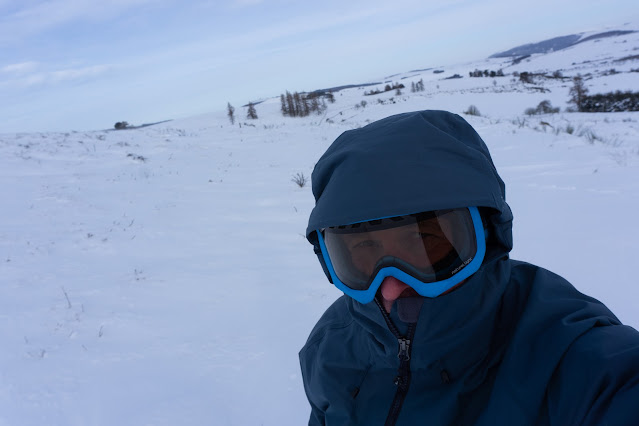
Photo: Linda Johnston - taken in -15 Celsius weather, hence my expression!

There are pit zips under the arms to vent the jacket if required.  I've found that the breathability of the Skjoldr fabric is so good that I've very rarely got warm enough to think about using these, but they're available if needed and very easy to operate on the move. Jacket length is perfect for me, fairly short at the front but with a scoop back to protect the bum. There are hem drawcords which are snag free (i.e. not loops which could catch on gear or rocks).

A small zipped pocket is positioned on the left forearm.  This would conveniently fit a ski pass and I've used it to stow a wipe for goggles and a small laminated card with route notes.

The sleeve lengths have extra built in so that the wrist isn't exposed when reaching up (climbing/scrambling) or forward (nordic ski touring).  When I was looking at the jacket I did think that the measurements given would make the sleeves too long for me at slightly below average height, but this isn't the case at all in practice because of the design and the cuffs themselves.  these have reinforced Hypalon tabs and velcro closures at the front, and a lightly elasticated cinch underneath.  this means that the cuffs can be pulled over gloves without faffing with the velcro (which on previous jackets has had a tendency to freeze and be difficult to fasten in wet/just below zero conditions).  It's another feature of the Grim which just works.

The fit is streamlined, clean and uncluttered, but with plenty of space to layer underneath.  I'm 5ft 8ins (173cms) tall and 41in (104cm) chest and the Medium size is a perfect fit.  There's plenty of room in the shoulders to aid movement like placing axes, long reaches with walking poles or whilst ski touring.

What I can't easily show on these images is the design and cut of the jacket, which is exceptionally good and a reflection of the attention to detail and ethos of the company's founders.  Everything is there for a reason, and if it's there it adds to the jacket and is incorporated really well.  

My initial impression was that this would be a jacket I would use mainly in winter but the performance has been such that I used it right through the year on the hill in "Scottish summer" weather.  I have to really be working hard to generate even the slightest moisture inside the jacket and this soon dissipates - the Skjoldr is very, very impressive stuff and seems to this user to out-perform anything I've previously used.


Inside there's a smaller stretch chest pocket which just about takes a smartphone and a larger internat mesh "dump pocket".  This fits a pair of gloves nicely, would accommodate touring ski skins and is a great size to keep a 500ml water bottle in.  The internal taping is absolutely flawless and here too the design effort is really evident.


The hood is helmet compatible but adjustable to cinch it down.  It moves with the head faultlessly and has a very well designed stiffened and mouldable laminated peak.  This image was taken on a ski tour in very cold conditions when it really showed how protective a hood can be.

The one minor criticism I have of the Grim is that the hood can't be stowed or retained when not in use.  This means it can blow up against the back of the head if not being actually worn. A flap or retaining arrangement would be the only thing I'd change about the jacket -  it's a very small criticism though!

The Grim weighs in just over 550grams for a Medium size - not ultralight and that's a good thing as far as this user is concerned.  But neither is it heavy and the jacket rolls down neatly when not being worn.

Jöttnar jackets are all single colourways, most of which are understated (though there are some brighter options available).  I like the understated colours!  A women's version of Grim is also available.

After 15 months of very regular use in Scottish conditions hillwalking, backpacking and ski touring as well as general walking the Grim still looks like new, the DWR has remained effective and it has performed faultlessly.  Conditions of use have ranged from 20 degrees Celsius to minus 20 degrees Celsius and have included dry gales, wet gales, rain, sleet, hail, snow, ice, drizzle and freezing fog.  In all these conditions I've remained dry and comfortable when wearing the Grim.  The term "bombproof" is a little over-used, but is genuinely applicable here. Add in superb design, form and function and you get an outstanding piece of outdoor kit.  Put simply, this is the best waterproof jacket I've ever owned - in 40 years of outdoor activities.  

There's no getting away from the fact that Jöttnar products are high performance kit designed for sustained usage - and the £449 price is reflective of that.  The price was certainly a factor when I chose the Grim and it required delaying the purchase in order to save up, but I haven't regretted the outlay one little bit. 


Saturday, 22 January 2022

Equipment Review - Kahtoola Microspikes

In icy conditions the soles of walking boots and shoes are seriously compromised in terms of grip, and some form of traction is very desirable.  On steep ground or on the hill, especially in the mixed conditions typical of Scotland I use 12-point articulated crampons with stiff mountain boots but this combination is not well suited to tracks, forest roads or footpaths.

In autumn 2020 I purchased a set of Kahtoola Micropsikes to use on my regular walks when things got icy.  This review is based on regular use through winter 2020-21 which proved to be exceptionally cold and prolonged even by Aberdeenshire standards.  The Microspikes have been used in temperatures from 3 Celsius down to -20 Celsius and in underfoot conditions ranging from hard, frozen turf, iced forest fire-roads, refrozen snow, in hard, clear ice and melting ice.

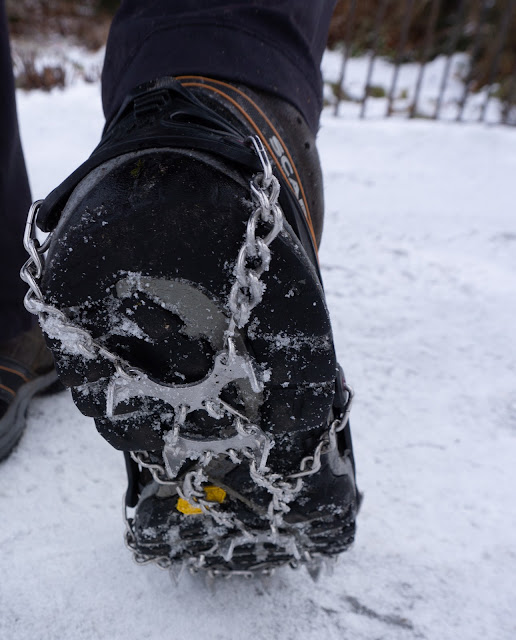
The Microspikes don't require stiff or rigid soled boots which means they should fit a range of footwear (indeed many folk use them on trail running shoes).  The upper part is a shaped Thermoplastic Elastomer (TPE) harness with reinforced eyelets which is claimed to retain its elasticity down to -30 Celsius.

The Microspikes are quick and easy to fit with a little practice and don't require footwear to be removed in order to put them on and take them off.  The technique is to place the forefoot into position then use a raised tab on the rear of the harness to pull the heel into place.  I found that I was able to easily fit and remove the Microspikes on-the-go, which is useful when they may not be needed for all of a walking route.

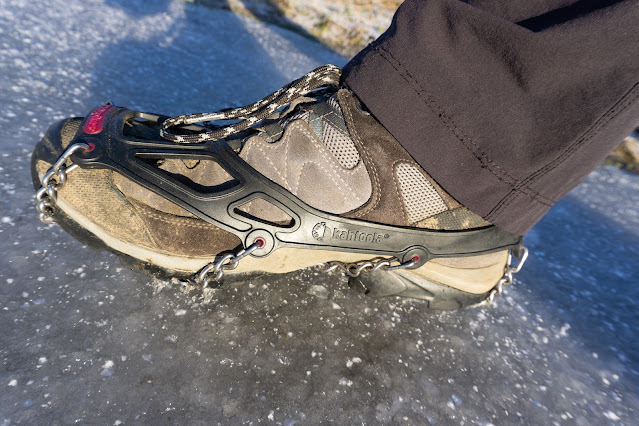
The design of the harness holds the spikes in place nicely and there is no tendency for the footwear to slide out even on quite steep descents.  A real positive is that I haven't experienced any pressure points or "cold spots" from pressure as can happen with some crampons.  In the image above the Microspikes are being used with a walking shoe on hard ice.


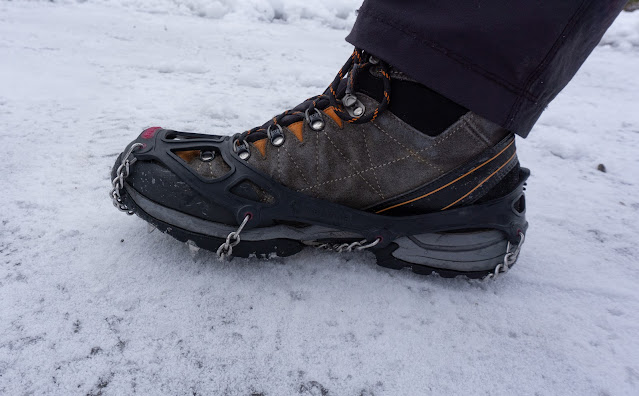
In this image they are being used with a general purpose walking boot in mixed conditions with heavy frost and frozen patches of forest road.  Unlike with crampons, it's not necessary to use a "duck waddle" modification to your natural walking style when using the Microspikes, due partly to the much shorter length of the spikes compared to crampons and also because there are no front points which could catch the ground.


 The chain and harness hold the Microspikes in place very well, I've not experienced any misalignment when walking across level or rough terrain.  Sometimes with articulated crampons strapped tightly to stiff winter boots and secured with toe bail and heel fastener there can be cold spots on the feet from the pressure.  I haven't experienced any cold spots with the Microspikes as they aren't holding the foot rigid and any pressure is distributed across the harness.

So, although for mountain walking my preferred combination is and always will be stiff winter boots and 12-point articulated crampons, the Microspikes definitely bring benefit in winter walking for lower levels, making otherwise inaccessible icy paths easy to walk.  I can also see a place for them in Spring mountain walking when most of the snow is off the hills and there are just occasional patches to be crossed which don't require front-pointing technique.

The Microspikes retail for around £50 in the UK, and I think that they're very good value at that price.  If you walk regularly on icy tracks and paths, live in an area which has winter conditions most years or walk on hills with some icy patches, they're well worth considering as part of your kit.  I purchased my set from Icegripper, a main UK importer of Kahtoola products.  The Microspikes arrived quickly, and I can vouch for the customer service - the initial set sent out were the wrong size and when I informed the company the correct size were sent out before I returned the original set.

Conflict of interest statement:  I purchased my set of Microspikes at full retail price an have no connection with either Kahtoola or Icegripper other than being a satisfied customer.

Friday, 30 August 2019

Tarp test - Alpkit Rig 7

This is a catch-up post from early summer, testing out a tarp on the hills above the house on an overnight trip.  These quick trips have become known as "microadventures" - but they're still overnight trips!


Allan and I set out from Terpersie on a lovely evening of bright sunshine. Whilst not particularly warm, the weather was fairly settled with the forecast of a cool and clear night to come.  At just two kilometres from home, there wasn't far to travel!  We set a leisurely pace and climbed the ridge known as the Fouchie Shank on a grassy track.


It didn't take us long to reach a spot I'd noted several times as offering a nice camp or bivvy spot.  At the edge of a wood which covers part of the upper ridge there are a number of decent pitches - in fact the difficulty was choosing the best of them rather than finding anywhere to pitch.  Allan had brought a tent and chose a spot under a large pine tree just outside the wood where there was good flat ground.


I was trying out my new tarp for the first time and chose a spot at the very edge of the wood.  Having tarped a long time ago, for some reason (midges mostly!) I'd switched to tents and not used a tarp for many a year.  My interest had been rekindled not by weight considerations - the combined weight of tarp, groundsheet and rigging isn't that much different to really light tents these days - but by the experience of sleeping in the open again.

Looking at various designs and configurations I'd decided on an Alpkit Rig 7 as seeming the best combination for what I envisaged.  Regular readers of this blog will know that I'm a bit of a fan of Alpkit products anyway, but what interested me about the Rig 7 was the lift points along the face of the tarp and the 16 eyes around the edge which are all reinforced with "hypalon" - which seems to be a very tough and strong relative of neoprene, with enough stretch to allow walking poles etc to be used with no risk of ripping the hypalon or the tarp fabric.  The fabric itself is 30 denier PU coated cordura with a ripstop weave, and comes in two colours; "kelp" as pictured here or a "chilli" red shade.  Dimensions of the Rig 7 are 2.4m x 2.8m and the pitching options are limited only by your imagination!  Guy lines and pegs aren't included, but Alpkit do a bundle which includes these items.  I used mainly 3mm guy lines which worked well and carried a long length of 4mm line which could have been used as a continuous ridgeline for rigging between trees.  the Rig 7 is one of a family of tarps with similar characteristics but differing sizes; from small solo tarps to group shelters.

My groundsheet was an "Oooktub" from Oookworks in a 220cm x 90cm configuration which has an ingenious design to form the tub shape when pegged out.  It's made of tough PU coated nylon and looks to be able to really keep the wet stuff at bay. My sleeping mat was an Exped Downmat 7 UL, one of the best pieces of outdoor kit I've ownd.

All up, my rig for this trial run was 1100g for the tarp, rigging, pegs and groundsheet.  As mentioned, this isn't much different from a lightweight tent; though it is noticeably lighter than my usual tent of choice, the full spec Terra Nova Voyager at 2100g.


As the night was forecast dry I chose to rig the tarp with an open frontage to maximise the experience of sleeping in the open.  there are so many ways in which the Rig 7 can be pitched that there should be an option for just about any weather - there are some tips on the Alpkit website for some simple rigs.....there's even a name for the art of pitching - "tarpology"!  I was glad I'd tried out a number of pitching arrangements at home; this gave me a start in deciding where and how to pitch for the trial run.


By coincidence, Allan was also using an Alpkit product; the Tetri; a two person tent with a tried and tested design.  Weight here is 3kg, so quite a difference.  That said, had the evening been very wet or midgy a tent would have been the preferred option!


After a bit of supper I settled down for the night, the sun not quite set on an early June evening.  The feeling of being out in the open is a real contrast to sleeping in a tent; even though I habitually leave the door open on fine nights.  Here, I was immersed in the wood and was able to see and hear the place settling for the night as part of it rather than being sealed away and slightly separated.


I slept pretty well too!  Deer moving past woke me briefly and a cuckoo called intermittently right through the night, but then in June the "night" here in Aberdeenshire is just a couple of hours of dusk rather than darkness.  For the first time, we heard the sub-song of the cuckoo, a chuckling low laugh between the familiar two-note call....probably it was amused by waking us?!

First thing on waking was the realisation that I was still "outside", immersed in the wood with early morning sunshine dappling through the trees.  I had been warm inside a down bag despite the night being quite cool and the tarp had kept any dew off me. There was little or no condensation on the sleeping bag; on colder nights I'd probably add a lightweight bivvy bag to the kit list.  Second thing was one undoubted advantage a tarp has over a tent - the ability to roll over and put on a brew without leaving the sleeping bag!  In fact two cups of tea were enjoyed from the comfort of my bed before getting up.


It was all in all a very successful test of the tarp and groundsheet and a very pleasant "microadventure".  I'll be using this set-up more often once the midges have disappeared and will write a more informed review once I've tarped in less favourable conditions.  For now, it's enough to say that it was a very enjoyable experience.

Tuesday, 19 March 2019

Scarpa Moraine Plus GTX shoes - Long Term Review

An outdoor company's designation of  "Approach shoe" can mean anything from an ultralight trainer style shoe to a semi rigid shoe almost suited to rock climbing.  A good pair of approach shoes (in my view) should sit somewhere between the two extremes and be suitable in a whole variety of situations They should offer day-long comfort, be reasonably hard wearing and offer good support without feeling rigid.

I've used Scarpa products for many years because they just seem to fit me well and although certainly not cheap the brand does make a quality product.  This review  is based on wearing the Moraine Plus GTX shoes for a full year.  Used daily for commuting and travel, they have also been worn on short walks, on long day walks at lower levels, around camp on sea kayak trips, for shopping, casual wear and just about everything else in between.  My original pair have just about got to the stage of being replaced - and I've purchased another pair of the Moraines.


Up to 2019 the colour scheme was a smart grey with blue trim - the 2019 version is brown with an orange trim.  The uppers are 1.6mm Nubuck leather with a Goretex Extended Comfort membrane lining.  For comparison, the R-Evo GTX walking boot from the same company has a 1.8mm upper.  The weight of a UK size 8 (Euro 42) pair is 930 grams, so these shoes don't fall into the lightweight category, but neither do they seem particularly heavy.

Construction is up to Scarpa's usually high standard.  The midsole is bi-density EVA which gives a good mix of shock absorption and support.  Straight from the box the shoes are comfortable and supportive.  Initially the heel strike feels quite firm but this isn't noticeable after a short time.  The walking action is nice and natural and I've experienced no discomfort or "hotspots" at all.  There's a TPU shank in the midsole under the central part of the foot for lateral support and this works very well - it can be seen clearly on airport X-Ray machines if you are required to remove the shoes at the security search area!

Perhaps the strongest point in favour of the Moraine Plus GTX is that I simply forget I'm wearing them.  They are comfortable even on long days and unlike some Goretex lined footwear I've not felt them to be over warm.  Within the limitations of a low-cut shoe they've also been waterproof; the only times I've experienced a wet foot is when water has come in at my ankle.


The style of the shoe is more substantial than a trainer and probably closer to a walking boot in design -in fact there's a mid height version available too.  The rubber rand at the toe does the job of protecting the Nubuck from bashes and scrapes.  The Vibram Dynatech 3 sole gives great grip on most surfaces (but be careful on shiny floors when they're brand new!) and the well defined heel breast is very effective when going down steep inclines.

After a years wear, I felt that it was time to replace my original pair of Moraines and after saving up a bit (see last paragraph!) I had no hesitation in purchasing another pair. 


In this image the new pair are nearest the camera with the well-worn pair farthest away.  Some abrasion and fading on the uppers is obvious but the shoes certainly aren't damaged in any way - all stitching is intact and there isn't even any fraying on the laces.


The soles have worn pretty well - I walk approximately 50km on a variety of terrain during a typical week (excluding any specific hillwalking) and the Moraines have been in daily use - so the wear shown here represents over 2500km of walking.  I wear the heel of my left foot more than any other part of a shoe due to my gait and (as expected) this has worn significantly; otherwise the level of wear is certainly not excessive.


I've found the Scarpa Moraine Plus GTX to be a well-designed, quality approach shoe which is comfortable on a range of terrain.  They've lasted well - the old pair will be relegated to gardening and will probably still be going for a long time to come.

Retailing at £155 in the UK for the 2019 version, the Moraines are pitched as a premium product.  For me, the quality, performance and comfort of these shoes outweighs the high price. 

Conflict of interest statement:  I purchased both pairs of shoes at retail price (less a small club discount) from a national outdoor equipment retailer and have no connection with Scarpa or the retailer apart from being a satisfied customer.

Wednesday, 11 April 2018

Alpkit Filoment Down Jacket - Long Term Review

A lightweight down jacket is a versatile piece of kit for the outdoors, providing warmth without bulk. This review is based on wearing an Alpkit Filoment jacket very regularly for over two years. Alpkit are a British company based in Nottinghamshire, England.

 Until recently products were available only by ordering online (with a free return/exchange system). The company regularly wins awards with the latest being voted "Best Online Retailer" by readers of TGO magazine. In 2017 Alpkit opened three shops; one at the factory, one in Hathersage and one in Ambleside.


The Filoment jacket is a mainstay in the Alpkit range and has gone through several incarnations.  I purchased my first jacket in 2015 and have used it mainly for walking, general out-and-about wear, as a warm layer around camp between Spring and Autumn and for travelling during colder weather.  I received the hooded 2017 version as a Christmas gift and so have been able to compare the two versions. Available colours are "Rocket" (green), "Nemo" (blue) and Black.

The Filoment is described as "a lightweight and packable micro-rib down jacket" and as "a versatile and lightweight addition to a layering system".  Retailing at £130 including postage, the Filoment is competitively priced when compared with lightweight down jackets of similar specification.  The sizing is reasonably generous, a medium size is a comfortable for me (5 feet 8 inches, 42 inch chest) and has room for a base layer and fleece to be worn underneath.  The medium size weighs approximately 400 grams, of which 140 grams is down fill.

The down itself is 90/10 European duck down rated at 650 fill power and uses a Nikwax Hydrophobic treatment.  Alpkit only use down which conforms to the RDS standard, meaning that birds aren't force fed or live plucked.  The outer is 20 denier polyester ripstop and is DWR treated to help keep moisture at bay. The down is contained in stitched through baffles; I've not experienced any clumping or migration of the down, and there has been no loss of feathers at all. The cuffs and hem are lycra bound (but see below concerning the latest version of the jacket). Design is in UK, manufacture is in China.


The latest version, the Filoment Hoody, has a couple of updates over the original jacket I bought.  Firstly, the hem now features an elasticated and adjustable drawcord.  I feel this is an improvement over the original which had a non-adjustable lycra hem.  The waist can now be cinched in a little to take it above the bum, or dropped down to protect the backside in colder conditions.

The second change is that, as suggested by the name, the jacket now features a hood.  This is large enough to go over a climbing helmet, moves reasonably well and is volume adjustable.  I must confess that I find this update a bit of a mixed blessing.  I rarely use a hood on a mid layer, preferring a hat unless the weather is really hostile - and then I'll be wearing a hardshell jacket with a hood.  The size of the hood doesn't lend itself to fitting comfortably under a cag, which could be a limit on use as a mid layer.  That said, I' probably in the minority concerning hoods!  The perfect solution for me would have been to have the hood detachable as on Alpkit's super-toasty warm Filo jacket.


The third update is that the lining in the front of the jacket is now a scrim type fabric rather than the original plain face.  This feels great and seems to shift body moisture very effectively during moderate exercise.


The cut of the jacket is subtly athletic and features articulated sleeves.  In the 2015 jacket there are smaller ribs at the elbows, but this feature isn't on the 2017 version.  Despite the light weight of the jacket, I've been pleasantly surprised by how resilient it has proved in use.  The only sign of wear at all is that after two years use the lycra hem isn't as elastic as when new, which clearly won't be an issue with the Hoody which has an adjustable elastic drawcord


The Filoment has two handwarmer pockets and a chest pocket, accessible by a vertical zip.  Zips all run smoothly, and while not particularly chunky, are all usable while wearing gloves.


Full care instructions are on the fun care label.  My original Filoment has been washed twice, using Nikwax Down Wash.  After gentle tumble drying the down lofts up again well, but it does take a little time and patience to regain full loft.


Both the original and the Hoody fit comfortably into a 1 litre stuffsac, making them very compact.  This Cordura/nylon silicone treated stuffsac is available from Alpkit for £7.50, and is better quality than the majority of stuffsacs.

The Filoment (and now the Hoody version) have become my "go to" jacket through most of the year.  For cool evenings, general walking, around camps and just about everything else.  Warm enough for most activities and yet not too warm to (for instance) wear when travelling through airports, the bottom line is that the Filoment is a well designed, well made and very versatile lightweight down jacket.  If you feel that you need something warmer again for very cold conditions, Alpkit's Filo may be what you're looking for.

Conflict of interest statement:

I own a number of Alpkit products, and have found all to be great kit.  Other than being a satisfied customer, I have no connection to Alpkit - my original Filoment was bought at full retail price and the Hoody was a family Christmas gift.


Monday, 20 March 2017

Equipment Review - Helinox "Chair One" camping chair


It was this winter camp which finally convinced us that camping chairs would be a good investment on sea kayaking trips.  A bitterly cold evening sat on just on the ground with the cold penetrating upwards was followed by.....


...a frigid morning several degrees below zero.  Mike, Douglas and I camp regularly both in the mountains and on sea kayak trips; in all seasons and in all kinds of weather. Whilst backpacking I tend to keep things reasonably light, but with the sapce available in a sea kayak there seems no good reason not to pack a chair to make things a bit more comfortable.

Douglas and Mike purchased Helinox chairs shortly after this trip, and having done some research I came to the same choice; I've now used the chair for two years in a variety of situations from summer and winter wild camping, in bothies, at camp sites, for family picnics and as an extra chair when the house was full of folk.


Helinox are a Korean company specialising in lightweight, innovative outdoor equipment.  If you've not heard of them (I hadn't before researching folding chairs....) then you may well be familiar with their best known products, the respected DAC series of tent poles.  The European dealer is Nigor BV based in the Netherlands.

The Chair One is designed as a lightweight but strong folding camp chair capable of supporting up to 145Kg.  The frame is constructed of DAC TH72M shock corded pole sections which are thicker and more robust than the average tent pole.  The frame connects to a pair of moulded attachments and the seat is then attached to the ends of the poles - as shown on the video on the Helinox website. The whole thing folds down and stows in the supplied zipped bag.  Total weight is 960 grams and the pack size is surprisingly small.


It has to be said that the Chair One is in no way a budget product, retailing at around £95 in the UK.  There are other desings and some close approximations of the Helinox design for less money, but none have the quality of the Chair One.  Right from unpacking the chair the quality and design are plain to see, the frame is strong and the design is good - everything fits just as it should and after extended use shows no sign of becoming loose or sagging.

The seat fabric is a robust and quite stiff cordura type material with panels of mesh at the back and lower sides for ventilation; the pockets into which the pole ends fit are very strongly constructed.

After a few months of using the chair I slipped on a wet rock and fell onto it, placing a stress at an angle onto one pole section which it was never designed to take.  Surprisingly, the pole didn't break but was slightly bent.  At the end of the trip I contacted Nigor to see if I could purchase a replacement section, explaining that it wasn't a fault with the chair but my clumsiness which had damaged the pole.  My email was answered within twenty minutes - a pole section would be despatched from Holland that day free of charge and postage.  That level of customer service and the quality of the chair mean that I should be enjoying a seat for many years to come!


If there's a drawback with the Chair One (and most folding camp chairs) it's that the legs tend to dig into soft ground, snow, and or pebble beaches.  Helinox have thought of this and there are two optional extras - a groundsheet which attaches to all the feet, and "ball feet" made of ABS plastic with silicone bases which push over the legs.  We purchased the ball feet and have found that they transform the stability of the chair - they can stay on the legs and the whole thing still fits into the zipped pouch.  The feet add about 250g in weight but are well worth considering.

So, it's a chair....... big deal you might think.....


But it really is!  Comfort at camp sites is just so much better; one's backside and legs are raised off the ground and into a comfortable sitting position.


The angle of the back seems just right to relax and the Chair One is still comfortable after a couple of hours sitting, whether that's enjoying a sunset......


......or sitting around a fire.  The seat height is 34cms without the ball feet, a couple of centimetres higher with the ball feet attached.  This height is just right for me, and is a convenient height to be able to sit and stand comfortably.


The Helinox Chair One may not be the cheapest chair on the market, but it is a premium quality, lightweight and comfortable chair which should see many years of use.  It packs small enough to easily fit in a sea kayak or rucsack.  Mine lives in the car when it's not in my boat and goes on most trips with me - only if I'm lightweight backpacking do I revert to a piece of sit-mat. 

There's a lot to be said for getting one's backside off cold, wet or tick-infested ground and chilly camps are now much more bearable!

Conflict of interest statement:  I purchased my Chair One at retail price (less a club discount) from a national retailer and have no connection with Helinox or the retailer apart from being a satisfied customer.

Tuesday, 22 November 2016

Equipment Review - Exped Downmat UL 7 sleeping mat


A good sleeping mat is pretty much essential for a good night's sleep when camping or bothying, particularly when the weather is colder.  Up until two years ago I'd used Thermarest inflatable mats for about ten years, which were a big step up from the closed cell Karrimats I used before that.

A friend recommended looking at the Exped range of downmats - I was intruiged by the concept and after some research took the plunge and purchased a Downmat UL 7.

Exped are a European company with a reputation for producing innovative lightweight camping equipment, and the downmat series certainly fits this theme.  The Downmat UL 7 is an inflatable mat with 170g of 700 fill-power goose down distributed along the tubes.  The combination of the down and the thickness of the mat are designed to provide insulation from the ground, claimed to be effective down to -24 degrees Celcius.  At a suggested retail price of £180, this is a premium product.....  so is it any good? 


The pack size is very compact - 23cm x 11cm and fitting into a 2.2 litre stuffsack.  Shown here against a 250g gas canister and a lightweight "traditional" inflatable sleep mat, the pack size is noticeably smaller, and lighter too.  The mat itself in the Medium size weighs 575g, and is supplied with a stuffsack, a useful repair kit and instructions (both of which fit into a pocket in the stuffsack - a good bit of design).  Also supplied is the inflation method.....


.....which Exped have named a "Schnozzle".  This is a large and lightweight stuffsack-type bag with a roll and clip closure and a "beak" fitted with a valve.


On the mat are two large valves, one to deflate and a non-return inflation valve.  To avoid the down getting damp from oral inflation, the method is to attach the Schnozzle, capture a bagful of air and squeeze it into the mat.  This takes a few goes to get the hang of, but is a really efficient method of inflation.  In a breeze, the bag can be fully filled and the mat filled very quickly.  The non-return valve ensures that no air escapes when removing the Schnozzle.  Deflation is very quick via the large deflation valve and the mat is easy to roll up. Unlike many outdoor products, it also fits easily back into the stuffsack with the Schnozzle and other accessories.  Incidentally, filled with spare clothing, the Schnozzle makes a useful pillow - I find it most comfortable if I then put the "pillow" of clothes inside a fleece top rather than sleeping in contact with the nylon bag.

Exped's website is packed with information about the mat, including full instructions, tips and repair instructions.


Fully inflated, the Downmat UL 7 is (as the name suggests) 7cm thick, the comparison with a traditional inflatable mat is quite striking.  This provides not only insulation, but evens out bumps in the ground under the tent.  The medium size is 183cm long and 52cm wide, ample for a 175cm tall, 75Kg adult.  Although lightweight, the construction is tough. Like any inflatable product, care needs to be taken to avoid punctures, but this mat feels well made.


Of course the only measure a sleep mat should be judged against is whether it offers a good night's sleep.  I can honestly say that the Exped Downmat has revolutionised my comfort and the quality of sleep.  The combination of insulation and the "plush" feel of the 7cm thickness make sleeping on this mat more akin to sleeping in a proper bed.  The outer two tubes are slightly larger than the other tubes which helps prevent any tendency to roll off the mat whilst asleep. Some lightweight and ultralightweight sleep mats sound like "crisp packets" when they are laid on; the Downmat is not, though there is a slight rustle when turning over. 

The Downmat has is astonishingly comfortable in use.  No more waking up with cold spots, and no more emerging from the tent in the morning feeling like the night has been spent lying on bumpy ground.  It's and expensive product, but in my opinion pays this back many times over in the quality of sleep it provides. Another noticeable benefit of using the Downmat is that there's no condensation on the base of my sleeping bag or under the mat itself. After a look at my mat, Douglas and Mike also took the plunge and bought Downmat UL 7's - none of us would consider going back to our previous sleep mats for a second!

After multiple uses, the down sometimes "clumps" in the tubes a little, this can be made out if the mat is held up against bright light.  Inflating the mat and giving it a good shake redistributes the down along the tubes.  One thing to look out for is the length of the mat.  For average sized folk, the Medium mat is well long enough at 183cm; if you go for the Long model,  it's 197cm and it would be worth checking if it will fit in your tent.  For very cold climates, a 9cm thick version with more down is available.

Having used the Downmat UL 7 for two years, in all kinds of conditions from well sub-zero to comparatively warm, in tents on a variety of surface and in bothies, I can highly recommend it - put simply it provides an extremely comfortable outdoor sleeping experience.


Sunday, 28 February 2016

Scarpa R-Evo GTX Hillwalking Boot - Long Term Review

A 3-season boot is one of the "go to" items in a hillwalker's kit; one pair of boots which can potentially take the walker from valley paths onto the high mountains in everything except full winter conditions and  cope with scrambling too when required.

I've had lots of pairs of boots designed as "3season", ranging from early forays with heavy single-piece leather boots and almost rigid soles to much lighter boots which really weren't up to what I was expecting them to do.  Gradually, over a period of 30 odd years I've come to know what kind of boot suits my feet and the type of walking I do, which involves long days on sometimes pathless terrain ranging from bare rock, boulders and scree through rough heather moorland to boggy, grassy ground and stream crossings (very often all in the same day!).  I expect a good 3 season boot to cope with all that, to be supportive if I'm carrying a backpacking load, to be comfortable through a long day and waterproof (within reason - some days would need waders to keep out the water), to be durable - and to do all this without me noticing I'm wearing them.  It's a tough set of criteria.

For winter (4 season, crampon compatible) boots I much prefer leather boots without breathable linings; in my view a well-made single leather boot with minimal stitching shouldn't need such a lining.  However, leather boots designed for 3 season mountain use are usually of thinner construction and utilise breathable liners.


Scarpa are one of the manufacturers who make boots which I know should fit me well.  Being designed in the UK they are suited to Scottish conditions, and without exception the Scarpa boots I've owned previously have been well designed and used high quality materials.


Scarpa's R-Evo GTX  is marketed as a 3 season trekking and hiking boot with some innovative features including "Sock Fit Technology".  This last bit did make me slightly wary; my preference is very much "simple is best".  I've owned a pair of R-Evo's for 18 months during which time they've covered a good amount of variable terrain and been generally bashed about on the hill.

The grey and orange colour scheme is initially quite bright and won't be to everyone's taste, but I found it quite smart.  The first thing I noticed when trying the boots was that they fitted as expected and were instantly comfortable from the box.  The "Sock Fit Technology" links the tongue, collar and ankle with a variable fit thanks to a section of Scholler fabric (the black parts of the boot) and a well thought-out lacing arrangement.  The effect is ever so subtle, but the foot is held withing the boot without having to crank the lacing - I mainly notice this on steep descents when it seems to help reduce the tendency of the foot to move forwards to the toe of the boot.

The  R-Evos are very comfortable and for me have just the right blend of support without feeling rigid or restricted.  The supplied footbed was replaced straight away with a Superfeet Green Insole, as I do with all my boots.  At 1320 grams for a pair of UK size 8 (Euro 42), these aren't lightweight, but the weight is very reasonable for a mountain boot and they've not felt heavy or "clumpy" at all.

The 1.8mm water resistant suede upper is backed with a Gore-tex waterproof and breathable lining.  This can sometimes be a little sweaty in hot weather but has proved very waterproof - the only wet feet I've had have been when crossing running water which was deeper than the height of the boot.  The upper moulds to the shape of the foot after a reasonable amount of wear


After 18 months regular use, durability has been impressive.  The Fagus sole unit is a highlight of the boot in my opinion, it grips well, has a nice "rolling" profile when walking and good shock absorption.  The flex is just right in combining comfort on long days with sufficient support for use on rough ground and occasional scrambling. Crucially, the heel breast is prominent to give grip at the heel when descending slippy or gravelly ground.  There's obvious wear after 18 months use, but the sole is proving very resilient.  The rubber rand around the toe area is useful in protecting the toe area from bumps and scrapes on rocky terrain. 


The Shoeller fabric section has stood up to the use the boots have received; I'd initially thought it might wear quicker than the suede section but that hasn't been the case at all.  The effect of the "sock fit" is, as previously mentioned, very subtle but it is noticeable.  It's possible that the Shoeller fabric contributes to the boot being a little sweaty in hot weather - and truly this is the only slight criticism I have of the R-Evo's.  It's not a major issue and I find other Goretex lined boots I've owned to be similarly warm.


The Scarpa R-Evo's aren't cheap, retailing in the UK at around £180, but the quality of design and construction coupled with the durability and comfort makes them well worth the outlay in my opinion.  They have satisfied all the tough criteria of a true 3-season hillwalking boot and have been outstandingly comfortable even on long days.

I can wholeheartedly recommend the Scarpa R-Evo's - if you're looking for a quality 3-season boot for use from glen to summit then these are well worth looking at.  I'm hoping that when I do wear this pair out that they're still in production so that I can replace them with another pair!

Conflict of interest statement:  I purchased my boots at retail price (less a club discount) from a national retailer and have no connection with Scarpa or the retailer apart from being a satisfied customer.

Monday, 18 May 2015

Equipment Review - Kayak Carrier Systems Expedition Trolley

A trolley is one of the most useful sea kayaking accessories, the ability to move a kayak on a trolley can both reduce strain on the body and extend the flexibility of expeditions, offering additional route options.  There are two broad scenarios in which a trolley may be most useful; moving a kayak from a car to the launch site and to carry inside or on the deck of a kayak during an expedition.

In the first scenario a trolley is really useful if the launch site is any distance from the car, or if the tide goes out any sort of distance at your paddling venue.  If you are paddling solo then the advantage of a trolley should not be underestimated to save the effort of carrying even an empty kayak. 

In the second scenario a trolley can be used to portage the boat across land barriers, past difficult sections of water or canal locks, and of course, on and off ferries.  The ability to get a boat on and off a ferry extends the available route options and allows escape in deteriorating weather.  In my opinion, a trolley is pretty much essential kit if making a solo journey by kayak.

Some years ago I was on the point of purchasing a Kayak Carrier Systems (KCS) trolley from Mike Thomson at Scottish Paddler Supplies.  Following Mike's untimely death in 2008 the KCS trolley (which was designed and manufactured for Mike by Ronnie Weir) ceased production as Ronnie couldn't at that time take on the retail aspect of the business.  I was delighted to hear recently that Ronnie had restarted production and would retail direct via his website at Kayak Carrier Systems.  Even better, following comments from Douglas Wilcox and a couple of other folk, Ronnie had designed a new version of the trolley in which the original version had been widened and lowered, manufactured to an even more rugged standard and now featured an inbuilt stand to aid solo loading.  The redesigned trolley would be marketed as the "Expedition Trolley" to reflect its intended use.

The review below is a first impression report of the KCS Expedition Trolley - I intend to follow up with an extended use review after using it over several expeditions and a range of day paddles.

Conflict of interest statement:  I purchased a KCS Expedition trolley at full retail price.  I have had a small input in providing feedback in order that a couple of small design tweaks could be made but have no connection with KCS other than being a customer/reviewer.

The KCS Expedition Trolley is designed to be strong, light and durable - a difficult set of conflicting qualities to achieve.  It is designed to carry the weight of a fully laden sea kayak (or open canoe) over smooth or rough ground and to be easy to assemble/disassemble in order to transport it inside or on the deck of a kayak.

At present KCS products are sold directly via the website, and trolleys are available to demo at Glenuig Inn on Scotland's west coast and at Seaborne in Devon in the south west of England.


On opening the packaging the quality of the components used is immediately obvious.  The axle is high quality aluminium and fittings are either brass or stainless steel.  The legs are manufactured from the best available grade of polypropylene and have pads of closed cell foam to protect the hull of the kayak.

A real plus point is the spare parts kit supplied with the trolley.  Parts which might be misplaced in use such as T-Grips, a wheel retaining pin and the knurled locking handwheel are supplied as spares.  The spares kit is a thoughtful addition by a designer who is a paddler himself, and ties in with the "expedition ready" design brief.

A set of assembly and maintenance instructions, a securing strap and a strong drybag in which to store and transport the trolley completes the package.


Assembly is very straightforward; the pads (backed with strong polypropylene) secure to the frames with threaded T-Grips.


The axle is pushed through the frames and nylon spacers placed at each end. 


The frames are secured together with the knurled handwheel and the wheels can then be fitted and held in place with stainless steel gate-pins.  The wheels are the tried-and-tested 10 inch (25cm) wheels of the type found on many trollies and have pneumatic tyres fitted with Schraeder valves.  In use I've found it best not to fully inflate the tyres in order to give a balance between flotation and ease of pulling.  The single leg stand folds down from one side of the frame and makes solo loading of a kayak straightforward, the stand folds back up alongside the frame once the kayak is secured.


The trolley fits in an oval rear hatch with ease if the axle is removed.  Breaking it down further means that it can be fitted into a surprisingly small space (see the image on the KCS website which shows just how neatly the parts can fit together for stowage).  The wheels won't fit into a 20cm round kayak hatch, but fit into an oval hatch easily enough.


When journeying with a fully packed kayak the trolley can be broken down into two frames/axle/wheels and stowed in a storage bag strapped to the back deck.  The total weight of 3kg makes no discernable difference to stability on a loaded boat, but rear deck re-entry techniques may need to be adapted to take account of this or any deck cargo.


The optimum position for the trolley underneath the kayak will vary slightly from model to model and will be affected by kayak loading, but in general terms just aft of the cockpit gives a good balance.  Do take some time to practice securing the boat before heading out, it will be time well spent.

To secure a trolley I use the straps from my roof carrying bars which are longer than most.  The strap originally supplied with the Expedition trolley was slightly too short to comfortably secure a boat - when this was fed back to KCS a longer strap was immediately supplied and this is now standard.  A second strap running from the cenre of the frame of the trolley and up around the front of the cockpit rim will prevent any rearward movement of a trolley on soft sand or rough ground.


Following some trips with the Expedition trolley, the only criticism that Douglas and I could find was an occasional instance of the trolley rotating forwards under the boat on extremely rough ground or in very soft sand.  This could be mitigated by careful use of straps, but Douglas suggested a small rear extension for use on really tough terrain.  Ronnie came up with a design solution which has been successfully tested by Douglas on the trolley-eating portage across Jura and found to work very well in preventing any forward rotation.


The keel extension resembles a small aircraft tailplane and is now supplied as standard with the Expedition trolley.  It may not be required on most types of portage but underlines the expedition focused design and the willingness of Ronnie to adapt and improve an already good design.


Image by Douglas Wilcox

My first multi-day trip with the KCS Expedition Trolley included a portage with a heavily loaded kayak from the River Shiel to the sea at Moidart and took in a stretch of tarmac road....


.....and a bumpy estate track with some muddy sections.  It has also been used when day paddling to move a lightly laden boat across a variety of terrain.  In all situations so far it has performed faultlessly and has been easy to assemble and load in the field.


In my opinion the KCS Expedition trolley is a very high quality product and is unrivalled as a trolley for use on kayak (or canoe) expeditions. The quality of materials used make for a product which feels absolutely bombproof in use looks to be very durable.  The lower, wider design and subsequent small improvements make this the perfect trolley,and the addition of a single leg stand makes it particularly suitable for a solo user. In fact it is difficult to think of any way in which it could be further improved.

The current retail price is on the KCS website and is competitive when compared with other high quality trollies; the price also includes free UK delivery.

There will be an update to this review after I've had the opportunity to use the Expedition trolley as intended, on extended journeys which include rough and challenging terrain.  I have little doubt that it will prove as rugged and durable as the Scottish landscape itself!

For now, if you are looking for the best sea kayak trolley available  - look no further than this one.