Showing posts with label Flowers. Show all posts

Tuesday, 20 September 2022

Pinned on Pabay

The morning weather was as lovely as the evening had been, clear and calm.  The view to the Cuillin of Skye was our constant companion on this trip and one of the highlights with changing light and angles subtly altering the colour and form.  We've all got great memories of climbs on that great arc of ridge - exhilarating and sometimes downright frightening!
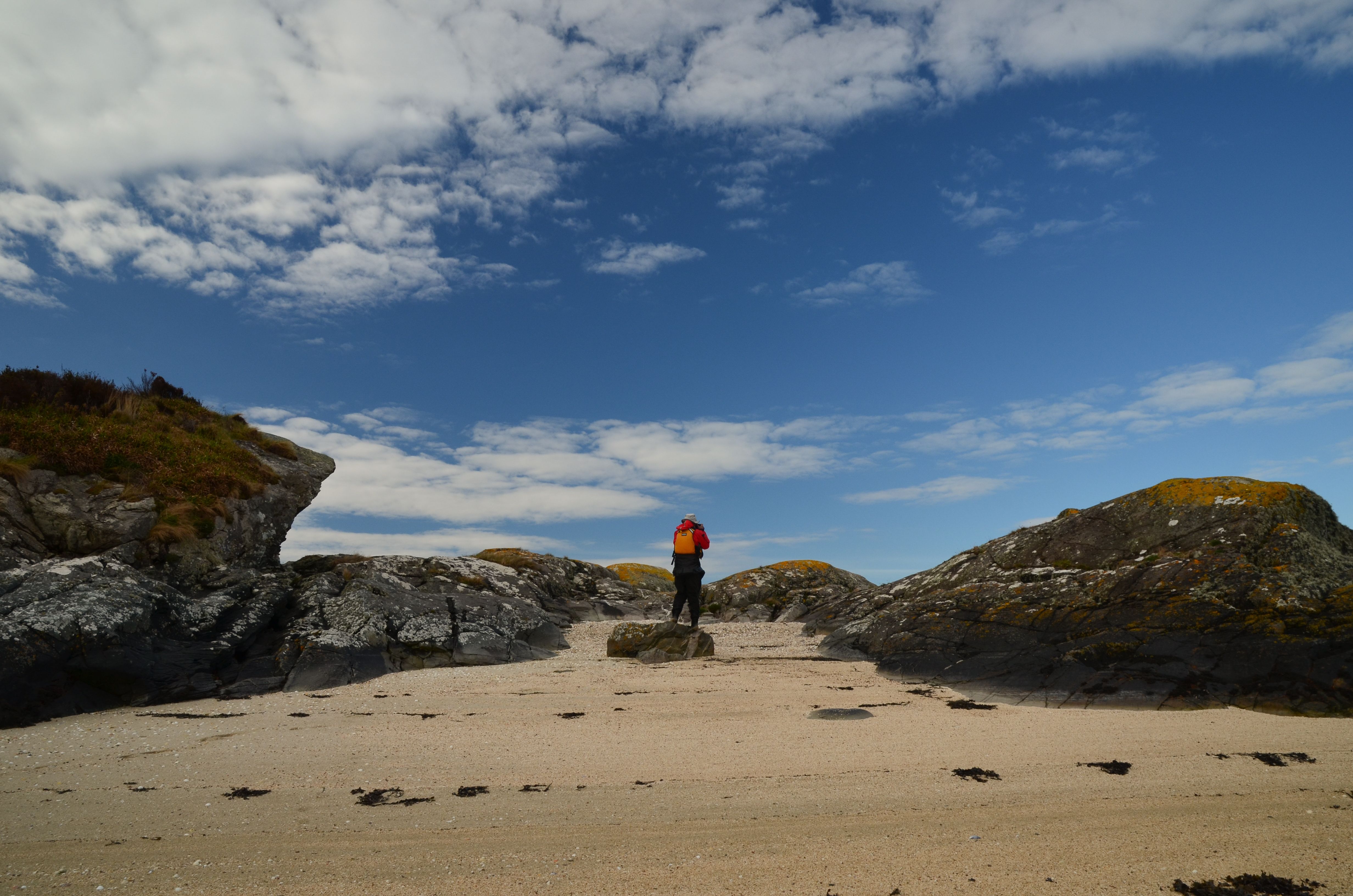


We had a leisurely breakfast and got on the water - within a few minutes we were back ashore on a tiny island with a "now you see it, now you don't" sandy beach which disappears at higher states of the tide.  We'd wanted to stop here because it's rather a fine viewpoint; the first image in this post was taken from the beach.
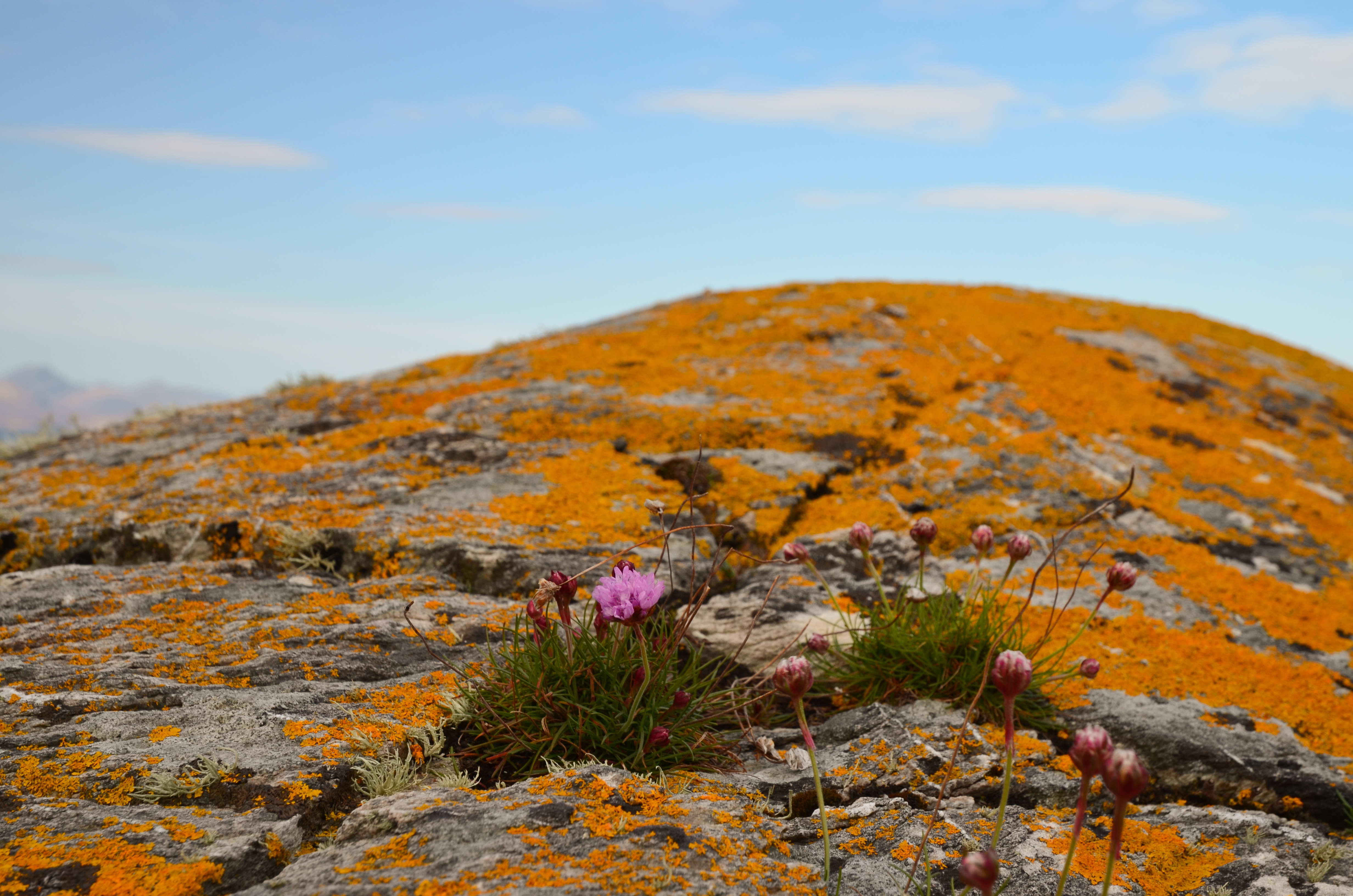


The view near to hand wasn't bad either - vivid orange lichens glowing in the morning sunshine, set off by a few Thrift flowers.


Orange seemed to be the theme of the morning; we returned briefly to Kyleakin to collect some things and whilst preparing to get back underway we noticed a bright orange vessel passing under the Skye bridge.


She's the "Mikal With", a 67 metre long palletised cargo vessel.  On most marine vessel websites she has a blue hull and a different owner than recently.  She's either owned or on charter to MOWI, a Norwegian aquaculture company.


We set out again from Kyleakin and aimed for the island of Pabay, which we intended to use as a stepping stone on our way to an intended camp on Scalpay.  The breeze had been slowly building and once clear of Kyle Akin it became quite strong from straight off the Skye coast (our port quarter).

We put our sails up to take advantage of the push and were absolutely blasted across towards Pabay.  I found this a really great sailing run, but was certainly not prepared to stop paddling in order to take photos!  Our average speed on this blast was 9.4km/h, or nearly twice cruising speed.....


Although a fast passage, it had been an energetic one - it is paddle sailing rather than just sailing!  We were all ready for a lunch stop by this point.


Approaching Pabay the wind seemed to ease  a little and we dropped our sails to paddle into the tiny harbour area.  Donny had motored along to Broadford in his F-RIB and made a direct crossing from there to Pabay; he had a pretty wet ride!
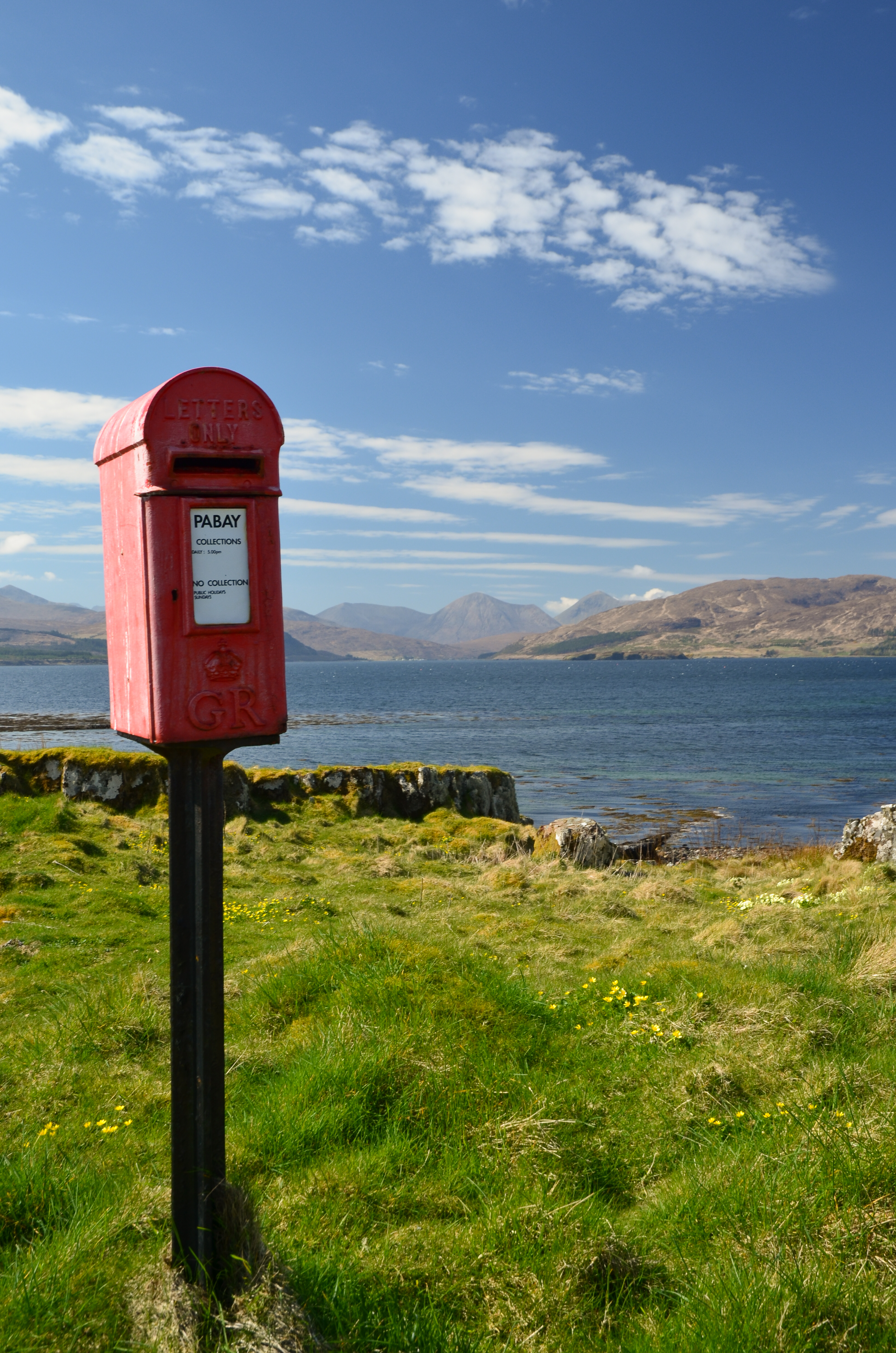


One of the iconic sights on Pabay (Norse: Priest Island) is this post box.  It seems incongruous since there are only a couple of houses on the island but is here because the island issues it's own postage stamps for mail which is transferred into the Royal Mail system in Skye (from where it needs Royal Mail stamps).


Sheltered from the breeze (which was becoming stronger) we lazed in warm sunshine, surrounded by clumps of Primroses.  The pale yellow of the flowers set against the blue of sky and sea was gorgeous.


Above where we lunched a pair of Bonxies (Great Skuas) watched us warily.  These impressive piratical predators had picked a nest site with a great view over the low lying island.


One of the features of Pabay is its geology which is shales intersected by dykes of harder rocks.  The whole island is almost flat and nearly doubles in size as the tide falls from high to low water, leaving the geometric patterns of dykes.

Another feature is that, despite being flat the island has virtually no wild camping spots accessible from the water.  The rock layers from a barrier and the softer rock gives good growing conditions for brambles and tangled low undergrowth.

This gave us a problem; we were pretty much pinned on Pabay.  The wind had continued to rise and in the Sound between Pabay and Scalpay was approaching a Force 6.  None of us was keen on trying the paddle across unless we really had to, but despite trying along the sheltered parts of Pabay by kayak we could find nowhere to camp.  We returned to the harbour to have a re-think.  Douglas and I walked up to the "big house" which is undergoing renovation by a new owner of the island.  We explained our situation and asked if we might camp near the harbour.  The Access provision in the Land Reform (Scotland) Act is wide ranging but does not cover access near to houses or infrastructure.  The owner was most kind in allowing us to camp for the night and it was really appreciated by us.


We pitched our tents in areas which wouldn't affect access to and from the harbour itself and found a spot out of the wind to cook dinner - preceded by fresh soup.  The day had been recovered but our plans would need to be altered.  The forecast was for the wind to drop almost completely by morning, so we decided on a paddle to the Applecross shore via the Crowlin Islands.


As the sun set, the wind came around a couple of points and seemed to drop by several degrees in temperature - it was pretty cold within minutes.  Dinner done, we retired to the tents (which we'd pinned very securely to Pabay) for an early night.
 

Friday, 1 July 2022

A perfect pitch

It turned out that our day could and did get better!  The camping spot we'd originally planned on was a few more kilometres up the coast, and given the wind direction we realised that it would be right in the wind.  So when a flash of white sand backed by bright green woodland caught our eye at the back of a small bay, we had to take a look.


Landing near low water we found ourselves in an enclosed bay, sheltered from the wind and in full sunshine.  A few folk were enjoying the late afternoon sunshine, indicating that the bay was fairly accessible, but it did look very promising as a wild camping spot.  Our preference is for fairly remote areas which are little used, but never look a gift horse in the mouth!


As the day visitors started to leave, we pitched our tents, Donny and Douglas pitched on the level turf above the beach itself - where there was even a picnic bench......


Allan and I chose spots in a beautiful wood of birches at the back of the bay which was alive with birdsong.  At the time and in the memory, this felt a perfect pitch.


Once we'd pitched up we wandered the bay, just enjoying the sunshine and the location.  We came across this lovely piece of beach art which must have taken both patience and real creative talent to produce.  Transient and perfect, it would be washed away by the evening's high tide.


Much of the beach was covered in pieces of white "coral" - actually Maerl, a corraline algae which when living is a purplish colour.  When they die, the calcereous remains of Maerl are broken and crushed by wave action, then bleached in the sun to form dazzling white "coral" beaches such as this one.  

A rare and fragile environment, Maerl beds have comprehensive protection, but are at risk from scallop dredging - one pass by a scallop dredger's bottom gear can destroy a bed which might be hundreds of years old.   Loch Carron has some of the best examples of Maerl beds and as a result is protected by designation as a Marine Protected Area (MPA).  


In the wood, Primroses were in flower on sunny banks - perhaps my favourite of the early Spring flowers; such a cheery sight at the back of a long winter.


After dinner we wandered over to the edge of the bay and climbed a rocky outcrop to photograph the setting sun - it was a really lovely evening.


Our fire below the Spring tide mark was lit to get going while we took our photographs and brought snacks and drinks down from the tents.


 Across the sea, beyond Skye and Raasay, the setting sun slipped down to the horizon to end a truly great day on the water.  We sat with a dram by our fire and chatted into a glorious evening.

Note: Since we camped here, the bay and its beach have been featured in a national newspaper and on a well known travel website as "one of the most beautiful and accessible in Scotland".  This is undoubtedly going to increase it's popularity and perfect as it is, we will avoid camping here for the foreseeable future in order to go a small way to reducing future pressure.

Sunday, 16 May 2021

Away and underway

Through both lockdowns I've been exploring local hills and routes and there will be a whole series of "catch-up" posts at some point.  Great as this was, it was a relief to get to the point where travel restrictions could be lifted and we could get "away".

In the week that Covid-19 restrictions were lifted sufficiently to allow travel outwith our own local authority area, Lorna, Allan and I met at Inverness and drove on to meet up with Douglas who'd travelled from south Glasgow, Raymond who had travelled from north Glasgow and Donny who had come up from Taynuilt near Oban.

You'll be able to follow this trip in "Sea Kayak tri-vision" by checking out Douglas' blog starting here, and Donny's Youtube channel here.


Our rendezvous at Glenelg takes some getting to; down the main road towards Skye and then a twisting drive on the single-track road over the 339m/1112ft pass of Mam Ratagan.  Mind you, it's a lot closer than the twinned location on Mars!  The strange association was instituted in 2011 when NASA was looking for a palindromic name for a location on the Martian surface which the "Curiosity" rover would visit twice - and Glenelg is Scotland's only palindromic place-name.

We parked our cars at Bernera beach and checked with a local lady that they'd not be in anyone's way for a few days.  We took our time packing, it's been over a year since we last packed boats for a multi-day adventure!  Finally all was ready.  Our friend Donny was using his 2.75m folding RIB (F-Rib) "Guppy" and set off a little ahead of us to play in the tidal stream at Kylerhea.  We'd timed our departure to take advantage of the last of the south going tide which would push us down the Sound of Sleat (pronounced "Slate") towards our intended camp site for the first night.


We'd deliberately scheduled a short first day as we didn't set out until early afternoon.  A couple of hours of steady paddling got us back in the rhythm of travelling in fully laden kayaks and it wasn't long before we reached our intended camp.  


As it was low water and Springs, we had a fair carry to get the boats up - as there were five kayakers we were able to lift even the laden boats and move them in two stages; firstly up to the beach to give us time to sort our camp.  We moved them to the same place as our tents later on.  Donny anchored "Guppy" in a lagoon around a sheltered point on the other side of our camp.


We pitched our tents and got a cup of tea on....we'd arrived and another adventure was underway!


Our camp was sufficiently spacious that we had choices of where to put the tents...which is not always a good thing as several pitches looked equally promising!  To get our boats above the Spring high water mark we moved them up to the turf - which was actually a little higher than mine and Douglas' tents!


Our camp looked across a sheltered bay to a ridge, above which the upper slopes of Beinn Sgritheall (scree mountain) soared.  A couple of heavy showers blew through, sending us into our tents temporarily - and each one left more snow on the mountain.


While the temperature was on the cool side, it was undoubtedly Spring.  Bright clumps of Primroses (Primula vulgaris) dotted our camp, splashes of colour among winter-bleached grasses.


The play of light was really quite special and the occasional shower was well worth sitting out to watch the change of colour and form during the late afternoon.


A rainbow stretched across the bay; too broad for my camera lens to get it all in as it arced up over one side.....


.....and back down to the other side of the bay.


 Dinner was a superb chicken casserole followed by home-made carrot cake - both courses courtesy of Lorna.  I was unsurprised to find that there were large quantities of driftwood along the shore; the absence of people around to collect it for over a year meant that we could gather what we needed from close at hand, and even to just collect the driest pieces.   The fire was lit below the high tide mark which meant that by the early hours of the morning all trace of it would be erased.  We sat long into the evening around the fire, catching up with each other after not having been together as a group for so long.  It felt so good to be away and underway.....

Monday, 1 March 2021

Heralds of winter's end

After a long, cold start to the year some glorious days at the end of February have brought a hint of the coming Spring.  Warm sunshine and clear skies seem to have set everything off - remarkably this "winter" barley crop was under almost a metre of snow just ten days previously.


Even more remarkably, the Snowdrops (Galanthus nivalis) on the banks of the River Don were not only under huge volumes of snow, but once that melted they were submerged in a torrent of fast flowing icy water as recently as five days ago when the river couldn't contain the volume of snowmelt.


These welcome heralds of winter's end seem to flower as soon as they emerge from the snow - delicate in appearance but incredibly hardy.


The river banks are carpeted with drifts of Snowdrops.  Although some bulbs were torn out by the surge of water, the flood also left lots of rich silt as it receded - perhaps one reason they are able to not only survive but thrive here.


Against a neighbour's south facing garden wall is another very early flower, the White Butterbur (Petasites albus) with its almost alien flower spike.  Later in the year the leaves of this strange plant can reach over 90cms across - it seems to do really well in the north east of Scotland.


A clump of Crocus in a tub against the wall of the house have responded to the warmer weather and simply shot up; in just a couple of days the flower buds emerged and then the flowers opened as soon as the morning sun warmed them.  Within hours, two Honey Bees had visited and taken advantage of this early bonus of pollen.

It's just the first day of March and there will no doubt be more hard weather to come; this month has a reputation as a wintry one in Aberdeenshire.  But for a few days at least it seems that Spring isn't too far away - and that's a great thought.

Saturday, 30 May 2020

One good thing - 29th May 2020

On Friday 29th May Scotland moved to Phase 1 of the route map through and out of the Coronavirus crisis. Initially, cautious steps have been taken - and rightly so.  The initial changes allow people to meet with one other household at a time in the outdoors, to resume activities where distancing can be maintained like golf, fishing, walking and paddle sports - but with the guidance that this should remain locally based.

These are welcome steps, a sign that there will be a return if not to normal, then to a new normal beyond the lockdown.  And they come as Spring has, in the space of a few days, turned to summer.


Fields of Rape are dazzlingly bright against early summer skies, the heavy scent carrying on a warm breeze.


Along the riverbank and roadsides early summer flowers are emerging everywhere - this is Greater Stitchwort (Stellaria holostea) - white stars studding the greenery; when their seeds are ready they explode like miniature fireworks at the slightest touch.


In our garden Azaleas are in full vivid bloom, at twilight they absolutely glow with colour.

When lockdown started the Snowdrops were still in flower; now, as we begin to carefully move beyond lockdown the summer flowers are out.  This seems an appropriate point to conclude this series of 45 posts across 67 days which have been the most extraordinary period of most people's lives.  Looking out for that "one good thing" to balance the tragedy and relentless bad news cycle has helped me to stay positive - and in truth this has been a much more positive time personally than I could have imagined.  In due course I'll be able to reflect on how this period has changed my outlook. I hope, too, that you have found something of interest here.

We have started to move beyond lockdown, to gain control of the CV-19 pandemic - and that, of all the "good things", is the best one.

Saturday, 23 May 2020

One good thing - 22nd May 2020


In a bank shaded by a large Copper Beech tree at the edge of the garden, a clump of English Bluebells (Hyacinthoides non-scripta) have flowered - the second year they've done so after we transplanted a few bulbs some years ago.

These lovely flowers, when seen in large numbers, give a violet glow to woodlands which is actually quite difficult to depict accurately on camera.  they are associated with ancient woodland and can be a good indication of where a woodland once was - good examples are found at Eilean Fhianan in Loch Shiel and Ailsa Craig in the middle of the Firth of Clyde.  In late spring and early summer Ailsa Craig's slopes are carpeted in violet blue - as shown on the visit Douglas made in 2012

Wednesday, 6 May 2020

One good thing - 6th May 2020


Spring flowers cut from the garden, bringing some of the colour indoors.  Red Campion (Silene dioica) and Spurge (Euphorbia spp).  The first is a much loved native and the second a garden plant, but what they have in common is that we have plenty of them in the garden!

Friday, 1 May 2020

One good thing - 30th April 2020


The last two days of April have brought the type of weather usually associated with the month, heavy pulses of rain and sunny intervals.


When the showers passed through in the evening the lighting effects were really intense, changing by the second.  The rain has really brought a spurt of growth to Spring flowers....


Wood Anenomes (Anenome nemorosa) are at their peak, tens of thousands of lovely white stars in the Birch woodland.


On an area kept as a natural wildflower meadow there's been a sudden flowering of Cowslips (Primula veris) - soon the whole meadow will be studded with yellow flowers.


In the woods again, and the first of the late Spring flowers are beginning to appear, the delicate bowed heads of Wood Sorrel (Oxalis acetosella) are appearing.  Both flowers and leaves of this plant fold in the evening, perhaps an inbuilt frost protection measure.  The leaves, if chewed, have a zesty lemon flavour from the oxalic acids thy contain - a great natural freshener for the mouth.

Rain is not often something to relish in Scotland where we usually have it in an overabundance - but at the right time, in the right amount, it's a good thing.