Showing posts with label Corbetts. Show all posts

Monday, 28 October 2019

A small diversion from Loch Ericht


Allan and I were up and about early after a comfortable night at Ben Alder Cottage bothy...and as expected the only sounds of footsteps and activity through the night were of the mouse, and not the ghost variety.  We emerged into a gloriously bright morning...


...and soon after breakfast had our boats packed and ready to go.  Both boats were somewhat lighter as we'd brought in firewood for the evening, some of which was left for the next occupants.  One small advantage of fresh water paddling is that boats don't need to be lifted above a high tide mark, so there's less distance to carry them back to the water...though this isn't always the case....


As we paddled out of Ben Alder bay we got a great view back up the loch.  There was hardly any breeze and our paddling seemed effortless; a nice contrast to the effort we'd had to put in the previous afternoon.


The first leg of our return journey along Loch Ericht took us across the loch and up the eastern shore to land in a bay north of Corrievarkie Lodge; another of the Ben Alder estate properties.  As we passed a fairly narrow part of the loch the breeze got up considerably; something we'd note for later in the day. We changed into walking boots for a short diversion; first steeply up an estate road to a bealach, then a turn to the west ups very steep ground.  It was a bit of a steep slog, but we think worth it....


...for the stunning view up the length of Loch Ericht.  There's no enhancement in this image, the water was really this vividly blue in the crystal clear air (which we were sampling at a copious rate having climbed 500 metres in one steep lift!).


When we arrived at the summit of Stob an Aoinach Mhoir - at 855m/2805ft one of the "Corbetts" the views just kept coming.


Back down the loch into Perthshire, with the entrance to Ben Alder Bay on the right


And across the loch to Ben Alder itself - at 1148m/3766ft it's one of the highest hills around and visible from much of the central Highlands.  The nearest transverse ridge links Ben Alder's plateau to Beinn Bheoil - it makes a superb round and possibly all the better because it's a fair day's walk just to get to the base of these hills.


To the south east the skyline was silhouetted in the morning sunlight.  Schiehallion is prominent on the left - a pointy hill standing apart in a central Highlands view is pretty likely to be Schiehallion.


Instead of returning to the road, we took the north ridge off Stob an Aoinach Mhoir; appropriately the name is peak of the big ridge and kept to the crest to maintain the view for the longest time.   We reckon comparatively few people climb this Corbett via the loch route, the vast majority will use the estate road from Loch Rannoch.


The last steep decent was rough and at the base of the ridge there's dense forestry to negotiate, but it made for a good descent.  There's a good view down to Corrievarkie Lodge - our boats were in the bay near to the hydro station in the far right of this image.

It had been a very well worthwhile diversion from the paddling to climb the hill - the effort was more than well rewarded with the view - save the hill for a good day!

Friday, 21 December 2018

Blowing in the wind on Corryhabbie Hill


Near the summit of Corryhabbie Hill there's a series of small cairns and stone lined hollows.  I can't find much information about their origin, but it's known that Ordnance Survey teams camped on the summit in 1819 and again in 1850.  Sometimes the parties built stone shelters to live in and its possible that these are remnants of the shelters.


A fairly level walk along the ridge with splendid views soon arrives at the 781m/2562ft summit which is marked by a trig point within a shelter wall.  The trig point is topped by a conical metal "hat", something I've not seen on any other trig pillar.   I hunkered down in the lee of the shelter wall to get some respite from the biting cold of a north wind.

In the previous post I remarked on just how expansive the views are from Corryhabbie Hill, and that's why it was selected as a triangulation point for mapping by the Ordnance Survey.  The views have recently been altered completely though - to the east of Corryhabbie is Cook's Cairn, a broad ridge of heather...........


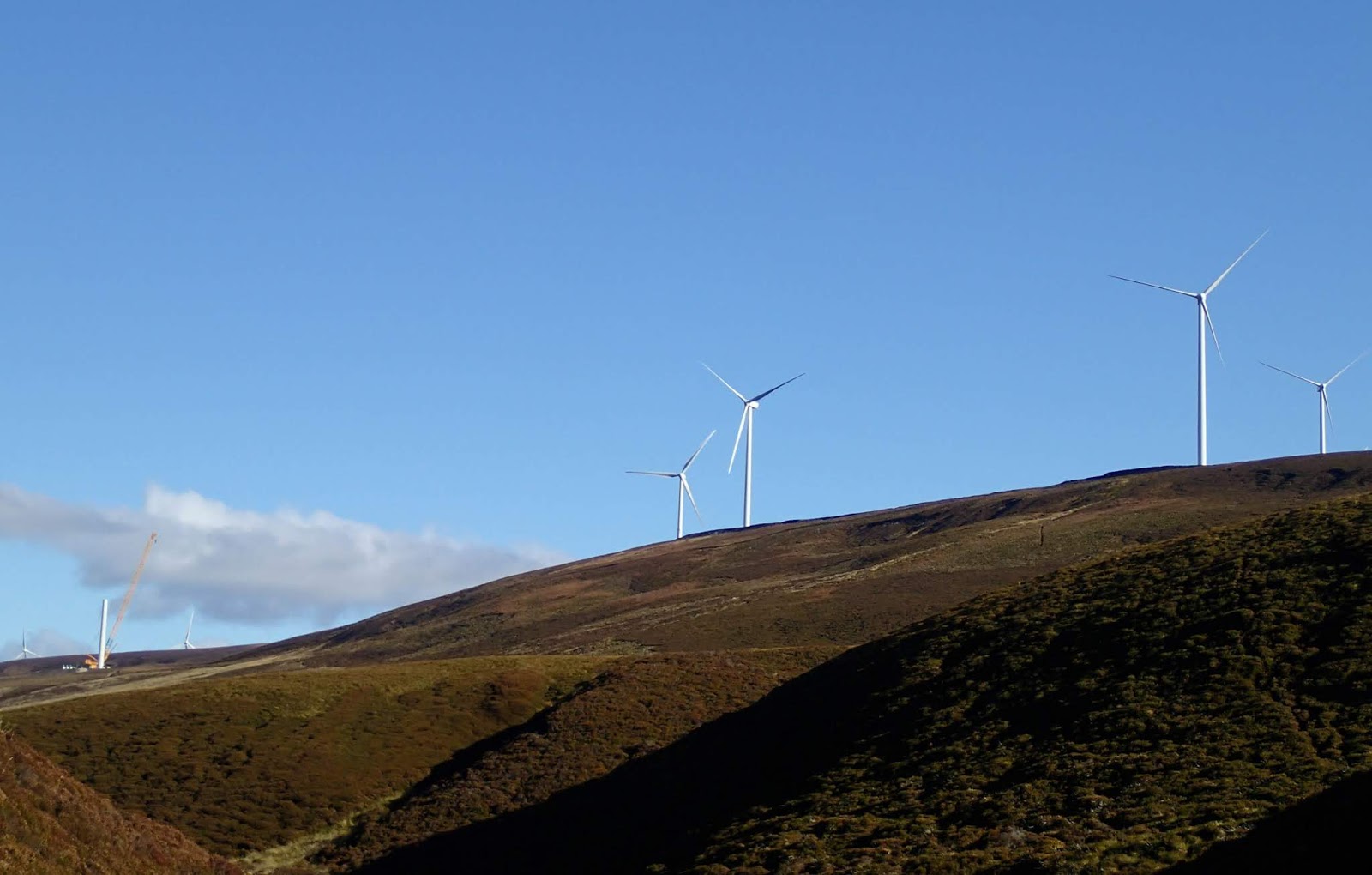
.......the north end of which hosts the turbines of the huge Dorenell Windfarm.  This has been, and continues to be, a very controversial project for a number of reasons.  The Aberdeen Press and Journal (P & J) articles make for interesting reading, as do the ones from Energy Voice.  Whatever the controversies and whatever your opinion of onshore wind energy, the simple fact is that the industrialisation of this hill has changed it forever.


I descended from Corryhabbie Hill to a boggy bealach which drains to form the River Livet on one side and the River Fiddich on theo other, thus providing the raw material for some of Scotland's best known whiskies.  The 120m/400ft turbines dominate the ridge above, the noise of those which are operating was really obvious.


I was glad to get past the windfarm and follow the Fiddich as it curved around towards my starting point at Bridgehaugh.


The final few kilometres were a joy, some warm October sunshine on my back and glorious autumnal colour around me.  I still think that this is a better route to Corryhabbie Hill than the much shorter "up and down" from Glen Rinnes - despite the visual intrusion of Dorenell.

Friday, 14 December 2018

Old friends above the valley of the deer

This is the first of two "catch-up" posts from the end of October.  A bright and breezy day looked good for a hillwalk, and looking at the map I realised that it had been a while since I'd been over the hill to Speyside. I decided to climb Corryhabbie Hill, but not via the usual route.


My route from Donside to Speyside climbs up through high farmland and across the Cabrach, an area of moorland studded with mostly abandoned buildings.  It wasn't always so and there's a good history of the Cabrach on "Lenathehyena's" blog.  The play of light was marvellous on this October morning, rainbows appearing and disappearing as showers passed through.


I started my walk at Bridgehaugh where there's space to park a couple of cars clear of the estate road and entrance.  A steep slope covered with bracken was virtually glowing against a blue sky.


A look at the map in the link above will show that the track leading southwest from Bridgehaugh goes upstream alongside a river which is by no means large, but has a name known throughout the world.  This is the River Fiddich, and this view looks along part of Glen Fiddich.  Downstream the river runs through Speyside's "whisky capital", the village of Dufftown.  Along the banks of the river are some of the best known of Scotland's distilleries; Mortlach, Balvenie and, of course, Glenfiddich among them. Nowhere else in Scotland (or indeed the world) has a higher concentration of distilleries than this corner of Speyside.


I walked alongside the river past the now delapidated Glenfiddich Lodge, a former shooting lodge, and took a track climbing above a bend in the river up into a landscape of rounded hills covered in wind-clipped heather.  the track made for fast walking and I was soon swinging around between two hills and beginning the climb to the broad ridge which forms Corryhabbie Hill's summit.


From the higher ground the views open up to be really expansive.  To the north west, the most distinctive hill in the area, Ben Rinnes, is prominent.  It's a hill which has given some great days.  The "normal" route to climb Corryhabbie Hill from Glen Rinnes comes up the track in this image - my route would only coincide with that one on the summit ridge itself.


To the north, the slopes of the wonderfully named Thunderslap Hill fall to the Dullan water, and rising beyond is the Dufftown "double" of Meikle and Little Conval.  Looking to familiar hills - old friends-  is one of the small joys of hillwalking, and the more hills one climbs, the more joy there is to be had!


On the upper ridge of Corryhabbie Hill I was exposed to a biting north wind - to the north there's no higher ground between these hills and the north pole....and today it felt like it.  I stopped to put on another layer, gloves and a hat. 

Crouching down to sort out my kit I noticed the stunning colour on tufts of Deer Grass (Trichophorum cespitosum).  The name is misleading, it's neither a grass (actually a member of the sedge family) or particularly favoured by grazing deer.  The name derives from the wonderful shade of the plant in autumn, reminiscent of the coats of Red Deer.  There was a theme here too, because "Glenfiddich" is valley of the deer in Gaelic. 

Wrapped up against the chill of the wind, I walked on along the ridge.

Tuesday, 17 July 2018

Cloudy on Cliseam

After a run of brilliantly clear sunny days, it was a surprise to wake up to a grey morning with banks of low cloud hanging just above sea level.  The forecast was for the cloud to lift gradually through the day and, hoping that this would prove correct, I set out to climb the highest hill in the Outer Hebrides, An Cliseam.

Most ascents are made from the A859 road immediately east of the hill, a straightforward "up and back".  This is the quickest and easiest way to climb An Cliseam, but misses out much of what's good about the hill.  I planned to do a full circuit taking in some of the outlying summits - and hopefully something of the view too.


I started out up Glen Bhiogadail on a well made track to reach the Bealach na h-Uamha (col of the cave).  At the bealach a view opens up down Loch Langabhat and across the rugged country to the north.


After crossing the rounded top of Mo Bhiogadail you're faced with a steep climb of some 300 metres to the summit of Mullach an Langa, the northernmost summit of the five which form the Cliseam horseshoe.  I was glad that the views were opening up a little on this climb - there was excuse to stop to look around!  Loch Seaforth is one of the most notable features of this part of Harris, cutting deep into the island.


I was marking the cloud level by surrounding hills, and true to the forecast the clag seemed to be slowly lifting.  Across a dividing glen the 729m summit of Uisgneabhal Mor was almost clear - which I hoped would mean just the top of 799m An Cliseam would be in cloud.


I eventually reached the base of the cloud just below the first of the narrow sections of the ridge, the 720m/2362ft top of Mullach Fo Tuath (the north roof), the cloud streaming in from the north on a cool breeze, quite a contrast to the previous days of heat.


There's a great section of walking along Mullach Fo Tuath and the cloud was continuing to lift, giving at least a clear view ahead and simplifying navigation.


At last, there was a blink  of sunlight and a clearance to the south.  This is a famous view, looking down the Sound of Taransay over Luskentyre - having paddled and walked in this area it was nice to get an elevated perspective.


A sharp dip in the ridge leads to the most technical section of the route, the scramble up and over Mullach Fo Dheas (south roof).  A couple were traversing the bealach, the only folk I saw all day.  The climb up to the summit of this fine ridge is easy and pleasurable, though with a strong wind blowing across the hill some care needed to be taken.

The descent to the bealach (col) betwen Mullach Fo Deas and An Cliseam is altogether more tricky; a steep drop leads to a pitch of about 10 metres which, if taken direct, needs careful downclimbing. I opted for a flanking move to the north side of the ridge where a small scratch of a path slants down before contouring onto the bealach. This flanking path is steep, loose and a little exposed, needing careful movement.


As I climbed the last rise onto An Cliseam the cloudbase had risen to just brush the summit.  The forecast had been absolutely correct and there was even some sunshine breaking through.  From muted tones and grey sky, colour was beginning to emerge.


The summit of An Cliseam at 799m/2621ft is the highest point in the Outer Hebrides and the only Corbett .  While they may not be high, the hills of Harris are rugged, often pathless and generally tough going.  A circular wall enclosing the trig point gave shelter from the wind - a summit view was so close, but the cloud just failed to clear the top whilst I was there.


My descent route went initially south east down the "normal" ascent route, with some great views down towards Loch an Siar (West Loch) and the Tarbert road.


Where the steep ground eases, I cut back left under the north face of the hill to gain a broad bealach, then up onto the domed top of Tomnabhal, which had granite slabs very reminiscent of some Cairngorm hills.  My route back to our accommodation would take me across most of the ground in this image, to the shore of Loch Seaforth.  If it looks a long way off, that's because it was!


An hour or so later I crested a final rise and descended wearily down the Harris Walkway path to the road.  I'd been looking forward to making the final descent on a good path, but the track is very wet underfoot, and this was in a period of prolonged dry weather.

The final 3km of my walk was along the A859 road in weather which had turned from the grey of the morning into a hot early evening.  You really earn your hills in Harris; my route had been 18 km with well over 1400m of ascent and descent - which is a lot for one Corbett - but what a great day out. 


The following day, our last in Harris, dawned fine and we drove along the road to get this image of the hill rearing into a flawless blue sky.

We'd had a superb holiday in Harris and Lewis; my hopes of experiencing the stunning light quality had been amply fulfilled.  It has to be said we'd been fortunate with the weather; apart from a day and a half at the beginning, we'd enjoyed dry, fine conditions.  It's a place towhich we'll certainly return.

Saturday, 30 December 2017

A winter day on Morven

The period since Christmas has been quite cold, with temperatures down to -8 Celsius overnight, while a northerly airstream has brought snow showers. I was looking for an opportunity to get out and about and a day of clear weather on 28th December looked perfect.


I headed the short distance over to Cromar to climb Morven - there was markedly less snow on the ground here than at home but plenty higher on the hill.  Morven is an Anglicisation of "Mor-Bheinn" (big hill), and it lives up to the name- a bulky dome which stands apart and seems to tower over the surrounding countryside.  I've climbed this hill several times and it always seems to take more effort than you'd think it should. On the drive across I noted the shroud of cloud across the higher parts of the hill, and the banner of snow blowing from the summit - there would be some lively conditions near the top.....


The shortest route to the hill from near Balhennie is the one most folk use, it's short but quite steep and pretty much out and back.  I looked for a route with a bit more variety and settled on starting from the minor road north of Loch Davan, taking a track past Raebush and Redburn which passes through a pleasant wood before heading uphill onto the moor.  The views up to the northeast are extensive, beyond Cromar to the hills near my home.  Snow showers were moving across much of the higher ground, but up to this point I was in clear conditions.


A clearance in the cloud over the top of Morven offered the hope of a summit view, but I was still three kilometres from the top and the cloud soon closed back in.  My route followed tracks curving across the broad saddle to the left of this image, then I went up more steeply, aiming for the right hand edge of the summit ridge.  The going was initially tough in deep, snow covered heather, but as height is gained the vegetation becomes much shorter and the underfoot easier....


...though the conditions were really fierce as the summit area was gained.  The cloud was combining with a 50mph tearingly cold northwesterly wind which was raising a considerable groundstorm of pulverised snow.  This image was taken in a brief lull in the wind and shows the best visibility for some time!  To add to the fun, a heavy snow shower arrived so I battened down and put on ski goggles to maintain some limited visibility.  This was full-on winter and I found myself really enjoying the wild conditions. 


A line of battered fenceposts is a useful guide towards the summit; today adorned with foot long frost feathers.  These feathers are formed when a cold, strong wind deposits moisture onto the windward side of rocks and other objects; the feathers show the direction of the wind as they grow directly upwind and can build up to a considerable size.


The now shower eased as I was heading across the flattish ground of the summit ridge on a compass bearing and I was pleased to see the cairn emerge from the whiteness right on cue.


This wasn't a day for a leisurely snack whilst enjoying the summit vistas!  A brief crouch behind the trig point to set up bearings to the track below and I headed back along the ridge - the wind by now was really biting and was pushing me bodily sideways in the stronger gusts.  At the end of the summit ridge I took another bearing and headed dead SE down into the murk towards a track which passes to the south of Morvern.  The snow whirling off the ridge was all being deposited down here, but not in sufficient quantity to constitute an avalanche hazard.  It did make for a speedy descent through the heather and I was soon on the track and into much more benign conditions.


A look back from the point where the track heads steeply back down to Raebush; the cloud banner still streaming off the top of the hill, conditions would still be as fierce up there.  At 872m/2860ft, Morvern isn't the biggest of hills, but once again it had given me a terrific winter day.

Monday, 13 February 2017

Long luncheon, long view


 It didn't take too long for us to settle into a natural paddling rhythm; we don't tend to paddle fast unless there's a really good reason to do so such as a tidal imperative.  Besides, with the views we were enjoying, why would we rush?  To our right, rocky ridges sharply down to the loch from the Corbett of Beinn Odhar Bheag (little dun-coloured hill).

The neighbouring hill to this fine Corbett is Beinn Odhar Mhor (big dun-coloured hill), which is actually lower than the main summit and not a Corbett.  The apparently illogical order of names is due to the fact that "Mhor" is a much bulkier and more prominent hill, and hills were named from their appearance to those who lived below them rather than their summit height.


 To our left a series of lower but very rugged hills lined the loch, punctuated by steep glens containing fast running burns which could be clearly heard across a kilometre of water.  There was little wind, though it wasn't as utterly still as the last time we paddled here in quite exceptional conditions.

It was by now early afternoon; and we'd all had an early start.  First luncheon was most definitely overdue and as luck would have it, a perfect spot was close at hand......


 A small beach with a long view ahead down the loch, built-in furniture on which to sit and a fine Caledonian Pine for scenic effect - really, this was too good to pass.  We took a leisurely luncheon, giving us time to relax into the trip and absorb the surroundings.  From the hillside across the loch a stag was roaring, the sound echoing over the water.  Mid October is just about the peak of the Red Deer rut and the sounds of competing stags would be a feature of the trip.


 We set off after lunch and having made those small adjustments to packing of the boat which always seem to need doing in the first day of a trip.  Keeping close to the west shore of the loch took us into the shadow of the hills but gave the opportunity to see the best of the natural woods along the shore.


 Astern of us, a long view was developing as we continued down the upper part of Loch Shiel.......


...and it was a scene that rewarded frequent glances over our shoulders to admire the play of sun and shadow on the mountains as Glenfinnan receded into the distance.  With long views ahead and astern, we really felt that our journey was underway.