Showing posts with label seals. Show all posts

Tuesday, 15 October 2019

Summer sojourn on the Moray Firth - sealed with a kiss

Almost as soon as we'd paddled through the tall cave-arch from among the red towers we were joined by another young Grey Seal (Halichoerus grypus)


Just as curious and confiding as the one we'd encountered earlier in the day, it swam repeatedly around and behind us before approaching each of our kayaks in turn to investigate us more closely.  As it padded under the bow of my boat there was the faintest kiss from its muzzle and flipper - perhaps trying to figure out what the boat felt like.


The youngster followed us for a couple of kilometres, never far from us but never so close as to cause alarm to either it or us.  Adult Atlantic Grey Seals are Europe's largest native carnivore; bulls can weigh in at up to 300Kg and reach around 3 metres in length - they are animals to respect.  This little seal - we weren't able to tell whether it was male or female, but suspect male - was less than half that, but still a wild animal and the fact that  it chose to accompany us made for a special encounter.


When we stopped, so did it.  Completely relaxed in our company, it seemed to relish the encounter as much as we did.  Whilst I don't lke to anthropomorphise animal behaviour, it really seemed like this young seal which was on its own was enjoying the company.


"Who, me?"


As we approached Pennan harbour the seal pulled up alongside us, then turned and headed back along the cliffs.  It's possible that it was wary of going too near the harbour due to the level of motorised boat traffic, or perhaps it had reached the end of its patch, or just had had enough of accompanying us. We encounter seals almost every time we paddle on the sea, and try as we might we sometimes take sightings a bit for granted.  But when an encounter with a wild animal is so intimate, and especially when initiated by the animal - it's a special experience.


The pretty village of Pennan was our destination for this paddle.  A line of cottages strung along the shore beneath a low cliff, it's one of the most picturesque of Aberdeenshire's many fishing villages.  A claim to fame for the village is in it's role as a setting for the 1983 film "Local Hero".


A development since we last visited is the Coastal Cuppie, a tea shop with a bit of a difference.  Housed in a converted wooden shed, its a bright spot in the harbour.  It looked open, but the sign said "Kettle on the boil, scones in the oven", while another said "open at 1250".  We had a half hour to wait and so took a stroll along the village and back, where the scones were just arriving in a little pull-along cart.  We can report that both coffee and scones were wonderful!


By the time we headed back along towards New Aberdour on our return leg the tide had dropped considerably.  The tall arch we'd paddled through was completely dry and we landed to walk through.  We recommend paddling this section of coast as near to high water as possible, and to save it for very calm conditions in order to get the best of it and to paddle all the caves, stacks and arches.  I've been here in a moderate onshore swell and been unable to get anywhere near the rocks.


Nearby, a cave right through a stack was revealed which would usually be submerged.  I took a look and found the rocks to be very slippery, but the effort was worth it......


.....because inside, several rock pools were lined with what seemed to be coral of a vibrant pink shade.


The final day of our three day's route on the Moray Firth had been different to the preceding two days of a continuous linear route, but had, once again, given so much.  These three days were almost the last of the settled summer conditions - late August and most of September were mostly unsettled, so we counted ourselves doubly lucky!

Thursday, 10 October 2019

Summer sojourn on the Moray Firth - underneath the arches

The third day of our trip on the Moray Firth dawned bright and sunny again. Raymond had hillwalking plans for this day and so it would be Allan, Lorna and I paddling. We'd discussed various route options for the day over dinner the previous evening - perhaps setting out again from Whitehills to make a continuous journey, or heading farther east to Aberdeenshire's North Sea coast.  It didn't take much debate before we decided on a trip which would take in some of the best rock architecture on this coast.


It takes longer than you'd think to drive the 30-odd miles from Sandend to Pennan, then take a twisting, hilly road to the pebble beach below the village of New Aberdour.  It's notobvious on this image but this beach is quite steep-to and often has dumping surf which makes launching and landing tricky.  If this is the case, a burn running into the sea is a good guide to some rock channels which can break up some of the swell.  No swell problems on this morning though!  A bit of a cloud sheet had drawn overhead, but it was still warm and there was clear blue sky to the west indicating sunnier conditions on the way


Rather than run a lengthy shuttle which would have been awkward with three kayaks and two vehicles we'd decided to paddle west from New Aberdour to the village of Pennan and return by the same route, perhaps visiting Troup Head if there was time.  Doing an out-and-back isn't always the best option, but given the scenery we knew was on this stretch, paddling it twice would be just perfect.  The rock architecture starts almost straight away, a square-cut arch forming a bridge leading out from a small headland.


This arch is bigger than it appears - we wondered how many people might have casually strolled out to the headland without knowing that this was beneath their feet!


Having passed through the first arch, there's immediately another one, taller and narrower. This would be great paddling in itself, but is just the warm-up for what follows.


Crossing a small rock bay, we headed through a couple of channels between different types of rock - this coast has some really complex geology which is in part the reason it's so interesting.


Ahead of us was the impressive Strahangles Point.  Much less well known than Troup Head farther to the west, it's actually higher than Troup - if not as massive.  The cave-arch at the base of the point goes through one of the spurs of the point, and can be very tricky in less benign conditions.


Having paddled through the cave into the shaded geo beyond, I landed on a pebble beach to see if there were any interesting pieces among the driftwood.  I was surprised to see a young Grey Seal pull up into the shallows right beside me.  It showed no fear, just curiosity and seemed to want to know exactly what I was up to.


When I walked up the beach at the back of the geo, the young seal swam back to investigate Lorna's boat a little closer, following her every move.  The water in the geo was shallow and we could see the seal twisting underneath the kayak.  Although not behaving at all nervously it could have panicked at any time - not really a good thing in this confined place.  Lorna moved out into more open water and the seal followed, allowing me to launch without spooking it.  A lovely close encounter, and it wouldn't be our last of the day.


Beyond Strahangles Point there's another change in the geology to a conglomerate rock with flood-washed pebbles in a red matrix.  Quite a soft rock type, it erodes to form some great features; this narrow arch is the gateway to a place of wonders.....

Monday, 15 May 2017

A wildlife spectacular

On a cold and blustery day at the end of April we drove to Newburgh at the mouth of the River Ythan (pronounced "Eye-than") to do some wildlife watching. Although less than an hour away, we hadn't previously visited and were reminded that we really should do by an article on BBC Radio Scotland's "Out of Doors" programme.


We parked near the golf course and walked a short way along a path through the dunes which are such a feature of this part of the coast to reach the edge of the estuary close to where the Ythan enters the North Sea.  A guided wildlife watching group and some families were already enjoying the sights.


There are lots of birds on the Ythan.  Eider ducks (Somateria mollissima) are simply everywhere; this is the largest breeding colony of these striking sea ducks in the UK with some 1500 pairs nesting in the dunes of the Forvie National Nature Reserve - with non-breeding birds the summer population can be up to 5000 strong.

The heaviest, fastest flying and largest UK duck, Eiders feed primarily on molluscs, especially Mussels which they can swallow whole and crush in their gizzard - crabs are also taken and are similarly swallowed whole once the legs have been removed; a remarkable digestive feat!  The male Eiders are truly beautiful birds; predominantly black and white with pale green napes and a salmon pink blush to their breasts.  They also have a distinctive call - which leads to them being known to generations of children as "woo-woo birds"....try the video on the RSPB page to hear why!

As well as Eiders, the Ythan estuary is home to four species of terns; largely Sandwich Terns and Arctic Terns, but we were delighted to get close views of a Little Tern (Sternula albifrons) which was fishing right in front of us.  Forvie has between 15 and 35 pairs of these lovely little birds breeding each year - and this is a quarter of the entire Scottish breeding population.

Sand Martins were whizzing along the shore and we watched a pair finishing a nest burrow in a sand dune right next to the path.  The birds at Forvie make for a great wildlife experience in their own right, but it wasn't birds we'd primarily come to see....


 Now, I can get close views of seals every single time that I get in a sea kayak, so why come to a beach on a raw day to see them?  Well, just across the channel Atlantic Grey Seals (Halichoerus grypus) haul out onto the sand to rest, to moult and to pup and they can be seen at quite close quarters without disturbance.

The UK's largest land carnivore, Grey Seal bulls can reach 2.6 metres in length and weigh up to 350Kgs - they're an animal to be respected, especially when in a sea kayak!  The bulls are generally dark grey, brown or black with some lighter blotches whilst the cows are usually lighter grey with some darker blotches.


 The pebbles on the shores of the North Sea and Moray Firth coasts are actually quite similar colours to the seals.


But what makes the seals at the Ythan such a spectacle is that there are a lot of them.......


....an awful lot of them!  Over 1000 animals haul out here; the sight and noise is extraordinary - and if the wind is blowing from the north we're assured that the smell is too.   One of the presenters of the "Out of Doors" radio programme described this as one of the greatest wildlife spectacles not just in Scotland or the UK, but in Europe.

We'd agree - it's a truly world-class wildlife experience and very accessible too. The north side of the estuary is now an area of special protection and this designation means that it's a criminal offence to recklessly disturb seals which are hauled out here.

To get the best sighting, visiting near to low water allows a fairly close approach from the south side of the river, but doesn't disturb the animals.  If they raise their heads or start to move - you're too close.  From the main road through the village of Newburgh, turn onto Beach Road (near the Newburgh Inn) and drive to the car park near the golf course.  A five minute walk will bring you to the water and this remarkable wildlife watching location.


Tuesday, 11 April 2017

Caribbean Scotland


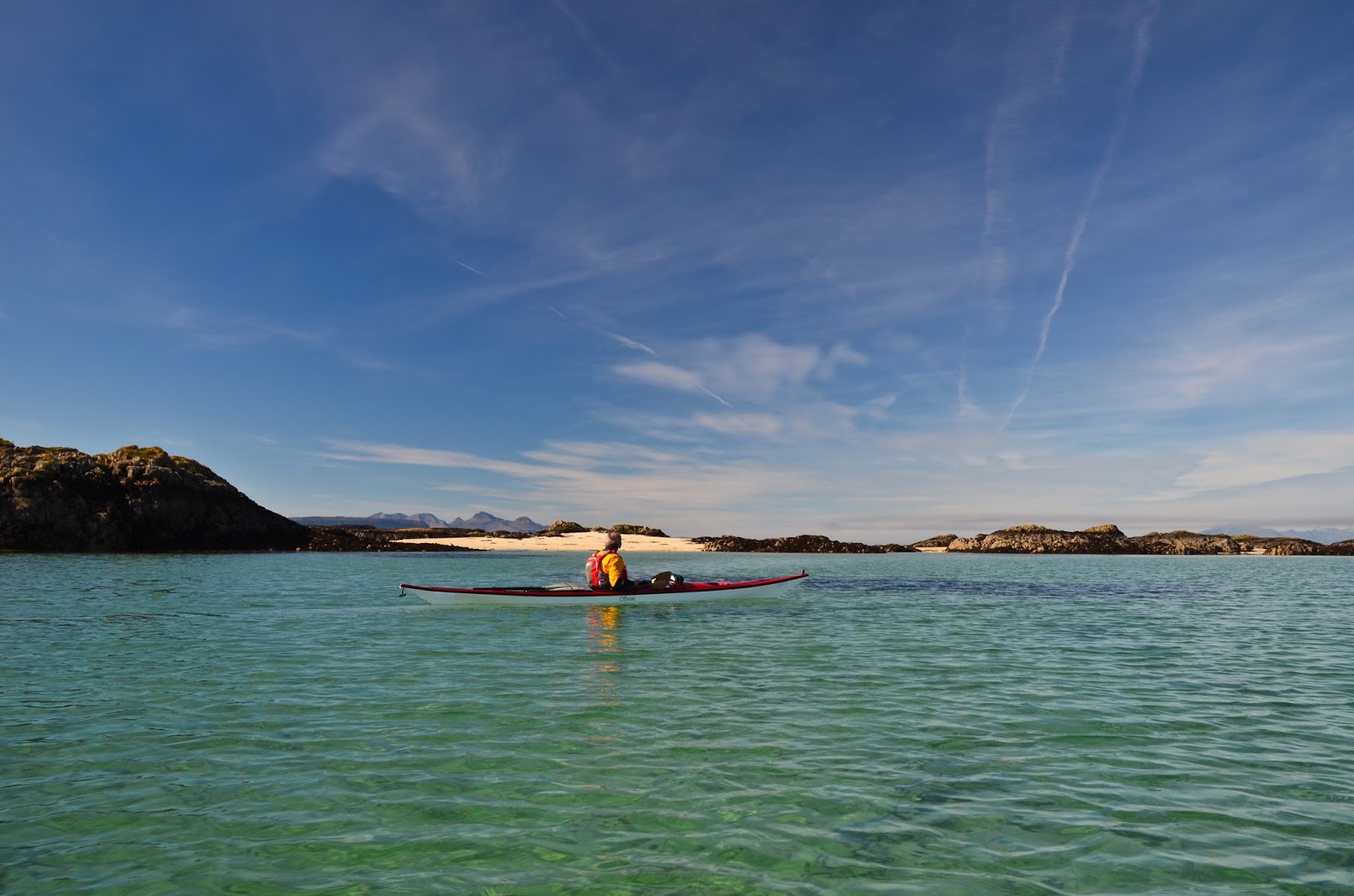
After the dolphin pod left us we paddled inside the Arisaig skerries, a complex of rocky islands and channels separated by white shell sand at the mouth of Loch nan Ceall. 


At a little after low water most of the channels are empty so we landed on the bed of one for first luncheon while we waited for more water. 

The tide in the skerries doesn't conform to the "rule of thirds" due partly to the complex topography but also due to the fact that the area of the skerries is a gentle dome separating the slightly deeper water of Loch nan Ceall and the open sea. The result is that rather than the strongest streams being at mid tide, the flood runs quickest in the first part and the ebb runs strongest in the last part as the water is forced through narrow and very shallow channels.


We didn't have to wait too long for the channels to begin filling and we set off to explore this ever-changing maze.  This area is immensely popular due to the sheltered location, white sand and wildlife - it's often busy with paddlers in the summer.  The guidebook Scottish Sea Kayaking - Fifty Great Voyages describes the Arisaig skerries as "the nearest you will get to paddling the Caribbean in Scotland".......


....and it's difficult to argue with that!  In fact, having paddled both; I can say that in my opinion this is a lot better....


One attraction is accessible wildlife; Seals are absolutely guaranteed here - a big draw for visitors as they often follow kayaks.


We exited the skerries at the north end and headed back south on the outside of Lunga Mhor, one of the larger islands.  A light breeze tempted us to put up the sails for a short while, but it was short-lived.  Ahead, a distinctive shape cut through the glitter and glare of the afternoon sun on the sea...


...yet more dolphins!  This was a different group to the one which had so enhanced the morning's paddling and seemed to be moving much more purposefully.


Nevertheless, they diverted to check us out and did a few circuits of our boats before continuing on their way north.  We had a small diversion of our own in mind on the way back........


....and really, why wouldn't we; did someone mention the Caribbean?!


Kayaks drawn up on a deserted white sand beach bounded by turquoise water - just idyllic.


We enjoyed a coffee break on the machair above the beach and had the place to ourselves - but if you come here in summer you'll be lucky to be able to do the same, it's a justifiably popular spot though somewhat overused by commercial groups for camping.  We restrict our visits to outside summer and don't camp here any more to reduce the pressure a little.  There are other spots equally beautiful and lots quieter within an hour's paddling.

Jennifer, Douglas and I can recommend a winter swim from this beach as a refreshing exercise - although we couldn't claim that the water temperature will match the Caribbean!