Showing posts with label Marilyns. Show all posts

Sunday, 5 August 2018

Fried on Eigg

After enjoying lunch and checking out the facilities at Galmisdale Mike and I returned to our boats and paddled a couple of hundred metres round to the bay which is recommended for yachts to anchor and for informal camping


I knew from a previous visit that the ground behind the bay is also used for grazing sheep and cattle - and sure enough some of the cattle were cooling themselves in the water when we arrived on the beach.While we felt that they'd have seen it all before and would be unlikely to bother us, we felt t wise to leave everything in our boats rather than pitching the tents straight away in case one of the younger beasts got curious....

Having used a trolley to half pull and half carry each boat up the soft sand, we got changed into shorts and light shirts for a bit of a walk.  We each had an ultralight rucsac in our boats and packed these with water, some snacks, a long sleeved top and sun cream....good to go.


Heading up the track back towards Galmisdale, we found where the sheep normally on the machair had gone......everything on Eigg is dual purpose where possible!  These ewes had the right idea, at just gone 1pm the heat was pretty full-on, and they still had thick fleeces.


At Galmisdale there's a sign board detailing waymarked walks, with each walk having a colour code.  The coloured waymarks are a bit sketchy to find - if, like us, you want the quickest route to climb An Sgurr, take a track up through some pretty woodland, then follow a rough track across open pasture to reach a gate near this house.  The route then goes left beyond the house and then immediately right - not that obvious but once on the hill path, very straightforward.

This must be one of the most photographed views of An Sgurr, it has a nice composition with the house giving some foreground - and is also a good place to pause on the first of the steep slopes!


There really isn't much doubt which way the wind blows here.  This tree, unexpectedly it's a Beech, was older than its size suggests, cropped and sculpted by the wind.


The climb towards An Sgurr is steady and uncomplicated, just a couple of rocky steps on the crossing of a moor which laps the base of the prow - which gets steadily more impressive as you approach.

The Sgurr is the southern termination of a pitchstone ridge which runs along the spine of Eigg.  Formed during the birth of a huge volcano complex which included creation of the island of Rum, it is effectively a mirror image of the landscape of 58 million years ago.

Pitchstone is formed from viscous lava flows and is tougher than the usual basaltic lavas.  The story of the Sgurr ridge is this:

As the Rum volcano complex erupted, a layered basalt lava flow landscape emerged, covering the ground to the level of the present day ridge.  Over time (about 6 million years), a valley was eroded out of the basalt lavas, and when the pitchstone lava was erupted it filled this valley to the brim. Because pitchstone is so much harder than basalt it resisted erosion as the basalt around it was worn away, so what you see today is an inverted valley, like a jelly-mould image.  There's a good explanation of the process in this paper by the JNCC.


As we crested the slope at the base of the great prow, the view opened to Rum, the source of all the lava. From an elevated viewpoint the vague shape of the Rum Main Ring Fault can be seen in the hills.  Our route contoured along the north flank of An Sgurr to climb though a fault line and emerge onto a shallow col.....


....where the view to the south is suddenly revealed.  The long finger of Ardnamurchan is in the foreground with the west coasts of Islay beyond, fading into a heat haze.


The route now switches to the south side of the An Sgurr ridge and follows a narrow path with a little bit of exposure and stunning views.  Below our feet was the coast we'd paddled that morning, out to sea lies Muck, our original target for the day.  Beyond Muck, faintly discernable in the haze we could see the outline of land - and puzzled for a few minutes about where this might be until Mike correctly identified Coll and Tiree - islands I've yet to visit.

It was clear that the wind had dropped considerably, and that we'd probably have been able to get to and from Muck safely - but what we'd missed in visiting Muck was being amply compensated by this brilliant hillwalk.


Cresting the ridge, we got a view down to Galmisdale and the route we'd walked to get up.  We could clearly see the narrow finger of turf where we would camp, just below the dark coloured skerry in this image.


To the north, the previous night's camp at Bay of Laig was visible at the same time, and the view leapt across the Sound of Rum, now an intense blue.


The final few metres to the summit track across the surface of the pitchstone, showing some of the columnar shapes formed as it cooled.  Right now, it felt like the lava was still warm from the volcano - the heat was terrific and was being reflected up from the rock in pulsing waves of dry, hot air.


On reaching the summit, we flopped down and spent a good half an hour just taking in the views and the situation.  At 393 metres/1289 feet An Sgurr is quite a small hill, but it has a view matched by few other hills in Scotland.  The combination of islands, mountains and lochs forming a true 360 degree panorama are simply stunning.

We left the summit reluctantly - it would have been easy to while away hours up here but we were being absolutely scorched by the sun and had limited water with us.  Truly, we were being fried on Eigg, and would be "sunny side up" for days afterward.

We went fast and direct on the descent - for we had a powerful incentive.....


Friday, 17 March 2017

Meall Alvie

Back home after a long spell working away, I scanned the forecast to see if the weather might be suitable for either sea kayaking or hillwalking. A run of very strong winds didn't offer much encouragement for either the sea or the high hills, so I looked for something with a bit of shelter to get back out and about.


Mid March is very much late Winter rather than early Spring in the Highlands, despite the very mild Winter.  The day was pleasant on low ground but with a forecast of severe gales setting in rapidly higher up the hill during the morning.


East of Breamar, the River Dee takes a couple of turns as it squeezes between low but rugged hills on its way from the mountains to the lower ground.  One of these, Meall Alvie, hems in the northern bank of the river and forces both road and river close around its foot.  The summit is only 560m/1837ft which is very low compared to the surrounding mountains and is wooded right to the summit with Scots Pines.

There's a estate car park at the Keiloch with a £2.50 charge.  The charge is per visit rather than per hour or per day, which is sensible given that this is the departure point for many long routes.  The toilet in the car park is decorated with front covers from Scotlands iconic hill "fanzine" - The Angry Corrie; sadly missed by this hillwalker.....

An information board shows the waymarked routes on this part of Invercauld estate, and nearby a Scottish Rights of Way signpost indicates the way to Inver via Glen Felagie and the start of the route.


After about a kilometre the track passes Felagie Cottage, a locked bothy used by Cults Girl Guides from Aberdeen - it's in a fine location sheltered by woods on one side with a view to Craig Leek on the other.  This is the point where I left the track.....


...to look for a drystone dyke indicated on the 1:25K Ordnance Survey map (but not on the 1:50K) which runs right up to the summit and over Meall Alvie.  From here on there's no path through the deep heather, it's steep and surprisingly hard going.  I was lucky to be doing the walk in dry conditions but was still glad I'd put on gaiters; you'd definitely want them in wet weather!


Higher up the heather gives way to blaeberry underfoot which gives easier walking.  The wood seems to be semi-natural, perhaps a plantation which has been thinned and allowed to naturalise.  There's plety of dead standing trees and some fallen so the wood is a rich habitat.  It should have been rich in birdsong at this time of year but the predominant sounds were a marine roar and the creaking of trunks and branche as the wind thrashed the trees above. 


The trees grow smaller as the summit is reached, stunted by exposure to the wind.  A wooded hill summit is not the norm in Scotland, but with a bit of searching some good views can be had - this is looking north-west to the massive plateaux of Ben Avon and Beinn a'Bhuird......


...and a bit of searching for a clearing in the trees gives a good view of Lochnagar to the south. 


The wind was now at full gale and the air had the faint haze often seen in strong wind, particularly noticeable in this view ENE along the River Dee and the A93 road towards Balmoral Castle in the distance. 


The 560m summit of Meall Alvie is hidden among the trees, so it had a bit of shelter.  An hour is sufficient time to reach the top of this small "Marilyn", and most folk seem to turn around and return by the route of ascent.  Wherever possible I prefer to find a different descent route to make a bit of a circuit, and this is possible on Meall Alvie. 

The stone dyke can be followed across the summit area to the south-east, where it runs downhill.  The way down is even steeper and rougher than the ascent route, for a small hill this one takes a bit of getting at!


The wall continues to the top of some crags, but just above these it crosses the end of a grassy forest track which winds pleasantly down through the woods.  Walking quietly here pays dividends, there seem to be plenty of Roe Deer in the wood and I got several good views as they browsed near the track.  Lower down the grassy track joins a new and broad forest road which perhaps indicates that the trees on this side of the hill will be harvested.

This route is about 6km with 240m of ascent - it took around two hours to complete. The whole route is on OS 1:25K sheet 404 (Braemar, Tomintoul and Glen Avon) and is easier to follow at the 1:25K scale as the wall is clearly indicated.

As a bonus, the excellent food and coffee at the Bothy in Braemar is just a few minutes drive away :o)

A good hill for a windy day!

Thursday, 28 July 2016

The Coyles of Muick

When travelling from Ballater on the narrow road up Glen Muick the undulating ridge known as the Coyles of Muick rises prominently on the opposite side of the glen. Despite being only half an hour or so from home, it's a hill I'd not climbed. A day with a forecast of low cloudbases seemed a good one to climb a "wee hill" and retain something of a view, so I took a look at the route possibilities on the map.

The most obvious route is to climb the hill's eastern slopes which can be accessed by walking up the forestry tracks in lower Glen Muick (glen of pigs), but it's not so easy to work out a circular route from this side of the hill.  Instead I decided to start from the north and to include Glen Girnock on the way back.


There's space to park off the B976 South Deeside road near Loch Ullachie, which was an unexpected gem, covered with water lillies.  A track leads past the loch and up through the forestry to emerge......


....at Crag Liath (grey crag), a small summit at the northern edge of the ridge.  There's a distant view of the highest point of the hill ahead, and the route from here was really enjoyable; a ridge walk with an open pine wood on one side and a heather moor on the other.


Butterworts (Pinguicula vulgaris) were in flower by the side of the track in the damper parts, a plant I'm always careful to avoid treading on where possible - it eats midges!  Butterworts grow in bogs and on acidic soils which don't provide sufficient nutrients so the plants have evolved an alternative method of obtaining food.  The bright yellow-green leaves secrete a sticky fluid which attracts and traps midges and other small insects, the leaves then slowly curl over to envelop and digest the insects.  While each Butterwort will only "eat" a few midges at a time, it's a start!


On a rocky outcrop just below the summit I had to look closer at this fine fellow, a hare made from tarred papier maché with a long view to Lochnagar.  I've not been able to learn how or why he should be here, or who sculpted him - but he's a unique addition to the hills!


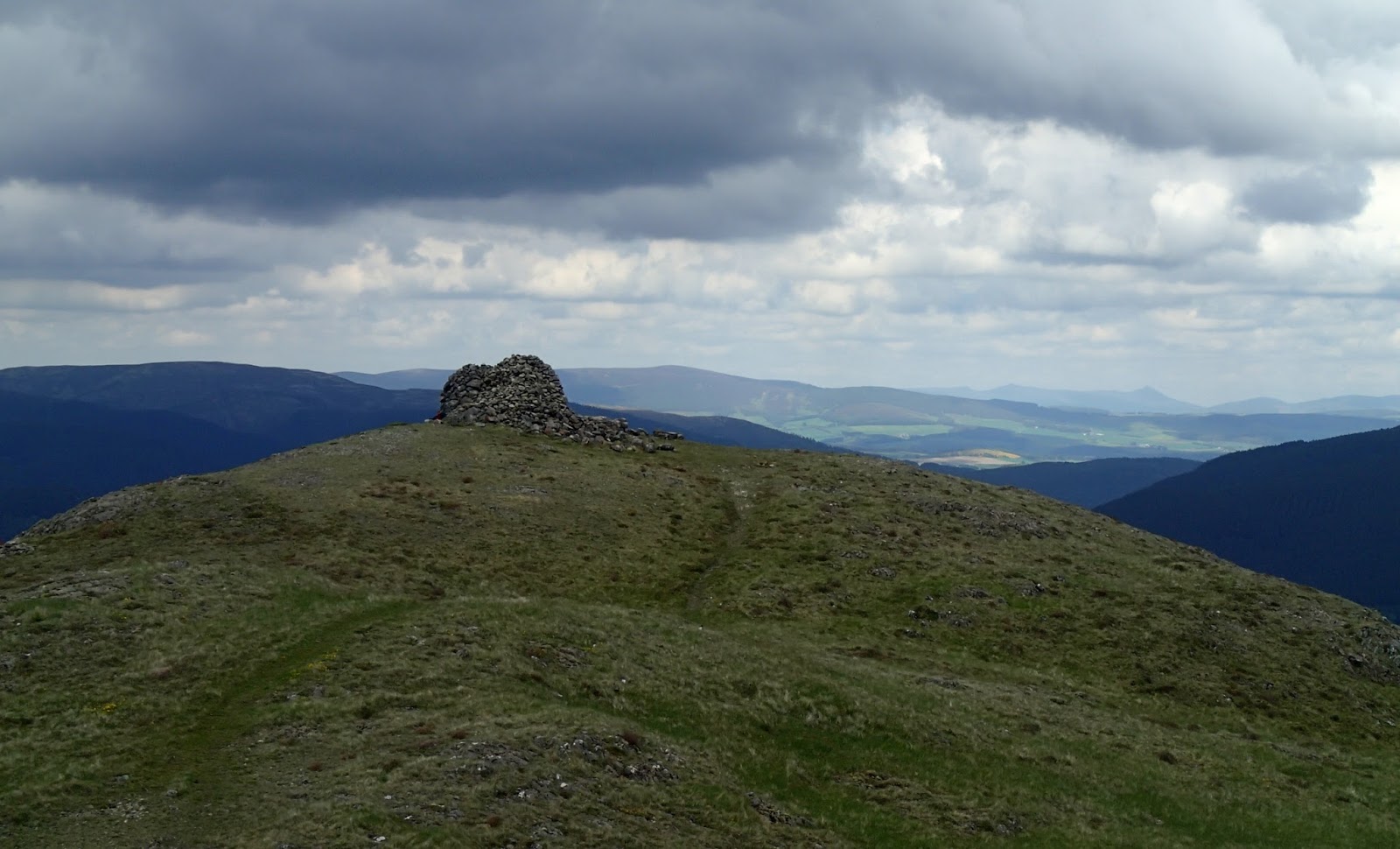
The name "Coyles of Muick" refers to the whole ridge, the 601m/1972ft summit is simply "The Coyle" and has a prominent stone cairn.  It's a surprisingly good viewpoint - in this image Bennachie can be seen away to the northeast.


Across a shallow dip is a second cairn on a small rise which has a fine view of Lochnagar, which on this day had a banner of heavy cloud streaming from the summit.


It looks that a replacement cairn is being constructed on the main summit, the circular base seems freshly placed alongside the existing cairn.


I sat for a while and enjoyed the play of light and shadow across Loch Muick at the head of the glen.


My descent route left the paths to the summit and went west down heathery slopes to the head of Glen Girnock (locally spelled as Glen Girnoc), a somewhat hidden glen, but well worth exploring.


In the wet grassy ground near the Girnock Burn, Spotted Orchids  (Dactylorhiza fuchsii) were quite numerous.  The name refers not to the flowers, but to the leaves of this pretty little marsh plant which have oval purple spots (not visible on this one!).


The clouds broke up and the sun beganto come through as I walked down Glen Girnock, a really lovely glen with wooded lower slopes.  It was once well populated and besides the more recent abandoned farms there are older archaeological sites, it's a glen which would make a fine lower level walk.  The track eventually joins the South Deeside road at Littlemill and I had a stroll back up the road to my starting point.


Sunday, 3 April 2016

A look back to winter - brilliant Bennachie


 Brilliant low winter sunlight and a cutting northerly breeze wrung tears from the eyes on the summit of Bennachie; I'd wanted to linger and enjoy what would be my last hillwalk before a period of months away at work, but the wind put paid to a leisurely summit experience.....


I've climbed this hill many times but there's always something new and I'd not previously noticed this carving in the granite near the summit trig point.  Somebody in the 19th century took a good deal of time and effort to carve out the relief and then the lettering in what I suppose should be considered grafitti, but admittedly stylish grafitti - some sets of initials and the date of the visit.  Presumably the north wind wasn't quite so flaying when this was done!


My onward route over to the highest point of Bennachie, Oxen Craig, was an obvious white line where the snow lay on the path but had been blown from the surrounding heather.  Away in the distance, another distinctive hill, Tap o' Noth, bore a broad wreath of snow.


From below the west side, the tor of the Mither Tap looks a formidable obstacle but there are routes for the walker even here.


From farther away the view changes to the distinctive shape of the landmark visible from so much of Aberdeenshire 


On the broad slab forming the summit of Oxen Craig another grafitti artist had been at work.  It's possible that the "T" stands for Tillyfourie, an estate lying on the banks of the River Don below the hill.


I managed to get some shelter from the biting wind at the foot of the highly featured granite outcrop at Oxen Craig, with a good view back over to Millstone Hill, my first hill of the day.  Already the sun was getting low in the sky with pronounced rays forming super patterns.

The descent back to the valley was a leisurely stroll, then a walk along snowy forest tracks marked by the traces of Nordic ski - an early first run for folk grabbing the brief early winter conditions.  I arrived back at the car as the the light was fading to a clear and starry evening.  The last hill before a period away at work is always a bittersweet experience, but it had been a cracking day out.


Thursday, 31 March 2016

A look back to winter - granite and blue sky


The low winter sun was just about clearing the summit of Millstone Hill at midday; the air among the trees frigid, still and sharp.  I found myself moving slowly and carefully, subconsciously tying not to break the delicate silence.


Above the trees the south facing slope of Bennachie's Mither Tap had been stripped of snow by the sunlight and the air was noticeably warmer - the summit boss a thrust of granite into a perfect blue sky


....although in the shade the snow still clung.  A tiny lichen caught the eye, strikingly scarlet in a monochrome miniature landscape and a good excuse to pause on the climb.


There are a few routes by which to climb to the top of the granite boss forming the Mither Tap - you can take one of the relatively easy paths or try finding your own route up slabs of varying challenge.  The rock is rough and offers good friction, but these slabs are a different prospect when wet or icy!


The Mither Tap is a "proper" little summit, it's small, well-defined with steep drops.......


To the east, the remains of the Iron Age hillfort can be made out - massive tumbled walls and a paved entranceway


To the west, the highest point of Bennachie, Oxen Craig, is the foreground to a wide skyline filled with the distant and snow-covered Cairngorms.  Bennachie demands a fair effort for such a small hill, but the climb is well rewarded!

Tuesday, 19 January 2016

A significant view from the Tap o'Noth


One of the most distinctive hills in the north east of Scotland, Tap o' Noth with its sawn-off cone of a summit lying at the end of a ridge is one of the familiar landmarks of Aberdeenshire.  On a walk along the Correen Hills I realised that it had been more than a year since I'd climbed it despite the hill being barely fifteen minutes drive from home.


A couple of days later a dry-ish day and a few spare hours gave me the chance to revisit.  I started from the tiny car park below the highest point of the hill from where a straightforward ascent can be made.  The route climbs on a track through farmland before contouring out on a level grassy area with the summit cone straight ahead.


The village of Rhynie seems very close from just below the summit area.  The village is mainly known for  the Rhynie Chert, an early Devonian sedimentary rock deposit aged about 410 million years which contains the earliest known insect fossil, and a strong Pictish connection - of which more shortly....


To the south west there's a long view across to the Buck o' the Cabrach , itself a noted viewpoint lying between Strathdon and Glenfiddich with grandstand views to the Cairngorms.


On the subject of grandstand views, the extent of the view from Tap o'Noth is shown on an information board just below the summit area.  Each circle is a 5 kilometre extension with the outer, 50 kilometre ring showing the potential view on clear days.  From the North Sea at the city of Aberdeen to the Moray Firth, south to the Angus Hills and west to the high Cairngorms, it's a marvellous panorama from a hill which is just 563 metres/1847 feet high.

Probably the most significant elements of the view are direct sight lines to the Pictish fort at Burghead on the Moray Firth, to the hillfort summit of Bennachie and below to Rhynie itself. 


Significant because the entire summit area of Tap o'Noth consists of a huge hillfort; the second highest in Scotland and one of the largest at 21 hectares in area.  The best angle from which to get a sense of the scale and extent of the place is from above, as in this image from the Canmore archive.

I first climbed Tap o'Noth when we moved to Aberdeenshire some 15 years ago - I was blown away by the fort then and every time I return it has the same effect - let me show you around......