Showing posts with label Lower level walking. Show all posts

Saturday, 6 January 2024

After the rain....


 December 2023 and into January 2024 saw some exceptionally wet weather in the north east of Scotland - Aberdeenshire received three times the average monthly rainfall in December as storms tracked more to the south than usual, resulting in a run of what felt like weeks of south easterly wind and rain for us.  This part of Scotland is usually the driest place in the country, but there have been only two dry-ish days in the last 20!

But, at last, the rain pulled away early afternoon on the 5th January with a forecast of much more settled weather for the next week or so.  As the sky cleared the temperature fell sharply and a ground mist spread across land saturated by rain.  the effect was very atmospheric as the sun set, the mist suffused by a gorgeous glow.

Wednesday, 25 May 2022

Bridging the gap

This is a catch-up post from a walk in upper Donside in the second half of April.  Lorna, Allan and I have explored many of the area's tracks, especially when Covid restrictions limited the distance we could travel.

We decided on a linear walk from Corgarff at the foot of the Lecht road down to Bellabeg in Strathdon.  By the A944 road this isn't a particularly long route but we intended to use parts of altogether older roads.  We would also link a series of bridges which have historical interest - the "bridge" theme would continue in that our route would bridge a gap between walking routes we know well.


We set off on a lovely Spring morning, heading SE from Ordgarff along the track which is signed as "Old Military Road".  This simple statement has a deal of history behind it because this is a section of road built between 1748 and 1757 as part of  a massive roadbuilding and infrastructure project following the 18th century Jacobite rebellions.

That said, the first of the bridges isn't typical of the "Wade Bridge", being a graceful, slender arch over the Allt Damh - seemingly defying gravity! 


Just under 2km further along the track is Delavine Bridge.  This is much more representative of the bridge construction on the 18th century military roads.  Delavine was one of three bridges repaired and stabilised over three years from 1997 to 2000 to keep these scheduled monuments intact.  A plaque on Delavine bridge records the work, placed on the outer parapet where it is particularly difficult to read without standing in the burn itself!  It is typical of the larger bridges of the period in construction and in being 4 metres wide.

The familiar term is "Wade roads" and "Wade Bridges" in reference to General George Wade, a military Commander in North Britain from 1724 to 1740.  Wade is actually the only person named in the British National Anthem - one of the more clunky verses which isn't used today reads:

"Lord grant that Marshal Wade
may by thy aid victory bring
May he sedition hush
And like a torrent rush
Rebellious Scots to crush
God Save the King"

The "Wade" road here is part of a 100 mile (160km) route from Coupar Angus to Fort George near Inverness via Braemar, Corgarff and Grantown on Spey.  The whole route was built in nine years between 1748 and 1757, starting just two years after the final Jacobite defeat at Culloden Moor.  For context, the 26 mile/42km Aberdeen Western Peripheral route took five years to complete in the 21st century!

By the time construction of this road was started Wade had long since left the Highlands and in fact died in the same year work on this route started.  His successor, Major William Caulfeild (note the spelling, not "Caulfield") was appointed Inspector for Roads in Scotland in 1732.  While nowhere near as well known as Wade, Caulfeild oversaw far more of the network: Wade was responsible for 250 miles (400km) of road, forty bridges and two forts; Caulfeild  for 900 miles (1400km) of road and over six hundred bridges - an astonishing series of works.   

The road we now walked is part of the longest single stretch Caulfeild built at 100 miles and the line it took was clearly good because the vast majority of the route is still public road, suitably upgraded for modern traffic. This stretch wasn't absorbed into the road network and remains as a great walking route. 

The ingenuity, effort, endurance and craft of the road planners and of the regiments of soldier-navvies who constructed the military road network is a great testament to one of Britain's greatest engineering feats. 


A little over a kilometre further on the road crosses the third bridge of the section, this one spanning the Burn of Tornahaish.  Here also the bridge required restoration works and all three bridges on the section are now leased from the landowner, Candacraig Estate, by the Gordon Trust on a 99 year lease.  Smaller than Delavine and without a parapet, the span and height above what is a very small burn gives an indication of the volume the Burn of Tornahaish is capable of in spate.


The track climbs up from Burn of Tornahaish to join the A939 road, or more properly become the A939 road.  From here the Military Road goes to Gairnshiel then on over the hill to Crathie on Deeside.  We walked uphill for a short way before leaving the road on a track cutting back uphill, having bridged the gap of several kilometres between our previous walks.  Here we had a choice of routes to reach Bellabeg.  One route would take us over to link with a lower level walk we've done before while the other would climb up onto the high ground to cross the summit of Scraulac - a route done several times previously.


We chose the higher level option as the weather was good and we were in no particular rush.  The summit of Scraulac (which I think may be from the Gaelic for Scree Place) is really wide, though today a bit breezy too.  An estate worker passed us on a quad bike here and was the only other person we saw on the entire route.

We left the estate tracks to descend Scraulac's north east ridge, finding a remarkable hidden building en route.  A good track which became a metalled road soon led us down to the public road at Culfork.  This really is a "road less travelled", a loop of minor road running parallel to the A944 but on the opposite side of the river Don.  A relatively new venture along here is Cairngorms Glamping and Camp Site, which looks to be a super place to spend a holiday!


 Cutting off the road just outside Bellabeg, a track descends around a wooded hill to the last of the historic bridges of our walk.  Poldullie Bridge was constructed in 1715 by Sir John Forbes of Inverernan and crosses the River Don. A remarkably graceful single span bridge, the elegant form is best seen from above as in the images on the Canmore site.  Sir John Forbes made a fatal choice in throwing in his lot with the Jacobites at the 1715 rebellion and was captured following the battle of Sherrifmuir.  He died in Carlisle prison the day before the date of his execution.  It was this rebellion which prompted much of the roadbuilding effort in Scotland in order to "pacify" the Highlands.  Movie buffs might recognise Poldullie Bridge as it featured in the 2019 film "Mary Queen of Scots".


From Poldullie Bridge we climbed a steep bank to the main A944 road and strolled downhill to Bellabeg where we'd left a car earlier in the day.  

This had been a great walk with lots of history and great views.  The route we took is 19km/11.8 miles and it took us six hours at a fairly relaxed pace with a couple of stops.  Ordnance Survey 1:50K Landranger map 37 (Strathdon and Alford) covers the whole route.  As there is no public transport between Bellabeg and Corgarff this route does require two cars and a shuttle.  It would also make for a great mountain biking route with scope for variation.

Saturday, 22 January 2022

Equipment Review - Kahtoola Microspikes

In icy conditions the soles of walking boots and shoes are seriously compromised in terms of grip, and some form of traction is very desirable.  On steep ground or on the hill, especially in the mixed conditions typical of Scotland I use 12-point articulated crampons with stiff mountain boots but this combination is not well suited to tracks, forest roads or footpaths.

In autumn 2020 I purchased a set of Kahtoola Micropsikes to use on my regular walks when things got icy.  This review is based on regular use through winter 2020-21 which proved to be exceptionally cold and prolonged even by Aberdeenshire standards.  The Microspikes have been used in temperatures from 3 Celsius down to -20 Celsius and in underfoot conditions ranging from hard, frozen turf, iced forest fire-roads, refrozen snow, in hard, clear ice and melting ice.

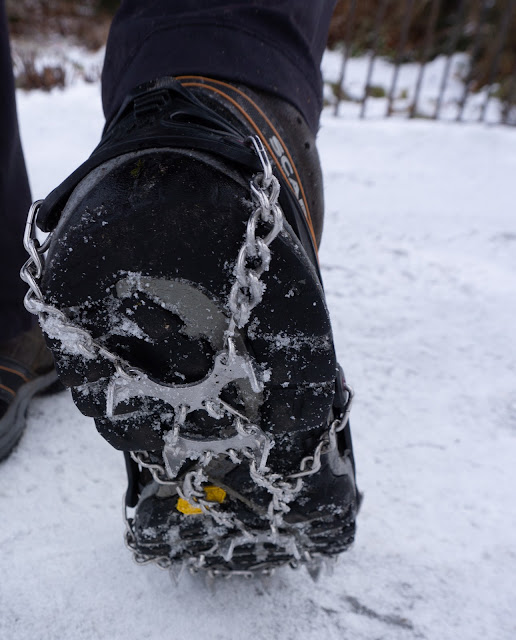
The Microspikes don't require stiff or rigid soled boots which means they should fit a range of footwear (indeed many folk use them on trail running shoes).  The upper part is a shaped Thermoplastic Elastomer (TPE) harness with reinforced eyelets which is claimed to retain its elasticity down to -30 Celsius.

The Microspikes are quick and easy to fit with a little practice and don't require footwear to be removed in order to put them on and take them off.  The technique is to place the forefoot into position then use a raised tab on the rear of the harness to pull the heel into place.  I found that I was able to easily fit and remove the Microspikes on-the-go, which is useful when they may not be needed for all of a walking route.

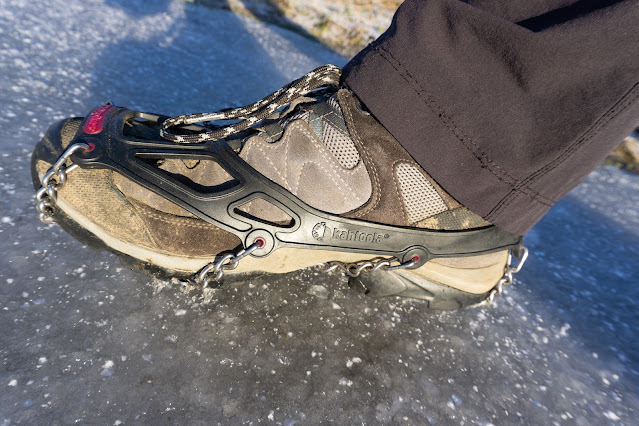
The design of the harness holds the spikes in place nicely and there is no tendency for the footwear to slide out even on quite steep descents.  A real positive is that I haven't experienced any pressure points or "cold spots" from pressure as can happen with some crampons.  In the image above the Microspikes are being used with a walking shoe on hard ice.


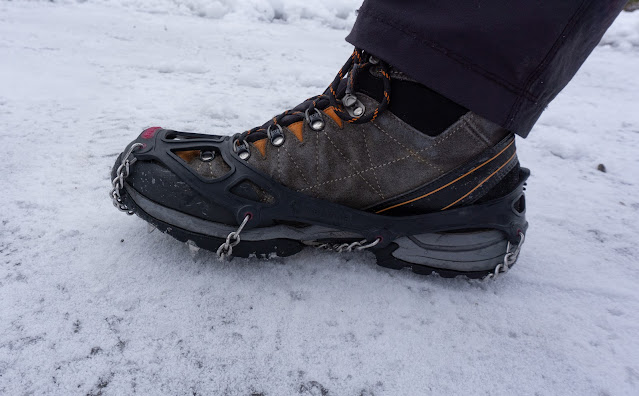
In this image they are being used with a general purpose walking boot in mixed conditions with heavy frost and frozen patches of forest road.  Unlike with crampons, it's not necessary to use a "duck waddle" modification to your natural walking style when using the Microspikes, due partly to the much shorter length of the spikes compared to crampons and also because there are no front points which could catch the ground.


 The chain and harness hold the Microspikes in place very well, I've not experienced any misalignment when walking across level or rough terrain.  Sometimes with articulated crampons strapped tightly to stiff winter boots and secured with toe bail and heel fastener there can be cold spots on the feet from the pressure.  I haven't experienced any cold spots with the Microspikes as they aren't holding the foot rigid and any pressure is distributed across the harness.

So, although for mountain walking my preferred combination is and always will be stiff winter boots and 12-point articulated crampons, the Microspikes definitely bring benefit in winter walking for lower levels, making otherwise inaccessible icy paths easy to walk.  I can also see a place for them in Spring mountain walking when most of the snow is off the hills and there are just occasional patches to be crossed which don't require front-pointing technique.

The Microspikes retail for around £50 in the UK, and I think that they're very good value at that price.  If you walk regularly on icy tracks and paths, live in an area which has winter conditions most years or walk on hills with some icy patches, they're well worth considering as part of your kit.  I purchased my set from Icegripper, a main UK importer of Kahtoola products.  The Microspikes arrived quickly, and I can vouch for the customer service - the initial set sent out were the wrong size and when I informed the company the correct size were sent out before I returned the original set.

Conflict of interest statement:  I purchased my set of Microspikes at full retail price an have no connection with either Kahtoola or Icegripper other than being a satisfied customer.

Saturday, 6 June 2020

A golden path


After a couple of days of really very poor weather, a bright and breezy early summer day.  The colours absolutely "zinged" in sharp air - and warm sunshine returned.


Broom (Cytisus scoparius) is in full,  glorious flower.  Seen against the green of conifers and a blue sky, the effect is dazzling.


To walk along a track lined with gorse and Broom is to walk a golden path - and in the warm sunshine the coconut scent of the Gorse arrives in waves - just a superb early summer day.

Monday, 20 April 2020

One good thing - 20th April 2020

As we complete four weeks of lockdown, I'm continuing to looks for "one good thing" about each day to counter the relentless 24 hour news cycle of death and economic bad news. And, despite everything, there's good things to be found.


One of my regular daily walks takes me along two stretches of the River Don - and it was the river which caught my attention this evening.  A winter of comparatively little snowfall and an exceptionally dry spell in which we've not had meaningful rain for well over a month have left the  Don at a very low level.


In fact I can rarely remember the river to be as low at this time of year, and certainly not to run just as crystal clear as it currently is.  The River Avon in the Cairngorms flows off granite and is famed for the clarity of its water .  The Don which also flows from granite hills but which have a peaty overlay is running it quite close for clarity at present.


Which is probably quite good news for this pair of Goosanders (Mergus merganser) but maybe not for the Brown Trout and Salmon which these sawbill ducks feed on.  The sky above the river was full of Swallows this evening, and there was the also the trilling call of a Common Sandpiper, another recently returned summer breeder.

Tuesday, 7 April 2020

One good thing - 7th April 2020


On my walk this evening, the Rooks nesting in two tall Scots pines were making a tremendous noise.  One of my bird guidebooks describes Rooks calls as "around the nest, deep "comfortable" caws and croaks; typical "craa-craa-craa".  Frequent, loud and far-carrying high "crroo-crroo-crroo, choked trumpeting notes, musical squeaks and squeals; deep mechanical wooden rattle in flight" - which is varied for sure!

The naturalist Sir John Lister-Kaye has studied Rooks at his home near Beauly for many years and has identified nearly 30 different types of call made by these fascinating birds, most linked to specific behaviours or situations.

What was happening this evening appeared to be more dispute than comfort calls, and stopping to watch soon revealed the source of the commotion.  Whenever a bird or pair left the nest, one particular bird seemed determined to steal sticks from their nest for its own nest.  The outraged owners would snatch back the stick and the whole process would start again.  Whatever the purpose of this behaviour, it was certainly entertaining for a human!


Sunday, 5 April 2020

One good thing - 5th April 2020


Being restricted to walks from the house has prompted exploration of some of the tracks which lead off my "normal" routes.  Some are half-hidden and rarely used except by wildlife.  Sometimes they just peter out in the forest, or lead to a dead end.......


...but sometimes after following these forgotten tracks for a distance there's a new angle to explore...


....and a new way to link up routes and tracks which I'd probably never have found otherwise.

Wednesday, 25 March 2020

One Good Thing - 25th March 2020

While it's still OK to take one form of exercise outside the home each day I've been walking for an hour or so after working at home.  On an overcast and cool day thee wasn't too much colour about, but I was just thankful to be healthy and to be out in the fresh air for a short while.


Today's good thing was another plant; along the banks of Aberdeenshire's River Don the last of the clumps of Snowdrops (Galanthus nivalis) are still in flower, a delicate seeming yet tough splash of late winter brightness.

Thursday, 17 October 2019

October colours


All of a sudden it seems, the golden colours of autumn have come alive in Aberdeenshire.  On a walk above Glen Derry, the trees of the Doire Bhraghad (broad wood) have gained a palette of rich browns and glowing gold among the bottle green of the pines.  There's a long view north from here to the heart of the Cairngorms - the giants of Derry Cairngorm and Ben Macdui showed up well in the clear air.


The purple of late summer heather has faded to a purple-brown as the flowers dry out in the wind; it's not as bright as the swathes of stunning purple brilliance but has its own subtle beauty. As with many places in the east of the country, the hills have a plaid of dark green pines across their lower slopes....always the pinewoods as a setting.


A set of prints in the mud of a forest track - smaller than a fox, larger than a stoat or weasel? - ah, of course.... Red Squirrel, that bright spark of energy among the trees.


The pace had slowed; this was no day to be charging around the hill.  To stop and absorb the colours, the shifting light and the shimmer of golden birch leaves in the breeze seemed the way to get the best of the day.


At times the colours were breathtaking.  Just after taking this image, two Ravens powered into the sky from a big pine, flying straight and true with deep "krokk" calls.  We weren't the source of their alarm, so we followed their flight and, as suspected, a Golden Eagle slipped down the breeze overhead.  The Ravens started to mob it, but soon backed off when the eagle banked sharply and lashed out with its talons before casually resuming its glide towards the valley of the Dee, all rich brown against the blue.


On the short drive home we stopped of in Crathie to visit a new enterprise.  We've been regular customers of the Highlanders Bakehouse who sell superb breads at local farmers markets in Aberdeenshire.  The new enterprise is a cafe and shop, a big step for a young couple who have put everything into getting it up and running.  We can report that the food is superb, fresh, local and wholesome, if you travel on the A93 on Deeside, don't miss it!

It had been a beautiful autumn day, but there was one last treat.........


.....when the huge "hunter's moon" (the full moon after the September equinox harvest moon) rose over the fields of home - a fitting golden end to a golden October day.

Tuesday, 5 March 2019

Bin it


I've driven past the sign on the A96 road near Huntly which points to the Bin forest car park literally hundreds of times and yet not visited - feeling that a walk close to a busy road would be spoiled.  I'm pleased to say I was totally wrong.

On a really windy Sunday morning we parked and headed out on one of the waymarked trails which climbs steadily up through the forest. 


The Bin was originally planted for timber using seeds brought to Scotland by the great plant collector David Douglas, and while still worked partly as a commercial forest there's much more to it.  It's been a long time since I've visited a forest with quite some much variety; open areas alternate with denser woods and mixed stands of wood are much in evidence.  In this image there are Spruce, Scots Pine, Birch and Rowan all within a few square metres.


There was plenty of interest in the small scale too, miniature forests of lichen and mosses with just as much variety as the big stuff.


We saw the first frog spawn of the year in a pool beside the path, possibly laid the previous week in the very warm (for February) conditions.  Whether this spawn will survive is questionable with sub-zero temperatures and some snow forecast for the first week of March.


A small group of Ladybirds, probably 7 Spot Ladybirds (Coccinella septemunctata) were sunning themselves in a sheltered spot on an old pine branch.  We've seen a lot of these bright little creatures this winter, our Christmas tree proved to have large numbers hibernating among the branches which we carefully took outside and placed in similar spots in the garden!


Near the top of the forest the view opens up and our attention switched from the small things at our feet to the wider landscape - this is a view to the Buck, a prominent hill above the Cabrach.


The high point of the Bin forest is the hill after which it's named, the Bin is 313m/1026ft.  "Bin" is probably a variant of "Ben", the Gaelic term for hill or mountain - there's another so named close by, the Bin of Cullen, which is almost exactly the same height.  There top is an outcrop surrounded by trees offering good views through breaks in the canopy.  A nearby pool is known as the "Gallon of Water" and was supposed to have healing powers, especially for children with Whooping Cough.  The walk to the summit followed by a "dook" in freezing water probably would have some effect, one way or the other!


We descended back down to the main track through a wood which little ones would recognise as good habitat for Gruffalo, and half glimpsed a strange creature through the trees....we're still not sure, but it may have been?


Other strange sights were present in this part of the wood - great mushrooms of mosses........


....and a split boulder through which the path winds.  Our route took the Yellow and White trails through the forest, the longest of the options and circling the hill to arrive back at the car park.  In total our walk was 10km and has around 200m of ascent, mostly on good forest rack with some smaller path sections.  For variety and interest the Bin has lots going for it - and is certainly not rubbish!  As a bonus, the nearby town of Huntly has a number of places to eat.

Tuesday, 26 February 2019

A February day in Glen Quoich


February has continued to be unseasonably warm with temperatures more usually associated with late Spring than late Winter.  On a "normal" February day a walk up Glen Quoich would need most of the gear required for winter hillwalking, but certainly not this year.  The glen is entirely bare of snow and even the mountains only have patches of old snow.  So complete is the thaw that the Quoich Water is at a low volume - most of the snow having already melted.


There are some wonderful areas of old growth Caledonian pine forest in the lower part of the glen, standing deadwood mixed in amongst mature pines and, pleasingly, lots of young trees.  It's not so many years since you could walk in this area and see lots of Red Deer but very few young trees.  The National Trust for Scotland took a decision to reduce deer numbers on the ground and the result is a much more healthy regenerating forest.  A healthier forest will also be good for the deer going forward as they're animals of forests rather than moorland.

The spiral grain of a Scots Pine (Pinus sylvestris) can be clearly seen in the dead trunk above.  This is a characteristic of the species and seems always to spiral clockwise.  It's thought that spiral grain is an adaptation which strengthens the tree and enables it to resist wind stresses better.  Some mature pines have huge crowns and of course retain their needles through the northern winter so an adaptation to resist wind stress seems to make sense.


At the opposite end of the scale from the huge dead pine trunk, there are clear signs of the coming Spring, especially in the smaller trees like this Rowan (Sorbus aucuparia), even though the colours of the wood are generally muted at this time of year it won't be too long before the fresh greens of Spring emerge.


Much more colourful was a large granite boulder covered in orange lichen - quite beautiful in it's own way.


At our feet we noticed a number of dark brown or black hairy caterpillars crossing the path.  I've not been able to identify the species - so if anyone knows what type of caterpillar this is please let me know!


As hazy sunshine began to break through we looked up to a great view.  Across upper Glen Quoich the southern spurs of the sprawling Ben a' Bhuird dominate the view. We sat and "brewed up" tea, enjoying both the view and the warmth of sunshine on our backs.


We kept close to the Quoich Water on our way back down the glen.  Flowing off hills of granite rocks, it's a clear lively river.  As can be seen by the landslip on the bank in this image, it's also a dynamic river which thrashes around in times of spate.


Near to where the Quoich flows into the River Dee is a favourite spot of ours. A series of small falls are formed where the river drops over shelves of rock.  One of these rock shelves has a waterworn hollow known as the Earl of Mar's Punchbowl.  Local legend has it that the Earl of Mar had this hollow filled with punch during a hunting trip to toast the Jacobite cause in 1715.  He'd be disappointed today though as one side of the hollow is worn through allowing water to pour out.


Below the Punchbowl a wooden bridge crosses over the river above the Linn of Quoich (a Linn is a narrow constricted channel) where the whole volume of the river roars onto a narrow gorge.  In spate this can be a fearsome sight.


Walking back up from the Linn of Quoich we looked back up the glen to see that a dark bank of cloud had obscured any sun.  The forecast was for afternoon rain and it looked like the forecast was absolutely accurate!


The rain passed through during the afternoon, and back at home we were treated to a fine show as the sun set.  It had been a very pleasant winter day.....

Monday, 18 February 2019

A hint of the Spring to come

A run of remarkably mild and sunny days in the north east of Scotland has brought a hint of Spring, in mid-February; and nature has responded.  Birdsong increased noticeably, where there had just been Robins singing they've been joined by Great and Blue Tits, and yesterday a Thrush belting out song from the top of a Birch tree.


The flowers have responded to some warmth too - Snowdrops (Galanthus nivalis) usually flower in February but have fully opened their flowers in the sunshine.


The Crocuses in a small flower bed next to a south facing wall visibly grew over two days, a couple of weeks earlier than expected they're much more a Spring flower than a winter one!


On a walk by the lower reaches of the River Spey, a sunny and sheltered spot in a wood was full ofa plant which seemed familiar, but not completely so.  We have Butterbur (Petasites hybridus) growing near to home and this was similar but somehow different.


A bit of research revelaed that the plants are White Butterbur (Petasites albus), a non-native variant introduced to Britain in 1683 from southern Europe.  It apparently thrives along watercourses in the north east of Scotland and can be invasive as it spreads via underground rhizomes and can out-compete other species.

There's no doubt more of winter to come, but it was certainly good to feel a hint of the coming Spring!