Showing posts with label Birds. Show all posts

Monday, 13 May 2024

Happy returns in Morar

The first few months of 2024 have seen some really poor weather conditions in Scotland.  In the north-east of the country it was the wettest winter for many years and April was the coldest since 1905!  When the forecast for the first few days of May showed warm and settled conditions on the west coast, Douglas and I made plans for a few days sea kayak camping.

We met at Mallaig mid-morning on a glorious day.  A glance at the map shows how well positioned Mallaig is to access superb sea kayaking routes.  Our plan would be very flexible and would largely be dictated by a forecast of variable winds from a generally easterly direction.  Before packing our boats we took second breakfast of croissants and pains au chocolate with coffee from the excellent Mallaig Bakehouse and also bought a large focaccia bread to accompany dinner.


 We were on the water and away shortly after noon and enjoyed a leisurely few hours paddle towards our first planned camp.  As we'd both had long-ish drives to reach Mallaig we had no intention of pushing hard to make distance, it just wasn't that sort of a day.  A light breeze from astern helped push us gently along as we paddle-sailed a shoreline alive with the sounds of Willow Warblers and echoing to the calls of Cuckoos.


Arriving at a camp we've used before is a bit like meeting an old friend; one looks for the subtle changes and reminisces about good times.  We were pleased to see not much had changed here and that the bracken hadn't started reaching up, making for a better range of pitches.  We got our tents up, enjoyed a coffee and then went for a walk.  Douglas and I both enjoy the off-water parts of a sea kayak trip as much as the paddling, exploring and just being in a place adds so much to the experience.


We climbed above the shore and through woods of birch and oak to a stretch of higher ground which had clear signs that this now deserted shore was once worked by a community.  "Run Rig" furrow marks were everywhere, testament to back-breaking work over generations to make something of the poor, acid soils by fertilising with seaweed and dung.


Croft houses, some little more than a gable or a "rickle o'stanes" dot the ground near the shore.  It's likely that the occupants had been moved from better agricultural ground inland to theses far edges to make way for sheep in the years of the Clearances.  The houses had a superb situation, but a view won't feed your family and this was subsistence living at the extreme with starvation an ever-present threat.


Near the ruins of a more substantial house was this tractor which is slowly being consumed by rust and the boggy ground.  We could make out that the engine was a Standard make, but little else - it would be fascinating to learn something of its story.

Just around here we were treated to one of the experiences which really make a trip.  Overhead we heard the distinctive "kyow-kyow" call of a White Tailed Eagle.  looking up we saw not one but two birds flying purposefully overhead.  But things got even better; a third, absolutely huge eagle (an adult female we think) launched from a nearby crag and engaged the two overflying birds.  Twisting in mid-air and presenting its talons seemed to intimidate the two birds which flew quickly off.  Then the third bird was harried relentlessly by a pair of Ravens which mobbed it all the way back to the crag - it was a great wildlife spectacle!


It was only four or so hours into our trip but already it felt that we'd been amply rewarded for making the effort to get out!  Returning to our camp we gathered driftwood and some fallen birch branches for a fire and started to think about getting dinner prepared....

Thursday, 31 March 2022

A noisy morning and a quiet day

I slept fairly well at our first camp site, but only until the first hint of light.  the clear, fluting song of a Blackbird singing solo was the start of the dawn chorus, and was a strikingly beautiful sound in the quiet dawn.  What was neither beautiful or quiet were the many geese, a Raven, a Pheasant and several Oystercatchers who joined in soon afterward, a more discordant dawn chorus would be difficult to imagine!

No matter, it was a lovely morning when we emerged from the tents, and surprisingly there was absolutely no condensation on the tents or the ground - quite unusual for this time of year.  The sunrise was a slow and stately affair, the forecast for overcast and hazy but warm conditions looked pretty accurate.  I never underestimate the privilege of waking up in places like this....we were less than 60km/40 miles from the very centre of Glasgow, Scotland's busiest and most populous city and yet we might have been in another world.


The party would split here; Douglas and Mike would head back to Portencross on the Ayrshire coast, Donny would head off to explore in his F-RIB with the possibility of joining up with us later in the day.  Raymond, Allan and I would head back north into Loch Fyne.  It had been great to catch up with everyone - I've so missed these journeys with good friends during the pandemic.


As we paddled back up the west side of Inchmarnock we were accompanied by the noisy neighbours; a flock of Canada Geese and small groups of Greylag Geese.  They allowed us to get fairly close, then splashed their way airborne in noisy indignation to land just ahead and repeat the process - why they didn't just fly around behind us I've no idea!


This was a strange day of weather; neither cold nor warm, calm with absolutely no wind, dry and with soft-focus light.  I'm sure that the conditions subconsciously affected our pace and energy - we all remarked on being a bit lethargic during the day.


At the mouth of Loch Fyne the Ardlamont buoy sat on top of its reflection, perfectly still


I'd had a very distant view of dolphins - which Donny later confirmed as Common Dolphins.  For some years a lone Common Dolphin nicknamed "Kylie" (as he frequented the Kyles of Bute) had made a permanent home near the buoy and had, it seems, been able to communicate across a species boundary with Harbour Porpoises but there was no sign of him when we paddled past.


Near to Ardlamont Point we heard a familiar high pitched chatter and looked along the cliffs to get a great view of a Peregrine Falcon (Falco peregrinus) arcing out over the water before returning to the crags - a really lovely sight.


I got quite tired paddling during the afternoon, maybe out of practice, maybe the strange weather, and took almost no photographs.  We trimmed our plans to head right up into Loch Fyne and instead headed to a beach recommended by Donny as a potential camp site.  Arriving mid afternoon after meeting up with Donny gave us plenty of time to select the best spot and to gather driftwood for our evening fire.


The wood was very dry and lit immediately, soon developing into quite a hot fire.  Purists can relax, the apparent proximity of the can of Brewdog sports recovery drink to the fire is an effect of the camera - the can (chilled in a nearby burn) was well out of range and no Brewdog was harmed during the making of this blog post.


 Dinner was Allan's excellent Venison Casserole, eaten around a fine fire (a Fyne fire?!).  All of us were tired and we headed to the tents pretty early with the promise of another fine Fyne day to come.

Monday, 21 December 2020

Big birds and big beasts on the shores of Loch Etive

We had little time to dwell on the fact that the brilliant autumnal sunshine had been replaced with a sheet of grey cloud.  As we paddled along the shore we became aware of two Oystercatchers and a gull going absolutely bonkers and dive-bombing a patch of beach.  Such behaviour usually indicates the presence of a predator, and in this case it was two of the most spectacular predators.

We were able to paddle slowly up to get really close views of two White Tailed Eagles (Haliaeetus albicilla) before the huge birds lifted off.  But, amazingly, they landed just a few metres along and seemed completely unfazed as we drifted past.  We thought that this was an adult and one of this year's young, the juvenile bird was mostly brown....


...while the adult was grey around the wings and mantle with the distinctive white tail of a mature bird.  We were treated to several minutes of very close encounter with these impressive birds and it was clear that they weren't at all bothered by us as long as we kept a comfortable distance and stayed quiet.


Eventually the juvenile bird got fed up of being dive-bombed by an irate gull and took off over the loch, followed by the adult bird which gave us a great fly-by.  Wildlife encounters like this are such a privilege - and to be treasured.  As it turned out, our wildlife experiences were far from over for the day.


We'd started looking for a good camping spot from fairly early in the afternoon; this trip was never about clocking up distance and all about an exploration of a sea loch all of us have walked above and along but not paddled.  We settled on a spot on the shore with good level ground around a stand of Alder trees, got the tents up and split up to scour the shore for driftwood for a fire.  We were surprised at the amount of wood along the tideline this late in the year but reasoned that for months through Spring and Summer there had been no visitors until the lockdown restrictions were lifted.


 After a superb dinner of home-made casserole (accompanied by a rather good red wine - no point in suffering!) we got a fire lit below the high water mark just as darkness was gathering.  As it turned out, I'd put the fire a little too far below the tideline and we had to move the whole thing up the beach as the Spring tide rose and rose!

Our other wildlife experience began as dusk was falling.  This trip was done in mid-October and the Red Deer rut was in full swing, stags roaring all around us.  As darkness gathered the wind had dropped to nothing as can be seen by the sparks and smoke from our fire, and the bellows of these impressive animals echoed across the water and from the hillside above the camp - it was very atmospheric!  We turned in late in the evening thinking that the stags might settle after a while, but the iconic sounds continued right through the night.  The stag with the deepest, hoarsest, loudest roar of them all seemed to be holding ground on the hillside just above our camp - and thankfully stayed there.  Stags fired up during the height of the rut can be a fearsome prospect and we didn't fancy coming up close in the dark!

After a Spring and Summer when we hadn't been able to get out in the kayaks it felt that we were getting the most special of experiences. 


Monday, 5 October 2020

Coming back to Ewe


We left Camas Mor with some reluctance.  It's a wild and beautiful spot and we'd been lucky enough to experience the place at its best in calm, sunny conditions.


We had a good distance to paddle back to our starting point in Loch Ewe and it was now hot in the afternoon sun. Our pace was steady, and why would we rush in such superb conditions?


Our friend the White Tailed Eagle was still in the same spot as we passed one of the higher points on the coast, taking off to become a huge shape just after we passed below.


At the mouth of Loch Ewe we landed on a skerry to take a break; it wouldn't be possible to land here on most days with swell running onto the angled slabs.  It was near here that the American liberty ship "William H Welch" was wrecked in a gale and snowstorm in the early hours of 26th February 1940.  Of her 74 crew only 12 survived.


We saw several other kayakers on our way back, like us taking advantage of a lovely summer afternoon.


The last leg into Loch Ewe was made much easier for us when an onshore breeze started up.  We had our sails up immediately and were soon scooting back towards our launch pint at a very satisfactory 8km/h with very little effort.


 Our route had been 27km and we'd enjoyed a simply superb day's sea kayaking in a fantastic location.  At the fourth time of trying I'd managed to paddle out to Rubha Reidh, and it had been so worth the wait!

Tuesday, 25 August 2020

Under the Eagle's gaze at Camas Mor

Continuing from Rubha nan Sasan we left Loch Ewe and began to head west towards Rubha Reidh.  A couple of low-lying skerries came into view and we just managed to squeeze between them and the mainland at quite a low tidal state.


The rock architecture began to grow again in stature as we paddled out of the loch; I remarked to Allan and Lorna that this spot was the furthest I'd previously managed in two attempts to reach Rubha Reidh from Loch Ewe (and one attempt from Gairloch when I didn't get far up the coast before it became to rough to safely continue.  So far everything was looking good.  We weren't the only ones enjoying this sunny morning either.....


I got a glimpse of a huge and unmistakable shape wheeling away above a small headland, and another huge shape atop a post.  A view of a White-Tailed Eagle (Haliaeetus albicilla) is always a thrill and this bird stayed obligingly on it's perch as we paddled below.  It was well aware of us as the head with its massive beak occasionally swivelled to stare at us as we passed by.  The bird had chosen its viewpoint well; as we rounded the headland on which it sat a great view into Camas Mor (big bay) opened up.....


It's an impressive place; a sweep of golden sand backed by steep grassy cliffs and in any kind of swell it has a reputation as a pretty difficult landing.  No road or easy path leads here either, to reach the place on foot is a long walk on a rough path, then a steep scramble down the 150m cliffs.  On this day conditions were about as perfect as you could wish, so we made our approach and landed on the sand among some reefs at the near end of the shore.  

First luncheon was most definitely in order, but before that I walked up the beach to explore a bit and to get a view right along the beach.


I deliberately kept my focus on the small sights, saving the wide view until I was in just the right place.  The only tracks here were animal tracks; whelks moving across the wet sand left their trails - these two forming a neat saltire shape.


A sandstone boulder had really interesting lichen patterns - I picked out the the outline of a heart shape and a turtle in the patterns....or is it just me?!


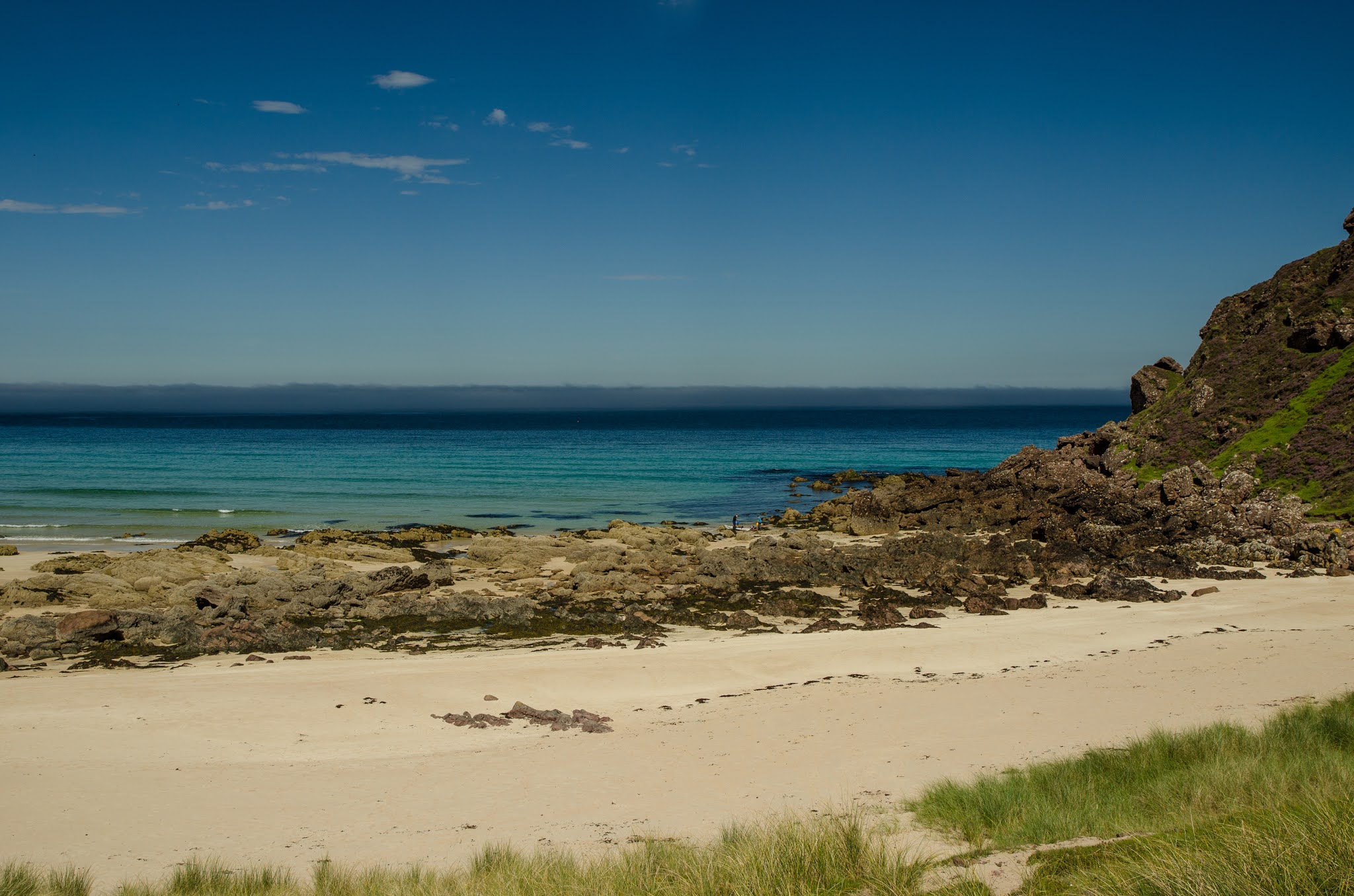
From the base of the cliffs I looked back to our landing place among the reefs, the view a layered one of green marram grass, golden sand, warm coloured rock, aquamarine water shading to deep indigo and a thin bank of sea mist below a blue sky.  It was lovely, but if the view over the beach was good.....


The view along it was superb!  We enjoyed a leisurely first luncheon, followed by a swim.  We can report that despite the warmth of the day, the sea temperature was on the bracing side of refreshing...though refreshing it certainly was.  It took no time at all to dry off in the sunshine and we ere soon ready to get back on the water; we were leaving as a double kayak and a RIB were arriving.  Camas Mor is a beautiful beach, and the fact that it's difficult of access by land or sea adds to its appeal.  But for all it's grandeur, we were to find out that it's not even the best beach on this stunning stretch of coast.

Wednesday, 27 May 2020

One good thing - 25th May 2020


A beautiful, warm and sunny evening tempted me to sleep out under a tarp again - and while lockdown continues in Scotland the only available option remains the most micro of "micro-adventures" in the garden.  The tarp is an Alpkit Rig 7 which offers almost limitless pitching options as it has so many guying and lifter points.  This set-up is a simple one but was very effective on a night which was forecast to be warm but breezy.


Pitched with the foot end into the breeze it offered good airflow and was quite low to the ground whilst giving adequate headroom at the top end.   It's a bit different to the open fronted pitch I've used recently, but is one I'll use again.  all that was left to do at this point was to put my sleeping bag in.

I slept really well until the dawn chorus began at 0312 with our resident Robin,  Blackbird and two Cuckoos first to get going.  By 0400 the birdsong was terrific, a real treat if a little early in the morning for humans!

Sunday, 17 May 2020

One good thing - 16th May 2020

I was working away from home through last week and on getting home it was obvious that some garden maintenance was needed; the grass has been growing fast as there's around 19 hours of daylight at this time of year.  I cut the grass then decided to use a petrol strimmer to cut down a patch of nettles and Ground Elder over the fence from the garden.

It was only after this was done that we noticed a pair of  Robins (Erithacus rubecula) repeatedly carrying food down into the area I'd strimmed.  I assumed that there would be a nest in the bank or drystone wall at the other side of the nettle patch, but I was wrong.


On the ground near the base of an old gate, the Robins had chosen a nest site in the remains of a plastic pipe on the ground.  Up until a couple of hours previously this would have been a sheltered, secret site in good cover.  It's clear how close I'd come to killing the chicks with the strimmer......


I took these photographs from a couple of metres away.  Although unharmed, the nest now looked pretty exposed, so to redress the balance and reinstate some shelter we used a broken roof ridge tile and some logs to recreate a site a pair of Robins had used in our woodpile a few years ago.


After just a moment's hesitation while they assessed the new situation, both parents carried on feeding the chicks and have been busy all day and late into the evening.  We'll watch with interest to see the youngsters fledge in a few days, but without doubt the best thing about today was that I didn't strim too low to the ground - and have made a mental note to be more observant before starting the strimmer!

Sunday, 3 May 2020

One good thing - 2nd and 3rd May 2020

One good thing about the weekends is the opportunity to take longer walks without the time constraint of working from home. These longer routes have averaged around 15km and are usually circular, although one of the walks this weekend was linear.


Setting out from home I revisited the route which runs from Alford to Rhynie over the Correen Hills.  Once used as a cattle droving route, it was also used as a path between kirks.  The parishes of Forbes on the Tullynessle side of the hills and Kearn to the north shared a minister and services alternated between the kirks, so on Sundays this route would have been busy with one or other congregation making a return journey over the hill.  This route remains a right of way between Alford and Rhynie and is relatively easy to follow.

From Terpersie a track climbs gently up on a broad spur to a long-disused quarry.  The soundtrack was all moorland birds, the constant backing stream of Skylark song, the sudden "squelch" call of a Snipe zig-zagging away from close by, the chuckle of Red Grouse, the wild call of  Curlews in display flight, and - as expected this weekend the familiar pirate call of a Cuckoo, the first of the year.


The view back down to Tullynessle opens up as height is gained, moorland and forest bounded by rich farmland. 


The highest point of the walk is at a shallow bealach (col) near Badingair Hill from where a wide view opens up to the north with Tap O'Noth crowned by its massive hillfort prominent.  The previous time i walked this route I turned east (right in this image) near the solar array to finish at the village of Clatt.  Today I wanted to follow the traditional route to Rhynie - which goes along the strip along the side solar panels towards Tap O'Noth.


Close up the renewable energy plant is quite impressive.  I had a fascinating chat with a mole-catcher who was checking his traps around the base of the solar panels.  He's one of the last people to specialise in mole catching locally and I learned lots in a short conversation.  The moles here are clearly very numerous judging from the amount of molehills and are presenting a problem not just around the infrastructure but in the livestock fields nearby.


The three turbines at Carnmore are 81 metres tall and each of the blades is 25 metres long, rotating at a nominal 26rpm, each has an output of 850Kw which is claimed to be capable of powering 600 homes.  The whooshing of the blade tips was noticeable but not as intrusive as some.


Nearby is the remains of Cairnmore hillfort - a Pictish site dated to around 500AD.  Not as immediately spectacular as the forts on the summits of Tap O'Noth or Bennachie, it is nevertheless thought to have been a site of high status in the Pictish era and has a wide outlook over the surrounding country and a direct line of sight to Tap O'Noth.

Tap O'Noth was built many hundreds of years before Cairnmore but it's possible that both were in use at the same time for a period.  At this time of year it's likely that huge fires would have burned near both sites at the celebration of Beltane, which has roots very early in history.


An information board gives a good impression of what the site may have looked like based on a series of archaeological digs.

The route from Cairnmore follows a farm road downhill to a quiet country road leading to the village of Rhynie.  If time allows there's an outstanding collection of Pictish symbol stones at the kirk in the village.

This route was a little over 15km and takes around 4 hours including stops. I feel that the finish in Rhynie is a better one than the finish in Clatt. It's another added to my exploration of walks straight from home, and has lots of good things to recommend it.

Sunday, 26 April 2020

One good thing - 26th April 2020


Today's "good thing" was waking up after a night spent "wild" camping in the back garden under a tarp on another micro-microadventure, finding myself comfortable, warm and rested and the first thing seen on waking was a Song Thrush hunting insects on the grass not 2 metres from me - what a privilege.