Showing posts with label Kintyre. Show all posts

Monday, 11 April 2022

An evening to savour

The Loch Fyne Light Show started with a distinct softening and warming of the light quality.  We picked up cameras to watch as the sun sank through a cloudbank over the Kintyre shore.


Donny walked to a vantage point on a nearby rock rib to take some video - you can see Donny's film about our trip on his YouTube Channel here.


I joined Donny to get a view with no rocks in the foreground and was rewarded with this lovely path of sunlight beaming across Loch Fyne.


I spent a good twenty minutes just taking it all in; the last two years have seen few trips due to Covid restrictions and work pressures....it was so good just to "be" in the outdoors again, in the moment with a lovely sunset.


The sun dipped below the Kintyre hills and the sky put on a final flourish of gorgeous light....just superb.


As Donny and I wandered back over to join Raymond and Allan at our camp site the light show faded to a pastel finish, but there was one last and beautiful element to come.


After sunset the pale, ethereal light was as gorgeous as the sunset had been, though in a completely different way.  My photographic skills don't do the light quality any justice whatsoever, the softness and opacity of a calm evening.  It's this changing "Solas" (light) which really makes a day.


The temperature dropped after sunset and we got our fire, built well below the Spring high water line, lit and away.


Contained by a few big logs, it soon built a very satisfactory heat with remarkably little refuelling required due to the lack of wind.  We sat around and enjoyed after-dinner treats and the odd dram - life seemed particularly agreeable on this Fyne evening!

Saturday, 9 April 2022

A Fyne afternoon for a swim

Replete and refreshed from our second breakfast in Tarbert, we headed south down the Kintyre shore before crossing back to the Argyll shore of Loch Fyne.  Conditions remained absolutely perfect with calm water and warm sunshine - we had to keep reminding ourselves it was still March!


Close by the Argyll shore we landed on the tiny island of Sgat Mor (the name is possibly Big Skate after the fish).  We were delighted to find this tiny shell sand beach on which to take a leg-stretch.  We didn't stay long as the island is home to a colony of Great Black Backed gulls who voiced their displeasure very forcefully.

Sgat Mor has a small navigation light in a tower on the highest point, and for good reason.  It seems to have been a regular shipwreck site and even with the light has seen groundings, the latest in 1994.

Our plan for the day was to reach our intended camp site early in the afternoon so that we could take some time to just enjoy the great weather, rather than cranking out distance.  Soon after leaving Sgat Mor we arrived at a spot we'd scoped on the way past the previous day.  Donny was already there and had enjoyed a doze in the sunshine; you'll be able to see this trip in video on his Youtube site.


We soon had the tents up on a patch of turf above the beach, which was backed with colourful early Gorse and alive with birdsong.  A couple of hours were spent just relaxing, collecting firewood and airing out kit.  As is the way of things, the time slipped by really pleasantly doing, essentially, not a lot.  This is an important part of these journeys for me, when all that's necessary is to keep fed, warm and comfortable all life's other hassles and stresses can be put on hold as doing pretty much nothing takes up all my time.


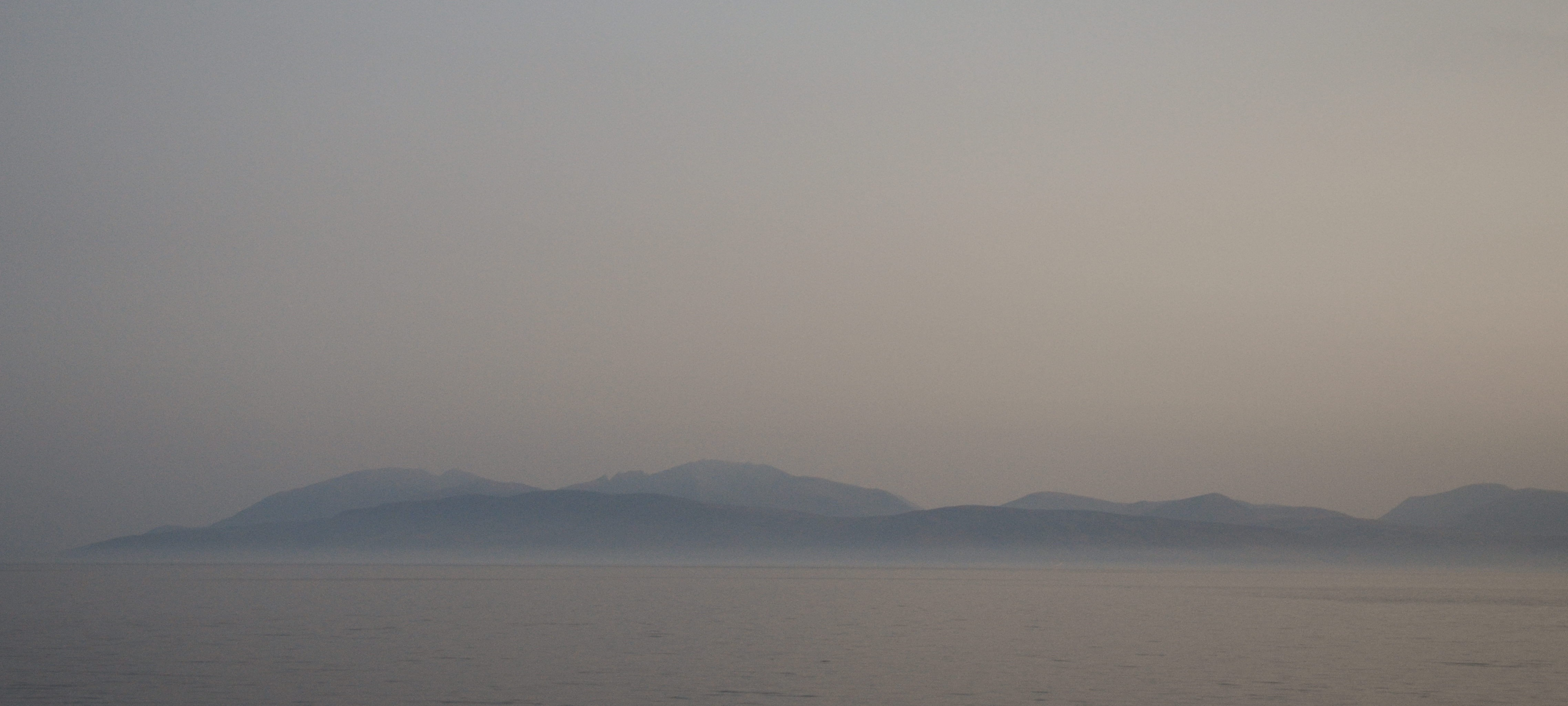
Our camp looked straight across to the hills of Arran which were in a blue haze.  Strips of sea mist around the north of the island made it appear to be floating above the sea rather than rising from it.


As the afternoon wore on the warmth increased and the light took on a lovely quality.  We were all rather warm in just t-shirts and light trousers and so a swim was debated.....


Donny, Allan and I took the plunge and can report that the water was on the bracing side of refreshing, but that once immersed it was a brilliant experience.  We emerged invigorated and dried off in the warm sunshine.  Only once have I swum in the sea earlier than 25th March and that was in similar conditions in the Sound of Arisaig - in February of 2013!


 After getting dressed and cooking a dinner of  home made Spaghetti Bolognaise courtesy of Raymond, we built the fire using some larger logs to contain and reflect the heat.  The early evening light was promising something special, so we finished all our camp chores and prepared for the light-show.

Sunday, 5 March 2017

Keeping an Iron Grip at Saddell Bay

During the summer of 2016 Douglas and I made a journey along the Kintyre coast which included a visit to Saddell Bay where we found a sculpture by Sir Antony Gormley staring out to sea.


One of the "Land" series created in 2015 by the renowned artist and sculptor, the Saddell Bay figure is called Grip and was due to have been removed along with the other Land figures in 2016.  However, Grip has been purchased by an anonymous donor and has been granted planning permission, so will remain in the setting for which he was made.


So, if you visit Saddell Bay, Grip will be there - an enigmatic and intriguing figure gazing out to the Kilbrannan Sound.

Note: Douglas will be touring and can be seen at a variety of Scottish coastal locations throughout 2017......
:o)

Thursday, 22 September 2016

There and back again....


Our camp site on the Kintyre coast had been a comfortable one and we woke to a morning which promised showers but occasional sunshine.  After breakfast we packed up and got the boats down to the water.


We intended to cross the Kilbrannan Sound to the island of Arran and head to the north tip of the island, stopping at Lochranza for lunch.  At the start of this trip we'd discussed various locations for our third evening, as we were making good progress we'd decided on a crossing to Inchmarnock and a campsite we've used before.


As we crossed the Kilbrannan Sound a lively breeze got up ahead of a shower which looked to be a very heavy one.  Fortunately the rain passed up the Kintyre coast we'd just vacated, but we did benefit from a great sailing wind all the way on the 8km crossing.  It seems that this piece of water is prone to meteorological interest, one previous crossing gave some of the most remarkable conditions either of us has kayaked in


We arrived on the Arran shore south of Catacol Bay and after a brief leg stretch on the beach continued north past Catacol village and the row of cottages known as " The Twelve Apostles".  Built between 1850 and 1860, they were intended to house folk cleared from inland crofts to make way for sheep.  There was considerable resistance to living in the row, possibly because the rents would have been comparable to the dispossessed croft ground and there was little land to cultivate nearby.  The cottages were known locally as "Hunger row" at this time.  The cottages are very similar, but each of the twelve upper windows is different.  A local story is that the folk who eventually lived here took to fishing the Kilbrannan Sound, and wives could light a lamp in the window when they wanted their menfolk to return - the men would be able to make out which house had the lamp lit from the window configuration.  Well, that's the tale anyway!........


Our next stop was at Lochranza where we took lunch in the Lochranza Hotel with a fine view to the castle.  The tide was well on the way out here so we could take a leisurely lunch knowing that our boats weren't going to refloat for a while.


Refuelled and refreshed, we got back on the water and headed up to the north of Arran to start the crossing to Inchmarnock.  Initially we had a pleasant push from a light breeze to help, but a glance over our shoulders showed an approaching wall of black cloud....and ahead of it quite a wind started up.

There were no more photographs taken on this crossing, which proved very uncomfortable.  The flood tidal streams pouring up Kilbrannan Sound and the Firth of Clyde meet north of Arran and some confused water can sometimes be found here.  Find it we did, and in combination with a strong wind from our quarter and some breaking wave trains in the great swirls of water I found this a challenging 11km crossing under sail. A couple of times I was tempted to drop the sail as it was driving the boat forward at a tremendous rush, but I'm glad I persisted.... the conditions in which I'd sail in the future a little extended by the experience.  Close to the Inchmarnock side, a Dolphin surfaced in a welter of spray right between our boats and ploughed along with us for a few waves - an experience totally in tune with the wild ride we were having.

We arrived on Inchmarnock at precisely the same time as a quite violent rainstorm heralded the passage of a weather front - it absolutely pelted down.  My awkward landing on the rocky shore in breaking water led to a soaking - things were going well!  We decided to pitch the tents and to see if the rain would abate before moving our gear from the boats, which was a fortuitous decision.  Tents up (if wet) and we took a moment to check the weather forecast online.  What we read was quite a surprise.... the forecast had completely changed from that issued just hours earlier.  We could expect the wind to drop to almost nothing overnight before becoming strong in the morning, when we planned to cross back to Arran.

One of the keys to good trips is flexibility in planning and being prepared to react to a changing situation.  We'd had a difficult crossing and got our tents up - but there wasn't the slightest hesitation in our agreement that we should take them back down and re-cross to Arran straight away to avoid the F5-6 headwind forecast for the morning.  As we restowed the tents and took a quick snack the wind began to drop, but the rain certainly did not and we got going again in a real downpour.


By the time we were half way back to Arran the wind had completely gone - the rain alternated between light,as in this image, and very heavy; in the absence of wind the heavier pulses were heard as a hiss of water hitting water (and us!).


We made landfall right at our target of the Cock of Arran, a place we knew we'd find a spot to camp. Strangely enough, the last time Douglas and I camped here was also accompanied by a drop of rain!  Readers familiar with a west of Scotland summer will realise what awaited us on the shore given the lack of wind and low light levels.......


Midges.  Millions of the little illegitimate insects....   Douglas' expression says it all - but my camera failed to pick up the miasma surrounding him - it was a really bad attack.  As time was getting on, we cooked our dinner on the rocky shore in pouring rain and with our own personal clouds of biting insects.  We could have camped here, but it would frankly have been a miserable experience.  We thought that by paddling slowly along the coast either the rain would ease or the midge attack would abate as darkness fell.  Somewhat improbably, the rain did eventually ease and we did manage to evade the midges - and passed a comfortable late evening on the north coast of Arran.

Tuesday, 20 September 2016

A fire on Kintyre


The coast north of Carradale is wooded right to the edge of the water and feels quite remote as the minor road leaves the coast and goes inland.  


Near to Eilean Grianain (sunny island) we stopped for luncheon and watched the "Ronja Challenger" manoeuvring alongside the salmon cages of a large fish farm.  A newly built vessel, the Ronja Challenger is Norwegian registered and is on a five year contract with Marine Harvest Scotland.


Described as a "wellboat", her job is to transport live fish from fish farms for either transfer to another location or to a processing plant.  She is 70 metres long and has a capacity of 1800 cubic metres - that's a lot of fish! 

Beyond the fish farm the hills of Arran remained resolutely in cloud, but we thought we detected a slight lifting of the cloud base as the afternoon went on.


Our next stop was on the inviting sand of the beach at Grogport - great name but sadly no grog seemed to be available other than that safely stowed in our kayaks for the evening.


The mica rock on this beach is featured in thin layers almost like scales - this half buried boulder resembled a huge seashell. 


Underway again, the seabed beneath our boats was lit with beautiful shades of green in the pale sunlight. During the next hour or so we looked at various camping spots on the shore which we'd marked as "possible" on our maps, settling on a rather fine spot.......


...where we could land on a shingle beach usable at all states of the tide......


...with a good bit of level ground behind on which to pitch our tents.  The ground was a little stony for the pegs but we both got good spots and put up the tents, the green colours blending unobtrusively with the vegetation.


Before dinner we gathered a quantity of driftwood, and after dinner we lit a fire below the highest tide line utilising a "Wilcox Ignition Aid" TM


Keeping the fire small and contained meant that we could generate a good heat.......


...and sit in comfort in our Helinox camp chairs with a Sports Recovery Drink and warmed by both fire and a small dram of our favoured Jura whisky - life seemed particularly agreeable!......


....and continued to be agreeable as we chatted long into the evening.  Baked potatoes were placed in the embers at "Log Mark 6" for the requisite 40 minutes and eaten with salt and butter under a sky which had cleared to show a swathe of the Milky Way.  All in all it was a pretty perfect evening, and it was as well that we enjoyed it as the following evening would be quite a contrast....

Sunday, 18 September 2016

The "Car" in Carradale


When we arrived back at Saddell Bay after walking up to the Abbey the view across the Kilbrannan Sound to Arran was obscured by heavy rain showers.....


...but there were signs of the weather improving with blue sky and sunlight giving an almost strobe effect as alternate light and shadow passed overhead.


We got on the water and almost as soon as we set off had a wonderful wildlife encounter.  As I paddled through a gap close to the rocky shore an Otter surfaced quite cloe ahead of me.  Rather than diving immediately or showing alarm, it swam quite deliberately almost to my boat, then dived and swam past to one side; I could clearly see it underwater as a silver shape with bubbles trailing from its coat.  Having surfaced behind me, the Otter took a look back then just went on hunting - a great close-up view.


The weather continued to improve as we headed north and by the time we stopped for second breakfast at Torrisdale Bay we were able to enjoy our coffee in pleasant sunshine.


Across the bay is the site of a hillfort situated on the headland of Carradale Point.  We paddled across and climbed up to explore the fort - little can be seen apart from the shape of the walls, now overgrown.


The place was built with a view though - right up and down Kilbrannan Sound and beyond to the Firth of Clyde.


Like many of these hillforts, there are signs of vitrification at Carradale Point, the most obvious section was just outside the main wall; we could clearly make out the joints of individual boulders had been fused by intense heat.


It's a short paddle from Torrisdale Bay to the harbour and village of Carradale, but we planned to stop again at the harbour to use the public toilets and to replenish drinking water.  Douglas had warned me that Carradale might not be what I imagined, and he was right........


Approaching the harbour, we paddled below an absolute eyesore of jumbled wreckage.  Old caravans, furniture, derelict Portakabins and cars were piled up at the edge of the water near a grim looking house.  It was a jarring sight and we later found out by chatting to a local that all this rubbish and more had been caused by one individual who owns a property at the harbour, and that there was little the community were able to do about it.  The village itself lies uphill from the harbour and is neatly kept, so it's doubly unfortunate that the harbour is such a mess.


The breakwater and pier were built in a curving sweep, originally in stonework.  This became very expensive and labour-intensive to maintain so a these days the stone is encased in steel sheet-pile, less picturesque but an effective way to maintain the operation of this working harbour.  Aside from Creel boats we saw a couple of modern and functional fish farm work-boats leave the harbour to service the large fish farms to the north.  Carradale village has undoubted charm, if only the "car" bit could be tidied up......

Monday, 12 September 2016

The "stone men" of Saddell Abbey

After breakfast at Saddell Bay we took down our tents and packed up our boats on the shore. One of the pleasures of sea kayaking for both Douglas and I lies in exploring a little of the places we kayak to, and close to where we'd camped was the ruin of the historic Saddell Abbey which we hoped to visit before moving on.


Walking along the track above the shore we first passed Saddell House, one of the properties owned by the Landmark Trust.  The Trust was formed in 1965 with the aim of preserving historic buildings which weren't in the care of either the National Trust or Historic Scotland (then part of the Ministry of Works).  The buildings weren't to be preserved as museums though, one of the key aims was to enable public enjoyment of the properties and in many cases this has been achieved by offering them as holiday rentals.  Saddell House was built in 1774 by Colonel Donald Campbell who had earned military fame as well as considerable wealth in the Indian service.  Built in a light and airy style , one of the most distinctive features of the house are the large chimneys.  In 1899 a fire in one of the chimneys spread to the attic and burned the roof.  Rebuilt almost straight away, it remains an impressive house.


At the western end of the curving bay is the older Saddell Castle, another Landmark Trust property. Built in 1508 by the Bishop of Argyll at a time when bishoprics were hereditary or granted by royal favour and the bishop's robes were interchanged with chain-mail, the castle was described in a contemporary document as "A fair pyle, and stronge".  A fairly typical Scottish tower-house, by 1600 it was held by the Campbells and continued in the ownership of that powerful clan for 400 years.


A long driveway leads from the castle up towards the public road which had a cool, green atmosphere on this morning of sunshine and showers.


The damp climate and shady wood give ideal growning conditions for mosses and fungi which were growing in profusion along the banks lining the drive.


It's a short walk from the end of the castle drive to the ruin of Saddell Abbey, of which comparatively little remains.  Somerled, Lord of the Isles granted land here to Bishop Malachy of Armagh in 1140 to build a Cistercian abbey and work commenced in 1148, the monks came from Armagh also.  Somerled's son Ragnald re-endowed the abbey in 1160 and it remained in use for probably another 350 years, finally being abandoned some time after 1493 when James IV took control of Argyll from the Lords of the Isles.


The ruin lies on a slight rise in the midst of a graveyard. the only really identifiable parts are the interior of the choir and the north transept, all the rest is gone.  But actually it's the graveyard and the stones within which are the main historical interest at Sadell Abbey.


Housed in a very well-made shelter of stone, glass and wood which sits well in the context of the site are a remarkable collection of stones, grave-slabs and effigies which marked burials at Saddell and show what an important place it once was.  On this fragmented stone a highland Birlinn (galley) and a sword are clearly marked, the means by which the Lords of the Isles exercised power.


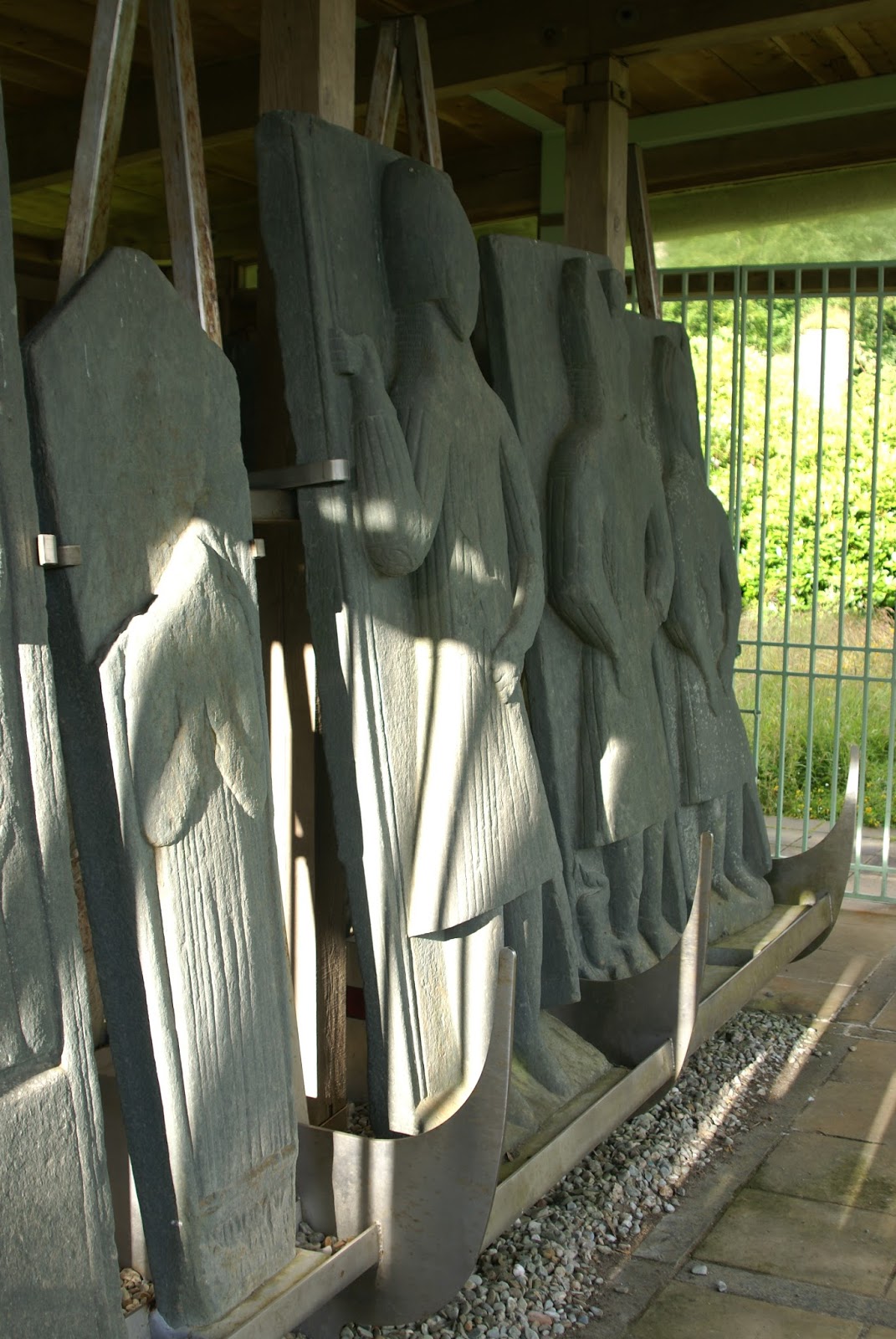
There are twelve grave-slabs displayed back-to-back within the shelter, most of which are believed to have been carved on Iona and transported here to mark the graves of great men and churchmen (women are rarely depicted on such stones).  All are thought to date from around 1300-1400 and are beautifully made with distinctive Celtic motifs which may once have been painted.


The most striking of the stones are five grave-slabs bearing life-size effigies; two probably represent priests and three are effigies of Highland Lords in full armour.


The detail and craftsmanship with which these "stone men" were carved has endured over 700 years - it's possible to get an impression of how the nobility of the day would have actually looked.  In most cases the faces are somewhat blank, but there are other fine details which emerge as the stones are examined more closely.  On two of the stones, figures are displayed at the shoulder of the which may represent wives, and at the feet of the central figure in this image an inverted figure of what appears to be a dead child is depicted in quite explicit detail.  A faded Latin inscription states that this effigy is of Neil McNair, and was commissioned by his son Donald - it's a fascinating window into a past inhabited by identifiable people.


Items of clothing and weapons are carved in superb detail, right down to the decorative elbow guards worn by the Lords and individual scales of chain-mail.  Weapons are carried by all (including the clergymen) and some of the slabs seem to have been carved with provision for an actual or decorative spear - the right hand of this Lord clasps an empty socket with a recess in the stone showing where the weapon would have been.

The shelter housing the effigies has been thoughtfully designed to allow light to flood the stones, enhancing the details.  A nice design touch can be found on the metal frame containing the stones where the separating uprights are made in the style of a Birlinn's bow.

We found the "stone men" of Saddell Abbey fascinating; the site is very well worth a visit.  I'm not sure whether Sir Antony Gormley visited the Abbey when designing his "Land" series of sculptures, but there's maybe a hint of these figures in his work nearby which looks out to Kilbrannan Sound.