Showing posts with label Alford. Show all posts

Friday, 15 January 2021

Night walking

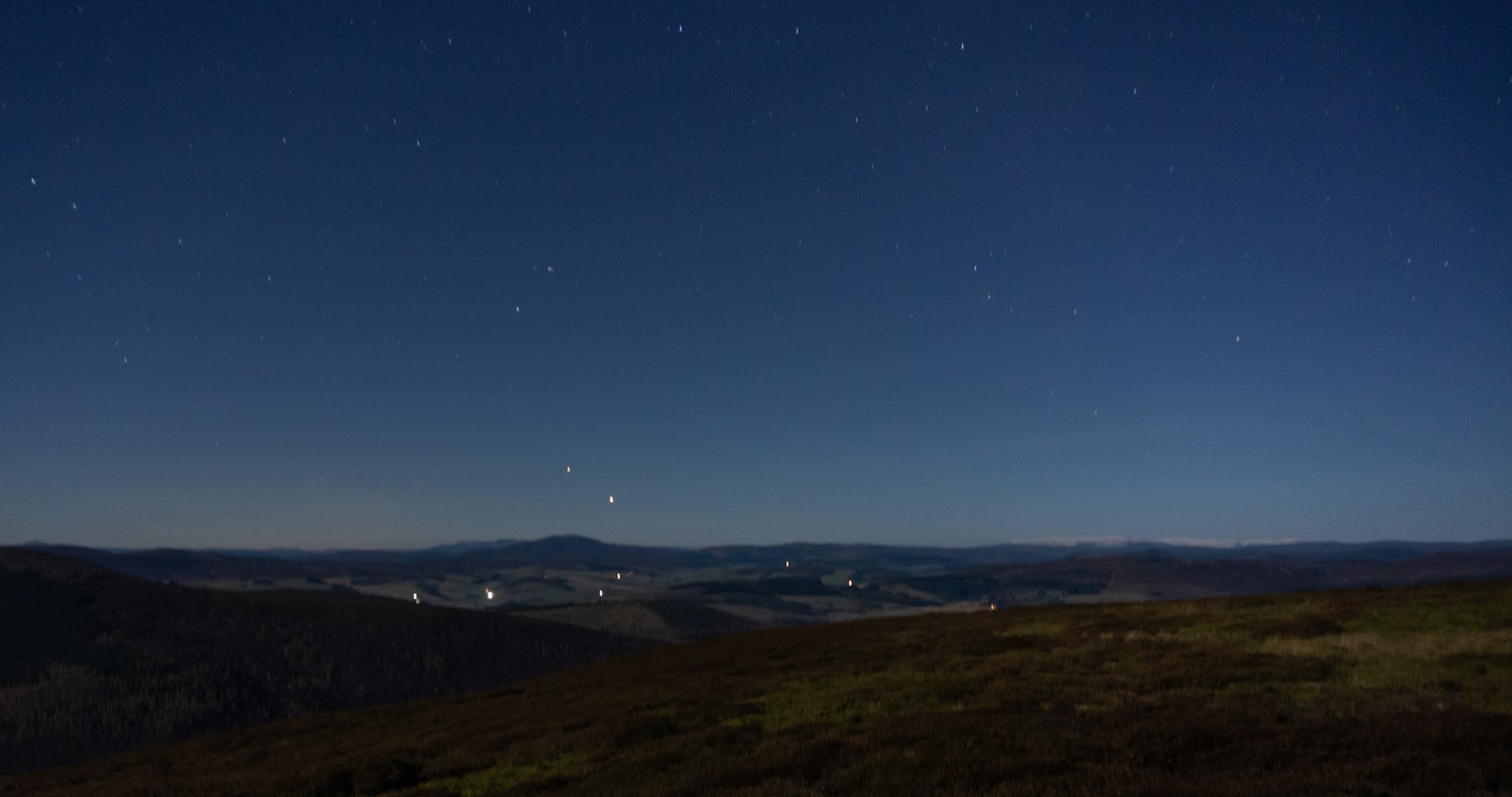
A catch-up post from November 2020, on an evening with a really bright full moon.  I set out from home well after sunset with the full moon up above the farmland of Aberdeenshire and the forecast of a clear night to come.  The plan was to take a night walk around the Correen Hills by night.  I expected to be using a head torch for much of the way, but in fact the torch stayed in my pocket the entire four hours I was out, so bright was the moonlight.


High on the ridge, three hours into my walk and four hours after sunset.  To the right of this image, the snow covered mass of Ben Avon, one of the Cairngorm giants, was clearly visible 50km away - the air was gin-clear and the moon was arclight bright; just a beautiful night to be out on the hill.


 From the summit of Lord Arthur's Hill, the village of Alford lay in a haze of frost and woodsmoke.  to the extreme left of this image are the distant lights of the city of Aberdeen - another world.  The top of the image shows a satellite pass in the long exposure - purely by chance.  

I'd forgotten how pleasurable walking by night can be. If you don't embrace at least starting and finishing walks and other activities in the dark during Scotland's winter months, it can be very limiting.  But deliberately setting out for a night walk is something I'd fallen out of the habit of doing, and I intend to do more of this in 2021.

If you want moonlight, the formula is fairly simple, given clear or reasonably clear skies:

Full Moon - rises near sunset, sets near sunrise - bright
3rd quarter (7d after full) - rises very late evening - reasonably bright
New moon (14d after full) - rises near sunrise, sets near sunset, dark skies
1st quarter (7d before full)- sets very late evening - reasonably bright

Sunday, 3 May 2020

One good thing - 2nd and 3rd May 2020

One good thing about the weekends is the opportunity to take longer walks without the time constraint of working from home. These longer routes have averaged around 15km and are usually circular, although one of the walks this weekend was linear.


Setting out from home I revisited the route which runs from Alford to Rhynie over the Correen Hills.  Once used as a cattle droving route, it was also used as a path between kirks.  The parishes of Forbes on the Tullynessle side of the hills and Kearn to the north shared a minister and services alternated between the kirks, so on Sundays this route would have been busy with one or other congregation making a return journey over the hill.  This route remains a right of way between Alford and Rhynie and is relatively easy to follow.

From Terpersie a track climbs gently up on a broad spur to a long-disused quarry.  The soundtrack was all moorland birds, the constant backing stream of Skylark song, the sudden "squelch" call of a Snipe zig-zagging away from close by, the chuckle of Red Grouse, the wild call of  Curlews in display flight, and - as expected this weekend the familiar pirate call of a Cuckoo, the first of the year.


The view back down to Tullynessle opens up as height is gained, moorland and forest bounded by rich farmland. 


The highest point of the walk is at a shallow bealach (col) near Badingair Hill from where a wide view opens up to the north with Tap O'Noth crowned by its massive hillfort prominent.  The previous time i walked this route I turned east (right in this image) near the solar array to finish at the village of Clatt.  Today I wanted to follow the traditional route to Rhynie - which goes along the strip along the side solar panels towards Tap O'Noth.


Close up the renewable energy plant is quite impressive.  I had a fascinating chat with a mole-catcher who was checking his traps around the base of the solar panels.  He's one of the last people to specialise in mole catching locally and I learned lots in a short conversation.  The moles here are clearly very numerous judging from the amount of molehills and are presenting a problem not just around the infrastructure but in the livestock fields nearby.


The three turbines at Carnmore are 81 metres tall and each of the blades is 25 metres long, rotating at a nominal 26rpm, each has an output of 850Kw which is claimed to be capable of powering 600 homes.  The whooshing of the blade tips was noticeable but not as intrusive as some.


Nearby is the remains of Cairnmore hillfort - a Pictish site dated to around 500AD.  Not as immediately spectacular as the forts on the summits of Tap O'Noth or Bennachie, it is nevertheless thought to have been a site of high status in the Pictish era and has a wide outlook over the surrounding country and a direct line of sight to Tap O'Noth.

Tap O'Noth was built many hundreds of years before Cairnmore but it's possible that both were in use at the same time for a period.  At this time of year it's likely that huge fires would have burned near both sites at the celebration of Beltane, which has roots very early in history.


An information board gives a good impression of what the site may have looked like based on a series of archaeological digs.

The route from Cairnmore follows a farm road downhill to a quiet country road leading to the village of Rhynie.  If time allows there's an outstanding collection of Pictish symbol stones at the kirk in the village.

This route was a little over 15km and takes around 4 hours including stops. I feel that the finish in Rhynie is a better one than the finish in Clatt. It's another added to my exploration of walks straight from home, and has lots of good things to recommend it.

Sunday, 26 April 2020

One good thing - 26th April 2020


Today's "good thing" was waking up after a night spent "wild" camping in the back garden under a tarp on another micro-microadventure, finding myself comfortable, warm and rested and the first thing seen on waking was a Song Thrush hunting insects on the grass not 2 metres from me - what a privilege.

Monday, 20 April 2020

One good thing - 19th April 2020

The weekend gave opportunity for a longer walk, and one which has been on my list to do for some time.  The enforced restriction to local ventures has focused me on exploring more of what's on the doorstep.  Setting out from home I intended to follow the cattle droving route which linked Rhynie to Alford - though my route would do it in the opposite direction to the drovers.


A short walk along minor roads reaches Terpersie and the small "castle", a 16th century tower house restored to habitable condition which is the earliest dated example of a Z-plan design in Scotland.  Terpersie marks the end of the public road and the start of a hill track leading over the Correen hills.


A long but easy climb on an old track goes up past old quarry workings on a gentle spur to reach the lowest point of the Correen ridge at about 450m/1475ft near Badingair Hill.  The view back is expansive but the whole of the Howe of Alford is hidden from here.


Looking east it was apparent that lots of the snow has been stripped from even the highest Cairngorm hills in the fine and sunny weather which has so far characterised April, the giant Ben Avon holding most patches.


Across the watershed of the ridge a fine view opens up into Strathbogie with Tap o'Noth very and it's huge hillfort very prominent.  Another hillfort site, Carn More, can be made out as a pale mound just beyond the right hand of the wind turbines.

The view is undoubtedly changed by the turbines and the large solar energy array - this is the compromise to be considered if a move to a low-carbon energy economy is to happen.

The drove route leads down past Carn More to the village of Rhynie, it once linked Rhynie with the cattle marts at Alford and Lumphanan.  My route went down to the base of the hill and then I headed west (right in this image) to link farm tracks towards Clatt.....


...with it's pretty church (which has a Pictish symbol stone incorporated into a boundary wall).  This was a 15km walk and a good one.  I'm glad that staying local prompted me to walk this track, next time I'll follow the drove route to Rhynie itself.

Thursday, 16 April 2020

One good thing - 16th April 2020


Under the current restrictions it's not possible to make backpacking or sea kayak trips, but that doesn't necessarily mean that camping is completely off limits.  During a lovely evening I decided to pitch the tent and camp in the back garden, the most micro of "microadventures".  There's normally very little noise from passing cars where we live, but even for here the lack of traffic was notable.


I settled in at my usual bed time and slept really well, woken just once when one of our neighbour's cows decided that she needed a drink from the trough over the wall at 3am...it was so quiet I could clearly hear the water gurgling down into one of her stomachs!

I woke to a somewhat grey and damp morning, but also to a glorious dawn chorus of birdsong - which is surely a good thing.  I got up, walked all of 20 metres to the house to shower and get breakfast; and then was back at my computer working.

As the lockdown has now been extended a further three weeks, I plan to either camp or bivvy once a week in the garden - a micro-microadventure.

Saturday, 11 April 2020

One good thing - 11th April 2020


One of the good things about today was the clarity of the air on a warm and sunny day; the colours were really "zinging" everywhere; overnight the gorse seems to have burst into flower and the grass seems to be really getting going.


My walk today took me around some of the country lanes and minor roads almost devoid of traffic.  Colours everywhere I looked - this Flowering Currant (Ribes sanguineum) was really vivid against the pale shades of the sown fields.  But the colours, fine as they might be, weren't the best thing about today......


Without doubt, the best thing about today was the privilege of being the only human witness to the emergence of new life.  This lamb was born in a neighbouring farmer's in-bye field just as I was walking past.  I stopped to watch from a distance which wouldn't disturb the ewe and was relieved to see that everything proceeded smoothly.  This image was taken less than 20 minutes after the birth; the lamb on it's feet and cleaned by Mum and another ewe, herself heavily pregnant.

On Easter weekend, bombarded by the relentless 24 hour news cycle of death during the Covid-19 pandemic, here was a counterpoint as a new life took it's first steps in the world - and that's certainly "one good thing".

Friday, 10 April 2020

One good thing - 10th April 2020


The warmer weather of the last few days has really brought on the Spring flowers; these Crocus planted at the edge of a woodland entrance are a cheerful sight.


Along the banks of the River Don wild Daffodils (Narcissus pseudonarcissus) are a riot of yellow.  One name for these native daffodils is "Lent Lily" because of the association with Easter celebrations, so it's fitting that they're at their best this weekend.  In the foreground, the first of the wood Anenome (Anenome nemorosa) was fully open in the sunshine.


Also along the Don, the first of the Lady's Smock, or Cuckooflower (Cardamine pratenisis) are flowering in a damp area.  This year they've definitely bloomed before the first Cuckoo has been heard, in fact the Sand Martins have only just returned to Aberdeenshire.


All around a wet flush in nearby woodland I found these attractive plants.  I couldn't find them in any of my wildflower guides, but a neighbour has them in her garden and identified them as Pulmonaria or Lungwort.  As this piece of wood is fairly close to the village of Alford they're more than likely garden escapes but are certainly doing well.

It's really good to see all the Spring colours starting to replace the bleached winter shades.

Thursday, 9 April 2020

One good thing - 9th April 2020


Over the last couple of days our neighbour's Aberdeen Angus cattle have started to calve.  Most of the herd are still indoors as there's not quite enough grass growth to put them out to just yet, but once the new Mums have settled with their calves, they're being moved to the field behind our house.


It's great to have them back - the field has seemed very empty through the winter!

Tuesday, 7 April 2020

One good thing - 7th April 2020


On my walk this evening, the Rooks nesting in two tall Scots pines were making a tremendous noise.  One of my bird guidebooks describes Rooks calls as "around the nest, deep "comfortable" caws and croaks; typical "craa-craa-craa".  Frequent, loud and far-carrying high "crroo-crroo-crroo, choked trumpeting notes, musical squeaks and squeals; deep mechanical wooden rattle in flight" - which is varied for sure!

The naturalist Sir John Lister-Kaye has studied Rooks at his home near Beauly for many years and has identified nearly 30 different types of call made by these fascinating birds, most linked to specific behaviours or situations.

What was happening this evening appeared to be more dispute than comfort calls, and stopping to watch soon revealed the source of the commotion.  Whenever a bird or pair left the nest, one particular bird seemed determined to steal sticks from their nest for its own nest.  The outraged owners would snatch back the stick and the whole process would start again.  Whatever the purpose of this behaviour, it was certainly entertaining for a human!


Monday, 6 April 2020

One good thing - 6th April 2020


The best thing about today has been the variety and quality of light throughout the day and into the evening......


Early morning saw showers and stroboscopic lighting effects in the wake of a cold front which passed over northeast Scotland overnight.  Clouds racing overhead alternately lit the view with dazzling, intense colours, then switched off the light to leave a muted version of the same scene.


After a mainly bright and breezy day the wind dropped towards evening and a slow-burn sunset underlit a cloudbank with gold and bronze.


Tonight's full moon was high in the sky before sunset, adding pale light to the most delicate of pink shades in the air.


While back to the west the cloudbank dissipated in the cooling air as if it had never existed, leaving just a hint of the sunset projected into the sky.

As I type this post a full hour after sunset, the same piece of sky is a colour somewhere between jade green and lemon; gorgeous but beyond the camera to capture.  The light (in Gaelic "solas") has absolutely been one good thing about today.

Wednesday, 1 April 2020

One good thing - 1st April 2020


After a cold front passed over northern Scotland overnight, the air has been superbly clear.  A day of bright sunshine and some late showers produced a nice rainbow over the farmland and hills - very appropriate as the rainbow has been adopted as a symbol of both hope and to show support for the UK National Health Service during the Coronavirus pandemic..

Tuesday, 31 March 2020

One good thing - 31st March 2020


Just across from our house a group of Rooks (Corvus frugilegus) have built nests in the upperworks of a Scots Pine tree.  We've watched these fascinating and characterful birds in flocks through the winter, then as they re-established their pair bonds - one particular pair use a tree in our garden to display to each other; they are an obvious pair and it's possible to distinguish male and female by appearance as well as behaviour.

The birds usually nest in early February but were held back by the series of violent storms which crossed the UK.  Things are well underway now though, and today we thought that we heard the first higher pitched "caah" of a tiny young Rook...new life emerging.

Thursday, 26 March 2020

One good thing - 26th March 2020


In the field opposite our house, a neighbour makes an investment of hope for the future, as he's done year after year, by sowing barley for the late summer harvest.

Monday, 23 December 2019

"Dark" December

This December has seen some periods of deep frost here in the north east of Scotland. Whilst the south of the UK has been soaked with rain, here it's been dry and clear, the land held in an iron grip; there have been many days when the temperature has stayed below freezing.  I much prefer this dry, brittle cold - it's weather one can really enjoy rather than endure.


On one morning when our home weather station was reading -6 Celsius i took a short walk just as it was getting light.  walking up through a stubble field across from the house towards a line of large beeches and oaks which form the skyline from our living room, I hoped to catch the sunrise - at this time of the year that's not an early start!

The only sound was the brush of my boots through the stubbles left from the barley harvest.  I stopped to listen to the stillness, and slowly began to hear the sounds of the morning.  Bird contact calls almost at the top of my hearing range indicated a flock of mixed Tit species moving along the line of trees, then a sharp bark drew my eye along the top of the field line where a small family group of Roe Deer had spotted me.  I angled away, unwilling to force them to use precious energy, but as soon as I moved they bounded gracefully away and out of sight.


From the ridge the view to the south east over the Howe of Alford was all about the glory of the sky; the farmland and hills still in deep shade.  I settled down to wait for the sunrise and sat with my back against one of the large oak trees.


Close at hand there was beauty too, each fallen leaf edged in delicate and perfect frost crystals.  To sit still was to start to hear the place - with almost no man-made sounds to distract.  Small birds calls, the call and flutter of a cock Pheasant and, thrillingly, heard but not seen - the thrumming wingbeats and wild calls of a party of Whooper Swans, the graceful angels of winter.


At last, around 0905 the sun rose beyond the ridge of Correnie Moor.  The sun rises well south of east at this latitude and the high ground leading to the hill of Benaquhallie delays sunlight reaching the Howe.


Once the sun rose, everything changed.  Searing light flooded across the land and brought colour and definition, if not much warmth. 


As I strolled back down the field to the house the sunlight reached across to the hills beyond.  Our house is in a slight dip and often the temperature dips significantly around sunrise as the hills above warm up and cold air sinks downslope.


At my feet each barley stalk was tipped with a flower of frost, the rows looking like miniature icy forests.


above, the Pink Footed Geese were on the move from their roosts, great skeins straggling across the sky trailing their wild music.  The geese are a real feature of winter and Aberdeenshire often hosts huge numbers.


During another period of really intense frost we took a walk to a narrow valley where we hoped to see the real beauty of the conditions.  The sun doesn't reach here much during the short winter days and the frost hadn't lifted for days.  It was really frigid and completely silent.


Dead grasses had been transformed into stunningly beautiful works of natural art - the glittering light better than any expensive crystal glass.  We took lots of images, these are just a few of them


The dead head of a cow parsley plant had become something quite special, every tiny surface edged with the most perfect frosting.

The December days might be short with barely six hours of daylight, but when winter is a stunning as this, it's as good as any other season!

Thursday, 10 May 2018

A year in the fields

During spring 2017 I took some images showing the rapid change as a "green wave" of fresh growth spread across the farmlands close to home, developing into summer gold. I hoped to continue a series of images taken through the year from the same viewpoint to show the change as the wheel of the seasons turned.


21st April 207 and the "green wave" was just starting; the fields changing almost daily as barley began to push through the soil.  All the fields in this image apart from the two at lower left had been sown a couple of weeks previously, the other two were kept under gras through the winter.


Just over a month later, in the second half of May and the change is really noticeable.  Lush growth despite a somewhat cool spring had given a good start to the season.


By mid June the barley was fully formed and beginning to take a slight golden colour; a cut had been taken from one of the grass fields.


Mid August and the barley was ripening fast, a litlle later than in an average year as the summer remained cool and changeable.  The field (fields are known as "parks" here in the north east) at lower right contains potatoes.


Most of the barley crop was cut in mid to late September - by 4th October the harvest was home and the fields were dotted with "tractor eggs" waiting to be stacked as winter feed and bedding for the Aberdeen Angus cattle.


November brought the start of winter, sweeping showers of hail trailing across the landscape.  The "tatties" were all harvested and the stacks of hay bales can be sen close by the farm.


The top field in this image had contained barley, undersown with grass.  Once the barley was down the grass could continue growing, giving an early start for grazing.


Late November and all was quiet as the winter shutdown began - the sun dropping lower by the day.


Early December and winter's grip tightened; spells of snow becoming more frequent.  Late December into January had less snow than usual, but the winter had still plenty of bite to come.


By mid February the farming year had begun again, fields gradually going under the plough to start the turn of the wheel again.


February and March brought the worst of the winter, as is often the case here.  Falls of snow built up rapidly - this image was taken at the start of a run of bitter easterly weather which lasted most of the month.


On 28th April, there wasn't much growth to be seen, just the green of the grass parks breaking the bare brown palette of the area.  It's interesting to contrast this image with the first in this post - taken a year previously and a week earlier.  The effect of a cold, prolonged winter is clear to see, the crop about three weeks behind already at this early part of the year.

The migrant birds have been affected by the cold conditions too, we usually see our first Swallows and House Martins on about 20th April, this year it was 28th April, and just a day later we had Willow Warblers and heard the first Cuckoo on 30th April - all very compressed compared to a "normal" year.


On 6th May the change is in full swing though, the green wave washing across the land.  A warm spell has helped to bring things on after a really slow start.

So that was a year in the fields, and the wheel continues to turn.......