Showing posts with label Troup Head. Show all posts

Wednesday, 3 May 2017

Nothing to see here.....

There's no question that the west coast of Scotland possesses world class sea kayaking locations - and it's been said that the east coast of the country "would be great if the west coast wasn't there".  Faint praise indeed...... 

Here's a look one of our local paddles, a Moray Firth outing from Gardenstown heading east to Rosehearty.


A feature of the Moray Firth and indeed much of the east coast is that there are plenty of small harbours from which to launch.  Gardenstown (also known as Gamrie) is one such, and close by is Crovie - so tightly packed against the cliffs that there isn't space for road access.  Some of the harbours are administered by Trusts - if you use them at the start or end of a trip there's usually an honesty box and it's worth contributing to help with the upkeep.


Most of the houses in these former fishing villages stand gable end to the sea and have small windows fitted with shutters to protect them from the violence of gales.  Big windows and the desire for sea views are modern phenomena!


The main feature on this trip is Troup Head, Scotland's only mainland gannetry.  The Gannets are evident long before the headland is reached, brilliant black and white shapes wheeling above on two-metre wingspans.


The gannetry itself is an assault of sound, sight and smell.  On this visit the birds hadn't begun to lay eggs - later in the season it's best to keep well out to avoid disturbance.


Not just Gannets here....there are Kittiwakes, Razorbills, Guillemots, Puffins, Shags and Cormorants in their hundreds of thousands.  The east coast has truly vast numbers of seabirds and this is one of the better places to experience them from a kayak - whirling masses filling the sky.  Top tip: wear a hat and be careful when you look skyward!


There are beaches of golden sand and beaches of wonderfully coloured pebbles - hours can be spent searching for particularly nice examples. 


The cliffs along much of this stretch of the Moray Firth drop sheer into the sea - and some have unusual rock architecture such as this mimetolith known as the Lion's Head.
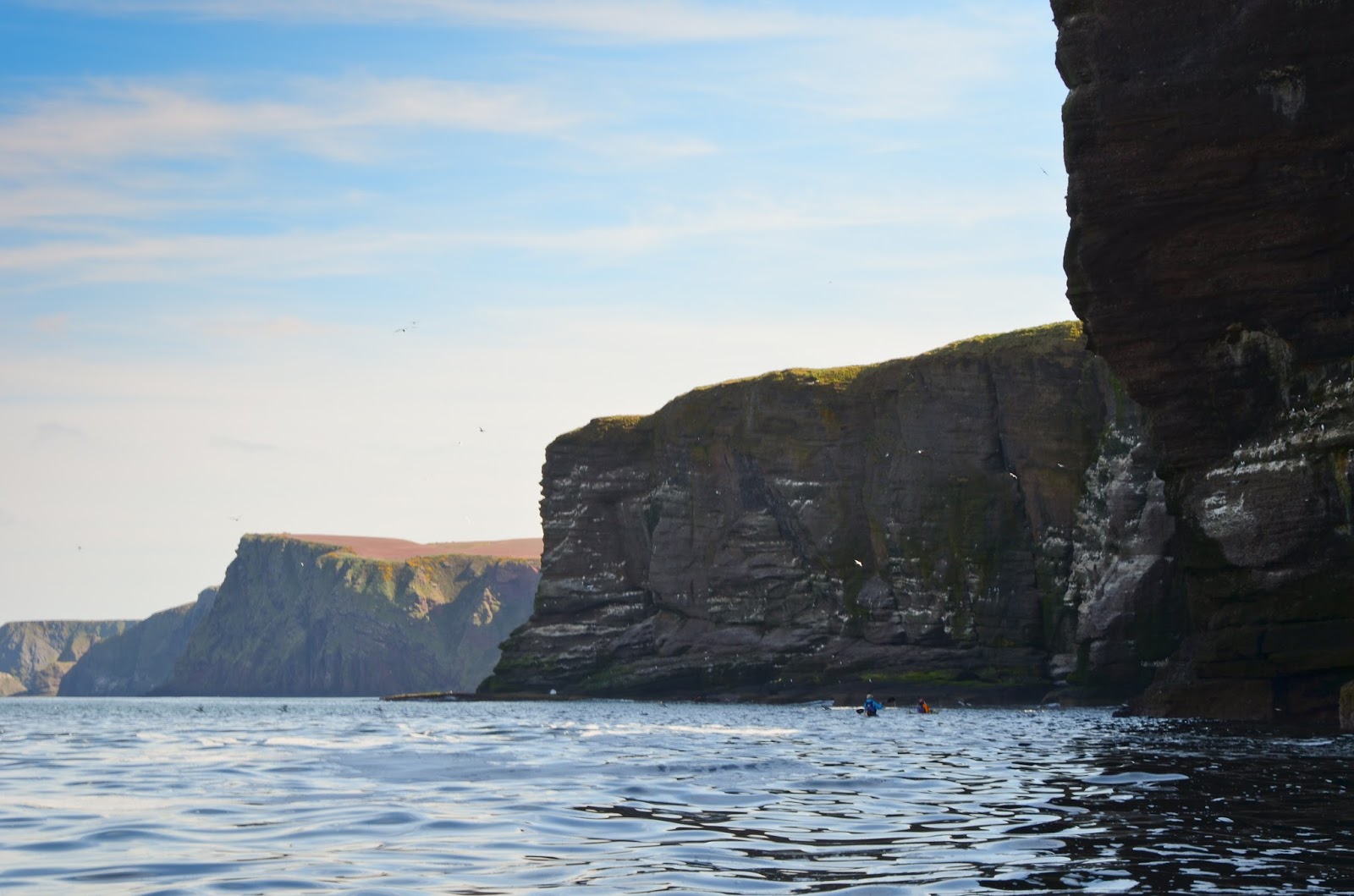


Each corner turned brings a fresh view, headland after headland marching into the distance along a wild coast.  There's a sense of scale and a definite exposure to the North Sea here, choose settled weather to get the best from this trip.


The verticality is punctuated with pretty villages such as Pennan.  There's a good pub here if it's all getting a bit much.....


The geology is fascinating; you'll travel along a wide variety of rock types.  At times the colour can be turned up to the maximum in Spring and Summer; the contrast of vivid red sandstone, brilliant yellow gorse and deep green water near Pennan is stunning - and on warm days the coconut scent of the gorse drifts down to the water.


The Moray Firth is one of the best places in Scotland to see Bottlenose Dolphins; a well known pod hunts regularly right along the coasts of the Firth.  These are the most northerly population of Bottlenose dolphins, the largest individuals of the species and some of the best studied - it's always a thrill to catch sight of the distinctive dorsal fins close by.


It's quite possible to be paddling along a wild shore with Gannets overhead, dolphins close on one side of the kayak and Puffins on the other side!


Another rock type and another change of scenery; sheer cliffs towering above deep bays.....


....stacks, towers, arches and caves linked by narrow channels......


...along with the odd secluded bay, totally inaccessible except by water......

All this, and the chances are high that you'll meet more dolphins than other sea kayakers.  Really, you wouldn't like it....nothing to see here folks!   :o)

Wednesday, 15 May 2013

Super Troup-er


Back in March, a neap tide combined with relatively calm conditions - a good combination to paddle around Troup Head, one of the large headlands on the Aberdeenshire coast.   I started some kilometres to the east, at a small bay near New Aberdour.   If launching here, it's worth knowing that the steeply shelving pebble beach produces dumpy surf in anything but flat calm conditions.  At the west end of the bay, narrow channels amongst a rocky reef provide a bit of a barrier to the swell.  I managed to get away from the pebble beach, briefly considering a "seal launch" down the steep angle before common sense prevailed!


This stretch of coast is well known for seabirds and for superb rock architecture.  The cliff scenery starts straight after setting out - in fact the section of coast between New Aberdour and Pennan is perhaps the best of the trip in this respect.  The day was hazy and overcast; not great for photography but perfect for getting in close to the arches, stacks and caves.


Even on a calm day this coast is exposed to swell from several directions.  Geos cut back into the cliffs, gaps open invitingly and caves just beg to be explored - but a constant eye needs to be kept for larger sets of waves, which are disconcertingly irregular.


My paddle was timed to start out in the last of the west-going ebb, so that the tidal stream would be just picking up on the east-going flood as I rounded the main headlands.  There is a good harbour in which to take a break at Pennan, a pretty village which was once a fishing port but is now more of a tourist attraction having been made famous in the movie "Local Hero".


Immediately after leaving Pennan the cliffs change from eroded sandstones to harder igneous rocks, and get markedly higher.  The nearest headland here is Lion's Head, Troup Head itself is the furthest.  The dark cliffs between the two are riddled with large, low caves.


The cliffs provide great interest, and choosing a calm day allows a close passage below.  From spring to late summer there are tens of thousands of seabirds nesting on cliff ledges and in the turf above.


Even at the very start of the breeding season, the air is filled with wheeling Gannets; Troup Head is one of very few places where Gannets nest on mainland cliffs, rather than on offshore islands and stacks.


Beyond Troup Head, the cliffs gradually diminish in height, but the interest continues with sharkfin stacks separated from the cliffs by narrow channels.  Atlantic Grey Seals are ever-present on this section, escorting the paddler along their "patch".


All too soon, the rocky coast opens into Gamrie Bay and the tiny village of Crovie is passed.  There is a small pebble beach here, but the houses are hard against the shore with their gables to the sea and it would be difficult to get boats up the steep hill to the road-end. Crovie is now best known as a village of artists, and has several studios among the strip of houses.  A couple of kilometers to the east is the larger village and harbour of Gardenstown (sometimes known by its former name of Gamrie).  There is a good harbour with a slip in which to land (there's also an honesty box for donations by harbour users).  It's worth knowing that the road down into the village is extremely tight - we unfortunately managed to scratch our new car here....

This superb paddle is only about 12 kilometers, but packs a huge amount into a short stretch of coast.  Choose a calm day and it will be a superb experience!