Sunday, 15 September 2013

The most beautiful bridge?


After paddling from the bothy back down Loch Glendhu and past the hotel, the Kylesku Bridge comes suddenly into view as a corner is turned.  The ebb tidal stream had just started in my favour and I had a gentle push into the narrows (Kylesku is Caolas Cumhann or Cumhang - the narrow strait).

Can a thing of concrete be beautiful when placed into a landscape like that of Sutherland?  I would say that in this case, it most certainly can; and that actually for me this is the most beautiful bridge anywhere......


Seen from drectly up the narrows it certainly looks slender and perhaps graceful, but from this angle the bridge hides its true nature until the last moment.


Passing underneath shows the graceful arc of the deck which forms a single sweep across the Kyle, but even here the best view is denied.  For that, and to understand the designers (Ove Arup Partners) vision, you have to see it from above.  The graceful arc compements the setting perfectly; any straight-line industrial style bridge like the one at Ballachulish would have spoilt this spot.  Both the designers and Highland Council, for whom it was built, deserve huge credit for their vision increating something truly beautiful.

Work began on the bridge in 1978 and it was opened by HM Queen Elizabeth in 1984.  It is 275 metres long and carries a continuous box girder section deck 24 metres above the water of the kyle.  The bridge replaced a ferry service here, one of the two final vessels on the service, the Maid of Kylesku. was simply beached at the north side of the kyle, the other vessel, Maid of Glencoul, remains in service as a relief vessel on the Corran ferry on Loch Linnhe.

My own favourite view of the bridge is from high up on Sail Garbh of Quinag, where the fit into the landscape is even more striking - I've no good images of this view; surely a reason to climb the hill again?!


Heading out of the narrows and into Loch a' Chairn Bhain (loch of the white cairn) another stunningly beautiful view opens up, this time the natural beauty of Quinag.  Really a mini range of hills with three Corbett summits (those hills between 2500 and 3000ft with a 500ft drop all round).  The most striking and obvious is Sail Garbh (rough heel) which gives the whole hill its name of Quinag - the milk stoup- as it's said to resemble a milking pail.

With this view for company and a gentle wind and tide behind me, the paddle towards the mouth of the loch and the sea beyond seemed effortless.....


Wednesday, 11 September 2013

Blazes of light in "the dark glen"


 The Mountain Bothies Association sign on the door of a bothy is always a welcome sight.   Then there's the anticipation - what will the bothy be like, will there be other folk staying?  One of the joys of bothying is in the people met, pretty much always like-minded outdoor enthusiasts.  Each bothy represents a leap of faith by the owner and continuous effort by the MBA to keep the place in good condition. Glendhu was one I'd not previously stayed in and I found it in great condition with four clean, dry rooms.  There were no other visitors staying that night so I picked  a room upstairs to sleep in and settled in.


As I unpacked the boat and carried my kit the few metres to the bothy from the loch shore, the western sky was ablaze with a glorious sunset.  I gatthered driftwood from the shore and spent twenty minutes with the saw to produce.......


A different kind of blaze in the grate. Although the evening was pleasantly mild, a bothy isn't quite the same without a companionable fire.  All done and I prepared my dinner of home-made cicken and corgette casserole featuring green and yellow courgettes gifted from a neighbours garden at home accompanied with saffron infused rice.  A small dram of Jura 12yo malt went very well with the food.

Before going to bed I took a walk outside to find a third blaze; that  of a dark sky full of stars with a huge swathe of the milky way overhead - just beautiful.  I slept soundly and comfortably.


The morning was bright and fresh, the southeasterly breeze would be at my back down the loch.


After breakfast I repacked the boat, tidied the bothy and cut some more driftwood for the next visitors.  Glendhu can be anything but "the dark glen" and I'll be back to visit this lovely spot soon.......

Tuesday, 10 September 2013

Thrusting out from Kylesku


For various reasons, it had been a while since I'd crossed to the west coast of Scotland.  A window of settled weather for the northwest seemed a good opportunity and a plan formed for a couple of days sea kayaking in this striking landscape.

On the day I travelled over it was forecast to be windy, reducing later in the afternoon which allowed for a leisuely start.  As I arrived at Kylesku, the wind had dropped away to a breeze and the air had that bright, hard look which follows a frontal passage.  The view up Loch Glencoul was enticing, but I was bound for a different loch.....


The boat was loaded and ready before the rising tide had covered the end of the old ferry slip at Kylesku. I'd have to wait, but this was no hardship as the Kylesku Hotel adjacent to the slip was open and serving some fine real ales!  We've stayed here and eaten here before, the food is particularly fine - fresh, local and superbly cooked.  Today I had time for just a pint before preparing to set out for my evening accommodation.


Out on the water and I paddled into the breeze with a great view of the Stack of Glencoul to my right.  This area is justly famous in geological terms, the Stack itself is one of the most prominent examples of the Moine Thrust belt; indeed the thrust zone here is given its own name of the Glencoul Thrust.


The planes of rock are really obvious on Aird da Loch  (point of two lochs) which separates Loch Glencoul from Loch Gleann Dhu.  It's a very complicated structure of rock which led to huge controversy in interpreting the sequences.

In short, Lewisian Gneiss (some of the oldest rock on the planet) is on the bottom, as you would expect. Next comes Cambrian Quartzite and Pipe Rock - again this is not unusual as these rocks are younger than the Gneiss.  Overlaid onto this is a plane of Fucoid beds, then a double "overthrust" of Sole Thrust (Cambrian) and , right on top, a plane of Lewisian Gneiss.  The process which placed the very oldest rock on top of and between younger rocks remained a puzzle until the early 20th century.

All this complicated geology is explained in admirable and entertaining simplicity in "Hutton's Arse" - a book which really must be read if for no other reason than the title! 


I wondered at the deep time involved in the geological upheaval all around me in this primal landscape - but I was also interested in a rather shorter timescale; my immediate prospects for dinner  :o)


Just an hour's paddle on a beautiful evening brought me to the head of Loch Gleann Dhu (Glendhu).  the translation is "loch of the black glen", which seems something of a misnomer as for the majority of the year the top of the loch is lit by both morning and evening sun. The rocky and twisting glen leading east from here is indeed a darker place though.  My "home" for the evening would be the building on the left of this image.....

Friday, 6 September 2013

Belatedly climbing Benaquhallie


Benaquhallie is just ten minutes drive from home - in fact I can see the hill from the end of the road, but for some reason I'd not previously climbed it.  An attempt to cross right over this high ground from the north via the forested slopes of Corennie Moor two years ago had ended up with me sweating and cursing among tangled fallen trees, then deep heather.  Climbing it from the southwest looked a much simpler propostion.

And so it proved.  Just 45 minutes pleasant walking on a grassy and rarely used access track brings the 494m/1621ft summit, and a spacious view.


Just below the summit is a very large and unusually shaped cairn.  The view to the south takes in Deeside and across to the distinctive hill of Clachnaben which has a prominent tor. 


Turning to the north east, the equally distinctive outline of Bennachie is well seen beyond Corennie Moor.

Clachnaben and (particularly) Bennachie are much loved north east landmarks - so distinctive that an old rhyme says that "Clachnaben and Bennachie are twa landmarks frae the sea".  I always feel that I'm home when I catch the first glimpse of Bennachie after having been away.

I hung around for a while to enjoy the views from Benaquhallie - wondering why on earth I hadn't climbed this super little hill sooner!


Monday, 2 September 2013

Harvest time


Harvest time has arrived in the Aberdeenshire countryside.  The view from our back garden shows fields of gold, and one already cut. 


The barley is ripe and ready; a forecast of several days of dry weather to come for north east Scotland has set the scene.....


...and the farmers, including our neighbour, have started the harvest.  The Combining machines can be seen everywhere as farmers try to get their "corn" in while it's dry and settled.


Several strips of a large field cut and the Combine is emptied into the waiting trailer, chaffs blowing in the wind.  Each trailer load represents a hard-won success from a late, cold and wet Spring followed by a much drier Summer than those of the last few years. At this point last year much of the barley was yet to ripen in a cold Summer. 

It's an anxious time; the success of the harvest is critical to farm viability and the plans for the following year. 


Grain tank emptied, the Combine heads off on another run up the field.  There will be long days (and nights) to come while the bonus of the good weather lasts.


This is what it's all about.  This barley will actually be largely converted into beef - winter feed for the beef beasts for which the north east of Scotland is noted, including the famous Aberdeen Angus animals, long associated with our local area.

Some of the better barley will be bought by maltsters to be converted into another great Scottish gift to the world....


As the last trailer loads of barley leave the fields, the baler is straight in to start baling the "ends" to make "Tractor Egg" bales of additional fodder and bedding for the cattle.  The evening will be long turned dark before just this field is done - it's a busy time.

Thursday, 29 August 2013

What's in a name? - Craignagour Hill and Scraulac


I walked west from Mona Gowan across a shallow bealach (col) to the next top on the ridge. This hill continued the goaty theme, it's name being Cairnagour Hill, a version of Cairn na Gobhar (cairn of the goats).  At one time presumably there was a herd of goats on these hills, but they're long gone.  The view here is looking back to Mona Gowan with Morven in the distance.


The ridge culminates a further kilometer or so to the west on a top called Scraulac.  No goat association here and I puzzled over the unusual name until I got to the summit.  The rock here is different to the other hills, a blocky quartzite which is quite unusual locally.  The Gaelic speaking people tended to name hills quite prosaically, and I think that Scraulac may be a version of Sgritheall-ach (scree place).  Just my guess of course - Gaelic mountain nomenclature is sometimes a hotly disputed subject!


My descent followed the line of an estate boundary, marked in fine Victorian style by granite blocks incised with a "C" on one face and an "I" on the other.  These are likely to represent Candacraig estate to the eastern side of the boundary and Inchrory estate to the west.

Candacraig House is these days owned by the comedian and former shipyard worker Billy Connolly while the estate remains in the possession of a Mr F. Wallace.  Inchrory is a huge estate, some 41,000 acres of mainly rough moorland and is owned by a secretive Malaysian businessman.  The shooting parties I saw out on the hill were on Inchrory ground, which was good as my descent was down Candacraig ground - I had no desire to spoil their day (and hopefully they wouldn't have spoiled mine either!)


There's a fine view of Mona Gowan on the descent; from most other angles it's not really a very prominent hill.


The day was very warm as I headed back to the forest edge, my track out can be seen on the right of this picture.


In the patches of muirburn were loads of Cowberry plants (Vaccinium vitis-idaea), the glossy berries shining in the sun. Also known as lingonberry, it's a plant of high heaths and is much used in Scandinavian cuisine.


The final couple of kilometers of my walk were on the road, but as fine a road as you could wish to walk, trees on one side and a burn (stream) on the other.

The round of Mona Gowan, Craignagour Hill and Scraulac is a great half day out in a quieter part of the country for hillwalking - really recommended.

Wednesday, 28 August 2013

Mona Gowan - a view fit for a Queen (or a goat)


On a warm late summer day I decided on short round on some of the local hills.  Just 15 minutes drive from home and I set off from Culfork near the village of Strathdon on a forest track.  Some forestry tracks can be dark and shaded, but this one had vibrant colour among the trees and heather.


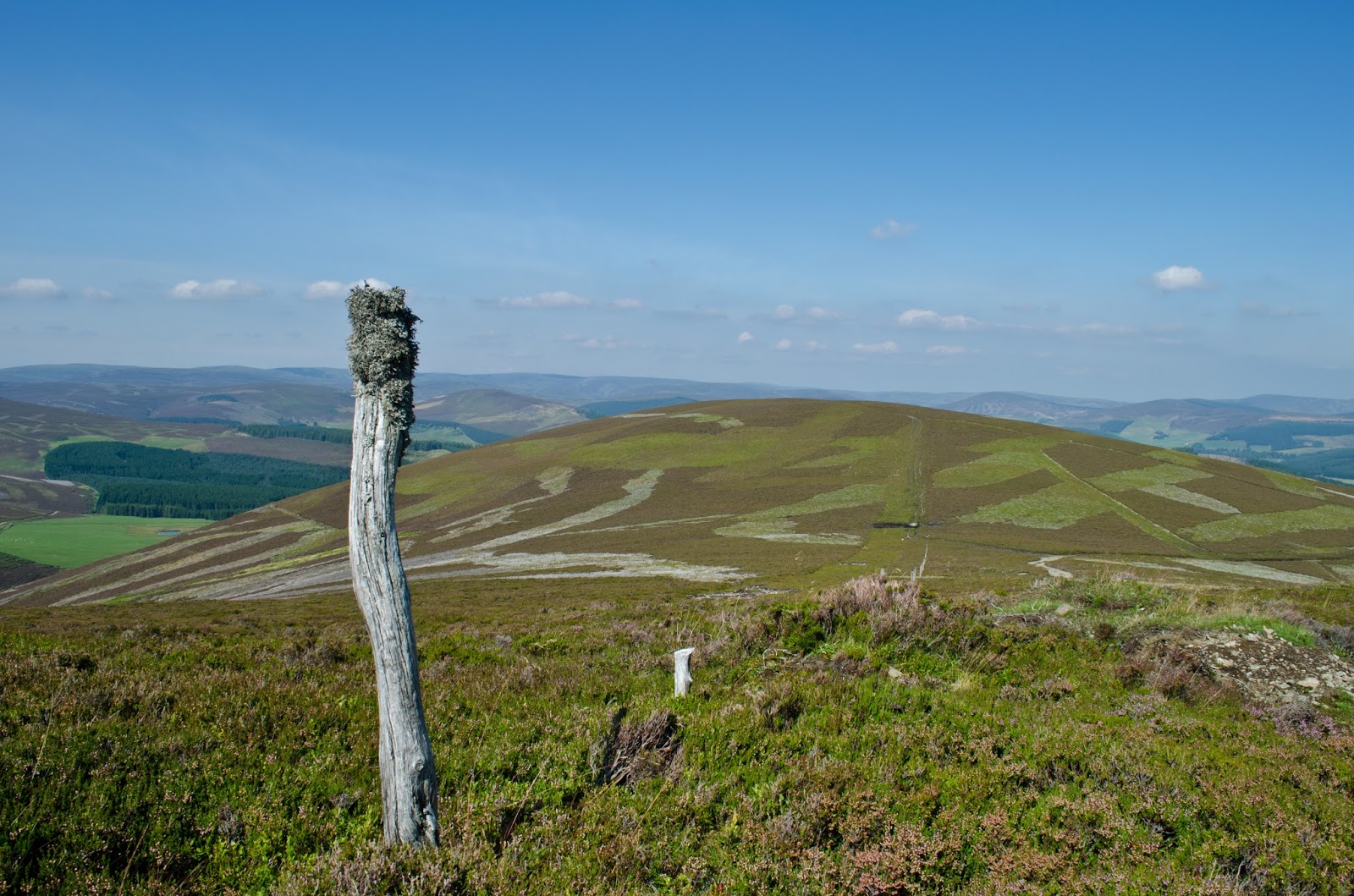
The colourful scenery continued as the track emerged from the forestry and began to climb across the open moorland above.  This view is looking north to Strathdon and Glen Nochty.


Looking back as the track began to zigzag up a steep section, the patches of "muirburn" were very obvious.  This is a managed grouse moor and patches are burned in early Spring to promote regeneration of young heather shoots which the Grouse feed on.  Regrowth of heather takes several years and the striped appearance of open heather moorland is a feature of the eastern Highlands.  The Grouse have clearly had a good breeding year; I saw lots of birds and also (this being August and the beginning of the Grouse season), several shooting parties.


Grouse shooting is an important part of the economy locally and "guns" travel from all over the world to shoot.  I do wish they'd learn to pick up after themselves though, the tracks and open hill are littered with cartridges.


After just an hour and a half's steady climb on a good track I reached the 749m/2457ft summit of Mona Gowan.  This hill is a "Graham" - a Scottish hill between 2000 and 2500ft; of which there are 224.  The name is a corrupted spelling of the Gaelic Monadh Gobhar - "Goat Moor".  The big cairn of stones was originally erected in 1887 for Queen Victoria's Jubilee.

The view from the summit is very expansive.  Mona Gowan is the eastern end and high point of a broad east-west ridge, and apart from nearby Morven it stands apart from any other high ground.  There's a huge feeling of space here, the rolling heather moors stretching in all directions to the Cairngorm giants in the south and west and to the Ladder and Cromdale hills in the north east - a patchwork of purple heather and bright green fields and forests.  Any Queen or indeed goat would be pleased enough with this view!


Despite all the colour, it was this hazy view towards Lochnagar which caught my eye.  I love these long views of successive ridgelines receding to the horizon.  Space, warm sun and enough of a breeze to keep away the insects kept me on the summit to eat lunch and enjoy the place.

Monday, 26 August 2013

A Late summer evening


 Late summer seems often to be a time of muted, heavy colours.  But walking around this evening there are still some vibrant shades too.  The showy, meter high flower spikes of Rosebay Willowherb (Chamerion angustifolium) are nearing the end of their flowering period.  The capsules which form as the flowers drop will open to disperse seeds carried on downy plumes.  Also known as "fireweed", it's a successful plant considered a weed by gardeners, and as each plant can self-pollinate and produce up to 80,000 seeds it's difficult to eradicate once established.  The bees like it though, flowering patches fairly hum with activity.


Wild raspberries are at their best in July and August.  The fruits really stand out against the dark leaves and make a sweet snack from the hedgerows :o)


On the farmland the pace is beginning to quicken.  A grass field newly cut for silage is almost shockingly fresh green against the gold of rapidly ripening barley.  Soon the big machines will be cutting the barley too.

On a warm and windless summer evening we ate outside and sat long into the dusk watching the light fade and the first stars appear, the evening birds joined by pipistrelle bats - the perfect summer evening in fact.  The following morning has  brought thick mist which is slow to burn off in the sun and there's a slight autumnal feel to the air.

It's still late summer, but there's no doubt that the wheel of the seasons is beginning to turn...